Tuesday, February 22, 2011

OER University: history in the making

Coat of arms of the City of ChristchurchImage via Wikipedia
I am in an exciting meeting today on the OER university. There were a few dozen participating in New Zealand and 47 virtual participants. If you are not familiar with this concept OERs are "open education resources." There are many opportunities to take open courses or utilize open course materials and we are currently looking for ways to give students credit for that learning. Wayne Mackenzie writes:

"The OER university is a sustainable international system which will provide free learning to all learners with pathways to gain academic credit from formal education institutions around the world. It is rooted in the community service and outreach mission of tertiary education providers to evolve parallel delivery systems (now possible with the open web and free content licensing of learning materials) that will augment existing educational provision. The OER University is an open network and public-private partnership (PPP) including post-secondary institutions, the private sector, non-profits, government and international agencies."

This is just in its infancy, and this is why it is important to get involved now.  "Open Education Resources (OER) encapsulates a simple but powerful idea that the world’s knowledge is a public good. The internet provides unique opportunities for everyone to share, use, and reuse knowledge." 

The logo of Otago Polytechnic.             Image via Wikipedia"The flagship initiative of the OER Foundation is WikiEducator, which facilitates the development of educational resources that are open for educators worldwide to re-use, adapt and modify. WikiEducator also administers Learning4Content – the world's largest training project, which has successfully enabled thousands of educators from 140 countries to access training in the ‘wiki skills’ they require to contribute to the development of OER."

I have a lot of questions about this: How will we ensure learning quality? How will we assess the students? How will we keep businesses from turning this into a commercial university? We are being asked to be creative and think differently. We can't be afraid to push the envelope. 


I am interested in free, universal higher education. I am not interested in supporting "low cost" because costs always go up and low cost for someone in Japan is different than low cost in Sri Lanka. Much of the world sees the value in this for libraries, healthcare (at least in civilized countries), police and fire services, why not education? This isn't the revolution yet, but the purpose of this inaugural meeting is to collaboratively:
  • Consider inputs and leading questions from meeting participants, anchor partners, the pre-meeting SCoPE seminar and international agencies.
  • Develop a shared understanding of a logic model for the OER university concept.
  • Review and refine the OER university logic model
  • Identify the key questions for each component of the logic model
  • Gauge interest and identify volunteers for leading and coordinating the constituent components of the logic model
  • Commence identification of the key activities required for each component of the logic model, including inputs, outputs and outcomes
  • Specify the next steps for the way forward.


 I will posting on these questions here, but I want to encourage you to get involved yourself here.
Enhanced by Zemanta

The Instructional Designer's Toolkit

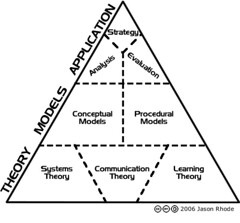
University of the Pacific Arthur A. Dugoni Sch...Image via WikipediaI have watched instructional designers from top-notch universities loaded down with the latest theories completely flounder when faced with the realities of the work. With instructional designers, I look for two things: a portfolio and any teaching/tutoring experience. I am not looking for a 3-d, animated Flash portfolio of Whizbang 2.0 - I am looking for a collection of problems that were solved through design, technical skill, or direct application of pedagogy. You will need some models for teaching and learning. Be prepared to talk about the strengths and weaknesses of any of them. I am not looking for ideologues, but folks that understand that models can be useful (a model is just a model though). Since instruction is about learning, we need a common language for how we describe how teaching and learning happens. A lot of this can be had in a traditional university but much of it comes through practice. If you are studying instructional design and want that kind of practice, there are numerous opportunities:
  • facilitate courses through your local community colleges, 
  • volunteer (or get paid) as a tutor, 
  • join a literacy project and teach people how to read, 
  • work as a teaching assistant in your dept., 
  • substitute teach,
  • facilitate online trainings in a professional organization.
Hierarchy of Instructional DesignImage by jrhode via FlickrThere are many more such opportunities. The  way to make the most of those opportunities is to ask questions, observe, keep a journal on what happens, read the professional literature in tutoring, education, and teaching for your discipline.

It is a lot to ask, especially for new graduates. Have of what is worth knowing about teaching and learning comes from program specific classes and the other half through a broad self-education. We need more people from the humanities in instructional design. There are problems that come up in ID that are seemingly insoluble to some yet are obvious to someone reads history or art. There are ideas floating around instructional design that would have little credence with an even casual acquaintance with philosophy or psychology would clear up. One has to ask why ID degrees have so little psychology in them when how we learn seems to be the central issue of the discipline!

An instructional design model representing Mer...Image via WikipediaBut all of this will only take you so far. It is unreasonable in every sense of the word to expect new graduates to have a broad education, fearless in the face of technology, and facility with theory. What is most important is the networks in which you are participating in. If you don't know the answer, how do you find out? Are you on Facebook, Twitter, or Plurk? Who are the most helpful people in your networks? Where are your most important connections? Are you taking online classes? What blogs do you read? What blogs do you comment on? How vital are your networks? How have your connections shaped your growth as a learner? I don't believe that one person can have all the answers, but one well connected person can come close enough.

What tools do you consider essential for instructional designers? Feel free to add a comment below. I also have a collection of tools that we are playing with here at College of the Redwoods.

Enhanced by Zemanta

Thursday, February 17, 2011

Watson for $200: What is a semantic wunderkind?

YORKTOWN HEIGHTS, NY - JANUARY 13:  (L-R) Exec...    Getty Images via @daylife
I am only somewhat impressed by Watson but to be fair, Watson is only seven years old.The most interesting thing about it is that it represents some real milestones for the semantic web.I also like that they are running the machine on Linux. Like most young people, Watson only understood questions once they were texted to "him." The newspapers fatuously report that Watson has beat us at our own game and yet humans are the kind of animals that invent games, trivia, and computers - none of which any so-called "artificial intelligence" has even come close to doing. I am not going to knock this achievement. This will be remembered as a historic moment because this is really an advance in our understanding of how to get machines to use "natural language" input and this is really going to help out the semantic web. The processing speed and sorting of data was remarkable.

HAL 2001  Game Hint: Let the computer win!According to the article in Wikipedia, Watson is made up of a cluster of ninety IBM Power 750 servers (plus additional I/O, network and cluster controller nodes in 10 racks) with a total of 2880 POWER7 processor cores and 16 Terabytes of RAM. Each Power 750 server uses a 3.5 GHz POWER7 eight core processor, with four threads per core, and yet he still thinks that Toronto is in the United States. I think he is ready for his high school diploma now. As a child of the 60s, Stanley Kubrick has made me suspicious of anything that I think might even be remotely capable of sealing all the doors and sucking all the oxygen out of the room.

According to IBM, "Watson is an application of advanced natural language processing, information retrieval, knowledge representation and reasoning, and machine learning technologies to the field of open domain question answering."

I like the qualification "knowledge representation." I make it a point not to ascribe anthropomorphic qualities to inanimate objects - especially if those qualities include things like "knowledge" when its definition is still being debated and explored by neuroscientists, psychologists, philosophers, and yes, even educators. We certainly do not know enough about intelligence to make any proclamations that Watson is doing anything close to "reasoning" since we are not really sure about what goes into that process (calling it a process is even suspect). But according to David Ferrucci, IBM's lead researcher on Watson "Humans are learning machines that live and experience the world and take in an enormous amount of information — what they see, what they taste, what they feel, and they're taking that in from the day they're born until the day they die," he said. "And they're learning from all the input all the time. We've never even created something that attempts to do that." So you see, according to Ferrucci, that is all there is to it - you take in information (input) and you spit out intelligence (output). I am not going to even address arguments about human psychology, intuition, creativity, inspiration, and emotions. Just looking at this from the "how-does-a-neuron" work kind of level, we are still in our infancy - okay, maybe seven years old. Would you ask a seven year old directions to the airport?

Enhanced by Zemanta

Wednesday, February 16, 2011

Towards an OER University: Free learning for all students worldwide

Australian Coat of Arms (adopted 1912)Image via Wikipedia
This is from Cable Green's blog:

Universities in Australia, Canada and New Zealand are hoping to achieve "a quantum shift" in higher education access by launching an "OER university". (article)


There is an open meeting (all are invited) on Feb 22: Noon – 8:00pm (pacific). If you can’t make it to New Zealand … join the meeting as a virtual participant… I’ll be attending from Olympia, WA ;)   


Please tag this activity with:  #oeru

·         Webinar recording.  (direct link)
·         Creative Commons post
·         Editorial on meeting (by organizer)


Enhanced by Zemanta

Tuesday, February 15, 2011

PLNs: The Power of Personal Learning Networks

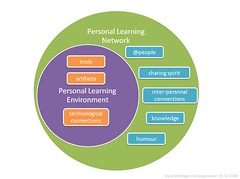
PLE as subset of PLNImage by catspyjamasnz via FlickrWhat is a PLN? I am not talking about the Polish Zloty but "personal learning networks" - the collection of links, tools, and people on the internet we use to support our teaching and learning. I have been reading some critical literature on "personal learning networks." We are seeing now the formalized study and analysis of informal learning networks (see some of the articles at the bottom of this posting). Why the interest? First of all, there is the growth of social networks like Twitter and Facebook. Students (and instructors) and connected in ways that were not possible even five years ago. Second, there is a power relationship inherent in traditional teaching that does not always make the classroom (online or off) the ideal place for learning, creativity, or innovation. The problem often comes from the idea that somehow the student is broken and needs to be fixed or contains a void that needs to be filled with a one-way dump of information. This is the "sage on the stage" model of teaching and learning. What often really happens is students attend a lecture and then talk to their friends, wikipedia, and Google to figure out what the teacher was talking about. This is a primitive personal learning network.

Interestingly enough, there is still a lot of language around PLNs that harken back to the one-way dump. This comes from instructors seeing new technology in terms of the old technology (e.g. the internet is a library). A PLN should not just be a place where one goes just to consult "experts." A true PLN requires participation and engagement. A PLN is a practice and a discipline just like traditional scholarship: it requires you to read, think, and create. In order for your PLN to be effective, you need to do four things:
  1. Link to others: Find the other participants in your field. Some will be "experts" and some will be participants just like yourself. If you are in education, for instance, there are many lists of educators in twitter. Link to people with opinions and ideas different from your own.
  2. Ask questions: Post questions. The wider your network, the wider variety of answers you will find.
  3. Share: Share ideas that you have found in your network with others. Share your bookmarks in Delicious and what you are reading on your blog. Share other people; let others know about your network and and recommend people and sources of information.
  4. Answer questions: Offer solutions or help others find the means to answer questions.
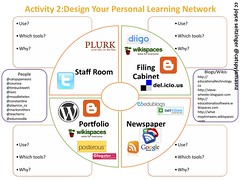
4 Faces of Personal Learning Network (Activity)Image by catspyjamasnz via FlickrYou can see from the list above, that as simple as it is, there is a lot going on. It would be just as big a mistake to abandon a traditional learning management system and just adopt PLNs as an answer as it would be to adopt an LMS and not sufficiently train students in its use. All of the skills around critical thinking and evaluating sources come into play here.We need a curriculum that teaches students how to make choices about who they are connecting to and why. Critical thinking skills around networks needs to be explored. Teaching and modeling technologies for sharing are also a part of this.These are critical skills in the community college, and we are still using early computer curriculum to show students how to use software that won't exist in two years.

In the right-hand side-bar of this blog is are some links to the HIM 101 class that I co-taught with Charlene Gore at Tacoma Community College. It includes a map of how we used Twitter in the class that I think represents an interesting use of Twitter as a PLN.
    Enhanced by Zemanta

    Friday, February 11, 2011

    Egypt: The Revolution Will Be Twitterized

    Egypt: ThebesImage by Brooklyn Museum via FlickrOnce again, the power of social media and networks has toppled a government. There is nothing superficial about tweeting 140 characters. There is nothing "weak" about the weak ties and connections in Facebook or other social networks. Events in Egypt, Iran and elsewhere have shown that these networks are worth learning and knowing about. It is interesting that in America the questions about social networks have to do with the so-called superficial nature of the connections (I am thinking here of Sherry Turkle) and in the rest of the world Twitter is the vehicle of change - the electronic samizdat.

    Technology as an agent of revolutionary change is nothing new - letters and newspapers linked networks of revolutionaries in Europe and America. Velvet revolutionaries in the late 80s were smuggling 2400 baud modems into Eastern Europe. The networks were used to send meeting information, demonstration notices, and information to illegal computer bulletin boards:

    "Back in '89, Czech students were trying to coordinate the uprising across the nation, and the technical students...were running the telecom angle. They used a 300-baud device with the size, shape, and heat of a kitchen toaster. The Czech secret police were far too stupid and primitive to keep up with digital telecommunications, so the student-radical modem network was relatively secure from bugging and taps. Fidonet BBSes were springing up surreptitiously on campuses whenever an activist could sneak a modem past the border guards. Modems were, of course, illegal. Most of the Czech cops, however, had no idea what modems were." - Bruce Sterling, "Triumph of the Plastic People," Wired 3.01. Jan. 1995.

    Computer networks are the new coffee house (the traditional hot bed of revolution in the 18th century). Twitter and cell phone texting has changed Iran (shaken, not toppled). The government of Myanmar knows all about the "dangers" of technology too which is why it is against the law there to own an unregistered modem. 

    Just as we would teach traditional journalism in schools with newspapers (I mean literal paper), we owe it to the students to utilize social networks and media in the curriculum. Social media literacy is not just for ordering pizza! The media is a superficial or as powerful as we make it.

    Enhanced by Zemanta

    Wednesday, February 09, 2011

    CTE Conference: Are you ready for distance education?

    The Distance Education Dept. at College of the Redwoods presented at the Career & Technical Education Conference hosted by CR. We love this conference because it is our chance to meet folks from the high schools, local businesses, and other colleges as well as the friendly faces of our college faculty. Our presentation was called "Are You Ready for Distance Learning?" This question has taken on different meanings for DE departments over the years. It can mean "Are you ready as a student?" or "Are we ready as a college?" or "Are we ready as a community?" Our presentation was meant to cover all three questions. We knew we were going to have a wider variety of people come in from the local community, so we wanted to put up a non-linear presentation that we could adjust to the needs of the participants rather than a forced march through a pre-fab lecture. We also wanted to use tools that would inspire the participants to think of education as a collaborative endeavor rather than a way to fill up empty minds with more stuff. I hope that this presentation serves as a starting point for a broader conversation about education and using technology to facilitate learning and community. We would like anyone who is interested, to go in to the presentation and feel free to add links, comments, suggestions and ideas.


    Enhanced by Zemanta

    Monday, February 07, 2011

    Student Privacy and Facebook

    This image is an example of a blocking cluster...Image via WikipediaThe Student PIRGs has come out with a guide for controlling your information on Facebook. This has come at a really good time because College of the Redwoods is expanding its presence on Facebook and other social networks. Understanding the benefits and the risks is equally important. We will have to review this frequently to keep up with how quickly Facebook can change.Social networks can be powerful communication tools but they are used by more than just students! I don't want to impede how folks communicate but understanding privacy issues is especially important in an educational setting (thinking possibly of FERPA).

    I am interested in how other colleges are managing the issues around Facebook and social networks. Feel free to leave a comment here if your college has guidelines or policies related to Facebook or other social networks.
    Enhanced by Zemanta

    Friday, February 04, 2011

    Courses at the Free Technology Academy

    Escudo gnuImage via WikipediaI was looking for training materials for open texts and open software in general and I found this in Europe. Their classes are a little pricey but their texts are open licensed (e.g. Introduction to Free Software & Gnu & Linux Basic).

    "The lack of high quality educational trajectories based on Free Software and Open Standards is often mentioned as one of the factors that slow down the adoption of these technologies.

    The Free Technology Academy aims to bridge this gap by providing a comprehensive list of educational modules aimed to a broad audience. These modules range from an introduction to the main aspects of Free Software and Open Standards to more technical courses on software development or network technologies.

    The courses provided by the FTA can be followed entirely online and with a flexible schedule, which makes them compatible with a full time job or other studies."

    This is exactly what we need for other disciplines besides technology.

    "The Free Technology Academy consists of an advanced virtual campus with course modules that can be followed entirely on-line. The learning materials are Open Educational Resources that can be studied freely, but learners enrolled in the FTA will be guided by professional teaching staff from the participating universities. The full master programme can be concluded at one of the three universities. The Free Technology Academy (FTA), financially supported by the Life Long Learning programme (LLP) of the European Commission, is a collaboration between the FKI and three European universities."
    Enhanced by Zemanta

    Thursday, February 03, 2011

    The Internet and the Collapsing Past

    I used to have memories. They were selected, chosen, and like old photographs, shifts of color and tone have changed them over time. Some memories are more highly selected and crafted than others. Some may even approach a certain degree of accuracy. There were things I thought I would never remember: names or friends from grammar school, that favorite Saturday morning cartoon character's side-kick, or what the old downtown of Santa Maria, CA looked like. Now all of this is coming back. All of the images, people, and places. In Facebook, I am talking to people that I met in middle school and have not talked to since. There was three and a half weeks once in the 7th grade when I was nearly not quite entirely unlike cool and that is how a couple of them still remember me. There are websites dedicated to the music and popular culture of the pretty much any year or decade. There was a time when the past would always remain the past. You didn't have to remember much of went by you so you didn't. Now, someone, somewhere, is uploading the play list from their junior college dance from 1982 up to Facebook, MySpace, their blog, ect. and you get to relive the Motels and the Bangles all over again. Between the 3.5 million articles in Wikipedia and the 24 hours of video uploaded per minute, your memories are up there somewhere. Friends and family send links to music, images, and people that I know that I would not remember, or more importantly, would remember differently. Sometimes, the way I remember a film, for instance, has more to do with my interests and values at the time rather than any merit the film may have had. I remember warning my wife that "Five Million Years to Earth" was a scary film. It is a good film, but like many Pinewood Studios films from the 60's, it ends with an apocalypse of "aliens" (plastic grasshoppers on the end of Popsicle sticks). Needless to say, she found the end very funny. I swore it was the most frightening movie I had seen as a 13 year-old.

    We look at the internet as authoritative. It is becoming like the collective unconscious of the species (or at least the overly-connected subspecies, Homo Iunctus). It is a form of memory but again, as selective and faded as brain memory but "authoritative" because it is an external record, a scrapbook. People can upload images, but they can't upload my context for those images, but I look at an old photo on the web and think, "My god, that is how it was." In other words, how I remember things is changing because of technology, but because of the limitations of technology, the "memories" on the web are no more authoritative than the memories that come from my brain.

    No other generation had this. We used to be able to move forward through time with just the shadows of recollections, content with vague images. Now we are using technology to mediate those memories. What does the game "Trivial Pusuit" prove now? That you don't have access to Wikipedia? I am not one of those who thinks that the internet is making us stupid - I think if the brain is freed up by not having to remember details of the career of Larry Storch or what was the name of the hotel on the corner of Broadway and Main in 1966, then the mind goes on to other things. Maybe this will facilitate extra intelligence or creativity?

    Enhanced by Zemanta

    Tuesday, February 01, 2011

    The Google Art Project

    The Google Art Project has created a "street view" visit to a dozen museums and put up a library of high definition images from the participating museums. This will be a great resource for art and history instructors and everyone interested in art. Resources like these would also make an interesting low cost alternative to a "textbook" - art history textbooks are fairly expensive and lack the magnification and resolution possible with HD computer screens.

    For now the following museums are included in the project:

    • Alte Nationalgalerie, Berlin - Germany
    • Freer Gallery of Art, Smithsonian, Washington DC - USA
    • The Frick Collection, NYC - USA
    • Gemäldegalerie, Berlin - Germany
    • The Metropolitan Museum of Art, NYC - USA
    • MoMA, The Museum of Modern Art, NYC - USA
    • Museo Reina Sofia, Madrid - Spain
    • Museo Thyssen - Bornemisza, Madrid - Spain
    • Museum Kampa, Prague - Czech Republic
    • National Gallery, London - UK
    • Palace of Versailles - France
    • Rijksmuseum, Amsterdam - The Netherlands
    • The State Hermitage Museum, St Petersburg - Russia
    • State Tretyakov Gallery, Moscow - Russia
    • Tate Britain, London - UK
    • Uffizi Gallery, Florence - Italy
    • Van Gogh Museum, Amsterdam - The Netherlands


    Enhanced by Zemanta

    Sunday, January 30, 2011

    The Semantic Web and Universal Design

    W3c semantic web stackImage via WikipediaI have been looking at PopcornJS this morning. PopcornJS allows programmers to build in triggerable events in the code delivering a video in a webpage. What problems does that solve? One of the things we are wrestling with at the college is accessibility. According to ADA 508, all videos have to be captioned. We have grants for captioning videos. I have always thought that we should be doing more. If we follow the principles of Universal Design, we are not only making media accessible, but we are crafting learning modules and objects for their maximum interactivity and, what I feel is the next step, connectivity. Videos and other learning content represent another opportunity to link students to subject matter experts and other students. We can integrate learning modules with knowledge networks. One avenue of exploration is HTML5 and the semantic web. We can do more than just caption videos - we can take the metadata, the code in that accompanies the video and package it with a transcript of the video to trigger events and things like live links to Twitter, Flickr, Google Maps & Translate, Wikipedia, etc. PopcornJS is the code that will allow us to do this. There is an interesting page and demo on PopcornJS.

    This is what the internet should be doing. There are too many tools like this available for us to accept content from publishers that is not accessible. Publishers will often supply textbooks and supplementary content that does not meet ADA guidelines. Educators and instructional designers should be taking the lead in the colleges using techniques like PopcornJS and not waiting for the commercial publishers to catch up. They have no interest in meeting ADA guidelines because they are not the ones that have to deal with the consequences. In my quest to make the internet a happier, shinier place, I am not calling for a boycott of those companies but suggesting a solution. Colleges could pool their resources (programmers, beta-testers, and content creators) to help move this project along much in the same way the Sakai project is supported. The commercial uses for something like PopcornJS are obvious - someone looks up and watches a surfing video in YouTube. The video opens in a page with a map of the area where the video was filmed, a link to the TripAdvisor page on the area, the Twitter feed about the surf from the locals, and of course, more targeted marketing. But imagine taking that page as a teacher or instructional designer and building in other learning modules, maps, translations and connections.

    Colleges should be setting the standards for media and the semantic web to, at minimum, ensure accessibility. We should go farther and develop guidelines for content around interactivity and connectivity. The semantic web and projects like PopcornJS represent another opportunity to open up education. What do we call these? Semantic knowledge guidelines?
    Enhanced by Zemanta

    Friday, January 28, 2011

    Rethinking Education from Mike Wesch

    Michael Wesch - Pop!Tech 2009 - Camden, MEImage by poptech via FlickrMike Wesch posted this video to YouTube via his channel. I like his work. I have been in classrooms that size before, and he seems to make his work just as much about that class as the rest of the world. I love that he starts this out with a quote from McLuhan who becomes more relevant as information and networks expand and deepen. I am really interested in assessing user-created content like Wikipedia, collaborative projects, and personal blogs. This kind of content is no longer the information of the future but what is happening today. Creating content via social media and networks is a different project than a 20-page research paper with a single author. The kind of culture that sustained that kind of academic research is shrinking and yet, that is what we are training students to do: to publish in journals that will no longer exist in the form they are currently in IF they will even exist at all. What Wesch's videos do is get people thinking about what we need to do as teachers and students to participate in this "new" culture. One of his first videos "A vision of students today," was seen by some faculty I showed it to as depressing and confrontational. It depends on your perspective, I guess. Another faculty member I was working with saw it as a wake-up call - a joyful, liberating call and we rewrote her syllabus to include the tools the students were actually using. In other words, it is painfully obvious that the media we are using to teach is woefully out-dated and becoming irrelevant. The only people who are going to go on and make a living writing 20-page papers are people who are going to go on to make other students write 20-page papers or publish in journals that publish 20-page papers. And why would you assess every subject the same way? We are missing an opportunity to help students become life-long, creative participants in knowledge creation.

    I am interested in your response to Wesch's work. Feel free to comment: where do you think assessment is going to go in the world of collaborative authorship and social media?


    Enhanced by Zemanta

    Saturday, January 22, 2011

    OER, Open Textbooks, and Innovation

    Aristarchus's 3rd century BC calculations on t...Image via WikipediaIn a recent blog posting from Cable Green, he posted a note on the new grant from the Dept. of Labor which is requiring an open license on all materials built for the grant, which means that the author is attributed but the work is open for others to copy, adapt and distribute. This is "in order to further the goal of career training and education and to encourage innovation..."

     "Innovation" is a fairly recent word. The Oxford has it back to only 1553 in English; "the alteration of what is established by the introduction of new elements or forms." It is from the Latin "innovare" meaning "to change" or "renew." It doesn't, interestingly enough, imply inventing things out of thin air. It was not always the compliment that it is today. Overly ambitious people, it was thought, were the kind who introduced novelties. As the progression of change in world culture heats up exponentially, we recognize the differences between useful innovation and the mere novelties even if it takes a generation or two.

    How does innovation happen? There are a number of theories out there - one that has been popular for a few millenium is the idea of the "Lone Genius." Before the 1780s or so it was based on the idea that an authority, that is "The Authority," often divinely inspired, would spontaneously have a really great idea (consider here of Aristarchus or Leonardo). In the Romantic Era, the "lone genius" was inspired and often slightly insane. He had to be a tortured outsider, (e.g. Coleridge or Frankenstein). But there are a lot of ideas that unfold out of a community. I tend to think that a culture of innovation arises out of necessity (the village needs more food) and then someone looks at other problems the village has (seasonal flooding) and then has an intuitive leap that brings the two problems together into a solution (irrigation). What is the difference between that village and the village that failed? Maybe it is because there are also cultures of dormancy - where folks try to innovate using the same paradigms and tools as they have always used but try to apply them to a radically new problem. Sometimes that is okay for quite a long while. We are basically sending satellites into orbit with 18th century physics. It is working so why not? It will continue to work until we are faced with a larger problem that requires a very accurate definition of gravity.

    So what does this have to do with Open Education Resources and open textbooks? One way of looking at the problem of open textbooks is to look at technologies, formats (open and proprietary), and distribution systems.  This is the old way. This is textbook authoring as a product. Products require support from corporations, distributors, editors, vettors, etc. In other words it is centered on the object rather than the act. Where is the innovation? The innovation in all of this is quietly going on around us in colleges like College of the Redwoods where the Math dept. saw the problem of Math textbooks and brought existing technologies together into their community (their department). The innovation is coming from places like Wikieducator where the tools are being created not just to create textbooks, but to facilitate the community needed for the real innovations to come.

    At College of the Redwoods, the instructors knew that there was no textbook currently out there that would serve the specific needs of their students: those needs are not just financial although Humboldt County is in pretty dire straights much like the rest of California. Those needs are also the preparedness of the students based on what is happening in the local high schools, and the needs of local business and industry. There is no one but the department that could ultimately vet a textbook to meet those problems other than the community that is experiencing them.

    It is my sincere hope that the direction that the OER community is going is not to figure out how to continue to traditionally silo knowledge and information but to inspire the creativity and facilitate the community-building necessary to solve one of the most important problems of our time: access to education. We need more research on how to facilitate open textbook creation on college campuses. There are successful models out there. Lets find out how they work.

    I am interested in your feedback on what you think helps create a culture of innovation on campuses today or give us some of your favorite examples of grassroots learning and home-rolled open education resources.


    Related articles
    Enhanced by Zemanta

    Tuesday, January 18, 2011

    Evaluation of Evidence-Based Practices in Online Learning

    Blended LearningImage via Wikipedia
    This report Evaluation of Evidence-Based Practices in Online Learning: A Meta-Analysis and Review of Online Learning Studies from the U.S. Department of Education Office of Planning, Evaluation, and Policy Development  Policy and Program Studies Service is an interesting contribution to the "no significant difference" phenomena in distance education. I like that this report does not attribute success in online learning to any media but to the teaching and learning practices.

    Abstract
    A systematic search of the research literature from 1996 through July 2008 identified more than a thousand empirical studies of online learning. Analysts screened these studies to find those that

    • contrasted an online to a face-to-face condition,
    • measured student learning outcomes,
    • used a rigorous research design, and
    • provided adequate information to calculate an effect size.
    As a result of this screening, 50 independent effects were identified that could be subjected to meta-analysis. The meta-analysis found that, on average, students in online learning conditions performed modestly better than those receiving face-to-face instruction. The difference between student outcomes for online and face-to-face classes—measured as the difference between treatment and control means, divided by the pooled standard deviation—was larger in those studies contrasting conditions that blended elements of online and face-to-face instruction with conditions taught entirely face-to-face. Analysts noted that these blended conditions often included additional learning time and instructional elements not received by students in control conditions. This finding suggests that the positive effects associated with blended learning should not be attributed to the media, per se. An unexpected finding was the small number of rigorous published studies contrasting online and face-to-face learning conditions for K–12 students. In light of this small corpus, caution is required in generalizing to the K–12 population because the results are derived for the most part from studies in other settings (e.g., medical training, higher education).
    Enhanced by Zemanta

    Wednesday, January 12, 2011

    Open Education Resources - Free Math Textbooks

    Infinitesimal Calculus 5Image via WikipediaCable Green was featured in the Chronicle of Higher Education in an article called "State of Washington to Offer Online Materials as Texts" by Martha Ann Overland. I loved the article because it promotes all of the things I am so excited about in education right now: free, openly licensed textbooks, open education resources, and the creation of communities that are creating freely accessible learning materials. It is a well-written and balanced article that discusses the promise and possibilities of OER as well as the problems


    I was surprised to see that they were having problems finding math resources: "During a recent meeting of mathematics professors and librarians who are designing the courseware for Washington's algebra, precalculus, and statistics courses, it was clear that no one was completely satisfied with what could be found online." 


    I work at College of the Redwoods where the Math department has created a couple of textbooks and I received an email from David Nelson who is the project manager for the Florida Distance Learning Consortium to let me know about the free pre-algebra textbooks at the Stitz-Zeager website (this looks like an excellent collection).


    There is also a free webinar happening on Thurs. Jan. 13th on a free online math textbook at The Stitz-Zeager Open Access Precalculus Project.


    There are links to College of the Redwoods open math textbooks in this post here:
    http://cain.blogspot.com/2010/08/good-teaching-is-accessible-and-open.html
    Enhanced by Zemanta

    Saturday, January 08, 2011

    Guido Europeaantje on Twitter and professional development.

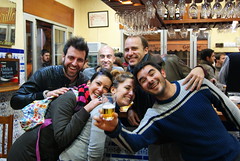
    Guido's students3 @europeaantjeImage by eltpics via Flickr
    Guido is an EFL teacher in Seville, Spain. He coordinates the teens’ department of the school where he works and conducts teacher-training workshops. After more than 10 years of experience his professional development has started taking giant steps forward again thanks to the power of Twitter.
    He gave an over-view of Twitter in his workshop called "Twitter: Turn 140 Characters into a Virtual Staffroom." He compares Twitter (for teachers) as a virtual staffroom where teachers can get together, share resources and ideas. 
    I love that he gets that Twitter is about networks. There are too many users out there who think that it is a "microblog" or a one-way push of information. He emphasized, as we do here, the importance of following and following someone back - i.e network building. 
    Guido writes that "Many educators worldwide connect on Twitter. This workshop is meant for teachers who are unfamiliar with Twitter or who aren´t very active on it (yet). The short messaging system Twitter can be turned into a huge virtual staffroom where teachers from around the world meet, communicate, support each other and share teaching tips, resources, weblinks and opinions. Come and discover some tools and tricks to help you keep up with “what´s happening” on Twitter."
    Guido promotes Twitter as a personal learning network. "It is a communication tool. You have to interact with people." It is a medium for sharing. 

    Enhanced by Zemanta

    Thursday, January 06, 2011

    Universal Customer Support Dice

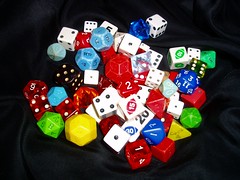
    DicepoolImage by Dru! via FlickrMost technology problems happen at random, why shouldn't your tech support answers be random as well? That is the idea behind the 12-sided Universal Customer Support Die. A customer calls, you roll the die, and you have an answer for any eventuality! Download the file, cut and assemble the die, and you have the foundation for your own customer support business
    Enhanced by Zemanta