My personal learning network (PLE) includes blogs, twitter, Facebook, journals, co-workers, classes and other communities. My PLE now includes Redwood Transit. I sometimes complain that I do not have enough time to read (physical books) and write (in a physical notebook). It is important for me because that is where I am inspired and it is a source of my own creativity. I obviously do a lot of writing on computers but it is too easy to just focus on "work related" reading and research. The printed word has not been at the fore-front of this learning network in a long time. I still read books and a couple of paper journals, but not on the scale that I used to in my pre-network literacy years. The primary reason is time. This is now changing. My new job at Humboldt State has me commuting. I was at first hesitant at the thought of taking the bus - I have spent a good deal of my early life on busses - school busses, Greyhound busses, the Green Tortoise, county and city busses. I have spent days on busses traveling to jobs, going to school, or visiting family. I never considered them luxurious by any means: they usually had no air conditioning or heat, you are stuck with others who are traveling for days. Their cleanliness was highly variable. I once rode a bus from Portland to Los Angeles with another passenger who was pregnant and had the flu. There has to be special circle in hell like that. I have also spent a day traveling with newly released prisoners they were traveling from San Luis to Los Angeles and some didn't make it as far as Nipomo.
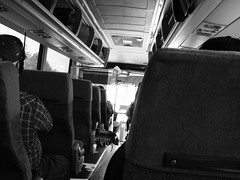
It seems busses have changed some. People can no longer smoke on the bus. The Redwoods Transit busses are clean, well-lit, heated and have wifi. I realized that I have a great opportunity here. I can start reading novels again on a regular basis. I am forced to spend time on the bus and now I have that luxury that is missing from so many of our lives right now - time. Time to read, write, and process. This is only my first week and I am half-way through Machado de Asis' "Epitaph of a Small Winner." I have had a stack of books on my night stand that I have not been able to get to and now I finally have the time and space.
I have a novel that I have been chipping away at for the last few years - my 3rd or 4th one depending on how you want to define the novel. It is a glacially slow process because of work. This is not the artistic medium for the bus! Short stories and poetry lend themselves well to the short bursts of reverie and 15 to 20 minutes periods of focus that the bus may allow. Despite all of my work in online learning last year, I managed to get a short story published and the editors of the journal, Border Crossing, nominated it for a Pushcart Prize. I was thrilled about all of this - I understand that being nominated is a modest acknowledgement, but I am still thrilled. It also has me thinking about writing more short stories, "flash fiction" even because, with apologies to Woolf, I actually have the time and space to do that; a bus of my own.
Image via WikipediaI am reading Hermann Hesse's "The Glass Bead Game" aka "Magister Ludi." The perfect novel to get my mind off of work. The novel is about a student who navigates the labyrinthine academic and quasi-spiritual institution of the glass bead game. Throughout the course of the novel, our maverick hero even rises to become the Game Master. What is the game? There is not really a lot of information in the book about the game, but it does talk about how themes in one discipline, such as astronomy, and another, like music, is proposed and the participants set about to make connections. (Is this the first Connectivist novel?) The more elegant the connections, the better. I think the novel is really about our hero's relationship to institutions. Well something interesting happens: there is instruction and lectures around the games each year that lead up to the big match. The hero of the novel gets sent to a Benedictine monastery for a while but asks his superiors if he can still listen to the lectures over the radio and send his completed game in via post. He does. And guess what? He wins. So in other words, there was no significant difference between the outcome of the contest between those who participated face-to-face and those who participated virtually. In this case, 100% of those who participated virtually did better than those who participated face-to-face.
Even though I am only half kidding around here, Hesse has always been a favorite novelist of mine, I could not have survived my teens without Steppenwolf, Journey to the East, or Siddartha. I like to think he would appreciate my playfulness.
Usually my life as a writer and my life as an instructional designer do not intersect much. I did begin life as a tutor and English teacher though. There has always been an element of technology involved with writing (reed stylus anyone?). My latest foray back into the world of novel writing has me thinking and rethinking what I need in a word processor.
My past writing process was to write long-hand in notebooks, type up a draft on a typewriter, annotate and mark up that draft, type up another draft, maybe do some very literal cutting and pasting, and then type up a final draft. This would then be read, annotated and corrected by Jacqui who might even be tempted now and again to retype short pieces for me. I could not have gotten out of community college without her.
I got my BA in English at Sonoma State in 1991. They had Mac labs and I had a couple (only a couple) of instructors who insisted on getting their papers back to them on floppy disk. One of the instructors commented electronically on the papers. I wasn't sure about this technology but my uncle Ed (who also wrote) said to me that what the chain saw was to logging, the word processor was to words. I always started in notebooks. I still have boxes of them.
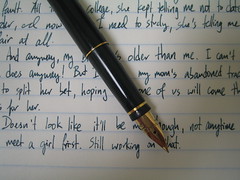
I still carry a notebook and pen but it is more to shock my brain out of ruts, brainstorming, concept maps, outlines and, of course, just to sit and process thoughts. The odd poem gets pulled out of there but it is mostly for notes and keeping my brain in order. It is more a part of my thinking process than my composing process now.
In November, I took on the insane task of the National Novel Writing Month "contest." The goal is 50,000 words in 30 days. I wrote the whole draft in Google Docs, Google Notes, and Delicious Bookmarks. It was insane because I am still settling into a new job at College of the Redwoods with a really hectic schedule, but of the many justifications, it was a good opportunity to give some online word processors a good shake-down cruise with a big project. I liked being able to write anywhere. I liked being able to share my draft with Jacqui. I will use Google Docs to share the first draft with a couple of volunteer readers and editors. I wish there were a way to join the docs, notes, and bookmarks though - maybe my next novel will be written in Google Wave.
I looked at Zoho Writer which is a great contender with Google Docs. Both of them allow the writer to build a table of contents and insert anchors into the document. This allows you to navigate quickly within the document. I found myself missing the navigation pane in MS Word or Open Office though. What Open Office (and MS Word) lacks though is the ability to edit or move sections of a document in that navigation pane. This is something that you will find in Jer's Novel Writer and in Scrivner (a Mac program I highly recommend).
I have been finding the act of organizing my discovery draft in Scrivener to be an invaluable aid in getting to the first draft. I am still in the 30 day free trial and I am about to shell out the $35 as an early birthday present. I don't usually buy software with a few exceptions but I am willing to pay for usefulness and innovation.


![Reblog this post [with Zemanta]](http://img.zemanta.com/reblog_e.png?x-id=88c2be33-b125-416c-98ba-236f6a73a107)