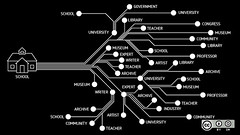
Image via Wikipedia
I am in an exciting meeting today on the OER university. There were a few dozen participating in New Zealand and 47 virtual participants. If you are not familiar with this concept OERs are "open education resources." There are many opportunities to take open courses or utilize open course materials and we are currently looking for ways to give students credit for that learning. Wayne Mackenzie writes:
"The OER university is a sustainable international system which will provide free learning to all learners with pathways to gain academic credit from formal education institutions around the world. It is rooted in the community service and outreach mission of tertiary education providers to evolve parallel delivery systems (now possible with the open web and free content licensing of learning materials) that will augment existing educational provision. The OER University is an open network and public-private partnership (PPP) including post-secondary institutions, the private sector, non-profits, government and international agencies."
This is just in its infancy, and this is why it is important to get involved now. "Open Education Resources (OER) encapsulates a simple but powerful idea that the world’s knowledge is a public good. The internet provides unique opportunities for everyone to share, use, and reuse knowledge."
 Image via Wikipedia"The flagship initiative of the OER Foundation is WikiEducator, which facilitates the development of educational resources that are open for educators worldwide to re-use, adapt and modify. WikiEducator also administers Learning4Content – the world's largest training project, which has successfully enabled thousands of educators from 140 countries to access training in the ‘wiki skills’ they require to contribute to the development of OER."
I have a lot of questions about this: How will we ensure learning quality? How will we assess the students? How will we keep businesses from turning this into a commercial university? We are being asked to be creative and think differently. We can't be afraid to push the envelope.
I am interested in free, universal higher education. I am not interested in supporting "low cost" because costs always go up and low cost for someone in Japan is different than low cost in Sri Lanka. Much of the world sees the value in this for libraries, healthcare (at least in civilized countries), police and fire services, why not education? This isn't the revolution yet, but the purpose of this inaugural meeting is to collaboratively:
- Consider inputs and leading questions from meeting participants, anchor partners, the pre-meeting SCoPE seminar and international agencies.
- Develop a shared understanding of a logic model for the OER university concept.
- Review and refine the OER university logic model
- Identify the key questions for each component of the logic model
- Gauge interest and identify volunteers for leading and coordinating the constituent components of the logic model
- Commence identification of the key activities required for each component of the logic model, including inputs, outputs and outcomes
- Specify the next steps for the way forward.
I will posting on these questions here, but I want to encourage you to get involved yourself here.