Showing posts with label pedagogy. Show all posts

Monday, April 28, 2014

Why Connectivism is a Learning Theory

Domains of major fields of physics
Domains of major fields of physics (Photo credit: Wikipedia)
David Wiley recently made a comment on his blog, in response to a very succinct posting by Stephen Downes, that the learning theory Connectivism, though he is sympathetic to it, was incomplete. I am not sure what to make of that. I understand David's point that terms need to be carefully defined. A solid theory needs operationally defined key terms. But I am not sure that Connectivism is really incomplete. There are a lot of great theories out there that work well and are very useful but are not "complete" in every sense. Einstein thought that his theories of relativity would lead to a Universal Field theory and because his work does not account sufficiently for quantum mechanics, in that sense his theory is incomplete. But it is still quite useful and irreplaceable in many fields of study and in practical application.

When Einstein first published his theory it had to go through years of refinement and testing. That is the process. There are still things being worked out with Darwin's Theory of Evolution but the days of wondering if it is valid are long behind us. It has been proven, observed, and tested. There are still evolutionary mechanisms to be worked out and the history of evolution will take more field work.

Looking at the history of theories, I am beginning to think that the discipline a given theory arises from is often the one least capable of evaluating it. But that is where all of the experimental and observational evidence is going to come from. Most of the criticisms I have read of Connectivism boil down to the new theory is not like the old theories. A theory is meant to provide a conceptual framework for viewing and understanding phenomena. As an instructional designer, I have a purely practical approach. I am only interested in a theory's usefulness, but for me, a theory must
  • account for current theories (either through refutation or inclusion)? A theory shouldn't just account for a given phenomena, it should do so in some measurably better way (more complete, elegant, etc.).
  • sufficiently explain where we are now.
  • make predictions. Any theory that can't predict anything is basically a conjecture at best.
  • be subject to testing. Here I would emphasize that the theory should change what we do based on experiment and empirical data.  
In my experience, Connectivism has met those four conditions. Those shouldn't be the only ones but as an instructional designer, the theory accounts for current issues in my work in ways that other theories do not. 
Stephen Downes speaking at D2L09.One of the problems of learning theory is that it is usually an interpretation of learning based on a psychological school of thought, sociology, or philosophy. It would be difficult for learning theory not to come from those disciplines, but learning theory seems to get stuck because while the derivative disciplines may have moved on, the learning theory often does not because educators are not participating or doing research in the parent disciplines.

New theories come about when the current theories no longer account for new information or phenomena. This is what made Connectivism particularly important to my work. The theory was created by Stephen Downed and George Siemens (Connectivism: a learning theory for the digital age) at the same time that networks and social media were impacting education in some profound ways. Some of the phenomena that Connectivism accounts for are phenomena that many educators fight against: online classes, social media,  MOOCs, student-driven learning, etc. Connectivism for these instructors will never be a valid theory because they will never be comfortable with some of the implications of the theory: it would represent a profound change in their world view that they are not ready to accept. Connectivism is a learning theory because it accounts for the changes we are seeing in our society and in education in ways that the older theories cannot. Even social constructivists have a hard time wrapping their minds around social networks.

With that said, I am no ideologue either. I have my own bones to pick with Connectivism. It is still unclear to me how learning "may reside in a non-human appliance." It should either be the case or not. My definition of learning requires someone to actually do the learning. I see non-human appliances storing information, processing information, even mimicking pattern-making (chess computers). I don't understand how learning resides there. That is my "why a duck?" moment with the theory. It also feels like a left over principle from another theory that is not necessary for Connectivism to be a strong theory on its own.

But Connectivism is not just an explanatory or descriptive theory. As an instructional designer, I can use it to help analyze the success and failure of a particular course. So how would I test it? There are a number of ways. First, we build a course design rubric based on the tenets of Connectivism, and compare the success and retention rates, and course satisfaction (for students and teachers). Second, we repeat the experiment, and share the finding so others can reproduce the results.

The jury is still out for Connectivism. This is as it should be! The jury should always be out for all theories if we are going to engage in the scientific method and reason together. 
Enhanced by Zemanta

Wednesday, November 06, 2013

Open Ed 13: What Teach a MOOC? Are you crazy?

 Maria Andersen talks about her experiences with MOOCs.
Twitter: @busynessgirl
Email: busynessgirl@gmail.com

"If you've ever actually taught an online course, the thought of teaching a MOOC sounds like an absolutely crazy idea. It's hard to get past the idea that you might be multiplying all your ?online student? headaches by a factor of 100 or 1000. Well, those were my first thoughts about it too. However, what I learned was that teaching a MOOC has been the purest and most fun form of teaching and learning that I?ve ever done. Teaching a MOOC is a complete paradigm shift from traditional education in terms of the design, the assessment requirements, and the diversity of students. As the manager of courses for Canvas Network, we?ve learned a lot about how to design a good online course for students who struggle with English, span all the time zones in the world, and have very different learning goals. In this talk I will share my own teaching experiences and surprises and some of these design tips from our MOOC courses."

Designing a MOOC was a good exercise in gathering and curating OERs.

Got into teaching and started working for Canvas. She taught a Social Media class. She did this while designing courses for Canvas. Post MOOC thinking: don't make me go back to a regular class.

It is hard work.

Myth: "I've already got an online course for this. i can make it a MOOC easily."

Teaching a SPOC (small private online course) is like being the head of a neighborhood community; a MOOC is like managing a city.

There is a difference in the students: level of education - MOOC students tend to already have a college degree. The deadlines have to follow the global timelines

Motivations: typical college students are hostages; MOOC students are self-motivated experienced learners.

Time commitments are different.

Students often do not have access to scholarly journals. Use open access journals

MOOC - not for credit, large course, all open resources; resources must be provided in the class.
The teachers role is a curator to the millions of resources on the internet.

Assessments - low-stakes and another opportunity to learn. It no longer matters - the assessment should be there to drive the learning.

The activities should provide a way to engage the real world.
One assignment was to get 50 followers on Twitter. Get them to think about who they want to follow and why and then lead them to get followers. This assignment had no assessment attached to it other than the outcome of 50 followers.

Discussions are the most powerful learning tools in MOOCs.

Types of Discussions
Help Forums
Showcase Forums - Ask students to show something to the class
Conversation Forum - not all students use forums in MOOCs. Pick topics to engage people
IRL Sharing: Lessons learned

MOOC students want to spend fewer hours per week and commt to less weeks. This doesn't mean you teach a less rigorous version of the same course. It means you teach a different course. It may mean you teach three couirses.

She would go after the alumni with money - don't charge the students. "Going after remedial students is not the way to go."

http://learn.canvas.net/courses/1
Enhanced by Zemanta

Tuesday, February 19, 2013

The Trouble with College, Online or Off

English: This is Juniper Hall at Humboldt Stat...
There is an editorial in the New York Times entitled "The Trouble with Online College" this morning about online education. It argues that online education has high attrition rates and that students who are unprepared for college will not do very well. The "therefore" is that we should think twice before seeking to attempt the MOOC model (Massive Open Online Courses). The article makes no distinction between "traditional" online classes or MOOCs. It makes no distinction between the different kinds of learning platforms and designs that are going under the name of MOOC. None of this confusion of terms really helps the opinion. All of the research cited in the piece is from Washington State's tracking students in their online classes, not from any research related to MOOCs. With that in mind, I think it is important to look at the success and retention rates of any online class, even MOOCs, and look at what makes for a successful online class.

To begin with, I generally agree with this article but disagree with the take-away. There are problems with online classes but they have the same issues as face-to-face. I recently worked at a college that had a graduation rate of less than 13%, a retention rate of 52%, and a transfer rate of only 15% with tuition at $5600. Not high by national standards but a considerable amount of money to the local population, especially considering the price of textbooks. If a student's classes are not using free, openly licensed textbooks, they can expect to add another $900-$1200 a year to that price tag. No one sounded any alarms; no one suggested that the model is suspect or broken. No one has warned that face-to-face learning may not be cost effective or sustainable. No one has suggested that teachers need special training or that the orientation to college needs to be redesigned - none of that is really possible is it because the face-to-face, brick and mortar model is the best possible systems of education. I would like to see the editorial pages of the New York Times or the Chronicle of Higher Ed hold face-to-face colleges up to the same standards as they do online colleges. But the interesting thing is that online colleges can meet that challenge.

There is a large body of research in online learning that shows that there is no significant difference between face-to-face and online learning that has been going on for decades and is routinely ignored by many educators and columnists. Despite the findings of that research, in the distance education department at the previous college where I worked, we saw in increasing difference between the success and retention rates of our online college versus our face-to-face college. We did some research and decided to do three things to close the gap:
  1. Student Orientation
    We designed a free, fully online student orientation that used all the tools that the school's learning management system used. It operated like a "real" online class over two weeks. It included not only the technology the students were going to use but the learning skills needed to succeed online (time management, communication, etc.).
  2. Faculty Training
    We increased our faculty training efforts. We kept a weekly schedule of workshops that were either presented in-house or we participated in free online workshops from other colleges. Our dream was to create a network of colleges that were already presenting online workshops to their faculty and keep them all in a central calendar.
  3. Online Student Advising
    We had a dedicated academic advisor who was completely focused on online students. This advisor was very good at his job. He made himself available to be enrolled in any online class and could do things like subscribe to the help forums in classes and call students on the phone who had not logged-in in two weeks.
The results were that we closed the gap between the success and retention rates in the online college first meeting the California community college average and then beating that and passing the national average. I wrote about that here and also presented on it at conferences.

I have also taught developmental English in a hybrid online course and have seen full-online developmental English courses beat the retention and success rates of face-to-face classes. This can happen with good instructional design that incorporates the skills that students need to be successful online and the connections to the same services that all students need to succeed (online librarians, advisors, etc.). 

One of the reasons why online teaching and learning has problems is because college's and instructors continue to believe that the same model that "works" in the face-to-face classroom is the same model needed for the online classroom. We need a different model and a different system of support. Colleges are not getting the same students they did 20 years ago. Students need to learn how to learn online. They have spent 12 years in the face-to-face classroom learning how to be face-to-face students (in the best of all possible worlds), and we can't just assume they will have the skills needed to be successful online - we need to teach them.
Enhanced by Zemanta

Thursday, August 30, 2012

Rubrics for Discussion Posts

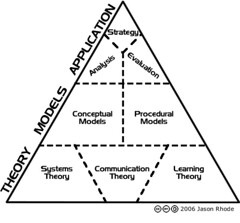
Hierarchy of Instructional Design
Hierarchy of Instructional Design (Photo: jrhode)
I gave a presentation today on discussion forums. I know that LMSs are old-fashioned now in the post web 2.0 social media world, but my goal as an instructional designer is to at least get the best use or best practices out there for whatever tools are available and being used by any particular school or institution. The presentation is in about 3 parts. The first talks about why we use discussion assignments. The second looks at the characteristics and practices that make for a successful discussion assignment, and the third talks about assessment. Oh yes, there is a fourth part: we actually went into Sakai and looked at the "Discussion Forums" tool which is the old open source forum "JForum." I prefer that tool over the generic Sakai "Forums" tool because I find "Discussion Forums" easier to grade and manage. I get where things are and why. The profile in "Discussion Forums" is easier to use than the Profile tool in Sakai which is NOT integrated with the Forums tool or any other tool for that matter. But my point is that the how and why of using a particular tool, the pedagogy implied by the assignment, and the assessment of the assignment is more important than the tool itself.

Map of income distribution in Salinas.
Map of income distribution in Salinas. (Photo credit: Wikipedia)
So in this workshop, I present a rubric for discussion posts. Most other teachers and instructional designers ask me about this. Why in a Facebook world do I need a rubric for discussion posts? Isn't this very mid 90s? Well, it is. Despite the "Millennial" thinking about students, we have a lot of students who do not know what the internet and online communication is really all about. I know this flies in the face of the "Net Generation" fallacy (where you take the recreational habits of the upper middle class/rich kids of your Ivy League school and try to extrapolate what is happening in the rest of the 99% world with technology and learning). I first developed my rubric for discussion posts around my rubric for blog posts when I was teaching English at Hartnell College in Salinas. Many of my students where first generation college students and the Spanish speaking children of migrant farm workers. Many of them did not have consistent high school experiences. A few had diplomas, some GEDs and many had incomplete educations because they moved around a lot. (According to the standard commercial English textbooks, these kids are ready for Shakespeare and Milton.) How are these students supposed to know what is expected of them in an online environment? Easy. You talk to them. You frame the question in terms that they are familiar with. You ask them about what the expectations we might have in a conversation in a classroom versus the cafeteria or at home. I told the students about the rubric and discussed what was in it and why and then we negotiated. Some were familiar with internet chats and wanted to know about "flame wars." We negotiated the points involved. We talked about what is a substantial reply versus superficial (like "great post"). So instead of imposing a list of seemingly arbitrary rules - the students made the guidelines their own. They now had a set of expectations for their interactions with one another and my grading. We referred to the rubric for about 5 weeks, and once we were sure that things were working - it slowly faded away. I think that is success.

I have a copy of my rubric here.

Here is a copy of my presentation as well:


Related articles:
Enhanced by Zemanta

Tuesday, July 10, 2012

Why MOOCs Work

English: Jim Groom as Edupunk
Jim Groom as Edupunk 
(Photo credit: Wikipedia)
I have been reading articles lately written by educators who have not participated in MOOCs but nonetheless seem to have some pretty strong opinions about them such as the "What's the Matter With MOOCs" by Siva Vaidhyanathan from the august (Latin for "dusty, old, and conservative") Chronicle of Higher Ed. And there is Joshua Kim's article for Inside Higher Ed, "Playing the Role of a MOOC Skeptic." I found myself getting a little testy about the issue because I am so passionate about MOOCs. I was in George Siemens' and Stephen Downes' Connectivism and Connective Knowledge class, and I skirted the fringes of Jim Groom's DS 106, his digital storytelling class. If you are not familiar with them, MOOCs are "Massively Open Online Classes" - classes with no limit to who can participate. There are no fees unless you want credit. If you read Vaidhyanathan's article, you will get a real sense about how this can really threaten the establishment. What if you hold a class and nobody pays? If we at the elite colleges give our stuff away, won't that devalue the education for the alumni and paying students? There is a lot of hand wringing like that going on. But that is not how MOOCs work. I want to look at how they do work based on my limited experience (which is better than something written by someone with NO experience).

Now I am going to warn you, I have drunk deeply from the MOOC cool-aid - my experience in Connectivism and Connective Knowledge changed how I work, and how I engage with faculty and students in some very positive, deep, and profound ways. I don't agree with everything that Siemens or Downes has written, they would be the last ones on earth to expect that, but there are no learning theories out there that can contend with, or account for, the rapid changes that are going on in education and technology than Connectivism. Interestingly enough, I think the success of MOOCs counts on an understanding of those principles. George Siemens wrote a great post on those principles in his posting "What is the Theory That Underpins Our MOOCs?"

My staff in the Distance Education department at College of the Redwoods also participated in Jim Groom's DS 106 and this experience is in turn shaping how we do our "DE 101" - our student orientation for distance learning. We are working on cracking that orientation out of the LMS box and turn it into a wider community of learning that we are hoping the students will take far beyond the confines of the orientation - through college and maybe even into their professional lives.

I love George Siemen's article on the theory of MOOCs, but as an instructional designer by trade, I would add these four points:

1. Student MotivationThis is one of the criticisms of MOOCs and the "flipped classroom model": students in those scenarios need motivation to be successful. Students are not born motivated. Lack of student motivation is not an excuse for classes not working. If you are a teacher and your students lack motivation, you need to get into another line of work. Part of what teachers do is inspire and motivate. Many teachers can't help but being motivational because they are enthusiastic about their field. Teachers can provide opportunities for the students to reflect on why they are in the class and be given opportunities to contribute to the class - in my experience, this is often enough to motivate students. I would often get students in my English classes who were used to teachers doing the work for the students. This is not a problem with MOOCs. Students can be taught motivation. As Siemens puts it, we need to foster autonomous, self-regulated learners.

2. Facilitated Connections
True learning occurs when the student chooses the modality in which the learning takes place. In traditional education, that modality is forced (typically, static classroom lecture mode). If the student accepts the choice, he or she is a "good student." What would happen if the learning materials were in different multiple formats; open, accessible and maybe sometimes asynchronous and the students got to choose which version of the material they used and how they engaged with it? Why can't "lecture" also be a video stream, podcast, or recorded event? Then the "live" bit can occur when the students decide to get together and review the materials, discuss them, and then later bring their questions to the facilitator. These reviews can happen in a Moodle discussion forum, Facebook, Twitter, or even in virtual worlds like Second Life.

3. Self-Organization
Teachers need to have faith in the students ability to self-organize - this is how revolutions, religions, and AA meetings work. Humans have evolved to do this very effectively, just ask the wooly mammoth. To this end, students need to be encouraged to use the media with which they communicate as a learning tool. If the students like discussion forums, make that available. If the students are texters or use Facebook, encourage them to take the discussion their. Even if you are not a chronic tweeter, why not have instructions available to students who are? What happened in my Connectivsm and Connective Knowledge class was that discussions took place in a wide variety of fora and then a self- or group appointed "leader" would bring our questions back to the course facilitators for clarification. Often the best thing that the facilitators did was to stand back and let us learn.

4. Content Curation
There was no text book for Connectivism and Connective Knowledge. The course consisted of many of the articles and readings that lead the facilitators to Connectivism, but also the people behind those ideas. What George Siemens and Stephen Downes are really good at is bringing the right people together to talk. They have been exploring these ideas for a while and they were good at breaking down how they arrived at some of their conclusions. Fortunately, the ideas are new enough that the people that helped them out along the way are still with us. So a "lecture" in this course consisted of some weekly readings, a video or two, and a live, weekly presentation by the facilitators or someone like Dave Cormier or another "guest lecturer." These lectures would often start out as a lecture and then evolve into a conversation with the facilitators and students. You would be really surprised at how open people are in your discipline to being a guest in your course via webinar or Skype.

So therefore, getting together with an instructional designer and creating course guides that account for the different media would be really helpful. Fortunately, George Siemens and Peter Tittenberger also thought of that with their "Handbook for Emerging Technologies" which needs to be updated and put back onto a wiki somewhere - maybe at College of the Redwoods or a college near you - so it can be added to and revised.

For Connectivism, the medium is the message - teaching Connectivism any other way than a MOOC is as ridiculous as buying a book about free, open text books from Amazon.Com. I hope that the critics of MOOCs take the time to actually take a course, even as a lurker - they will gain immensely from the experience, and who knows? They might even learn something.
Enhanced by Zemanta

Thursday, November 18, 2010

Concept Maps & Visual Pedagogy

This was the presentation for the Global Education Conference.: "This presentation will explore concept mapping and brainstorming tools for classroom discussion, discovering knowledge, and problem-solving. I will present a brief history of visual pedagogy from different cultures to show how concept maps work. We will explore teaching techniques using these methods. The tools we will look at will include everything from pencil and paper, free mind mapping software, online collaborative concept mapping, and 3-d concept mapping in virtual worlds like Second Life." It was a good session but I think that I need to work on developing presentations that encourage more feedback from the participants. I love this conference though. I have met a lot of people from around the world that I would not have had a chance to meet otherwise. Diversity of viewpoints is what it should be all about.

Enhanced by Zemanta
Here is the same presentation in a less linear form as a concept map.

Thursday, September 23, 2010

Connectivism and the Evolution of Pedagogy

Trotsky, Lenin, and Kamenev (from left to righ...Image via WikipediaIn some recent postings on connectivism and constructivism (see links below), educators and researchers write as if these models are oppositions; as if constructivism is early Bolshevist and connectivism is free market socialism. Pedagogy does not come from research and theorizing but from practice. The learning landscape changes over time and as the technology changes, we need new models to describe how people are learning. Connectivism is the next step in understanding how people learn in the digital age. Behaviorist and constructivist pedagogies describe a certain kind of learning that takes place in a particular milieu. Networks have changed a lot about the learning landscape, but on the other hand, much of how humans communicate and engage with one another has not. It happens faster, more often and over a wider population. I am talking to educators in India, China, and South America. I would not be talking to as many people around the world without the internet. There is a synergistic aspect to networks - we are smarter together than we are individually. There are network behaviors that are very different than purely social behaviors. Constructivist teaching is also occurring in networks. Connectivist learning is also happening. Will constructivist teaching fade away like feudal economies of old Europe?
An important point that should be made is that the social dimension of learning in constructivism isn't negated by connectivism. There is much that is complementary. To over-simplify, Connectivism accounts for the networks and learning in networks; constructivism accounts for what happens in them. Networks are only a means. Communication, interaction, and engagement all have to take place before anyone learns anything. Information itself is not knowledge. Forming a connection does not mean that any kind of engagement must or will take place.

In some of the online classes I have experienced with George Siemens (which I highly recommend), I see much of the constructivist pedagogies at work:
  • students are actively involved, rather than passively absorbing information;
  • the learning environment is democratic,the teacher is not seen as an authority figure as much as a learning guide;
  • the activities are interactive and student-centered instead of being lesson-centered;
  • a teacher facilitates activities in which students are responsible for their own learning and are autonomous from one another.
All of these are classic characteristics of the constructivist classroom (as opposed to the "sage on the stage" students-as-empty-vessel model). But I also learned as much or more from the connectivist aspects of his classes - the networks. My teaching, learning, and professional life have been immeasurably enriched by the people, communities, and networks I discovered through his classes.
All of the conversations about tools and personal learning networks presuppose an individual with some technical skills, facility with managing information and networks, the critical thinking skills to interpret that information, and a fairly high degree of motivation. All of these seem to be taken for granted - in the community college system (at least here in Humboldt Co.) and in less developed countries, one cannot make the assumption that networks in themselves will lead to learning. I am going to have to use all of the techniques of constructivist learning to show the value and purpose of these networks. I need to bring in the students prior knowledge and experience and guide them in applying that to new information and skills.
Enhanced by Zemanta

Wednesday, May 19, 2010

Deep Learning

This is Juniper Hall at Humboldt State University.Image via Wikipedia

Over the next couple of days I am at the Institute for Diversity in Learning and Teaching at Humboldt State University. This is an incredible resource. They are offering this free and in this time of some pretty savage budget cuts, this is a great opportunity. The opening keynote was Dr. Ken Bain who talked about the question "What Do the Best College Teachers Do to Foster Deep Learning?" Ironically, he could not make it out to Humboldt and was on live via teleconference link which is what we should be doing more of anyway. Bain distinguishes the "surface learner" from the "strategic learner" and the "deep learner." The surface and strategic learners are those who have basically figured out how to get by. They meet the requirements of the course without gaining any understanding of the subject matter. It is a really fascinating phenomena that he backs up with research into how physics students understand motion. It seems that most students have a decidedly Aristotelian approach in their understanding of physics - the problem with that is that it is absolutely wrong. Students are quizzed before and after their physics classes and they are shown to basically take the new information and wrap it around the old understanding of how motion works. In other words, they take the new information, combine it with the old world-view, and come up with the wrong idea about how things move. The classes that they took did not ask them to change the way they looked at the world. They could take these classes and not change a thousands year-old vision of how the universe works. It is really frightening.

According to Bain, deep learning only occurs when students are confronted with questions that are important, intriguing, or beautiful. There has to be some direct, personal application to the new information.

The students have been creating models about the world based on sensory input since they were born. Students have to construct a new reality based on new input. Teaching has to be more than passing multiple choice tests, competition, high stakes testing, and hierarchical learning in order to change these world views. Students can pass these tests with an "A" and still not make a shift in their basic understanding of the world.

Bain asks that courses be framed around essential questions that change a student's world-view.

Reblog this post [with Zemanta]

Wednesday, March 10, 2010

A Note on Learning Styles

I want it to be clear that I do not think that I have the all the answers about learning styles theory and pedagogy. I wrote about this earlier in the year here. Learning styles theory is an extremely complex subject that covers psychology, sociology, neuroscience, epistemology, and pedagogy. Notice all the soft sciences in this list. That said, in my own practice in special education in the k-12 realm, my work as a tutor and tutor trainer, and as an English teacher has benefitted tremendously from these tools. I have seen students who were tested as auditory learners begin to use recorders in the classroom and I have watched their lives turn around, but that is not research. The learning styles theories as they stand cover too much ground and are too broad to determine (at this point in time) solid empirical testing. Many of the theories are too simplistic to cover the complexity of the human mind. The research questions in some cases have to be narrowed. Researchers have to continue to define and test the theory, and explore - there is a lot to be done. There have been numerous attempts - many, to my way of thinking, have been successful. What happens though is that contra learning styles educators simply change the definition of learning styles to dismiss the conclusions of the research or weaken the argument by narrowly define what the theory should predict.

An example of that is a video by Daniel Willingham that has gained some traction on YouTube that declares that learning styles is bunk. It is filled with lots of unsupported phrases like "that is not how the brain works" as if we had a really clear picture of how the brain works (never mind how we learn). The only thing that can be said definitively is that more research needs to be done. Another really big problem with the video is that it ignores any research that has been done and there is a lot of it out there. To say that there has not been any research that supports the idea of learning styles means that Willingham has not done a thorough review of the literature.


Willingham says that "lots of people have performed that test" as if there was one way to test learning styles. He also talks about "meaning based" as if we are meant to take it for granted that "meaning based" learning is the final obvious word in epistemology and language. That is just not the case. Willingham narrowly defines learning styles and what it "ought to predict" and then takes the theory (as if there were one) to task.

The claim, for instance, that teachers have to change how they teach is just wrong - not everyone who supports learning styles makes that claim. The idea is that yes, we can teach to a broader spectrum of learning modalities. But learning styles theory is there to help the students understand why they may not be getting it. There are good, solid criticisms of learning styles theory and this ain't it.

Learning styles is still being defined as a theory. In this sense it is a lot like string theory - there is some decent math and models in there but a lot more work needs to be done and should be done. No one is going to through the theory out because it is accurately modeling what is happening in the real world. We don't even know how many strings there are! I consider the learning styles to more of a model like string theory rather than a full blown theory yet. But we cannot just discount research that supports the theory out of hand.

Some References That Go Beyond Personal Beliefsd (even mine)

If you want to look at how complex this question is, check out this paper that is really critical of the theories and is in depth. (Notice that I don't just choose research that supports my world-view or research bias.)

2. Christy Tucker's blog has some excellent summary of the research.


6. Ability, Demography, Learning Style, and Personality Trait Correlates of Student Preference for Assessment Method
"More than 400 students from four universities in America and Britain completed measures of learning style preference, general knowledge (as a proxy for intelligence), and preference for examination method. Learning style was consistently associated with preferences..."

Monday, April 13, 2009

Wisdom Cries Out in the Streets...

Krishna displays his Vishvarupa (Universal For...Image via Wikipedia

A in the "60 Seconds Science" column in Scientific American there is an interesting note about Jest and Meeks' attempt to map "wisdom." They have looked at 10 scientific papers that have attempted to define wisdom and believe that they have found its seat in certain areas in the brain.

"Jeste and Meeks concede that some might call their conclusions reductionistic because they based their 'map' not on the idea that wisdom is a single trait, but a collection of attributes. But Jeste said that similarities between how wisdom was portrayed thousands of years ago in the Bhagavad Gita (a Hindu scripture) and in the West today — as well as the tale of Phineas Gage, a railway worker whose allegedly wise attributes such as amiability and good judgment were said to vanish after a spike penetrated his left frontal lobe — 'makes you think it's not a cultural phenomenon but biologically consistent.'"

Skull diagram of w:Phineas GageImage via Wikipedia


First off, I have to say that my amiability might suddenly vanish if I had a railroad spike through my head. What makes me a little less cranky but cranky none-the-less is the illusive definitions of "wisdom," "knowledge," "memory," "ideas," and "information." I do like that they refer it to a collection of attributes. When we talk about learning and our relationship to knowledge and information, I think we are looking at a similar problem. When we use taking notes to learn, I think it is important to remember that that action includes the movement of the hand and the feel of the pencil. In other words, thinking and cognition may not reside in a single organ. Until we understand how all of the parts work together, I am not really sure if we have a working definition of knowledge epistemologically.

One of the weaknesses of the cognitive approach to pedagogy is that there is a false correlation between how the brain functions and how we learn. This cognitive approach is found in many theories of learning whenever the researcher wishes to put the stamp of legitimacy on a project with Real Science. Thinking, memory and learning are a little messier than the fMRI's would lead us to believe. Neuroscience is going to tell us how we sense the world around us and how currently measurable systems function in the brain but that is as far away from knowing how we learn as the Hubble is from answering cosmological questions about the origin of time. We are learning valuable things but we do not know enough about all the interrelated complex systems that go into creating a single thought to make any conclusions about how we learn.

I hope we read more about an accounting of Eastern systems of epistemology and ontology as they relate to learning. The current thinking about education is decidedly Cartesian. Ironically, Leibniz read a Latin translation of the I Ching which if it did not influence his exploration and invention of binary numbers, it certainly led him to strongly consider the the archetypal significance of a numbering system (as seen in his writings) which led to the modern computer.

Reblog this post [with Zemanta]

Wednesday, March 11, 2009

Education and the Scientific Method

It is interesting to me that education is one of those fields where everyone has a tenaciously held opinion about what it is, how it works, or why it doesn't despite not having any training or background in the field beyond having been educated. For myself, that is like saying "Of course I can sew my own jacket, I have been wearing one for years" or "I can fix your car; I have been driving since I was a kid." Pronouncements on the credibility or the veracity of learning theories or tools come fast and furious from people who do not engage in education as a discipline in itself or its research. This is why we still get teachers that tell us "they don't let" their students use Wikipedia, quote from blogs, or will ever consider using Second Life, etc. I mean, insert whatever-it-is-they-do-not-quite-understand here. These are the same students, when sent to the library to research geology or anthropology do not come back with citations from "Chariots of the Gods," hollow earth literature, or other non-academically viable sources. The students have the critical thinking skills required to go into a library, and despite the library containing books on astrology or conspiracy theories, that sort of thing tends not to be cited by students. Why can't instructors have the same faith in students on the internet? Who said it was our job to "let" or not let the students do anything? I won't harp on Wikipedia further because there is already enough actual research from journals like Nature that say that Wikipedia articles were shown to be just as accurate as anything in peer reviewed articles. The problem with things like Wikipedia or learning online in any form is that it is new. Books and traditional journals safely fit into the framework of traditional teaching. The increasing amount of available information, the users ability to participate in the creation of that information, and the myriad ways of accessing and aggregating that information are all shaking that traditional framework to its 1200 year-old foundation. All of a sudden it is very difficult for traditional teachers to evaluate online sources, information and tools because their sources of peer-reviewed information are always printed one to two years late with sources that are three to four years old - an eternity on the internet. And here we introduce fear. The last thing you do when you are afraid is ask questions: you certainly aren't going to bother with research, create an hypothesis, test it, and analyze data. You are going to run straight to drawing your conclusions and broadcasting your "results" because you feel threatened. This has never been about whether something is a good teaching tool or not but about our ability to adapt to change. Good teachers are often good communicators and when good communicators connect with tools that facilitate communication and interaction, good teaching happens whether that tool is a clay tablet and a stylus or a virtual world.

Monday, September 15, 2008

Learning Modality vs Learning Theory

I have used learning theory, Constructivism, to create course materials and assignments. I have used the theory to produce particular results. As quoted in Mergal's paper:

What is a theory?
* A theory provides a general explanation for observations made over time.
* A theory explains and predicts behavior.
* A theory can never be established beyond all doubt.
* A theory may be modified.
* Theories seldom have to be thrown out completely if thoroughly tested but sometimes a theory may be widely accepted for a long time and later disproved.
(Dorin, Demmin & Gabel, 1990)

I have seen all of this at work in one way or another with Constructivism and I haven't yet with Connectivism. This class is one experiment and what Char Gore and I are doing in HIM101 is another. It is to new of a theory to say it has been adequately tested - one can't reject an untested theory, one has to test it!

This is not a defense of Constructivism or a Constructivism vs. Connectivism aaproach. I just think it is important to talk about what people do as teachers and instructional designers and put Connectivism into that framework. In a simple form, Constructivist teaching is teaching that provides students the opportunity to put the information being taught in their own words and apply it to their lives. How is that not "connecting"?

I think the same thing is happening in a way with Connectivism, but it does not help that the vocabulary around it all has not really been nailed down. What do George and Stephen mean by "knowledge"? Berkeley? Hume? Kant? Buddha? Never mind how knowledge can exist in inanimate objects; how can you have knowledge without a knower? How can inanimate objects contain "learning"? There are some phenomenal changes happening in technology and culture and those changes are changing how I teach in some dramatic ways, but it is not clear yet if we are looking at technology, a new learning modality, or a theory. If students have visual resources available to them in an unprecedented way (movies, overhead projectors, photography) do we need a new learning theory to account for that learning modality (visual learning vs, traditional read/write) or do we adapt theories for the new media?

Any "scientific" picture of the mind has wound up not being how the mind actually works but being a model or metaphor that accounts for our current understanding of how we think it works. Connectivism will have to be able to account for the changes in that metaphor if it is going to keep the claim that it is a learning theory that reflects how the mind actually works.

A book doesn't even contain learning. Learning is what someone can do with information. Someone can read a book and not learn anything. There are no people in my telephone either, I have to actually call them.

Mergel, Brenda.(1998) Instructional Design & Learning Theory. University of Saskatchewan. http://www.usask.ca/education/coursework/802papers/mergel/brenda.htm

Saturday, September 06, 2008

SLED CC '08 Presentation

View the presentation at Slideshare to get my notes. This was my small contribution to "Training for Medical Professionals in Virtual Worlds" with John Miller et alia.

Monday, December 17, 2007

Second Life for Educators

This is a presentation I developed for the State of Washington that is an introduction to Second Life for instructors who have never heard of it before. This is for those faculty members who you know would benefit from this but don't really know what it is. I made this using Articulate Presenter. I have more presentations coming soon on developing curriculum in Second Life and how to design assignments.