Showing posts with label brain. Show all posts

Thursday, September 02, 2010

Pardon my Metaphor

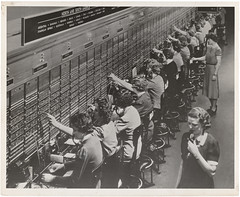
Photograph of Women Working at a Bell System T...Image by The U.S. National Archives via Flickr"Because we do not understand the brain very well we are constantly tempted to use the latest technology as a model for trying to understand it. In my childhood we were always assured that the brain was a telephone switchboard. ('What else could it be?') I was amused to see that Sherrington, the great British neuroscientist, thought that the brain worked like a telegraph system. Freud often compared the brain to hydraulic and electro-magnetic systems. Leibniz compared it to a mill, and I am told some of the ancient Greeks thought the brain functions like a catapult. At present, obviously, the metaphor is the digital computer." — John R. Searls.

I don't think there is anything particularly wrong with this. Humans connect with the world using language, and language is not about facts. Language really isn't information. Language describes. We understand the world through metaphors. Our metaphors are about as accurate as poetry, not geometry. Although as far as language goes, poetry is often a more complete description of a thing than the measurements of it.

I think we are moving on in our metaphors to networks. This metaphor suits me fine - it is as good as any of the other metaphors. A metaphor becomes a tool that allows us to talk about phenomena that we really have little understanding of. We know a lot more about the mechanics of the brain - we have gotten better at measuring parts of it. We see networks in the brain because that is how we understand modern communication and language.

We see the world through a complex of metaphors - through a shifting lens of definition. MRIs of brain events show that memories, sensation, and learning are all non-local events. Various sections of the brain light up and pulse like the shifting colors of a cuttlefish. I am always amazed that there are researchers that feel that they can take a limited model of how the brain supposedly works and then leap out to how we should therefore learn. I am thinking here of "Brain-Based Learning" theories where the fundamental principle is that the brain is a "parallel processor." Social cognitive theories and psychology are a little more useful because they examine interactions between people which, ideally, is something that happens in education.
Enhanced by Zemanta

Friday, March 20, 2009

Brain Lives at "Edge of Chaos"

A depiction of the atomic structure of the en:...

Studies like Brain lives at "edge of chaos" are particularly interesting to me because of the tendency of those engaged in education research to interpret the brain's ability to organize information as somehow a description of how the brain works or how we learn. This study applies a phenomenon they call "self-organized criticality" to brain science — where systems spontaneously organize them­selves to operate at the borderline between order and chaos. This phenomena is present in many different physical systems, including "avalanches, for­est fires, earth quakes, and heart rhythms." We can learn using concept maps, for instance, not because that is how the brain works, but because one of the functions of the brain is to organize information. Networks exist in the brain but rather than a flowchart model typical of cognitivist pedagogy, this study is interested in the synchronization of activity between dif­ferent regions of the functional networks in the brain. Pictures of the brain merely as a network are far too mechanistic to explain what is happening. I don't think there is anything mystical about how the brain works, but it is an incredibly complex system that cannot be described by a flowchart. Scientists will one day look back on those models just as we now (or at least should be) look at those models of atoms with orbiting electrons. It is easier to imagine them as orbiting electrons and it would be difficult to represent an electron probability cloud in k-12 science textbooks, but the model tells us more about our limitations than the world.


Reblog this post [with Zemanta]

Wednesday, October 29, 2008

Notes from Educause: Ramachandran

I am interested in Ramachandran and neurology lately because of claims made by George Siemens and others that there is a direct correlation between how the brain physically functions and how we learn (neurons connecting = learning). I think that there is a lot of psychology that happens between someone firing a neuron and writing an email. There are things that are happening in the brain (including neurons firing) but things like memories are distributed through out the brain. George sent out an interesting article on this called "Memories Are Made of This."

There are 100 billion neurons in the brain and there are ten thousand connections per neuron. The different possible states based on these connections out number the elementary particles in the entire universe. Despite that complexity, we can isolate particular parts of the brain by function based on what we learn from people who have had accidents that slightly damage the brain (strokes or accidents).

Different areas of the brain have different functions but that is different than making a judgement about what is happening at the level of the neuron.

Ramachandran studied the phantom limb syndrome. This happens because the brain maps out the nervous system in a particular part of the brain. The brain remaps the hand into the another portion of the brain. A physical event like amputation doesn't just change the body but rewires the brain. Learned paralysis carries over into the phantom limb. He had shown the connection between visual feedback and relieving pain and paralysis in phantom limbs. Used a mirror in his experiments - having patients move their functioning limb in a mirror and the patients are able to remap the state of their phantom limb with the illusion.

There are things called "mirror neurons" "empathy neurons" - they fire when we reach out and grab something but they also fire when we watch someone grab something. There is a malleability of connections. There is someting in the brain that tells us not to feel pain when someone else is poked but that goes away when we have phantom limbs.

He also studied "synesthesia." Theorie about why people see colors is that they are crazy, on drugs, or something that someone has done in childhood, or that they are being metaphorical. He says that it is a concrete phenomena in the brain - one in 50 are synesthetic. Color and number synesthesia is the most common and the areas are right next to one another in the brain. There is increased "white matter" between the areas. It is genetic, why? Our genes are involved in pruning excess connections in the brain in fetal brain development. In higher sysesthetes days and weeks are colored.

Poets, novelists, and artists are good at creating metaphors - making connections - linking concepts in the brain. Artists are 8 times more likely to be synesthetes. Not everyone has this.

The metaphorical allows us to engage in abstraction. Vision, hearing and touch section of the brain are involved in creating metaphors and abstraction.

Are there unique brain structures from other animals? We do have specialized brain structions the are of the brain that engages in cross modal abstraction. He called personality a neural phenomena.

My sense from this presentation is that we are still a long way off from making generalized statements about teaching and learning from brain imaging studies.