 Image via Wikipedia
There are often connections between my artistic life and my work in education that are surprising. I am reading a book called "
The Art of Describing" by
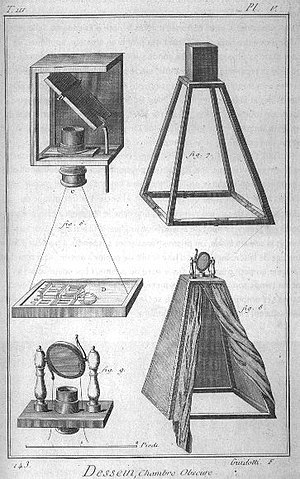
Svetlana Alpers. It is a book about Dutch art in the 17th century and it feels pretty far removed from my work in instructional design and distance education. It is not a new book but I am giving myself a crash course in art history and criticism to work out some ideas that are important to the current novel I am writing. Additionally, I am just interested in art in general. My current novel hinges on ideas of art, identity and authorship. In her book, Alpers talks about Dutch art as descriptive rather than being a narrative art like the Italians (she gives notable exceptions, of course) and in the second chapter, talks about how lenses and the
camera obscura began to change how the Dutch defined art, seeing, and knowing. There are two important terms describing art for the 17th cent. Dutch - "naer het leven" (after life e.g. painting from a live subject) and "nyt den geest" (from the mind). Alpers writes "while
naer het leven refers to everything visible in the world,
nyt den geest refers to images of the world as they are stored mnemonically in the mind" (p.40). This is pretty exciting territory for me because there is an intersection here between this work I am doing for my art (fiction) and the work I am doing in instructional design, which involves visual pedagogy. The 17th century was an important turning point in science and art because the inventions of the lens and the camera obscura were changing how we understood optics and images. Kepler wrote about optics Alpers sums up Kepler's arguments when she writes "To understand our view of the sun, or moon, or world, we must understand the instrument with which we view it..." This is very radical. It implies that there is no concrete "actual" image out there - just a view of the world that is an interpretation by an instrument which could be a lens, a camera obscura, or the eye itself. I think this was a common view of all technology back then. It comes from a fundamental mistrust of the senses and an understanding that all tools for observation are really tools of interpretation and the tool you choose shapes that interpretation.
The lense we are looking through now is the series of connected databases, documents, images, texts and people that make up the internet. Understanding how the technology determines our interpretation of knowledge on the internet is critical. I believe that we are only going to be able to fully understand how we can do that by looking at how we processed technical innovations in the past.
 Image via WikipediaI was really glad to see that people have stepped up and supported Smarthistory - this is a really amazing site that needs and deserves our support. Their Kickstarter page is here, but PLEASE contribute; this is an incredible project that can really promote art history and online education, and despite reaching their financial goals, we have to think about on-going support. These are just the kinds of courses that are on the chopping block right now in these hard economic times and we need to step up.


![Reblog this post [with Zemanta]](http://img.zemanta.com/reblog_e.png?x-id=405c3058-fc3d-49fd-a470-7896a6fdc689)