"One of the defining characteristics of Open Education has been the
widespread sharing of course materials from OpenCourseWare to Open
Textbooks to more generally open educational resources (OERs).
Unfortunately many OERs are primarily content or course materials and do
not include sufficient quizzes or other activities that students can
use to check for understanding and that instructors can use to track
engagement and performance. Research shows that embedding assessments in
texts increases student completion rates and learning. Open Assessment
complements existing OER efforts with tools to allow instructors to
embed assessments in any OER, and to create shared collections of
assessment items.
MIT and Open Tapestry are developing tools
and services to allow instructors and authors to embed assessments
directly in any content (e.g., in any OpenCourseWare course) thereby
providing a richer learning experience. And BYU will be developing
validated item banks of open assessments that can be shared (which will
be developed by domain experts and psychometricians). Our approach
differs from current practice because existing tools require one of two
things: either a system that presents both content and assessments
together as part of a dedicated system or the the learner is required to
leave the content to take an assessment in a separate quiz system
breaking the flow of learning. To be able to embed an assessment of your
choosing in any existing OER wherever it might be presented will be
truly powerful.
This panel presentation will provide
conference participants the opportunity to understand how to use the
tools, existing and forthcoming open assessment item banks, and how to
use open assessment in their OER content regardless of where it's
located right away."
http://openassessments.com
Content and assessment are always separate. Typically, you look at content and then go out and take an assessment. This might not be the best way to learn.
These assessments can be embedded anywhere. Focusing on formative assessment. Self-check of their own understanding and eliminates issues around cheating. - there are self-assessments in the materials - a "hide the answer" approach.
Examples are in Saylor.org of static tests. OCW Scholar focuses on self-learners has .pdf questions.
OpenAssessments.com has each item with an embed code much like the embed code that you will find in YouTube.
It will import test questions using QTI format.
Integrated with Open Tapestry. http://opentapestry.com
Open Tapestry lets you edit versions of websites.
David Wiley talked about the creation of item banks. Faculty are sometimes loathe to adopt open textbooks because the commercial textbooks often come with testbanks. A Hewlett grant has funded the creation of openly licensed textbooks.
THIS BLOG IS HERE FOR HISTORICAL PURPOSES ONLY - IT IS CONTINUED AT WWW.GEOFFCAIN.COM
Showing posts with label Open education. Show all posts
Thursday, November 07, 2013
Thursday, February 21, 2013
OER: Neuro-Cloud: a new model of textbooks
I am really excited about Neuro-Cloud. I heard about it in a tweet from Creative Commons this morning and went to take a look. This is a textbook that is being created by a community of neuroscientists who first began the project as an open journal. It is free for anyone to use because they are using the CC-by license instead of traditional copyright. It is still a work in progress: they want to have a finished textbook by July of 2013.
I have been very interested in textbooks that are created by a community of scholars rather than the traditional subject matter expert model of the traditional publishers. The math textbooks at my previous college are an example of this. I think it is particulary fitting that this is how a textbook on neuroscience is written and supported because neuroscience is a rapidly changing field. Every advance in technology gives us more ways to look at the brain and like astronomy or physics, the deeper in we look, the more we find. What is fascinating about this project is that students will be reading a text written by this current generation of neuroscientists and then will go on to do research and work that will contribute to the later editions of this book. This is a living community of scholarship as much as it is a textbook:
"The goal of the Neuro-Cloud Textbook Project is to provide a free, accurate and comprehensive introduction to neuroscience for both educators and students. This is to be accomplished through an online collaborative environment where the next generation of neuroscientists will have the opportunity to work with colleagues from all over the world. By providing students experience, connections and a chance to showcase their knowledge, all while providing a needed service to the community, the Neuro-Cloud Textbook Project creates a situation where the whole world can benefit."There has been a lot of hand wringing about "sustainability" over open education resources and open textbooks. As soon as we move away from the education-as-a-product model and move towards education as community (I am thinking here of the Connectivist model), questions about money become less relevant.
Related articles
- OER: 12 Sources of Open Textbooks (cain.blogspot.com)
- Boundless challenges textbook publishers to trial over OER (pandodaily.com)
- Pure OER: SOC101 (saylor.org)
- The Growing Adoption of Creative Commons Textbooks (usnews.com)
Thursday, November 29, 2012
Inclusive Learning Design Handbook
I am reviewing the "Floe" website today. I am particularly interested in their "Inclusive Learning Handbook." What is Floe? According to their website:
Ironically, I find the default font in the handbook almost impossible to read - but fortunately their platform includes an easy preferences button that will allow me to adjust the font, color, and contrast of the text AND it is openly licensed and not behind a pay-wall so I can use what ever font I want to read it.
This is a very important project: it includes content, instructions, and tools for making sustainable, accessible content that will render all of the questions about $ustainability in OERs irrelevant.
"Learners learn best when the experience is personalized to individual needs. OER is an ideal learning environment to meet the diverse needs of learners, including learners with disabilities. The Floe (Flexible Learning for Open Education) Project supports the OER community in providing a sustainable, integrated approach to accessible learning, addressing the needs of learners who currently face barriers."I like this approach because it includes a lot of principles of Universal Design but also addresses other access issues - including cost. Their handbook creates a very innovative context for the creation of OER. It includes not just the content itself but tagging that content with metadata, a profile for learners that the students create for themselves, and the use of open formats. Here are the suggestions for the "Technique" section of the handbook:
- Label resources to indicate what learning needs the resource addresses
- Allow the creation of variations and enhancements
- Support learning profiles
- Support flexible styling
- Support keyboard control of functions and navigation
- Provide audio or text descriptions of non-text information presented in videos, graphics or images
- Provide text captions of information presented in audio format
- Separate text that can be read in the interface from underlying code
- Use open formats wherever possible
"Open formats are typically published freely and don't require software developers or users to pay licensing royalties to use them in a variety of applications. As a result, open formats make it easier for content to be used and exchanged freely within different operating systems, applications, and software tools."This is one of the few platforms that pays attention to the learner - there are tools to help learners assess how they prefer to learn.
Ironically, I find the default font in the handbook almost impossible to read - but fortunately their platform includes an easy preferences button that will allow me to adjust the font, color, and contrast of the text AND it is openly licensed and not behind a pay-wall so I can use what ever font I want to read it.
This is a very important project: it includes content, instructions, and tools for making sustainable, accessible content that will render all of the questions about $ustainability in OERs irrelevant.
Related articles
- Babson Report on OER in US Higher Education (mfeldstein.com)
- OER Minicourse (slideshare.net)
- Fluid Project Wiki - Open Source Design Pattern Library and UI Design Handbook (talentopoly.com)
- WritingCommons.Org and Community-Based OER Models (cain.blogspot.com)
Friday, June 01, 2012
Open Content Licensing for Educators Workshop
![]() |
| Image via CrunchBase |
2012 is a significant year for open education and OER. We are celebrating 10 years since UNESCO coined the term "Open Educational Resources".
In
joining the global celebrations, the OER Foundation will host a free
online training workshop on OERs, Copyright and Creative Commons
licensing.
When: 20 June - 3 July 2012 (to coincide with the UNESCO World OER Congress in Paris).
Where: Online
Cost: Free. Registrations for this celebratory online workshop are now open: Register today to reserve your seat.
We
are aiming to break our previous #OCL4Ed record of 1067 registrations,
so please share the gift of knowledge and invite colleagues and
friends to join us.
- Download a copy of the poster for the OCL4Ed Workshop (614KB) and display on local notice boards.
- Blog and share the registration link through your social networks: http://wikieducator.org/Open_content_licensing_for_educators/About
We
welcome graduates of former OCL4Ed workshops to join our
lead facilitators and assist with peer-learning support for educators
around the world who want to learn more about OER and open licensing.
More info on how you can assist coming soon.
We look forward to welcoming you to OCL4Ed 2012.06.
With kind regards
The OER Foundation team
COL Chair in OER at Otago Polytechnic
UNESCO-COL Chair in OER at Athabasca University
Monday, March 26, 2012
OER Policy Registry: Request for Help
Image via CrunchBaseCable Green just lit the Bat Signal!Greetings Open Colleagues,
The open community shares a need for more information to help us with our work. We know, for example, that there are many policies supporting open education at institutions and governments throughout the world. Many of us know of some of these policies, but it would be extremely helpful if we had a single database of open education policies that the entire community could access and update.
To meet this goal, Creative Commons has received a small grant to create an “OER Policy Registry.” The Open Educational Resources (OER) Policy Registry will be a place for policymakers and open advocates to easily share and update OER legislation, OER institutional policies and supporting OER policy resources. We have begun to enter OER policies into the registry, but we need your help to make it a truly useful global resource.
The open movement is reaching a stage where we’ve had some real, concrete OER policy victories and there is the potential to achieve many more. Sharing our collective knowledge of existing OER policies, in the same way we believe in sharing educational resources, will help advocates and policymakers worldwide be more successful.
Please join the effort:
(1) Contribute any OER policies you know about via this Google form.
- We are collecting both legislative AND institutional (non-legislative) OER policies from around the world. Your form submissions will be added to the draft list of OER policies.
- If any entries need to be fixed, please email us at oer@creativecommons.org.
Anyone can add OER policies to the Google form through the next month. Beginning May 1, the OER Policy Registry will move to the Creative Commons wiki. At that point, anyone will be able to edit and update the OER Policy Registry on the wiki, and all contributions will be licensed under CC BY.
We’re starting with a Google form because (a) it’s easy and (b) wikis require you to create an account before editing, and that may be a barrier to participation.
CC is in contact with other projects that collect similar information, including UNESCO, CoL, the Florida Distance Learning Consortium, EU OCW and a project in New Zealand. We will add OER policy data they gather as it becomes available. If anyone knows of other efforts to gather OER policies, please send them to Anna Daniel (anna@creativecommons.org) and we will reach out to them too.
If you have any suggestions or feedback on the content and/or framework, please let us know.
Warmest regards and thank you!
Cable
Related articles
- CC Salon London: Open Educational Resources - Policies for Promotion (creativecommons.org)
- Launch of the Why Open Education Matters Video Competition (creativecommons.org)
- Creative Commons Search Engine (philbradley.typepad.com)
- CC News: Why Open Education Matters Video Competition (creativecommons.org)
- Another Job Opportunity: Communications Manager (creativecommons.org)
Wednesday, February 22, 2012
Open Education Week from March 5-10, 2012
CAMBRIDGE, Mass., – (February 21, 2012) –The OpenCourseWare Consortium announces today the first annual Open Education Week from March 5-10, 2012. Open Education Week is a global event that seeks to raise awareness about the benefits of free and open sharing in education, especially Open Educational Resources (OER). OER are high-quality, free and open educational materials that offer opportunities for people anywhere in the world to share, use and reuse.
“The vision of the open education movement is to create a world in which the desire to learn is fully met by the opportunity to do so, where everyone, everywhere, is able to access affordable, educationally and culturally appropriate opportunities to gain whatever knowledge or training they desire. The movement encompasses producing, sharing, using and modifying content, as well as innovative models of educational delivery,” said Mary Lou Forward, executive director of the OpenCourseWare Consortium. “Open Education Week will showcase projects, resources, people and ideas so that people around the world can see the breadth of what has been accomplished already, and participate in discussions about the future of the movement.”
Open Education Week is being coordinated by the OpenCourseWare Consortium. The event will take place online and in different locations around the world, with opportunities to participate in webinars, discussions and live events. Projects and events will be featured from institutions and organizations from around the world, including: University of Cape Town, University of Michigan, Universidad Politécnica de Madrid, University of California, Irvine, Delft University of Technology, and Creative Commons.
Participation is free and open to all. Visit www.openeducationweek.org for more information.
Related articles
- Fostering Government Support for Open Educational Resources (OER) Internationally (downes.ca)
- Open Education Week and Upcoming Events (openphd.wordpress.com)
- Contribute to Open Education Week (creativecommons.org)
Monday, December 12, 2011
Open Content Licensing for Educators Workshop
Image via CrunchBaseThis in from Cable Green: Creative Commons, the OER Foundation and Ako Aotearoa announce an international professional development opportunity for all educators. What: Open content licensing for educators workshop (#OCL4Ed)
Where: Online
When: 23 -27 January 2012
Cost: Free
Registration: Open (register today)
Facilitators:
- Cable Green, Director Global Learning, Creative Commons
- Jane Hornibrook , Public Lead, Creative Commons Aotearoa New Zealand
- Wayne Mackintosh, Director, OER Foundation.
Image via WikipediaThe course materials were developed as a collaborative project by volunteers from the OER Foundation, WikiEducator, the OpenCourseWare Consortium and Creative Commons with funding support from UNESCO. The course will provide prerequisite knowledge required by educators to legally remix open education materials and help institutions to take informed decisions about open content licenses.Visit: http://wikieducator.org/Open_content_licensing_for_educators/About
Please spread the word through your networks. Give the gift of knowledge and invite a friend to join you.
Download and share this poster with your colleagues.
We look forward to meeting you during the workshop and extend our thanks to Ako Aotearoa, New Zealand's National Centre for Tertiary Teaching Excellence for sponsoring this professional development opportunity.
Related articles
Thursday, October 27, 2011
Open Ed Conf. Keynotes: Cable Green & Philipp Schmidt
Image via CrunchBaseThe Obviousness of Open PolicySpeakers: Cable Green
The Internet, increasingly affordable computing, open licensing, open access journals and open educational resources provide the foundation for a world in which a quality education can be a basic human right. Yet before we break the "iron triangle" of access, cost and quality with new models, we need to educate policy makers about the obviousness of open policy: public access to publicly funded resources.
Speaker/Artist(s) Info
Director of Global Learning, Creative Commons
Notes:
"If we had a food machine that could feed everyone in the world and the marginal cost is zero, and it won't hurt farmers, should we turn it on?"
His dream - everyone in the world can get the education they desire. If there are is a need to educate 263 million students - we could never build enough traditional schools to educate those who need it.
If we are not sharing, we are not teaching. David Wiley
There is a huge community of open source organizations.
Problem: Most of the policy makers do not understand 20th cent. technology and tools (open licensing, mobile tech, the affordances of the internet). They do not understand the tools collectively - they are able to collectively create OERs.
Rivalrous vs. Non- Rivalalrous resources - NR is digital and open licenses.
Publicly funded resources should be available to the public who paid for them.
If the world spent 5% of the GDP on edu that would equal 3 billion dollars.
How do you sustain OERs? If OER is the default of our normal work, then we do not need to invest new money. The policy is simple to explain: if work is in public domain it goes to the public; if it is licensed, the license should be open.
"We should get what we pay for."
Cooperate & share = we all win
Affordability
Self Interest
If we had open policies what could we do? Billions is given out to ed institutes for research but there are few requirements to share that research with an open license.
English Comp - 55k enrollments x $100 text = 5.5 million dollars a year to the state of Washington. Does this make sense? The open text saves millions. The money comes from fed and state financial aide.
WA will pay 2 mil for an open textbook, spend 100,000 to update it every year and still come out ahead. And then they will openly license it and still offer it for free.
Brazilians have to search for open texts before investing in commercial texts.
Efficient use of public funds to increase student success and access to quality educational materials
Everything else including all existing business models are not sacred.
If we had a food machine, we have a moral obligation to turn them off.
"The opposite of open is not closed; the opposite of open is broken."
The Impossible Open Education Future
Speaker: Philipp Schmidt (bokap.net)
Executive Director and Co-Founder, Peer 2 Peer University
He is a Shuttleworth Fellow
"The Capetown Declaration twist"
Started Peer-to-Peer University in 2008 - Vijay Kumar said "You are starting from the wrong point - imagine that there was no university - what would it look like?"
They launched the first courses in 2009.
Anyone can join, OER, light interface, badge system. Their site is a light weight connector rather than an LMS. "School of Open" is being cooked up right now.
His frustration: Asking too much and expecting too little at the same time.
- OER cost savings are a big deal.
- Open is not a quick fix for all challenges in broken system.
- Brihanna needs an affordable student loan (in most places in the world, she would not have to work so hard)
- Disruption comes from the fringes - make open research institutes
- Open education is global - we are not paying attention to what is happening in dev world
- Open needs to keep the spirit of a lab
- Open - participation, making, tinkering, experimenting, social, serendipity
Brothers Wright: If we had studied flight we would have never done it because we would have learned that it was impossible.
Imagine the Impossible Open Education School of the Future
In P2PU - they tend to use cohorts rather than MOOCs
A strong social bond of cohorts
Great facilitators are hard to scale
Alternatives? A learning expedition - following the markers of others up the side of the mountain. You can hire a guide. There model is "challenges." There is a badge system and a "Request a Mentor" button. There is also a "Become a Mentor" button.
Learning = making things with others
What makes a good challenge? These can make good portfolio pieces
Goal: enable community to contribute "challenges"
How to: What makes a good challenge?
Testing challenges in other domains
Assessment: Every time you do an assessment apart from the activity you introduce inaccuracies.
Why not use gaming as assessment - assessment needs a "Press R to Try Again."
You fail a test - when you lose a game, you try again.
1st Step - Collect Data
2nd Step - Showcase and share portfolios
3rd Step - Listen to the community
"Framework and Design of Social Learning"
Related articles
- Open Educational Resources to be discussed at conference in Namibia next week (appablog.wordpress.com)
- Commonwealth of Learning adopts CC BY-SA as part of new OER policy (creativecommons.org)
Wednesday, October 26, 2011
Openness and Learning Analytics
Image by nep via FlickrSpeakers: John Rinderle Norman BierRevise/Remix can build a 1000 points of OER light. Can these lights converge to fire authentic learning analytics & share-alike data models?
Conventional wisdom in the OER community maintains that one of the more important features of the open education approach is the malleability and customizability of materials, allowing freely available component resources to be remixed, adapted and modified to suit specific institutional directives, student needs or faculty interests. These features are important enough that the ability to revise and remix content is a core part of the commonly accepted 4R framework that defines open content. While the ability to tailor OER to meet changing or specific needs is one compelling part of the open model, the infinity variety that this encourages creates serious obstacles for another expected benefit of openness: using learning analytics to drive adaptive teaching and learning, support iterative improvement, and demonstrate effectiveness.
The ability to deliver meaningful learning analytics has been one promise of the open education approach. A use-driven design process for OER depends on the resources being used by a large number of students with varied background knowledge, relevant skills and future goals—a student population that open and well-used resources should be able to provide. Such a process can use such interaction data to iteratively improve courses in a meaningful and empirical way. Beyond improvement analytics, this same data can be used mid-stream to improve the effectiveness of learners and instructors.
Despite this promise, the OER community has not been able to create or take advantage of widespread, generally applicable learning analytics tools. While some organizations have had success in developing analytics platforms and approaches, such successes have tended to focus on specific resources, often developed with data collection in mind and not always falling at the “most open” end of the open content continuum. One barrier to more widespread analytic tools has been the variety of OER afforded by remixing and revising.
This presentation will explore the benefits and trade-offs to be made between adaptability and analytics. In the course of this exploration, we will argue that the benefits to be had from an approach that places a higher priority on analytics may outweigh those to be gained from endless variety in the OER space. Similarly, we will discuss some approaches to better harness open education’s promised ability to drive learning analytics, with greater and lesser compromises to the adaptability of OER. We will propose open communities of use and evaluation coalesced around individual OERs using learning analytics to improve the resource through coordinated revision and remix. Open education has embraced share alike licenses for materials. The next logical step is the open exchange of learning data and evidence of effectiveness, to “share alike and share data”. We will also suggest approaches to integrating disparate analytics-enabled OER into common platforms and the development of OER to published standards for learning analytic data.
Notes:
Open Learning Initiative:
Produce and improve scientifically-based courses and course materials which enact instruction and support instructors
Outcomes:
Shared understanding of challenges, tensions, and possibilities in learning analytics
Describe community-based analytics plans
Driving feedback loops. We have a huge opportunity to use assessment data around OERs. There are enormous amounts of data available. "Infinite points of light" around all the OER repositories and initiatives.
Infinite proliferation
The 4 Rs
- Reuse
- Redistribute
- Revising
- Remix
Not recreate but to evaluate - recreate is a barrier to reuse.
What drives change in these settings?
- Data
- Intuition
- Market demand
- Instructor preferences - change happens because an instructor gets bored with material, but with no real idea if the changes are improving the course.
Effectiveness: An OER is effective when it demonstrably supports students in meeting articulated, measurable learning outcomes in a given set of contexts.
They are also looking at new forms of assessment for gathering data.
Rory McGreal asked whether or not there was a clearer way to talk about what is demonstrable. There are a lot of variables in the initial statement.
Why have we not been doing this?
- It's hard
- Costly
- Individual faculty need support
- It can be threatening to educators
- Disparate systems for collecting data
What do we mean by "learning analytics"?
Proxies vs. authentic assessment and evaluation
Analytics Definition
Data collection > reporting > Decision making > Intervention > Action
Collecting data is not enough. We also need to make sense of it in ways that are actionable.
Types of analytics
Education/classroom management
Learning outcomes
We need common, agreed upon standards, a core collection, and a space for exploration.
Problems include privacy and technical issues.
Tools that already exist:
DataShop, Evidence Hub, Learning registry, and communities of evidence
Community College Open Learning Initiative
And build new things:
We need better mechanisms to share data.
We need a community-based approach.
Learning Intelligence Systems
What would be giving up? This approach forces us to allow our minds to be charged by evidence.
Next Steps?
Innovate
Standardize
Scale
- Commitment to assessment and evaluation
- Community definition of analytics enabled OER
- Common approach to data
- Shared and private analytics platforms
Related articles
- Taking OER beyond the OER Community (downes.ca)
- How data and analytics can improve education (radar.oreilly.com)
Open Ed Conference - Keynote speakers Josh Jarrett & Jim Groom
Josh Jarrett at discussing "Access is Not Enough."
Challenges from here to 2020
Warning: raw notes ahead!
Three challenges for the OER community
Four Challenges for the Next decade
Higher ed tuition has gone up over 400%. There is over a trillion dollars in student loan debt. The "new normal" is students who work and go to school. "Education drives social mobility in the U.S."
Gate's Foundation rewards institutions for success, not just access, accelerate early momentum through restructured dev ed and smoother transitions between HS nad college; unlocks the power of technology for education.
First three accolades,
1. Developing frameworks, rules, and regimes to support OER.
2. Establishing a community of sharing
3. Creating access to rapidly expanding stores of OER
The three OER bugaboos: quality/impact, usage/dist., sustainability
Three Challenges:
1. Evidence: translate OER cost savings into student impact on
2. Content development: design for reuse
Analytics tools improved success in a course by 50%.
Jim Groom - Climbed out of a tent. "We are here today to occupy Open Ed."
Are we talking about open ed resources as a store? or as an on going experience. Ten years ago there was more of a community, outside of sustainability.
Why aren't the open repositories open and accessible?
Michael Branson Smith - his course DS 106. DS106 Radio.
Gardner Campbell wrote a book called "Love Analytics" that informs his presentaion. "The bags of gold" talk.
He doesn't care about the institutions or grants - this should be a grass roots movement.
He ran his DS 106 course as a open course. He ran three sections for credit and then opened it up and had 400 sign up online. DS 106 is not an open education resource, it is an open education experience. He started with 8 assignments but then let the students create assignments. There are 200 assignments now that a student can take.
The course has a student created tutorials, examples, and assignments.
http://bit.ly/radio4life
Twitter was an important component of the course - students hash tag their messages with #ds106
"A community that transcends any technology."
The Summer of Oblivion: a pedagogy of uncertainty
He taught the course as if he had not talked to someone for 20 years. He called himself "Dr. Oblivion."
Why would we waste out time lecturing when there are new media?
"Looking for Whitman" Michael Branson Smith has a class of 80 students are working on DS 106.
"Education is an experience, not a resource."
Challenges from here to 2020
Warning: raw notes ahead!
Three challenges for the OER community
Four Challenges for the Next decade
- Completion
- Quality
- Funding
- Demographics
Higher ed tuition has gone up over 400%. There is over a trillion dollars in student loan debt. The "new normal" is students who work and go to school. "Education drives social mobility in the U.S."
Gate's Foundation rewards institutions for success, not just access, accelerate early momentum through restructured dev ed and smoother transitions between HS nad college; unlocks the power of technology for education.
First three accolades,
1. Developing frameworks, rules, and regimes to support OER.
2. Establishing a community of sharing
3. Creating access to rapidly expanding stores of OER
The three OER bugaboos: quality/impact, usage/dist., sustainability
Three Challenges:
1. Evidence: translate OER cost savings into student impact on
- course completion
- retention
- enrollment intensity
- credential completion rates
2. Content development: design for reuse
- How much of this content is reuseable?
- Content has to be modular for reuse.
3. Integration, instrumentation, and distribution
- How do we create common distribution?
- We need a comparable OER distribution channel like a publisher.
What would it mean to solve these issues?
"You can't fail placement but placement can fail you!"
Analytics tools improved success in a course by 50%.
Jim Groom - Climbed out of a tent. "We are here today to occupy Open Ed."
Are we talking about open ed resources as a store? or as an on going experience. Ten years ago there was more of a community, outside of sustainability.
Why aren't the open repositories open and accessible?
Michael Branson Smith - his course DS 106. DS106 Radio.
Gardner Campbell wrote a book called "Love Analytics" that informs his presentaion. "The bags of gold" talk.
He doesn't care about the institutions or grants - this should be a grass roots movement.
He ran his DS 106 course as a open course. He ran three sections for credit and then opened it up and had 400 sign up online. DS 106 is not an open education resource, it is an open education experience. He started with 8 assignments but then let the students create assignments. There are 200 assignments now that a student can take.
The course has a student created tutorials, examples, and assignments.
http://bit.ly/radio4life
Twitter was an important component of the course - students hash tag their messages with #ds106
"A community that transcends any technology."
The Summer of Oblivion: a pedagogy of uncertainty
He taught the course as if he had not talked to someone for 20 years. He called himself "Dr. Oblivion."
Why would we waste out time lecturing when there are new media?
"Looking for Whitman" Michael Branson Smith has a class of 80 students are working on DS 106.
"Education is an experience, not a resource."
Tuesday, October 25, 2011
Open Ed Conference: From Shared to Open: The evolution of open education in Washington State
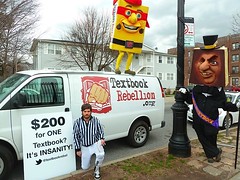
Image by textbookrebellion Speakers: Tom Caswell & Connie BroughtonLearn how Washington's colleges went from a few system shared courses in 1997 to developing 81 courses as part of the Open Course Library.
Washington's State Board for Community and Technical Colleges (SBCTC) is currently developing the Open Course Library, an ambitious 2-year project to design open educational resources for 81 high enrolling courses. In 1997 SBCTC began developing a way to share courses with a "pooled enrollments" model. For over a decade, SBCTC's system shared courses have allowed smaller colleges to provide a variety of "long tail" course offerings through a well-organized system of online course sharing. In this presentation we will explain how our system shared courses paved the way to the Open Course Library, providing a culture of sharing as well as the technical framework to allow Washington State's colleges to engage more fully in the Open Education movement.
Notes:
Their strategic plan included shared tools, ANGEL, Tegrity, Collaborate, NW eTutoring Consortium, Professional development, and the open course library.
More information at http://techplan.sbctc.edu
"We will cultivate the culture and practice of using and contributing to open education resources."
Internet + digital content + open license = lower cost, greater access, and greater quality.
Students were averaging $1000 for textbook costs.
WA legislation in SSHB1025 asks that faculty consider the lowest cost options (all things equal) that faculty will adopt open content where possible.
Saylor Foundation adopted their courses that did not use commercial textbooks. They also fixed the broken links and put much of the material into a consistent form.
Related articles
- Big Winner: OUR Open Course Library (elearningcentralia.wordpress.com)
- Running Start students might pay part of tuition costs (kitsapsun.com)
- Betty White is now honorary WSU alumna (seattletimes.nwsource.com)
The Open Course Library: Bridging the gap between the LMS and OCW
Speakers: Tom Caswell & Connie Broughton
We will share the Open Course Library project, including technical & professional development challenges faced as we developed phase 1.
The goal of the Open Course Library is for faculty to design digital, openly licensed materials for 81 high enrolling courses in Washington State community and technical colleges. During the development of the first 42 Open Course Library courses, faculty designed, piloted, and then revised their courses using the our system wide ANGEL LMS. We chose to use ANGEL as our primary development platform for because most of our faculty course designers were already familiar with that LMS. Using ANGEL also made sense because all faculty were required to pilot their OCL course, so initial development, piloting, and revisions could all be made with the same system.
In this presentation we will explain the workflow and roles of the Open Course Library staff. We will share some of the challenges we faced developing OER in an LMS. While new systems such as Canvas are removing many of the technical barriers to open sharing from an LMS, other challenges remain. Considerations for open content sharing include professional development for copyright and Creative Commons licensing, instructional design, and web accessibility.
Notes:
They had to make the case for open education.
Why is "open" important in education?
We will share the Open Course Library project, including technical & professional development challenges faced as we developed phase 1.
The goal of the Open Course Library is for faculty to design digital, openly licensed materials for 81 high enrolling courses in Washington State community and technical colleges. During the development of the first 42 Open Course Library courses, faculty designed, piloted, and then revised their courses using the our system wide ANGEL LMS. We chose to use ANGEL as our primary development platform for because most of our faculty course designers were already familiar with that LMS. Using ANGEL also made sense because all faculty were required to pilot their OCL course, so initial development, piloting, and revisions could all be made with the same system.
In this presentation we will explain the workflow and roles of the Open Course Library staff. We will share some of the challenges we faced developing OER in an LMS. While new systems such as Canvas are removing many of the technical barriers to open sharing from an LMS, other challenges remain. Considerations for open content sharing include professional development for copyright and Creative Commons licensing, instructional design, and web accessibility.
Notes:
They had to make the case for open education.
Why is "open" important in education?
- Efficiency: You can build on content that is already created
- Affordability
- Quality: We tend to do our best work when we know our peers can see it.
- Self-Interest: Increased faculty exposure, reputations, and opportunities
They built 80 top courses and created an open course library all built on open education resources and open textbooks. The state of WA has 75% adjunct teachers in the community and technical college system. This is a quick way for faculty to get course materials together quickly. They didn't slam the door on commercial publishers but limited the textbook costs to $30. This approach is different from an "open courseware site." The open course library workflow is more of a straightline workflow - teachers who built the courses are also the ones who have taught them.
The courses will be available on Connexioins.
Master & open course materials are linked
- Faculty update both together
- Older versions still available
- Proprietary content is flagged and hidden from open course
They have a new RFP for an LMS that is requiring an open publishing feature.
Goals:
- Design and share 81 high enrollment gatekeeper courses
- Improve course completion rates
- Lower textbook costs
- Provide new resources
- Fully engage our colleges in the global open educational resources discussion
Phase 1: 42 courses released this Monday
Phase 2: 39 courses available in Spring 2013
"Every faculty member works with an instructional designer and a librarian."
Q1= design, Q2= more design, Q3 Teach pilot course, Q4 review
Process: 81 courses built by our own faculty:
- Define learning objectives
- Go to OER library for materials
- Fill in missing content with created content
How does OER help teach more students and teach them better?
- No-rivalrous, scalable, searchable
- Allow for preview
Results?
- 81 courses with 411,133 enrollments
- Textbook savings of 41 million a year
- Completion rates may also increase if students can afford to actually buy the text
Phase 1 Faculty Concerns
- Many were unfamiliar with the particular LMS
- No way to compare work between course teams
- Too many websites to keep in track of
Phase 2
- Using Google Docs to collaborate and share as we go
- All project management information in one Google Site
They are also using Tegrity.
More information on http://opencourselibrary.org
Related articles
- RFP Process for New LMS Will Commence This Fall (elearningcentralia.wordpress.com)
Open Ed Conference: Towards an aggregated profile of the Global OER and OCW audience
Speakers Mary Lou Forward, Meena Hwang and Una Daly
Developing a profile of our global audience through aggregated surveys of OER and OCW users worldwide.
What are the demographics of those looking of open education resources and open courses? based on their surveys, most of the people visiting http://www.educationportal.com are mostly over 40. They are getting mostly life-long learners. Only a third of the visitors are there to support their studies. The most popular answer to their survey was "to update my job skills."
People were visiting from 57 different countries.
All of this points out the importance of translations.,
Survey data is up at http://www.ocwconsortium.org
There was then examples of a wide variety of users who provided comments about how folks are using OCW. There are huge communities being built around open content around the world. One site in China that hosts ed videos and a microblogging has 1.4 million followers. One study group has 3000 members.
Una Daly got up to talk about who is using the open repositories. She discussed the OER advocate training programs, online communities of practice, and adopter communities. She mentioned the grant around adoption of OERs and the Hoopa Tribe Reader.
Developing a profile of our global audience through aggregated surveys of OER and OCW users worldwide.
What are the demographics of those looking of open education resources and open courses? based on their surveys, most of the people visiting http://www.educationportal.com are mostly over 40. They are getting mostly life-long learners. Only a third of the visitors are there to support their studies. The most popular answer to their survey was "to update my job skills."
People were visiting from 57 different countries.
All of this points out the importance of translations.,
Survey data is up at http://www.ocwconsortium.org
There was then examples of a wide variety of users who provided comments about how folks are using OCW. There are huge communities being built around open content around the world. One site in China that hosts ed videos and a microblogging has 1.4 million followers. One study group has 3000 members.
Una Daly got up to talk about who is using the open repositories. She discussed the OER advocate training programs, online communities of practice, and adopter communities. She mentioned the grant around adoption of OERs and the Hoopa Tribe Reader.
Related articles
- CC News: The Power of Open (creativecommons.org)
- Big Winner: OUR Open Course Library (elearningcentralia.wordpress.com)
- Sir John Daniel of the Commonwealth of Learning: Open Education and Policy (creativecommons.org)
Open Ed Conference: "Which License for OER?"
Image by kool_skatkat via FlickrSpeakers: Ahrash Bissell, Gary Lopez, Philipp SchmidtTired of the never-ending debate about "Which license for OER?" We agree! Perhaps we should talk about "Which assets" instead.
For too many projects, and for too long, the OER community has grappled with the proper interpretation of open-content licenses, their use, and possible sustainability strategies built around them. The Creative Commons licensing suite has emerged as the global standard for OER licensing, yet it has not lessened, let alone solved, this debate. The problem can be distilled to three key issues: 1) there is more than one CC license, 2) interpretation of some licensing terms (such as the non-commercial term) is subjective, and 3) the license chosen is widely perceived to be a key factor in determining workable sustainability models for OER use and production.
In this session, we will examine each of these issues, paying particular attention to their effects on people's perceptions of OER, the different ways in which licenses are justified and used, and the overall impact on the progress (or lack thereof) of the field.
We will also discuss whether it could be helpful to shift the frame of the debate, from "Which license?" to "Which assets?" In brief, the contention here is that the persistent focus on licensing has stifled the emergence of creative new production, use, and delivery models and reduced the impact of OER accordingly. One option is to embrace hybrid production models, where all "OER" are released with as few restrictions possible (e.g., under CC BY), but not all resources (from a given producer) need be released as OER. We are hoping that the discussion will reveal other options as well.
We are anticipating that we will be able to integrate the insights gained from this discussion into helpful resources for both existing practitioners and newcomers to the OER field.
Notes: There was no presentation here but this was a question and answer session. How do we produce OERs in a way that schools can use them. The speaker claims that copyright issues are not really an issue in the classroom. He is a proponent of the "CC by" license. He discussed the OER decision tree for organizations seeking to be involved in OER production. He thinks that a dual publication model might be a good idea. If you have some materials that are aligned by standards or that they were put together with scaffolded learning in mind. Can we publish a restricted version for the purposes of standards AND then break that up into open modules.
What do you do with faculty who want to release their materials for free but then they get picked up by someone who wants to put a license on it that will allow them to make money?
Two reasons licenses are important is that they can protect the author and to foster more reuse. There is now no "blessed sources" for texts in the open environment. We do not know enough about the sustainability issues around the licenses to know what the effects will be - we need more research.
Jaroslav made the point that BSD used to be an open source operating system that was made commercial. We e need more consensus on licenses.
Related articles
- Blackboard to add support for CC Attribution (creativecommons.org)
- OERs: Public Service Education and Open Production (downes.ca)
- Commonwealth of Learning adopts CC BY-SA as part of new OER policy (creativecommons.org)
Thursday, September 15, 2011
Creative Commons Positions: Senior Project Manager & Senior Project Analyst
Image via CrunchBasehttp://creativecommons.org/weblog/entry/29046Creative Commons is seeking highly motivated and organized individuals to fill two positions: Senior Project Manager and Senior Project Analyst. Both positions are full-time with full benefits. Both positions will key members of the team supporting Department of Labor TAACCCT grantees.
Ideal candidates have contributed to open source, open education, open licensing, and/or other open content projects, are proficient in required technologies, and possess at lease two years of work experience. Joining CC means getting the chance to interact with motivated staff and a brilliant international network of affiliates and community members.
Please feel free to share these jobs descriptions as far and wide as possible. We will be accepting applications on a rolling basis until we find the right candidates. Please be sure to indicate the job title you are interested in applying for in the email subject line, and send to “jobs@creativecommons.org”
Application Deadline: Friday, 7 October.
Friday, July 29, 2011
OERs: Creating Assignments with Public Domain Documents
Image via WikipediaWhile working on the Kaleidoscope Project (assisting faculty at eight colleges develop courses that implement open education resources or open textbooks), I have run into interesting instructional design challenges with creating assignments using materials that were written a hundred years ago. Typically, instructors will take assignments out of a teacher's edition of a textbook or from supplemental material. When they do that, they often trust that the publisher is aware of the learning outcomes of the course or subject. This is not always a safe assumption to make. We are not limited to using older public domain texts, but there are instructors using them. If one wanted to create an course using openly licensed materials, there are modern textbooks, essays and openly licensed journals that can all serve those purposes. If one wanted to use nothing except materials written in the past four or five years, it could easily be done. Such projects are becoming more and more common. Ironically, there are English textbooks out there that are still using excerpts from Toffler's Future Shock (1972) when discussing technology, so the openly licensed textbooks have opportunities to make vast improvements.But there are cases where instructors want to take advantage of the vast wealth of public domain texts. This seems like a non-issue in most areas of the humanities where we still traffic in Plato, but the question comes up; how do we make it relevant? How do we make it new? The funny thing about that is that students have to do that all the time. They do this whether we want them to or not! One of the ways that we understand a piece of writing or new knowledge, is by applying our previous personal experience, what is happening in the world around us at the time, and combine it with what we have learned before. From this constructivist approach, the teacher's assignment is to give the student
opportunities to apply personal experience and previous knowledge to new information. We can add to that by facilitating the connections the students can make to one another and subject matter experts via twitter and other social networks. But given a public domain text, let's say an essay by psychologist Otto Rank, a teacher could ask the students, based on their personal experience, if Rank's description of interpersonal relationships is valid. What recent news stories seem to support or refute his theory? If the students are reading works by other writers, they can be asked how the theory differs from that author. If they are using a discussion forum (and they should be) then the students have the opportunity to share their experiences and benefit from the experiences and readings of others. They should also be encouraged to follow experts in the field on blogs and twitter and to participate in broader discussions outside of class. In other words, we make sense out of the world through our interactions, and these may be interior or exterior. We are connection-making animals. Learning does not come from a text by itself no more than a textbook is a class.What techniques do you use in your classes to help your students connect to the broader issues? Feel free to email me or use the comment link below.
Related articles
- A Basic Guide to Open Educational Resources (OER) (downes.ca)
- Sir John Daniel of the Commonwealth of Learning: Open Education and Policy (creativecommons.org)
- Open Educational Resources: Share, Remix, Learn #iste11 (speedofcreativity.org)
- 10 Open Education Resources You May Not Know About (But Should) (mindshift.kqed.org)
- Fwd: Academic Developers Sharing Open Resources: CPD4HE Workshop (academic-practice.blogspot.com)
Friday, July 08, 2011
OERs and the Next Stage of Open Textbooks
By rubyblossom. via FlickrThere are some exciting things happening in the world of open education resources and open textbooks. I have worked in the recent past on projects that create or find open education resources, participated in presentations on open textbooks, and this latest project feels like the next step in all of this. I am working as a consultant (instructional design) on the Kaleidoscope Project. The purpose of the project is to create collaborative efforts between colleges to create courses using existing OERs with each course being developed by at least two partner institutions. A number of our College of the Redwoods faculty are participating in this grant. The focus on the grant is not the production of open textbooks or course materials (although that is happening anyway) but on design and results:"Project Kaleidoscope will close the loop on improved course design and student learning. Using OER and a common assessment process will allow faculty teams to improve the course design and learning results based on analysis of embedded assessments and deeper learning results. Actually, the project requires this on-going, iterative review and improvement."
The learning outcomes piece of this is what is going to allow us to track the effectiveness of the materials used. Folks in the OER world have an idea of where this might go, that using open textbooks and learning objects can be just as effective and in many cases, more effective than a commercial textbook. Why? Because learning objectives and outcomes differ from institution to institution based on the needs of the local communities. This is especially true for the community colleges who often have to work on getting students up to speed academically. Faculty already have to adapt and remix commercial texts for the needs of the student populations often in the form of additional, costly supplements or multiple books. What I have been finding in my work with open textbooks is that textbooks are often supplanted (not supplemented) by openly licensed video, audio, images (and yes, open textbooks) making the course even more engaging for the students. When colleges work from the learning objectives and then find openly licensed materials that meet those learning objectives, everyone wins. But we have gone through that phase; it is now time to apply learning analytics to OERs and really show what works, what yet needs to be done, and what is possible.
Partners with the grant include Cerritos College, Chadron State College, College of the Redwoods, Mercy College, Palo Verde College, Santa Ana College, Santiago Canyon College, and Tompkins Cortland College. Advisers to the grant include Norman Bier, the ubiquitous Cable Green, M.S. Vijay Kumar, Terrel Rhodes, and David Wiley. rSmart is supporting the project by hosting the Sakai sites where the courses will live. And Kim Thanos, CCH*, is managing the whole thing on amazingly tight deadlines!
If you are involved in similar research into OERs and learning analytics, I would love to hear about it via email or leave a comment.
Related articles
- 10 Open Education Resources You May Not Know About (But Should) (mindshift.kqed.org)
- Brazil introduces OER into federal legislation and adopts local government policy (creativecommons.org)
- Creative Commons & the Association of Educational Publishers to establish a common learning resources framework (creativecommons.org)
- Should OER favour commercial use? (downes.ca)
*Chief Cat Herder
Thursday, May 26, 2011
Hubris 2.0: OERs, Publishers, and Federal Money
If Blackboard or McGraw-Hill wants to see the future and innovative business models, they should look to Flatworld Knowledge. These new business models are the future of education. For myself, textbooks, teaching and learning materials are better when they come from the learning community. If you have to have a commercial textbook, FWK is the next best thing.
I personally like it when the government takes my hard earned tax-payer dollars and uses them to broaden access to education, lower the costs of education, and get people to work together. It is so much cheaper than invading other countries and funding the things I don't like about the world to the tune of trillions of dollars.
If you are interested in open textbooks or want to know more about what dangerous things we are doing with some of that federal money at the College of the Redwoods, leave a comment here or email me at geoff-cain@redwoods.edu.
Related articles
- 10 Open Education Resources You May Not Know About (But Should) (mindshift.kqed.org)
- The Quiet Revolution in Open Learning (downes.ca)
- Open Educational Resources (OER): Switching the focus from production to re-use? (downes.ca)
- 7 Things You Should Know About Open Textbook Publishing (hollymccracken.wordpress.com)
Subscribe to:
Posts (Atom)