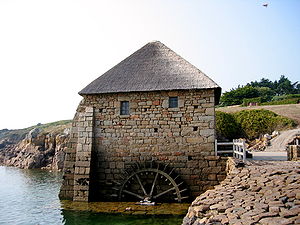
 Tide mills, along with riverine ship mills, were a major early medieval technological advance, allowing to tap the tidal power along the Atlantic Coast for milling. (Photo credit: Wikipedia)
Watching
TED Talks this morning made me think about how different the cultures of innovation are now and a thousand years ago. The TED Talks tend to promote the myth of the lone, gifted super genius entrepreneur. Nothing particularly wrong about that but it is a cultural construct and myth that rarely acknowledges the past work of others, graduate students, adjuncts, the labor or the laborers, the dead ends that others went down so you didn't have to, and positions of privilege. I would like to see a "
TED Talk" of a 6th Century
Irish monk from the west coast of Ireland to talk about alternative sustainable energy and if they did that, we would notice a lot of really familiar ideas and "innovations" such as tide mills.
Tidal mills were used since Roman times for grinding mills for cereals (wheat flour) and salt. They have existed for centuries (possibly millennia in some places) along the European Atlantic coast (Ireland, Holland, Britain, Belgium, France, Portugal and Spain), located mainly in pipes, canals and rivers, where the potential energy of the tides was maximal, which allowed them to run for about six hours by flood-tide cycle. They basically existed where ever the Romans built roads. And they were also picked up later by the monasteries who were often headed up by missionaries from Rome.
I don't know if our star monk could bring in a Powerpoint presentation - maybe he could tell the highlights of the story in stained glass or in an illustrated parchment. But notice that we don't have a record of that particular monk. We don't because they tended not to see themselves as tenure track wunderkind but as a part of a community and, for good or ill, part of the "
Great Chain of Being." I think if your innovations survive a thousand years, you should at least get rewarded with a sabbatical or something. We know of very few Roman or monastic innovators by their names. There was learning, apprenticeship, and mastery but it was for a community and tended to not be for any one person's particular gain. No one copyrighted or patented the aqueduct. These were truly, in the best sense of the word, civic works.
The TED Talk I listened to this morning was with David Sadoway who is developing liquid metal batteries. I loved that he gave a shout out to Volta, and his graduate students and assistants - that happens rarely in these talks, mostly because they are so pressed for time and they have to get the ideas out there in that small amount of time.
Which brings me to my next point about cultures of innovation: I love hearing that the Chinese can't innovate: they invented the compass, gunpowder, paper, and the printing press to go with it. What they don't have is a culture of mentorship, entrepreneurship, and creativity that David Sadoway talks about. When they get that, Silicon Valley will seem like a pretty quaint little place.


