Showing posts with label networks. Show all posts

Monday, September 15, 2014

mLearning Initiatives at Humboldt State University

This just in from Morgan Barker, an instructional designer at Humboldt State:

Hello Staff & Faculty,

I would like to personally invite you to campus sessions centered around the topic of mobile learning. The eLearning department will be holding a monthly 2014-15 Bring Your Own Device (BYOD) session. Come join us -grab a cup of coffee and a croissant, during the session.

Sessions will run like an open mike forum - the perfect venue to start an academic discussion, ask questions, share your mobile lessons or learn from the campus community.

Fall Session Dates/Times - BYOD Mobile Learning Sessions

The Fujitsu iPAD
Friday, September 19th
Theme - Facilitate Classroom Use - mobile lessons, all disciplines
SH 117 9-10am

Friday, October 17th
Facilitate Collaborative, Content Sharing Elements, all disciplines
SH 117 9-10am

Friday, November 14th
Facilitate Field Journals, all disciplines
SH 117 9-10am

More Information - What is Happening at HSU with Mobile Learning? During Spring 2014 the College of eLearning facilitated a semester-long Faculty Learning Community (FLC) on mLearning that created a fun and safe environment in which faculty collaboratively explored, applied and shared mobile technologies and pedagogies to enhance student learning. Take advantage of these resources:

Cannot make these sessions? We will continue the use of #mobileflc and our tagboard mentioned above. This is a great way to see the conversations and add relevant content.

More and more events like this will be happening here as they are in the rest of the country. I am really interested in how these tools can change how students learn. I was very skeptical at first because when the iPad first came out, I saw it only as another consumption device and I associated "mlearning" with proprietary platforms. It is a different world now - the web has gotten to be a much more creative place to be since the dawn of Web 2.0 and it is really worth looking all of the ingenious uses of networks and even the simplest of tools. These events are the follow-up events that grew out of the mLearning Faculty Learning Community that Kim Vincent-Layton and Morgan Barker led last year - I highly recommend this and if you are on campus, please stop by. 


Thursday, January 16, 2014

Using a Blog-Based Environment to Support a Community of Learners

Presentation notes for: "Using a Blog-Based Environment to Support a Community of Learners"
Institute for Student Success, Humboldt State University
Presenters: Daniel Fiore, Riley Quarles, Claire Knox, and Child Development Faculty

Riley introduced everyone by saying that the network of blogs (Wordpress) created with the Child Development department began with solving a problem: communication. Claire Knox pointed out that there was learning that they wanted visible to everyone, they wanted everyone participating in the conversations. They wanted the learning to not be locked down behind a learning management system. Resources for the presentation are at the Child Development site for the Institute.

They created a network of blogs to support their program. The network of blogs arose from the users - the needs of the faculty. All of the course blogs reflect the interest and needs of the individual classes. The blogs serve as eportfolios.

The department blog provides calendars, advising, and a link to all of the other classes. The site supports online and hybrid courses. It allows students to feel and be connected throughout the program.

They also wanted to engage alumni in an open site. They are expanding the community to include former students. Students create their own blogs that feed into course and department sites. They are using RSS feeds and categories in Wordpress.

Blog posts help students get to know one another before they work together in the class or in other classes. This has increased the sense of connectedness and community.

The students sign up for a blog at Wordpress.com, send the address to the instructor, the instructor puts them into a plug-in that gathers the students postings that are labeled or catagorized according to the class instructions. The pulg-in automatically pulls in all of the materials that the students tag to the class blog. Instructors and students then comment on the postings.

The blogs allow students to explore topics further. The instructor was using the blog to post more articles and resources and the students began to do the same on their blogs.

Carole said that she is not a technological person but found that Wordpress was easy to use and the program allows the faculty to go at their own pace in using these tools. The blogs assignments were good tools to discuss web presence, communicating online, and our web history. They had conversations about how the blog can represent the student to prospective employers and how what you put online represents you.

They want the students to carry their experiences in the program and their relationships after they leave the program. Learning management systems do not allow that. They want the learning community to continue.

All of the course content from the courses stays visible. Students can look at other classes and see how course materials are related to other courses. They begin to link what they are learning to their other classes. Students can go and look at any courses that they are going to take in the future. They can see how all the courses fit together. Faculty can also visit the sites and find new ways to make connections to other classes in the program. Typically, faculty in purely face-to-face courses might not have that opportunity. The blogs also serve as a community orientation site.

They have also had a lot of discussions about privacy - there are some materials that they put into Moodle (the learning management system). Observations of children or copy written materials,  for instance, need to be kept private.


Even though the environment looks structured, the community created by the students and their comments represents another network within the network - this is like the idea of rhizomatic learning posited by Dave Cormier. There are opportunities here for collaborative learning and team-based projects. Blogs allow students to communicate their processes, to reflect on how they learn. Peer instruction and support can begin in this network and follow them throughout the program (also much like Eric Mazur's ideas on peer instruction). This is also a good example of students learning through their connections with one another (connectivism).

Sunday, November 24, 2013

Some Notes on Connectivism and Peer Review

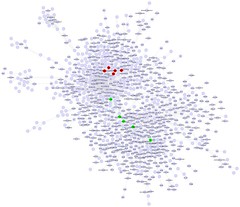
A social network diagram
A social network diagram (Wikipedia)
I have been looking at social constructivism and the social generation of knowledge over the last week. I am interested in this line of thought because I feel that for us to really get a handle on what connectivism is, we have to be able to talk about it in the context of previous theories that talk about how we communicate and learn. Connectivism has to account for social constructivism because that is one of the prevailing theories about learning in the universities. According to Stephen Downes, "connectivism is the thesis that knowledge is distributed across a network of connections, and therefore that learning consists of the ability to construct and traverse those networks." Connectivism, if you are not yet familiar with it, is a learning theory proposed by Stephen Downes and George Siemens. It is important to note that even though this is a new theory, it is not particularly dependent on any technology: connectivism was not invented by the internet. The internet was invented because we are very interested in communicating and being connected, and connectivism is a useful theory that can describe how this happens. When I say that connectvism is nothing new, I am not saying that in a derogatory way, I mean that it is the natural evolution of our understanding of how we learn. In various postings in this blog, I have pointed out how throughout history spontaneous learning networks have arisen between groups and individuals. I am interested in in the development of communication and knowledge networks from the earliest mail routes to the "Republic of Letters," from the telegraph to the early dial-up networks, from the Minitel to the modern internet. There is a lot of concern out there about whether or not connectivism is a learning theory or not. I find this issue ironic and kind of amusing. Well, it is about learning, so that is settled. How can it not be a theory? According to Merriam-Webster, a theory is "an idea or set of ideas meant to explain facts or events" and "an idea that is suggested or presented as possibly true that is not known or proven to be true" and finally, the third definition "the general principles or ideas that relate to a subject." So yes, it is a theory, the real question is whether or not it is a strong or weak theory, or does it account for the facts? Can we make predictions with this theory? Does it explain what happened before? The irony is that the same mechanisms that educators are going to use test whether or not it is a useful theory are the same mechanisms connectivism describes, for instance, peer review.

Brent Renalli has in interesting paper called "A Pre-history of Peer Review: Religious Blueprints from the Hartlib Cycle." In it, I ran into my old friend John Cominus (1592-1670), the author of one of the first illustrated textbooks for children. He was also an early proponent of universal education, visual learning, and going beyond rote memorization in schools. All of these ideas, like connectivism, are still considered "new" and controversial in many universities - any instructional designer can tell you stories about that! I didn't go looking for Cominus, but in my research into education, I keep running into him. In a typical paper on peer review, authors tend to credit the Royal Society with its invention, but it was already a well-established system in Europe and elsewhere to ensure religious orthodoxy as a mechanism of censure. "Peer review" is generally not a good way to get new ideas out.

Connectivism has gone through its modern "Republic of Letters" stage via the blogs. Downes and Siemens both have used the blogs to write books, essays, and propose ideas. Educators in turn have responded for and against on their respective blogs - and continue to do so. And now, Siemens has published in a more formal and traditional manner with peer reviewed journals such as MERLOT's Journal of Online Learning and Teaching. Other education researchers are publishing articles about connectivism such as Dorothy Kropf in the European Journal of Open, Distance, and Elearning. Thus far, the ideas around connectivism have had more exposure and peer review than Einstein's theory of relativity had in 1905 (the "Annus Mirabilis" papers) when only Max Plank and Wilhelm Wien had read them before publication in Annalen der Physik. I wonder if the theory of connectivism could have come out of the traditional institutions. I think these ideas had to have been born in the very media the theory analyzes. In many ways, the theory flies in the face of all the accepted theories in education (behavioralism, cognitivism, and the many shades of constructivism) and probably would not have gained traction. I have seen papers get rejected from journals because there are not enough researchers publishing about idea X in refereed journals. We have to expect that. Universities rarely innovate - that is left to the lonely patent clerks of the world. Universities are where ideas go to fossilize and become the established order. Connectivism needed the internet, blogs, and Twitter to take shape.
Enhanced by Zemanta

Sunday, March 13, 2011

The Japanese Earthquake: New Roles for Social Media

Tsunami warning sign on seawall in Kamakura, J...Image via WikipediaI think we should all be getting now how important social media has become in politics (Iran, Egypt, Tunisia, Wisconsin, etc.) and in natural disasters such as Haiti and now with Japan. The earthquake and tsunami are terrible disasters and my focus on social media is in no way meant to trivialize them, on the contrary, social media will be an important component in the international response. Social media and networks after the tsunami were the only way millions of people in Japan were getting information about the scope of the disaster. So many people photographed, filmed and tweeted the tsunami that not only do researchers now have a historically unprecedented amount of data available, but lives were saved. Trapped people were able to tweet or text their location and get help. Families were able to communicate for hours after the event to let one another know where they were and what was happening.
Tsunami Evacuation Platform in Yaizu, Shizuoka...Image via WikipediaSocial media is also part of the solution afterwards. With services like HelpAttack!, people are able to easily pledge money to the Red Cross and spread the word to others on how to help. It is very easy: you just log-in with your Twitter account, pledge an amount for every update (up to a limit you set), and after 30 days, you pay your donation. 
The Red Cross also has a mobile giving program: you can text "REDCROSS" to 90999 to donate $10.
Groupon has an online offer inviting customers to donate $5, $10, or $25 to support International Medical Corps' emergency efforts in Japan. They have raised $16,000 in donations so far.


Related articles
Enhanced by Zemanta

Monday, February 07, 2011

Student Privacy and Facebook

This image is an example of a blocking cluster...Image via WikipediaThe Student PIRGs has come out with a guide for controlling your information on Facebook. This has come at a really good time because College of the Redwoods is expanding its presence on Facebook and other social networks. Understanding the benefits and the risks is equally important. We will have to review this frequently to keep up with how quickly Facebook can change.Social networks can be powerful communication tools but they are used by more than just students! I don't want to impede how folks communicate but understanding privacy issues is especially important in an educational setting (thinking possibly of FERPA).

I am interested in how other colleges are managing the issues around Facebook and social networks. Feel free to leave a comment here if your college has guidelines or policies related to Facebook or other social networks.
Enhanced by Zemanta

Thursday, April 15, 2010

Ning is Our Wake-Up Call

Ning just recently announced that they will no longer support free sites. I belong to a lot of Ning sites. Ironically, the Open Textbook Advocate Trainers website is a Ning site. That site is (was?) dedicated to open source textbooks. It really makes you rethink exactly what tools you use and why. I have a lot of materials in Google Docs that I think I am going to be backing up at home more often. I used to use Flickr a lot until I one day they emailed me to say that I was over the limit and they down-graded my account so I could not upload anymore or see pictures in full resolution until I sent them some money. This "premiumware" happens when something is free to drum up a customer base and then they "offer" you an "upgrade." Very effective when the company is holding your files and network hostage. Google does say they have a commitment to education but we will see what the economy dictates here. George Siemens warned about this too.

I use a lot of "free" online tools but I have some redundancy in there in case one fails - for instance, I use Slideshare and Slideboom for my online presentations. I use Google Docs and I use Scribd. I decided this early on in case someone's server was on the fritz and I was travelling. Now this redundancy is especially important when companies are looking to "monetize their assets." It is amazing how short-sited business people can be. How do you monetize a network? What do you charge for the learning and connections that happen? All of the great work that people did in these networks is swept away to "capture a big opportunity." Why not partner with education institutions, UNESCO, and other governments to harness those networks for everyone's benefit? That would be a far greater opportunity (and maybe even more lucrative) than any current business model could conceive.

In the meantime, we should be pushing more for open source tools, platforms, and public hosting of those open source tools.

Monday, February 01, 2010

12 Free Learning Networks for Students and Academics

A social network diagramImage via Wikipedia

The rise of new online technologies has reshaped the way people learn. Print reference sources, though still valuable, are no longer the primary gateway to information. Students and other academics have turned to social networks and collaborative learning communities to find research materials and increase their knowledge of various subjects.

There are many free learning networks that have been created specifically for students and academics. The following twelve sites are good examples. These online communities provide access to alternate forms of teaching and learning. They also offer a central place where like-minded people can easily meet and share information.

LearnCentral- LearnCentral combines social networking with live collaboration technology to provide a unique teaching and learning environment. Classrooms can connect with other classrooms, peers can connect with other peers, and groups can conduct online meetings and seminars.

LearnHub - This social learning network is home to a number of experts who can help with standardized tests, college admissions, and other academic pursuits. LearnHub also offers a community space for users who want to contribute educational information and learn from other members.

Sclipo - Sclipo is a social learning network that makes it easy for academics to teach and learn using the site's many built-in applications. Popular apps include a course manager, a document and video library, and a webcam-based classroom that can be used for live teaching and webinars

GCFLearnFree.org - Created and supported by the Goodwill Community Foundation, this global learning network provides free lessons on everything from math and money to careers and computers.

Academia.edu - This unique learning network can be used to find researchers with similar interests. The site's search feature also allows members track the latest developments in their research area and see what other people are researching.

Academici - Academici is a professional social network for academics and scientists. Site members include people from more than 200 countries.

GradeGuru - Designed specifically for college students, this knowledge sharing network makes it easy for students to share course notes and study together online. Members who share notes can earn gift cards, PayPal cash, and other rewards.

Pronetos - Pronetos is a social network for scholars, professors, and their institutions. The site encourages collaboration by allowing members to share papers, find research, post course materials, and share special announcements.

TheApple - TheApple is a learning community and social network for current and future educators. The site offers career resources, lesson plans, education-related quizzes, education news, teacher trivia, inspiring videos, and a community forum where members can chat and learn online.

Livemocha - Livemocha, the world's largest and most active online language learning community, provides a place for language learners to meet and communicate online. The site also offers free courses in 36 different languages and learning tips from native speakers.

LingQ - LingQ is a knowledge sharing network for language learners. Visitors who sign up for the site's free membership can meet other language learners online, take an unlimited number of free language lessons, and join live conversations for extra language practice.

VoxSwap - VoxSwap is another good place for people to learn new languages online. Members work together to teach each other new vocabulary words and language skills.


Guest post from education writer Karen Schweitzer. Karen is the About.com Guide to Business School. She also writes about online degrees for OnlineDegreePrograms.org.


Reblog this post [with Zemanta]

Thursday, October 15, 2009

Networks in the Rear View Mirror


"The past went that-a-way. When faced with a totally new situation, we tend always to attach ourselves to the objects, to the flavor of the most recent past. We look at the present through a rear view mirror. We march backwards into the future." - Marshall McLuhan

The real issue is not that networked thinking is new but the the networks have gotten significantly faster. But not faster than we think. The same technology that we use to build the networks is the same technology that we use to mediate the information. The information over networks is moving at such a pace that we have to adapt ourselves to keep up.

I loved the image that Jane Knight posted this month from Sean Carton. I linked it to the left. It is interesting to me because this is one of the few that acknowledges the inherent networked capacities in humans. The whole idea of writing arises from the desire to connect memory and ideas with other people, places, and the future. In a way, cuneiform libraries are networks because the information in them was meant to be copied, preserved, and sent to others. Carton's time line jumps from the 550 BC postal service in Persian straight to the telegraph in 1792. A nod should also be given to the East and the Silk Road as a network, especially since the Chinese found a 2000 year old letter in a post office adjoining the Silk Road. Again, I really appreciate the fact that he is giving us some idea of networks before the 1960s but I think an important addition to this timeline would be the monastic system of the Middle Ages. Not just for the "look-at-me-I-was-a-humanities-major" bit, but because those monasteries were so successful at transmitting, preserving, and passing on information that we are still struggling in the shadows of those institutions today. They were really good at finding, copying, and preserving books. That is where a lot of the traditions in colleges come from. Students are taking notes in classes today because in the 12th century university, the only way to get a copy of the book that the instructor was reading from was to copy it yourself. McLuhan calls schools the "custodians of print culture."

Some of the great epics of the West open with guards waiting to see the fire from the next tower over or with runners and messengers delivering news. A great deal of exposition is given in letters in Shakespeare and later we also have epistolary novels where the movement of information can sometimes shape the plot. What I am trying to point out is that there has always been this awareness of connectedness and information. What is happening now is that we are learning how to mediate that seemingly overwhelming speed of that change and that mediation is changing the way we think.

Saturday, August 01, 2009

Revisting the Digital Divide

My Samsung BlackjackImage by Dillon K. Hoops via Flickr

I was looking back at some bookmarks and materials that I had on an old computer and it was fascinating to me how the questions around technology have changed. When educators were talking a lot about the "digital divide" back in the early 2000s, the questions were around how were we going to get these expensive machines and infrastructure to the poor. They needed lots of power, cables, expertise and money. Computers were huge and expensive and they still can be today. But we now define a whole other class of machines as computers, including phones, netbooks and PDAs. The most important of these right now are the phones. According to a report by the International Telecommunications Union back in March of this year, at the end of 2008 there were there were an estimated 4.1 billion phone subscriptions world-wide, compared with about 1 billion in 2002. And the definition of a phone has certainly changed since 2002. Phones now play media and connect to the internet and allow for a whole new kind of connection to learning materials. We no longer need to distribute media through CDs or laser discs. Data storage and new kinds of programming (java, ajax, web2.0 tools, etc.) combine to make distributing media easier than ever. Technology is still not absolutely universal, but the wide variety of tools that are now available for communication, the availability of netbooks for under $200, the low-cost of connectivity via WIFI and phone networks means that the real digital divide is one of the imagination. We need to bridge the gap between how we think of learning networks and teaching and the wide variety of tools and technology that are now available.


Reblog this post [with Zemanta]

Saturday, April 18, 2009

3 Reasons Why Twitter Works in Education

Image representing Twitter as depicted in Crun...Image via CrunchBase

A number of us here at Tacoma Community College are using Twitter. Recently one of our faculty who is new to it said "I doing this but I don't know why yet" which is a fair thing to say. On the surface, it looks (and can be) fairly superficial. As a matter of fact, the Common Craft video on Twitter is pretty ridiculous. If I saw that video first, I would not have created an account. I thought I really didn't care what you were having for lunch; it turns out I am wrong about that, but the video is an overly simplistic view of Twitter that does not do the power of the simple or the network creation capabilities justice. It is quite possible that when the video was made no one really knew how this tool would really be used.

1. It's Simple
Twitter is one of those tools that nearly does nothing. It is extremely simple. I do not need to hold a two hour seminar to teach students or educators how to use it. It is a microblog. You can follow people and people can follow you. You can tell people what you are doing in 140 characters or less. Brevity is the soul of wit. Twitter forces you to be concise. I can easily create accounts and I can place a twitter feed on my blog or website very quickly. It is low bandwidth.

2. Communication

Twitter is a great way to link people back to your blog, business, or other website. It is also a way to be alerted when something is happening in your network of interest to you. And you also get a lot of mundane details about people's lives and vice-versa, but here is why that can be important too. Let's say I am trying to form a team and I need to talk to someone, I may know that John eats lunch at his desk every Thurs. because he tweets that now and again. I may not remember why I know that information, but it is Thursday and somehow, I know he will be at his desk. This mundane information gives me an idea of when students are studying, when people are going to work and puts me in the ebb and flow of their day no matter what time zone they may be in.

Network of testimonials: flickr's social networkImage by GustavoG via Flickr


3. Connections
Twitter doesn't just allow you to create networks but as you add people to your following/follwers list, you begin to see messages to and from people you may not have thought of following or meeting before. Instructors can leverage this in some very powerful ways. If a new student opens a teachers followers list and follows everyone on that list, those new students are then following a list of professionals, students from the previous classes, and those who have graduated and are working in the field. I have an example from a Health Information Management's social networking map. This is an easy way to increase the interactivity of a course.

There are a number of good introductions to twitter for educators, tools to harness the power of it's simplicity, or to find other educators on twitter, but the motherlode of all links to all things twitter is at Jane Hart's microbloging page.
Reblog this post [with Zemanta]