
Showing posts with label conceptmaps. Show all posts

Friday, February 25, 2011

Brainstorming: order from chaos

BrainstormingImage by MikeOliveri via FlickrBrainstorming is a method for rapidly gathering ideas from a group. These ideas can help individuals in the group solve problems and discover solutions. Brainstorming sessions allow members to express their ideas and creativity, and to discover connections between ideas and participants. There are marginalized voices in your class or organization that have something unique to contribute. Brainstorming can help bring forth these voices from the back of the room. By their nature, brainstorming sessions allow everyone to have an equal voice.

Ordo ab Chaos: Six Rules for Brainstorming Sessions:
  1. Suspend criticism and judgment.
    Everyone must agree to accept all answers; there is no good or bad idea. For five minutes, everyone is brilliant. Reviewing and sorting of the ideas will come later.
  2. Wild is permitted.
    Wild is good. Wild ideas give birth to great ideas.
  3. Quantity not quality.
    The more ideas you can work from the better.
  4. Everyone participates.
    All and any ideas will contribute to the whole. There are no bosses or teachers in a brainstorm.
  5. Invent and recycle.
    Utilize ideas already stated and combine them with others. Do not fear your creative voice.
  6. Record everything.
    Let people call out their ideas, but if the ideas are not written down, people will forget what was said. Use a white board or a computer projector. Misspelling, shorthand, and doodling are acceptable. Suspend criticism of the recording process as well; this is a creative process.

Guidelines for facilitating a brainstorming session:
  1. Schedule a brainstorming session during a regularly scheduled meeting or class time. The participants will appreciate the added interaction.
  2. Have the group or class help define the brainstorming topic. A facilitator may want to discuss general problems, but allow the group to decide on the question together.
  3. Assign a facilitator for the session. This person will keep everyone involved and will encouraging everyone to give ideas and keep the session moving. The facilitator can keep the session moving by repeating what was said and keeping others focused.
  4. Assign a recorder. This person will write down everyone’s ideas. The recorder’s goal will be to get everything down quick and dirty.
  5. Review the rules before starting. Everyone must agree to commit to the process. The facilitator should encourage wild ideas, and if participants laugh, they should be reminded that no criticisms or judgments are to be made.
  6. Set a time limit (for five minutes or so), but if ideas are flowing, let the process keep going.
  7. After the brainstorming is complete, read through the list of ideas and discuss, sort, and analyze them.
  8. Afterwards, have the recorder send out the results to participants as a document or webpage. Ideally, there will be some tangible record to promote further discussion. 
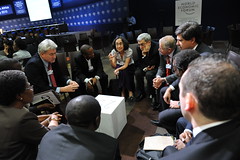
Africa Brainstorming Turning Vision into Reali...  Image by World Economic Forum via FlickrThis is where mind maps or concept maps come in handy. You can use an online concept map to record ideas and then send that map out to your students or co-workers. We typically use Gliffy or the web version of Inspiration. Gliffy, like Google Docs, allows the user to invite participants to the document via email. The email contains a link to the document and then it can be edited by that user as well. We will be using CMaps for this purpose in the future as part of an on-going experiment. We will report back here on the results of our investigations. We would love to know if you are using a combination of brainstorming and concept maps. Feel free to email me or to make a comment below.
 
    Enhanced by Zemanta

    Thursday, November 18, 2010

    Concept Maps & Visual Pedagogy

    This was the presentation for the Global Education Conference.: "This presentation will explore concept mapping and brainstorming tools for classroom discussion, discovering knowledge, and problem-solving. I will present a brief history of visual pedagogy from different cultures to show how concept maps work. We will explore teaching techniques using these methods. The tools we will look at will include everything from pencil and paper, free mind mapping software, online collaborative concept mapping, and 3-d concept mapping in virtual worlds like Second Life." It was a good session but I think that I need to work on developing presentations that encourage more feedback from the participants. I love this conference though. I have met a lot of people from around the world that I would not have had a chance to meet otherwise. Diversity of viewpoints is what it should be all about.

    Enhanced by Zemanta
    Here is the same presentation in a less linear form as a concept map.

    Thursday, October 21, 2010

    Of Concept Maps and Crucifixions

    I visited the National Gallery earlier this year and I spent a lot of time looking at a few paintings of crucifixion or passion paintings. I was particularly interested in a few early renaissance paintings. These paintings come from a time when art served a teaching and learning function; they had a didactic purpose and not just decorative or expressive one. Paintings that fit this bill will have the crucified Christ at the center and in the landscape behind him, arranged radially, will be scenes that illustrate the life of Christ or the events of the Passion. One example that is in Wikimedia is Hans Memling's "Tafel mit Szenen der Passion Christi"

     
    This is a painting of Jerusalem and at the center of the painting is the scourging of Christ. All of the scenes around it, in various parts of the city represent different events in the arrest, trial, and execution of Jesus. There are even two scenes representing the crucifixion; one with him dying on the cross and another on the next hill, of him being taken off the cross. There is even a resurrected Christ in the lower right corner about to harrow hell. This is all typical of Flemish painting especially.In the extreme lower right and left corners, I believe we have the devout patrons of this painting.

    The point of all this is that the painting represents a central idea, The Passion of the Christ. It has a series of connected stories that are all related to that central idea - spatially and temporally. This painting represents a concept map of that narrative. Concept maps allow us to see connections to different ideas in new ways, but they also help us describe knowledge in a way so that we see how all of the pieces are connected. There are many examples of this throughout history and the world. Art is used to share ideas and their connections in the tangka paintings of Tibet and the Navaho sand paintings. Concept maps and "mind mapping" are not something new, they are an integral method of sharing knowledge and ideas.
    Enhanced by Zemanta

    Thursday, February 12, 2009

    Concept Maps: from pencil to virtual worlds

    I presented at an online conference recently ("Connecting Online 2009") on concept maps. I not only want to present on concept maps and the technology around them, but I think I can show how the change in the media used to create the maps can change the way we think about the ideas and information. This is not really very new - the seeds of this argument were planted in readings from McLuhan to George Siemens. I felt that CO '09 was a good preliminary attempt at defining that and I will expand that work for a live presentation in Wanatchee later this year. One of the things I have discovered about concept maps is that, for myself, there is no "right" technology: pencils, Inspiration, Freemind, Personal Brain, and Spidergram Planner in Second Life all do different things and those differences can allow us to see information and problems in new ways. I don't like how some of the software forces you to label each connection but that labeling process can be helpful in seeing ideas differently. A lot of the discussion of the differences between "mind maps" and "concept maps" range from the nearly logical to the arbitrary; what you decide ultimately reveals what kind of thinker you are rather than which definition or tool is the "correct" one to use. I find myself using different tools in different situations. I used to teach in k-12 and that system has a long history of using concept maps. K-12 was on the cutting-edge with rubrics and portfolios long before they showed up in colleges. But it is no accident that concept maps are a popular teaching tool in k-12 schools because that is where students are just learning how to form their ideas and how ideas and thoughts are connected to one another.

    Monday, December 01, 2008

    Concept Mapping the Unconscious

    I have been reading about Matt Mullican since Dorothy Spear's New York Times article "Mapping an Imagined Order, Page by Page" from Nov. 16th. He traffics in symbols, signs, and links them together in ways quite familiar to those who use concept or mind maps. He "performs" his art by taking to the stage under hypnosis and drawing on large canvases. Of the many questions that Spears says his art posits include "how can thoughts and emotions be communicated visually?" This is a question we ask as instructional designers and artists. Mullican works in everything from notebooks to large, commissioned public works. If the work is familiar it is because there is something of his in every modern museum, and his work reveals something about how we use visual patterns to communicate. The Times piece discussed the influence of Oceanic and tribal art on Mullican but what is curious to me is that Oceanic and tribal art were also engaged in an attempt to communicate complex ideas and systems (cosmography, religious ideas, rituals, etc.). We engaged in the same activity in the work place that people have been engaged in for millennia now.

    Tuesday, July 29, 2008

    Conceptualizations of Information


    Luddites often fear technology because of the sense that it is something alien to human nature. There is this feeling that if we are using technology that somehow we are moving away from something essentially human. I would argue that our use of technology is part of our humanity and that the Rousseauist ideal of man in harmony with nature is a myth that never was. We invented fire as soon as humanly possible because it was damn cold. How do we communicate this new, vital information with others? We invented languages, drew pictures, and held workshops! Seriously though, our minds are so complex, they take in a huge amount of information at anyone time (consciously and unconsciously) that organizing information is probably the world's third oldest profession. I would like to look at one particularly early ordering of information. My wife, the most rational animal I know, hates hearing me talk about this because the idea sounds like I am saying that the ancient Chinese invented programming and computers. She believes, with little other evidence, that this is some marijuana-induced ramble from the 70s. Even if it were, it would only be additional proof of the archetypal nature of organizing information from chaos. Care for a brownie? Let us continue then.

    The I Ching, the book of changes, consists of 64 chapters. The chapters contain cryptic poems describing our possible relationships to nature and one another. Each chapter is titled with two hexagrams made up of trigrams, each trigram is named after an element or a condition of an element (water, air, mountain, etc.). Each trigram is generated by three lines that are either yin or yang, female and male, dark and light, the bianary opposites. One is meant to randomly access the information using a stick gather method or the throwing of three coins to generate the lines. (The lines can be classified as static and moving as well.) The earliest methods of generating the trigrams come from the reading of heated tortoise shells thrown into cold water. The cracks were then interpreted and the appropriate poem or reading recalled or read. (A true master could see the cracks in a rock and refer them back to the I Ching!) So here we have a database of information, a formula or program to access the information (that even starts in a binary code!), and action taken based on the information. The idea was that the user was engaging in a random process (all randomness guided by the tao) and that by freezing that moment in time by the throwing of coins, one could get of sense of where it was going and where it had been.

    You do not have to think that this is a computer. But it is a formal system for organizing and retrieving complex sets of information. It is probably 1200 years old and there are earlier examples than this. It shows that this is what the human mind does; this is what it was meant to do. Creating methods of visually communicating information is as natural to us as a walk in the woods.

    Sunday, March 30, 2008

    3-D Mind Mapping

    I have always been, and probably always will be, a big fan of Inspiration. This is a fairly traditional (but extremely flexible) concept mapping software. I believe that the traditional uses of software such as this can be great for communication, brainstorming, and as presentation tools. But one claim is that such software somehow represents how we think. Software packages like this seem all too linear and flowchartish to really represent thought; especially with what we are discovering about the nature of memory, that memories are not held in single neurons or even tightly grouped neurons but are patterns distributed over the whole brain. A single part of the brain can be damaged and the brain can remap memories. I am wondering if concept maps that are movable in three dimensions are not a more accurate representation of thought. (Is there really a connection between how concept maps communicate and the structure of thought?) I am currently experimenting with Personal Brain and with some concept mapping in Second Life. What I like about Personal Brain is that the user organizes links in a 3-d virtual space where anything that is clicked on is brought to the center and the other links shift around the new center. I find that this captures my style of thinking (meta-tangential ADD?) -- I will create some films using this and Jing and see what I come up with. Ultimately what I am looking for is 3-d collaborative mind maps and I think I have found some solutions in Second Life.