Showing posts with label PLN. Show all posts

Thursday, August 08, 2013

Are You Ready for Online Learning?

computer lab
Educators will often discuss the barriers to online education without considering what a student would need to do to overcome those barriers. The typical answer to "are you ready for online education?" is "online education isn't for everyone." As someone who has taught English at all levels, face-to-face and online, I could not disagree with this more.

If you are new to online learning, you might be wondering what skills you will need to be successful in your online classes. Students are often surprised at the fact that they already have some of the main skills it takes to be successful as an online student. Many of the skills that you need to take online classes you can learn as you take the classes; there are, however, some differences. The seven factors below are some of the considerations you may want to keep in mind as you take online classes.

1. Time Management
Time management is very important in online courses; be sure to download the course calendar and keep it near your computer. Keep "to-do" lists and take advantage of any calendar and alarm functions on your phone or computer. You can use online calendars like Google Calendar. Take some time to develop a system. Students tend to take online classes because they want to take advantage of the flexibility it gives their schedule.

 2. Academic Rigor
Often, students new to online classes expect them to be easier than face-to-face classes. Classes online are just as academically rigorous as face-to-face. Online classes require the same amount of effort as traditional courses, sometimes more; the convenience is that you can select (to an extent) when you show up in the course environment. They may require a little more for some students as they learn the technology. Online courses can rely heavily on reading assignments, written lecture, and written communication in groups. If you learn best by reading, then you have an advantage in an online environment.

3. Communication Skills
Online classes are primarily text-based environments. Communicating online lacks the visual cues we are all used to in conversations; be specific when you ask questions and don't assume that someone else can tell when you are joking. Remember to take a few moments to check spelling and grammar, as this it will affect the impression you create with your peers and instructor.

4. Technology Skills
You do not have to be an expert in technology to be successful in an online class. You should be comfortable navigating the internet, using email, and attaching documents to email. Technology skills are not a barrier to your success: just as you learned how to be a face-to-face student, you can learn to be an online student. Be sure to check out the minimum technology requirements recommended by your school's distance education department. As you take online classes you will become more comfortable with online technology. You can't "break" anything in your online class. Go ahead and click all the buttons and get use to the environment. Take the time to find out what kind of tech support is available to you and keep that information handy.

5. Networking Skills
Online learning is a social environment. Participate in your class. Online learning is about connections you will make with your instructor, your fellow students and the course content. Take some time to read about your instructor in the faculty area, and be sure to ask for a face-to-face or virtual office hour if you feel you aren't getting the information you need in the online environment.  Be sure to give some extra effort to all the group activities, discussion forums, or social lounges offered in the course. The real learning in your online courses comes in the connections you make with your instructor, fellow students and the content of the class. Use social media like Twitter and Facebook to help other students create learning networks - study groups and connections that will follow you throughout your academic and professional career.

6. Critical Thinking Skills
The same kind of critical thinking skills that are required in paper-based research is required online. You will need to remember that not all sources on the internet are equal as far as academic credibility is concerned. The same citation questions for paper-based research apply online: what are the author's credentials? What is the author's purpose in writing? Is the author an expert in his or her field? Remember that as an online student, you have access to a librarian for guidance by phone or email. Consult your college webpage for the reference librarian's contact information. Your college may even have a librarian that specializes in online learning or internet research.

 7. Motivation
The habits that you developed to be a successful face-to-face student are also required in online learning. Online learning requires a little more discipline. Online classes are generally not to self-paced classes and participation can be a major factor in your success as an online student. Typically, as an online student, you will need to check in with your class at least three times a week and take time to do your assignments completely and thoughtfully. Ask questions if you do not understand an assignment. Go into the discussion forums and see if there are students forming study groups (or form one yourself). Set course and personal goals in your calendar and don’t forget to reward yourself or celebrate your accomplishments. Remind yourself why you are taking classes online and keep fixed on your goals.

By keeping in mind these seven factors, any student can successfully take online courses.
Enhanced by Zemanta

Tuesday, February 15, 2011

PLNs: The Power of Personal Learning Networks

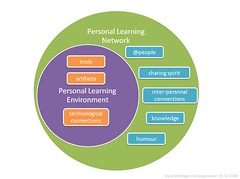
PLE as subset of PLNImage by catspyjamasnz via FlickrWhat is a PLN? I am not talking about the Polish Zloty but "personal learning networks" - the collection of links, tools, and people on the internet we use to support our teaching and learning. I have been reading some critical literature on "personal learning networks." We are seeing now the formalized study and analysis of informal learning networks (see some of the articles at the bottom of this posting). Why the interest? First of all, there is the growth of social networks like Twitter and Facebook. Students (and instructors) and connected in ways that were not possible even five years ago. Second, there is a power relationship inherent in traditional teaching that does not always make the classroom (online or off) the ideal place for learning, creativity, or innovation. The problem often comes from the idea that somehow the student is broken and needs to be fixed or contains a void that needs to be filled with a one-way dump of information. This is the "sage on the stage" model of teaching and learning. What often really happens is students attend a lecture and then talk to their friends, wikipedia, and Google to figure out what the teacher was talking about. This is a primitive personal learning network.

Interestingly enough, there is still a lot of language around PLNs that harken back to the one-way dump. This comes from instructors seeing new technology in terms of the old technology (e.g. the internet is a library). A PLN should not just be a place where one goes just to consult "experts." A true PLN requires participation and engagement. A PLN is a practice and a discipline just like traditional scholarship: it requires you to read, think, and create. In order for your PLN to be effective, you need to do four things:
  1. Link to others: Find the other participants in your field. Some will be "experts" and some will be participants just like yourself. If you are in education, for instance, there are many lists of educators in twitter. Link to people with opinions and ideas different from your own.
  2. Ask questions: Post questions. The wider your network, the wider variety of answers you will find.
  3. Share: Share ideas that you have found in your network with others. Share your bookmarks in Delicious and what you are reading on your blog. Share other people; let others know about your network and and recommend people and sources of information.
  4. Answer questions: Offer solutions or help others find the means to answer questions.
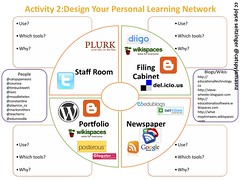
4 Faces of Personal Learning Network (Activity)Image by catspyjamasnz via FlickrYou can see from the list above, that as simple as it is, there is a lot going on. It would be just as big a mistake to abandon a traditional learning management system and just adopt PLNs as an answer as it would be to adopt an LMS and not sufficiently train students in its use. All of the skills around critical thinking and evaluating sources come into play here.We need a curriculum that teaches students how to make choices about who they are connecting to and why. Critical thinking skills around networks needs to be explored. Teaching and modeling technologies for sharing are also a part of this.These are critical skills in the community college, and we are still using early computer curriculum to show students how to use software that won't exist in two years.

In the right-hand side-bar of this blog is are some links to the HIM 101 class that I co-taught with Charlene Gore at Tacoma Community College. It includes a map of how we used Twitter in the class that I think represents an interesting use of Twitter as a PLN.
    Enhanced by Zemanta

    Saturday, January 08, 2011

    Guido Europeaantje on Twitter and professional development.

    Guido's students3 @europeaantjeImage by eltpics via Flickr
    Guido is an EFL teacher in Seville, Spain. He coordinates the teens’ department of the school where he works and conducts teacher-training workshops. After more than 10 years of experience his professional development has started taking giant steps forward again thanks to the power of Twitter.
    He gave an over-view of Twitter in his workshop called "Twitter: Turn 140 Characters into a Virtual Staffroom." He compares Twitter (for teachers) as a virtual staffroom where teachers can get together, share resources and ideas. 
    I love that he gets that Twitter is about networks. There are too many users out there who think that it is a "microblog" or a one-way push of information. He emphasized, as we do here, the importance of following and following someone back - i.e network building. 
    Guido writes that "Many educators worldwide connect on Twitter. This workshop is meant for teachers who are unfamiliar with Twitter or who aren´t very active on it (yet). The short messaging system Twitter can be turned into a huge virtual staffroom where teachers from around the world meet, communicate, support each other and share teaching tips, resources, weblinks and opinions. Come and discover some tools and tricks to help you keep up with “what´s happening” on Twitter."
    Guido promotes Twitter as a personal learning network. "It is a communication tool. You have to interact with people." It is a medium for sharing. 

    Enhanced by Zemanta

    Thursday, September 23, 2010

    Connectivism and the Evolution of Pedagogy

    Trotsky, Lenin, and Kamenev (from left to righ...Image via WikipediaIn some recent postings on connectivism and constructivism (see links below), educators and researchers write as if these models are oppositions; as if constructivism is early Bolshevist and connectivism is free market socialism. Pedagogy does not come from research and theorizing but from practice. The learning landscape changes over time and as the technology changes, we need new models to describe how people are learning. Connectivism is the next step in understanding how people learn in the digital age. Behaviorist and constructivist pedagogies describe a certain kind of learning that takes place in a particular milieu. Networks have changed a lot about the learning landscape, but on the other hand, much of how humans communicate and engage with one another has not. It happens faster, more often and over a wider population. I am talking to educators in India, China, and South America. I would not be talking to as many people around the world without the internet. There is a synergistic aspect to networks - we are smarter together than we are individually. There are network behaviors that are very different than purely social behaviors. Constructivist teaching is also occurring in networks. Connectivist learning is also happening. Will constructivist teaching fade away like feudal economies of old Europe?
    An important point that should be made is that the social dimension of learning in constructivism isn't negated by connectivism. There is much that is complementary. To over-simplify, Connectivism accounts for the networks and learning in networks; constructivism accounts for what happens in them. Networks are only a means. Communication, interaction, and engagement all have to take place before anyone learns anything. Information itself is not knowledge. Forming a connection does not mean that any kind of engagement must or will take place.

    In some of the online classes I have experienced with George Siemens (which I highly recommend), I see much of the constructivist pedagogies at work:
    • students are actively involved, rather than passively absorbing information;
    • the learning environment is democratic,the teacher is not seen as an authority figure as much as a learning guide;
    • the activities are interactive and student-centered instead of being lesson-centered;
    • a teacher facilitates activities in which students are responsible for their own learning and are autonomous from one another.
    All of these are classic characteristics of the constructivist classroom (as opposed to the "sage on the stage" students-as-empty-vessel model). But I also learned as much or more from the connectivist aspects of his classes - the networks. My teaching, learning, and professional life have been immeasurably enriched by the people, communities, and networks I discovered through his classes.
    All of the conversations about tools and personal learning networks presuppose an individual with some technical skills, facility with managing information and networks, the critical thinking skills to interpret that information, and a fairly high degree of motivation. All of these seem to be taken for granted - in the community college system (at least here in Humboldt Co.) and in less developed countries, one cannot make the assumption that networks in themselves will lead to learning. I am going to have to use all of the techniques of constructivist learning to show the value and purpose of these networks. I need to bring in the students prior knowledge and experience and guide them in applying that to new information and skills.
    Enhanced by Zemanta