Showing posts with label Community college. Show all posts

Friday, June 22, 2012

Amelito Enriquez: Its the teaching, not the tools

English: This is a photo of the state-of-the-a...
This is a photo of the state-of-the-art library at Cañada College in Redwood City, CA. (Photo credit: Wikipedia)
I had the great pleasure of attending and presenting at the Online Teaching Conference 2012 last week and hearing Amelito Enriquez deliver one of the keynote addresses.The conference website describes him as: ..."a longtime engineering and mathematics professor at Canada College which is located in Redwood City, CA. Cañada College has received a $10 million grant that will help rebuild the pipeline of engineering students from California’s community colleges to the UC and CSU systems while simultaneously increasing the number of minority students studying science, technology, engineering and mathematics. Amelito, the principal investigator for the grant, is one of the nation’s foremost experts on community college engineering education. He co-authored a paper, “The Dismantling of the Engineering Education Pipeline” that details the decline of community college engineering programs brought about by decreasing enrollment due to increasing divergence in lower-division course requirements and recent budget cuts to education. It received a Best Paper Award at the 2011 American Society of Engineering Education National Conference in June."

His story is certainly inspiring on many levels. He grew up in a poverty in Manila and went on to study at U.C. Irvine where he earned a Phd. in Mechanical Engineering. In December of last year, he was received the Presidential Award for Science, Mathematics, and Engineering Mentoring. Among his accomplishments cited in the Asian Journal article include:
  • establishing an intensive summer math program aimed at helping students improve their math test scores;
  • starting a Summer Engineering Institute for underrepresented students; 
  • partnering with the NASA to establish an internship program for students; 
  • and partnering with San Mateo County to help veterans transition from the military into engineering careers.
So if all that weren't enough, the instructional designer part of me was really excited about his discussion of the tools he uses.  He started teaching online by turning his courses into hybrid courses. He got a grant from Hewlett Packard for tablet computers and began to use CCC Confer - the California Community College's implementation of Elluminate Live (now Blackboard Connect) which is webinar software. Delivering content synchronously, students can attend class online or face-to-face. Faculty have the ability to archive the recordings and link to them. His methods are simple, he:
  • Shares his desktop
  • Uses MS OneNote (or Word, Windows Journal, etc.) as a "white board"
  • Uses Powerpoint for lectures (he makes all of these available as annotated PDFs)
  • Designates a student tech monitor
  • Records all class sessions
  • Makes the recordings easy to access from a single link to a webpage
All of this makes it easy for his students to engage with the material when ever they want. He is doing something right because his enrollments have increased by 8%. All of the technology he uses has been around for over ten years. It is a simple implementation of the technology. That is probably what makes his work so successful. He is living proof that there is no substitute for good teaching no matter what tools you use.

Related articles
Enhanced by Zemanta

Monday, October 31, 2011

WA Open Course Library saves students millions

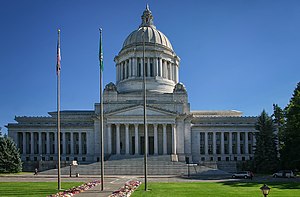
The Washington State Capitol Leglislative Buil...Image via Wikipedia
GROUNDBREAKING STATE-SPONSORED PROGRAM CREATES FREE COURSE MATERIALS THAT WILL SAVE COLLEGE STUDENTS MILLIONS

OLYMPIA, Wash. – Today during a telephone press conference, the Washington State Board for Community and Technical Colleges (SBCTC) announced the launch of the Open Course Library, a collection of expertly developed educational materials for 42 of the state’s highest-enrolled college courses. The materials — including textbooks, syllabi, activities, readings, assessments — cost $30 or less per student and are freely available online under an open license for use by the state’s 34 public community and technical colleges, four-year colleges and universities, and anyone else worldwide. The project is set to expand to 81 courses by 2013.

Nationally recognized as a groundbreaking initiative, the Open Course Library aims to cut down textbook costs and improve course completion rates, helping more students earn the industry-recognized degrees and credentials they need to enter the workforce.

“For employers, it’s about up-skilling the labor force,” said Shaunta Hyde, State Board member and director of Global Aviation Policy for Boeing Commercial Airplanes. “Evidence shows the burden of high college expenses can impact student success and degree completion. By offering high-quality, affordable resources, this initiative will ultimately lead to more college graduates with better job prospects.”
According to an informal study by the Student Public Interest Research Groups (PIRGs), the Open Course Library could save students as much as $41.6 million on textbooks annually if adopted at all of Washington’s community and technical colleges. The study also estimates that the 42 faculty course developers and their departments will save students $1.26 million by using the materials during the 2011-2012 school year, which alone exceeds the $1.18 million cost of creating the courses. “These savings will not only help Washington’s students afford college, but clearly provide a tremendous return on the original investment,” said Nicole Allen, Textbook Advocate for the Student PIRGs.

 Each course was developed and peer reviewed by a team of instructors, instructional designers and librarians. Use of the course materials is optional, but many faculty and departments are already moving to adopt them. This fall, the mathematics department at Green River Community College in Auburn, Wash. began using the Calculus I course in place of an expensive, traditional textbook. 

“I supported, and promoted, my division’s adoption of the text by David Lippman and Melonie Rasmussen text primarily because it is, in my opinion, the best pre-calculus text available. Even those in the division who might disagree ranked it no lower than second,” said Michael Kenyon, the department’s coordinator. “And there’s no contest on price. Our two main criteria for choosing textbooks are quality and price. The authors have simply written a better book at a much better price.”

Lindsey Cassels, an Esthetics Sciences student at Clover Park Technical College in Lakewood, Wash. took a class using the Open Course Library’s public speaking course materials. “It was the least expensive and most beneficial course I have taken, since the course materials cost us no more than $30 out of pocket.” Like many students, Cassels spends more than $1,000 on textbooks annually, which she says can deprive our economy of better-educated workers by making it harder to afford college. “It is outrageous to pay $200 or more per textbook. In a four-quarter program, it’s enough to make students drop out.”

Funded by the Washington State Legislature and the Bill & Melinda Gates Foundation, the Open Course Library joins the growing movement for open educational resources (OER), setting a strong example by requiring that all materials created through the program be openly licensed to the public to freely use, adapt and distribute. Already, other initiatives are lining up to use and improve the materials, including the Saylor Foundation, Project Kaleidoscope and the City of Sao Paulo, Brazil.

“It’s not often that government gets this right,” said Rep. Reuven Carlyle (D-Seattle) of Washington State’s 36th District, a champion of the Open Course Library and OER. “This is a significant state investment in this era of massive budget cuts. We had little choice but to seize the opportunity of this crisis to challenge the status quo of the old-style cost model in both K-12 and higher education.”
The Seal of Washington, Washington's state seal.                  Image via Wikipedia
“Washington state is a national leader in developing innovative programs that help more students graduate from community and technical colleges,” said Josh Jarrett, deputy director of Postsecondary Success at the Bill & Melinda Gates Foundation. “This Open Course Library will ensure more students can afford to stay enrolled in college and graduate with a degree that will prepare them for the workforce.”


CONTACT:
Tom Caswell, Open Education Policy Associate and project lead, mobile (360) 747-7301, tcaswell@sbctc.edu
Sherry Nelson, SBCTC Communications, (360) 704-4308, slnelson@sbctc.edu

About the Washington State Board for Community Colleges:
The State Board for Community and Technical Colleges (SBCTC) is responsible for administering the Community and Technical College Act and providing leadership and coordination for Washington's public system of 34 community and technical colleges. SBCTC also provides shared technology resources and manages a number projects, including the Open Course Library. SBCTC has used system-wide shared courses for over two decades to support faculty and students.

Background:
Open Course Library http://opencourselibrary.org
Student Public Interest Research Groups http://www.studentpirgs.org/textbooks/research
Washington State Board for Community and Technical Colleges http://sbctc.edu/
Enhanced by Zemanta

Tuesday, October 25, 2011

The Open Course Library: Bridging the gap between the LMS and OCW

Speakers: Tom Caswell & Connie Broughton

We will share the Open Course Library project, including technical & professional development challenges faced as we developed phase 1.

The goal of the Open Course Library is for faculty to design digital, openly licensed materials for 81 high enrolling courses in Washington State community and technical colleges. During the development of the first 42 Open Course Library courses, faculty designed, piloted, and then revised their courses using the our system wide ANGEL LMS. We chose to use ANGEL as our primary development platform for because most of our faculty course designers were already familiar with that LMS. Using ANGEL also made sense because all faculty were required to pilot their OCL course, so initial development, piloting, and revisions could all be made with the same system.

In this presentation we will explain the workflow and roles of the Open Course Library staff. We will share some of the challenges we faced developing OER in an LMS. While new systems such as Canvas are removing many of the technical barriers to open sharing from an LMS, other challenges remain. Considerations for open content sharing include professional development for copyright and Creative Commons licensing, instructional design, and web accessibility.

Notes: 
They had to make the case for open education.
Why is "open" important in education?

  • Efficiency: You can build on content that is already created
  • Affordability
  • Quality: We tend to do our best work when we know our peers can see it.
  • Self-Interest: Increased faculty exposure, reputations, and opportunities
They built 80 top courses and created an open course library all built on open education resources and open textbooks. The state of WA has 75% adjunct teachers in the community and technical college system. This is a quick way for faculty to get course materials together quickly. They didn't slam the door on commercial publishers but limited the textbook costs to $30. This approach is different from an "open courseware site." The open course library workflow is more of a straightline workflow - teachers who built the courses are also the ones who have taught them. 

The courses will be available on Connexioins.

Master & open course materials are linked 
  • Faculty update both together
  • Older versions still available
  • Proprietary content is flagged and hidden from open course
They have a new RFP for an LMS that is requiring an open publishing feature. 

Goals:
  • Design and share 81 high enrollment gatekeeper courses
  • Improve course completion rates
  • Lower textbook costs
  • Provide new resources
  • Fully engage our colleges in the global open educational resources discussion
Phase 1: 42 courses released this Monday
Phase 2: 39 courses available in Spring 2013

"Every faculty member works with an instructional designer and a librarian."

Q1= design, Q2= more design, Q3 Teach pilot course, Q4 review

Process: 81 courses built by our own faculty:
  1. Define learning objectives
  2. Go to OER library for materials
  3. Fill in missing content with created content
How does OER help teach more students and teach them better?
  • No-rivalrous, scalable, searchable
  • Allow for preview
Results?
  • 81 courses with 411,133 enrollments
  • Textbook savings of 41 million a year
  • Completion rates may also increase if students can afford to actually buy the text
Phase 1 Faculty Concerns
  • Many were unfamiliar with the particular LMS
  • No way to compare work between course teams
  • Too many websites to keep in track of
Phase 2
  • Using Google Docs to collaborate and share as we go
  • All project management information in one Google Site
They are also using Tegrity.

More information on http://opencourselibrary.org

Enhanced by Zemanta

Open Education Conf. Keynote Speakers Martha Kanter & Jim Shelton

Seal of the United States Department of EducationImage via WikipediaMartha Kanter, Under Secretary of Education, U.S. Dept. of Ed, started off the conference with a keynote address. She is the former chancellor of the De Anza Community College where she was a strong advocate for open education. Kanter and Jim Shelton drafted the educational technology plan. She was appointed by Obama to the dept  of education. She says that we are getting out competed by other countries (we are 16th in the world). She sees open education as a way to make us more competitive. The goal is to get knowledge in the hands of everyone. She discussed some of the research around OERs in k-12. She described some projects in k-12 where the students had access to the learning content 24/7 and not just 40 minutes per class. She hopes that we can become champions for the dept. of ed's research into what is working and why. We will have 10 million students graduating from high school in 2020. We lose a kid every 22 seconds though. If they have open textbooks, we have an opportunity to change the culture of education. China and India are also embracing open universities. She emphasized that there is a role here for businesses as well. She discussed the 440 requirements for someone to become a teacher and she asked us to let her know what kinds of things we can get rid of: regulations and other things that get in the way.  She talked about ENTER, a free online platform for online teaching and learning. She quoted Obama who said he wants to build more online open resources instead of brick & mortar classrooms.

Jim Shelton is the Deputy Secretary for Innovation and Improvement at the U.S. Dept. of Education. He spoke on "Enabling Better 'Teaching and Learning': A Status Check." He says that he role is to create an ecosystem that will let talented people make the changes that need to happen. We are also interested in growing opportunities internationally. He said that this is about teaching and learning, not just "free" - if we do the same thing that we have been doing but just cheaper - then sham on use.

Step 1: Shift the dialog
Make the OER value proposition "better" not just "free."

Step 2: More and Better OER about Creating Effective ER
How people learn
How to
  • Identify and describe what is to be learned
  • Demonstrate what is to be learned
  • Design and implement experiences
  • Optimize and select deliver methods 
  • Maximize motivation and engagement
Best -in-Class Examples

Step 3: Provide better Tools to Reduce Barriers to Quaility

Step 4: Create a Better Context / Align Incentives
Reduce regulatory barriers
make performance matter
Until then make "the science" matter
Ease and inform access

Moving Forward
  • What's missing?
  • What's in the way?
  • Who's steping up?
What is inhibiting the progress?

NB: These are merely my raw notes and impressions for the benefit of our team at College of the Redwoods. Your results may vary and contents may have settled during shipping. 
Enhanced by Zemanta

Friday, September 03, 2010

Resources for New Adjuncts

computer teacher for adultsImage via WikipediaA new instructor came into my office yesterday. She has been asked to teach online with no teaching experience. This is not unusual. It happens in grad school all the time. It is a bit more harrowing at the community colleges because a new adjunct may or may not have any support. When I first started teaching, I had the benefit of a couple of years as a lab teaching assistant in writing centers, developmental English classes, and ESL labs. I also met Laura Perkins, a great adjunct English teacher who believes in the principles of collegiality and openness. That meant that she shared her syllabi and assignments with her peers. She believed that her value as a teacher was in what she did, not in the documents and assignments.

I asked on twitter today "What would you like to have known before you began teaching?" and got some great responses from Jason B. Jones of the Chronicle's blog ProfHacker, which he says is essential reading for adjuncts especially the posts on applying for jobs and the six ways to make adjuncting more effective and fulfilling.

Stephanie Cheney responded generously with a link to her delicious book marks tag for an education class she is teaching. So I of course, immediately clicked on "Add to network" and will be following her work in delicious bookmarks.

Some websites & resources that I have found invaluable for online teachers include:
I found that searching for the assigned textbook title in quotes and then adding the word "syllabus" gave me a good idea about how teachers were using a particular textbook.

Lady of the Lake added: Geoff, you might like to know about a 6-week Online Instructor Certification course offered by Educational Teleconsortium of Michigan. S

Do you have articles or resources that you would give to new teachers? Post them in the comments below. Thanks!

__
Enhanced by Zemanta