Showing posts with label Critical thinking. Show all posts

Thursday, April 14, 2011

Why the Library is No Substitute for the Internet

My apologies to many of the fine librarians I know who have really kept up on the changing world of networked knowledge and the internet. The image at the left was posted by Xeni Jardin from Joe Sabia at BoingBoing. It is a sign on a shelf in his public library in Milford, Connecticut. (Click on the image to see the whole arguments.) It is a shame that the gate-keepers of knowledge are so little informed about what is happening with the internet. My responses are below.

1. Not Everything is on the Internet. Not everything is in the library either. I do not know any library that could currently afford to contain all of the books that are on the internet.
2. The Needle (your search) in the Haystack (the web). It is not very hard to find things on the internet. If you are having trouble, go to a library where the librarians believe in the web. That would be a good reason to consult a librarian. Why aren't the Milford librarians taking the time to teach then online critical thinking skills required to find academically viable materials?
3. Quality Control Doesn't Exist. The internet contains numerous repositories of vetted information (open access journals, MERLOT, etc.) Librarians have the opportunity to catalog these repositories and again, teach the critical thinking skills required to find good information. What the sign really means is that there is no one controlling the information. This has its pros and cons but why can't a librarian help me through this?
4. What You Don't Know Really Does Hurt You. Exactly my point. What these librarians don't know about the internet is hurting our children.
5. States Can Now Buy One Book and Distribute It to Every Library on the Internet. They do not understand electronic books, digital rights, or open education resources. How sad. See #4.
6. Hey, Bud, What About E-Books? Reading on a machine is different than reading a book.
7. Aren't There Paperless Universities Now? There should be but there aren't. But, university libraries are getting smaller and smaller. They are becoming service centers rather than book storage facilities.
8. But a Virtual State Library Would Work Right? Yes, in fact it will, especially with open source textbooks. This is a ridiculous statement. Using the old paradigms and business models, it would cost a thousand times that estimate. The sign, I am hoping, was put up before Google, Amazon, and the Kindle and iPad were invented.
9. The Internet: A Mile Wide, an Inch (or Less) Deep. This only partially true, it is mostly hundreds of miles wide and very shallow but it also has a couple of deep canyons of information and networks of experts in there. It contains the warp and woof of human expression. Where are the librarians and information managers to help make sense of it all? Not in Milford's library!
10. The Internet is Ubiquitous but Books Are Portable. And orange trees make terrible espresso. Hey Milford! 1997 is calling and it wants its MLS back!

Disclaimer: I have a nice little library at home but not because the internet is shallow!

Enhanced by Zemanta

Friday, February 25, 2011

Brainstorming: order from chaos

BrainstormingImage by MikeOliveri via FlickrBrainstorming is a method for rapidly gathering ideas from a group. These ideas can help individuals in the group solve problems and discover solutions. Brainstorming sessions allow members to express their ideas and creativity, and to discover connections between ideas and participants. There are marginalized voices in your class or organization that have something unique to contribute. Brainstorming can help bring forth these voices from the back of the room. By their nature, brainstorming sessions allow everyone to have an equal voice.

Ordo ab Chaos: Six Rules for Brainstorming Sessions:
  1. Suspend criticism and judgment.
    Everyone must agree to accept all answers; there is no good or bad idea. For five minutes, everyone is brilliant. Reviewing and sorting of the ideas will come later.
  2. Wild is permitted.
    Wild is good. Wild ideas give birth to great ideas.
  3. Quantity not quality.
    The more ideas you can work from the better.
  4. Everyone participates.
    All and any ideas will contribute to the whole. There are no bosses or teachers in a brainstorm.
  5. Invent and recycle.
    Utilize ideas already stated and combine them with others. Do not fear your creative voice.
  6. Record everything.
    Let people call out their ideas, but if the ideas are not written down, people will forget what was said. Use a white board or a computer projector. Misspelling, shorthand, and doodling are acceptable. Suspend criticism of the recording process as well; this is a creative process.

Guidelines for facilitating a brainstorming session:
  1. Schedule a brainstorming session during a regularly scheduled meeting or class time. The participants will appreciate the added interaction.
  2. Have the group or class help define the brainstorming topic. A facilitator may want to discuss general problems, but allow the group to decide on the question together.
  3. Assign a facilitator for the session. This person will keep everyone involved and will encouraging everyone to give ideas and keep the session moving. The facilitator can keep the session moving by repeating what was said and keeping others focused.
  4. Assign a recorder. This person will write down everyone’s ideas. The recorder’s goal will be to get everything down quick and dirty.
  5. Review the rules before starting. Everyone must agree to commit to the process. The facilitator should encourage wild ideas, and if participants laugh, they should be reminded that no criticisms or judgments are to be made.
  6. Set a time limit (for five minutes or so), but if ideas are flowing, let the process keep going.
  7. After the brainstorming is complete, read through the list of ideas and discuss, sort, and analyze them.
  8. Afterwards, have the recorder send out the results to participants as a document or webpage. Ideally, there will be some tangible record to promote further discussion. 
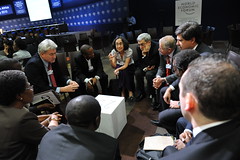
Africa Brainstorming Turning Vision into Reali...  Image by World Economic Forum via FlickrThis is where mind maps or concept maps come in handy. You can use an online concept map to record ideas and then send that map out to your students or co-workers. We typically use Gliffy or the web version of Inspiration. Gliffy, like Google Docs, allows the user to invite participants to the document via email. The email contains a link to the document and then it can be edited by that user as well. We will be using CMaps for this purpose in the future as part of an on-going experiment. We will report back here on the results of our investigations. We would love to know if you are using a combination of brainstorming and concept maps. Feel free to email me or to make a comment below.
 
    Enhanced by Zemanta

    Tuesday, February 15, 2011

    PLNs: The Power of Personal Learning Networks

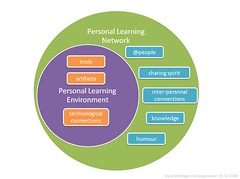
    PLE as subset of PLNImage by catspyjamasnz via FlickrWhat is a PLN? I am not talking about the Polish Zloty but "personal learning networks" - the collection of links, tools, and people on the internet we use to support our teaching and learning. I have been reading some critical literature on "personal learning networks." We are seeing now the formalized study and analysis of informal learning networks (see some of the articles at the bottom of this posting). Why the interest? First of all, there is the growth of social networks like Twitter and Facebook. Students (and instructors) and connected in ways that were not possible even five years ago. Second, there is a power relationship inherent in traditional teaching that does not always make the classroom (online or off) the ideal place for learning, creativity, or innovation. The problem often comes from the idea that somehow the student is broken and needs to be fixed or contains a void that needs to be filled with a one-way dump of information. This is the "sage on the stage" model of teaching and learning. What often really happens is students attend a lecture and then talk to their friends, wikipedia, and Google to figure out what the teacher was talking about. This is a primitive personal learning network.

    Interestingly enough, there is still a lot of language around PLNs that harken back to the one-way dump. This comes from instructors seeing new technology in terms of the old technology (e.g. the internet is a library). A PLN should not just be a place where one goes just to consult "experts." A true PLN requires participation and engagement. A PLN is a practice and a discipline just like traditional scholarship: it requires you to read, think, and create. In order for your PLN to be effective, you need to do four things:
    1. Link to others: Find the other participants in your field. Some will be "experts" and some will be participants just like yourself. If you are in education, for instance, there are many lists of educators in twitter. Link to people with opinions and ideas different from your own.
    2. Ask questions: Post questions. The wider your network, the wider variety of answers you will find.
    3. Share: Share ideas that you have found in your network with others. Share your bookmarks in Delicious and what you are reading on your blog. Share other people; let others know about your network and and recommend people and sources of information.
    4. Answer questions: Offer solutions or help others find the means to answer questions.
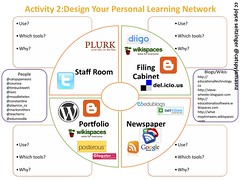
    4 Faces of Personal Learning Network (Activity)Image by catspyjamasnz via FlickrYou can see from the list above, that as simple as it is, there is a lot going on. It would be just as big a mistake to abandon a traditional learning management system and just adopt PLNs as an answer as it would be to adopt an LMS and not sufficiently train students in its use. All of the skills around critical thinking and evaluating sources come into play here.We need a curriculum that teaches students how to make choices about who they are connecting to and why. Critical thinking skills around networks needs to be explored. Teaching and modeling technologies for sharing are also a part of this.These are critical skills in the community college, and we are still using early computer curriculum to show students how to use software that won't exist in two years.

    In the right-hand side-bar of this blog is are some links to the HIM 101 class that I co-taught with Charlene Gore at Tacoma Community College. It includes a map of how we used Twitter in the class that I think represents an interesting use of Twitter as a PLN.
      Enhanced by Zemanta