Showing posts with label E-learning. Show all posts

Wednesday, November 06, 2013

Open Ed 13: OERs Rule, MOOCs Drool: MOOCs and DistRibuted Open Online Learning

English: Blended learning methodology graphic
Michael Caulfield discussed how MOOCs are being used. 

"The "wrapped MOOC" has gained attention over the past year as a way to integrate MOOCs into traditional education. This presentation will present results of interviews with practitioners of this method to show that in practice most educators are not "wrapping" the cohort experience, but are instead using the MOOC as robust OER. This trend is discussed in terms of "distributed flip" and "distributed blend" models, as well as David Wiley's joking but correct observation that MOOCs are distraction from the potential of DROOL (DistRibuted Open Online Learning). Implications include a hidden but high demand for robust, course-level OER, and the possible desirability of approaching blended learning from the online experience "backwards", as opposed to the traditional model which emphasizes the online refitting of an existing or assumed face-to-face experience."

Caulfield is from WSU Vancouver
Twitter @holden
Web; http://hapgood.us/

 Examples of courseware evolution
Publisher resources, OLI (Carnegie Mellon, Stanford)
AASCU
Kaleidoscope Project

There is a history behind MOOCs - it is a progression over time.

What do MOOCs provide above and beyond what blended learning provides?
It is the global community of students going through the work at the same time.
The mythology of the xMOOC is the affordances such as 24/7 peer assistance

What does use of MOOCs for blended look like?
Amy Collier and Helen Chen held wide-ranging interviews with students and teachers.
Not Synched
They found that the local cohort was not linked to the online cohort.
They were using the MOOC purely as a digital resource.
This was because of the differences between course and institutional schedules - professors needed more flexibility in scheduling.
It is difficult for instructors to not fall behind.
Not Conversing
Students were not really using the forums of the MOOC at all.
The students looked at the forums occasionally and only sometimes posted. These students were meeting face-to-face
[It sounds like the learning was not social or truly interactive. and why would you do something that were not assessed?]
Unaffiliated students who watched 75% of the videos viewed the forums 

Implications: do MOOCs Made Good Flip Materials
xMOOCs global classroom is not useful for blended learning - the students do not use the forums
The design of the course is mostly influenced by the global cohort
Problems
  Data not available
  Can't change schedule

Coursera is now working on decentralization.

Most instructors had gone through the MOOC before teaching it. That was a transformative experience for the teachers. 

Summary
Courseware is a big part of the future of education
A growing number of options exist for materials
When used in flips, MOOCs often function primarily as content
MOOCs can be used, but think carefully about benefits and downsides of centralization

A community college teacher expressed concern over xMOOC content as content divorced from the local context. I feel the same way about most commercial textbooks. 
Enhanced by Zemanta

Friday, September 13, 2013

MOOCs and Student Support

English: Internet Penetration (% Population). ...
Internet Penetration (% Population). Red
indicates no statistics available. (Wikipedia)
I read an article this week that I found via Stephen Downe's blog that is from the eLearning Africa News Portal called "The Underlying Inequality of MOOCs" by Alicia Mitchell. The main issue that Mitchell has with MOOCs is an old argument against all online education: the "digital divide." Unlike the education writers of the 1990s, she looks at the issues of poverty and connectivity and says that we have to be mindful that not everyone has access or the same means and skills that those of us in more privileged parts of the world may have. I do not argue that there is not a digital divide, I just don't think stopping online learning is a great solution to that problem. She does not make the leap that many have in the past with a "therefore," online learning is not viable or should be curtailed etc. I actually agree with her and my "therefore" is that, broadly, we need to continue to work for economic justice and universal education.  Africa is a hot bed of online learning, open education resources, and innovation specifically because of the problems discussed in her article. And my more focused "therefore" is say this is exactly why we need a MOOC to help students "learn how to learn." That is what we were getting at when we created "DE 101" - an free, two-week, fully online orientation to online learning. That was in a "traditional" online course format. The one I am working on here at Humboldt State University will be a MOOC called "eLearning 101."

In another look back to the 90s, I am really concerned about so-called "MOOCs" that are massive, not particularly open, online courses that are based on a one-way distribution of information and then tests. This is a huge step backwards. Especially when there are such better models out there such as Stephen Downe's and George Siemens' Connnectivism and Connective Knowledge MOOC or Jim Groom's project-based DS 106. There are all of these great models out there (often called "cMOOCs") but the ones that get all the attention are the ones supported by the Ivy Leagues and a lot of grant money. The entire MOOC phenomena is being judged by players like Sebastian Thrun who just figured out that online students need student advisors, mentoring, and tutors. These are things that many people have been writing about and more importantly doing for years now. In the article "Udacity CEO Says 'Magic Formula' is Emerging," David Carr reports:

Thrun's magic formula is not a fully automated online class featuring prerecorded videos and Web-based assessments. In other words, it's not a MOOC at all. To get better results, he said, "We changed the equation and put people on the ground." By adding mentors and a help line, and making phone calls to remind students to do their work, Udacity found it could get more students to do the work, finish the course and pass. Longer term, he has some ideas about using adaptive learning software to eliminate some of this labor, but for now it takes manpower.

The press, publications like the Chronicle of Higher Ed and Information Week are now defining MOOCs by such phrases as "a fully automated online class featuring prerecorded videos and Web-based assessments." This is not innovation, at least, not innovation in education. It may be an innovation in platform building, fund raising, or grant writing, but it is not an innovation in education. Real online courses and truly massive, open, online courses are engaging, interactive, and focus on building learning communities and networks. There is a rich body of literature and research that discusses the importance of student advising and support. If it has taken this long for Udacity to figure out what we all learned about online education in the 90s, I don't think I will live long enough to see them figure out the importance of learning communities and PLNs.

But it is not enough just to be against something. I am going to keep using the term MOOC even though the term is missapplied by the press and highly funded institutions and businesses. We need to keep building instances of MOOCs that counter the prevailing notions. I will be posting updates here as I continue to work on the eLearning 101 MOOC.
Enhanced by Zemanta

Tuesday, July 23, 2013

Four Steps to Getting MOOCs Right

Betonwerksteinskulptur "Lehrer-Student&qu...
"Lehrer-Student" von Reinhard Schmidt
in Rostock (Photo credit: Wikipedia)
I love alarming education headlines - five MOOC classes are put on hold and the San Francisco Chronicle says "San Jose suspends online courses." Which it didn't - it suspended five MOOC courses because of a high student failure rate. San Jose's online college is still going forward. And they are right to suspend the classes. I just wish more work went into how those courses were put together (if only for the sake of the students). These classes are not so far out on the cutting edge that one couldn't predict that there would be problems. The MOOCs at San Jose are nothing new - even the failure rate is nothing new. All of the research into how to make online classes successful, including MOOCs is already in place. Educators have been researching successful online programs since the 90s. There are very clear reasons why the best online programs succeed. My own work in community colleges in closing the student success and retention rates between online and face-to-face classes dealt with similar issues. What we learned about online classes, big and small, was that they will not succeed for any population, at-risk or otherwise without these four things in place:

  1. Interactivity and Engagement - There is a direct correlation in the research between online interactivity and student success rates. Interactivity means "meaningful, purposeful, engagement" not just clicking on the play button. Interactivity means teacher-student, student-student, and student-content. And yes, there are ways to do this successfully in a MOOC (step 1, hire an instructional designer!). There needs to be more emphasis in MOOCs on collaborative projects and less"watch a video, take a test." This distinction is easily made when you look at connectivist cMOOCs versus xMOOCs
  2. Student Support - If your face-to-face students can't be successful without tutors, academic advisors, a help desk, and librarians, why would you expect your online students to be successful without them? There are tutoring services on your campus and great peer-to-peer tutoring resources online such as OpenStudy
  3. Student Orientation - Students have spent 12 years learning how to be a face-to-face student and 0 years learning how to be an online student. This is an easy fix. We did it in the community colleges with courses like "DE 101." Things that make students successful in online classes include time management, study skills, motivation, and other metacognitive skills that can be taught. Online learning is not just about technology.
  4. Faculty Training - The same magic that makes someone a teacher instantly when they get their master's degree does not work online. Just as students need to learn the skills to be an online student, teachers need to learn the skills to facilitate online teaching. Recording your lecture and posting it online will not work. There are a lot of resources, classes, and research online on this subject
So interestingly enough, there are no real differences in how classes online or off are successful! I have been in online classes, including MOOCs that had all of this in place: the assignments were designed to be collaborative and engaging, there were links to student support, there was sufficient information to tell students how to take the class, and the instructors were skilled online facilitators, curators, and guides. A college does not have to ignore 20 years of research into online learning to be innovative.
Enhanced by Zemanta

Friday, July 12, 2013

Mobytes Instructional Design App

English: This is Juniper Hall at Humboldt Stat...
Juniper Hall at Humboldt State University.
(Photo credit: Wikipedia)
One of our technologically ever-vigilant instructional designers here at Humboldt State (Kim Vincent-Layton) shared an interesting Android app with us the other day - Mobytes Instructional Design App. The app is a handy collection of articles and templates on instructional design. What is a "mobyte"? A mobyte is a "just-in-time chunk of learning designed for just-enough knowledge to learn or apply while performing a task. It can be used for learning from scratch, refreshing and updating knowledge while on the move." I like this app because it covers, at a basic level, the current understanding and definition of instructional design that any student of education would find in a instructional design class. I would like to share this app with administrators and teachers to help promote a deeper understanding of instructional design and its possibilities. The author, Madhuri Dubey, has distilled five topics into the app:
  • Instructional Design (ID) basics 
  • Evolution and application 
  • Learning theory and styles 
  • Instructional theory 
  • Getting started with ID 
This reference would be useful for instructional design teams to all get on the same page as well as for instructors who would find it useful for a better understanding how teaching and learning work. It covers Gagne, ADDIE, Clark, Merrill, Bloom's and the usual suspects.

If you are not an Android phone person, much of the information here is available on Madhuri Dubey's blog.
Enhanced by Zemanta

Friday, June 14, 2013

MOOCs: Disruption is the Mother of Invention

Stephen Downes speaking at D2L09.
Stephen Downes
There is an article in the Boston Review by Thomas Leddy called "Are MOOCs Good for Students?" In this article Leddy claims that
"MOOCs pose a great threat to the most important value of higher education: 'literacy.' By 'literacy' I mean, very broadly, the ability to read, think about, and intelligently respond (both orally and in writing) to the literature of any field of study. Thus, implementation of MOOCs for university credit is bad because it is bad for our students."
Leddy says this because he seems to be familiar with only one kind of MOOC - those of the MIT and Stanford model. Not all MOOCs are alike, yet despite the fact that he has had the traditional education that would allow him to read, think about, and intelligently respond to any field of study, that does not seem to extend to education itself. I am not sure what publications like the Boston Review or the Chronicle of Higher Ed is up to, but the majority of articles about MOOCs in such publications are typically written by those who have never taught online, taught a MOOC, or even taken a MOOC. They are written by people who have not even reviewed the history or literature (however scant) on MOOCs.

I hate to tell Leddy this, but literacies are changing. I do a lot of writing, but my work depends more on my ability to collaborate with others and the creation of intelligent networks than my ability to write a ten page paper.

Leddy is very concerned with the massive (not "massively" by the way) courses that use multiple choice tests and paints all MOOCs with the same brush. I have taken three MOOCs and in not one did I take a multiple choice test. The MOOCs were assessed with what I would consider portfolio assessment. I could not have finished any of the MOOCs without reading, thinking, and intelligently responding to my peers.

English: George Siemens at TEDxNYED.
George Siemens
MOOCs didn;t just come out of nowhere to just to knock traditional teachers out of their chairs; they came from very thoughtful teachers who said "what if we did for teaching what open education resources was doing for content?" There were problems that needed to be addressed in education that traditional educators have no interest or stake in solving. MOOCs (massive open online courses) are not the disruption. The disruption came when the traditional schools decided that money was more important than access. The disruption happened when educators decided that they were fine with keeping education as an exclusive privilege of the few. The real disruption was the fact that the cost of education rose faster than the cost of living and the cost of healthcare combined.

We need to keep making the distinction between cMOOCs and xMOOCs - cMOOCs "Connectivist MOOCs" are actually community-driven models where the students create knowledge and learning together. This knowledge creation can be facilitated but it is not dependent on a "teacher." The teacher becomes the facilitator and curator of the learning experience. In a cMOOC the connections students make with one another are just as important, if not more important, than any other kind of interaction in the course.

xMOOCs are getting all of the press because their model more closely fits, for good or ill, the model of education most familiar for traditional academics: sage on the stage, education as information transmission, knowledge as consumable, students as commodity, etc. xMOOCs are not true MOOCs: they often massive online but they are seldom "open" and depending on what you call a "course" they may not be that either. A true MOOC should be free. There is still a lot of hand wringing about money and tuition in some of these models that falls under the "sustainability" issue. I would even question if some of these are actually "courses" in the sense that we mean them in the world of online education. As a Director of Academic Technology, I would not sign off on a course that had no student-student or teacher-student engagement. I would call it a correspondence course, a learning experience, but not a true online learning experience. In contrast, cMOOCs depend on the interaction of the students for their success.

MOOCs are going through the difficult stages of innovation that open education resources and open textbooks have and are still going through. Free, openly licensed (non commercial) textbooks are a great idea - monetizing that is a horrible, counter-intuitive, counter-productive idea. "Lower cost" is not the same as free. Open for business is not what the "open" in OER, open textbooks, of MOOC is supposed to mean.

MOOCs can work. There are ways to design MOOCs to maximize student interactivity and engagement. In the related articles below, I have included some postings I wrote on MOOCs and instructional design and give some of my history with successful MOOCs.  MOOCs are not going away and just like any other learning platform (including face-to-face) there are good and bad ways to use it. We need to research MOOCs thoroughly with an open mind to discover why the successful ones are successful and address potential problems.

I would encourage Leddy and anyone else who is interested in MOOCs to explore the work of David Wiley, George Siemens, Stephen Downes, David Cormier, and Jim Groom before coming to any conclusions. You might just learn something. 
Enhanced by Zemanta

Wednesday, April 17, 2013

MOOCs, Group Work, and Instructional Design

English: Debate Chamber of the Oxford Union So...
Debate Chamber of the Oxford Union Society (Wikipedia)
Everything Old is New Again
In my last post I pointed out that all the arguments about MOOCs sound so much like the old arguments against online education in the 90s. One of the main arguments for authentic online learning in the 90s was the possibility of making online classes social environments. This fit well with the pedagogy of Constructivism. Constructivism says that knowledge is constructed when new information comes into contact with previous knowledge and evaluated against experience. Social Constructivism is an outgrowth of Constructivism that "extends constructivism into social settings, wherein groups construct knowledge for one another, collaboratively creating a small culture of shared artifacts with shared meanings" (Moodle). The instructors goal then was to facilitate these connections. In the 90s, this learning theory seemed to fit what was happening with effective teaching online. The goal of online assignments was to give students the opportunity to receive new information, hold it up to previous knowledge and experience, share that with a group, and then together, coming to new conclusions or new knowledge. Educators and researchers like Palloff and Pratt with their emphasis on learning communities, promoted group work and discussion forums as the solution to the badly performing classes that were basically online repositories of documents and maybe multimedia files. Over and over again, from the early days of online learning, the research shows that the greater the engagement in an online class, the higher the success and retention rates. Engagement does not mean clicking a link, widget or consuming media - it means actual interaction with students and instructors as well as content.

English: George Siemens at TEDxNYED.
George Siemens
Everything New is Old Again
Today, we have learning theories that are evolving towards a more complete accounting of how we learn online. I am thinking here of George Siemens and Stephen Downes' theory of Connectivism. I am not ready to throw out the Constructivist baby with the pedagogical bath because Connectivism is still in the Copernicus vs. Relativity explanation for gravity stage - I believe logically and experientially that the theory is right, but I am not ready to use it to put a satellite in orbit. This doesn't make the theory wrong. We need to be doing more research; it is just a matter of time. For myself, I am satisfied that this new theory accounts for much of what is going on with Constructivism. I am going to let the Phd's battle out the details: instructional designers have courses to create, assignments to design, and faculty to work with. A good working theory is a good working theory. A lot of what we are doing with online classes and MOOCs is testing the viability of Connectivism.

What Then Should We Do?
So this preamble is really a way to point out that everything that makes authentic learning work in a brick-and-mortar classroom are the same things that make online learning work. And as a teacher and instructional designer, I have a really practical end in mind. To my way of thinking, there is no difference between an online discussion forum and the Debate Chamber of the Oxford Union Society except one is more expensive and acoustically louder than the other. They are just different platforms. A MOOC is just another platform. George Siemens wrote back in March that MOOC providers were going to have to rely more on group work to be successful. I find this sentence especially funny and pertinent here: "The 'new pedagogical models' (A Silicon Valley term meaning: we didn’t read the literature and still don’t realize that these findings are two, three, or more decades old)...." But what kind of group work should we use and how can we ensure that it is successful? Siemens points out that there is a high dropout rate in MOOCs that could make group work a problem, but I believe that group work is one of the engagement pieces that is missing from many of these MOOCs (especially those using content delivery model rather than the content creation model).

Ensuring the Success of Group Work
Faculty and students have often told me about problems with group work. What do you do about the alpha student who needs to be the leader and do all the work? How should instructors handle the student who has little motivation? I have a blog post coming about this but essentially there are eight things needed for a successful group work project:
  1. Clear objectives
    Students need to know the exact purpose of the assignment. Let the students know where they are going.
  2. Detailed instructions
    This is particularly important in a MOOC because students tend to have less contact with the instructor. A detailed instruction document accompanied with a video and some examples are very useful here.
  3. Give each student a specific role
    This prevents one person from taking over the process and helps with assessment too.
  4. Communicate expectations in advance
  5. Use collaborative tools
    Model the means for useful collaboration. Give students instructions for setting up a wiki or a Google site for collaborating
  6. Facilitate and model leadershipSometimes good leadership is not getting in the way of good work. Leadership in MOOCs means that you live the model: you are connected and engaged in your course. You cannot disappear for two weeks and expect this to work. 
  7. Encourage networks
    Having the students using social media tools allows them to bring other subject matter experts into the project.
  8. Provide assessment and closure
    You would not want to participate in a MOOC with an endless series of unconnected assignments with no sense of closure. Assessment in group work gets interesting. I liked to use a blank form for the students to divide up participation points.
I will be posting a short article on how these components work here on this blog.

Kinds of Assignments:
The ubiquity of internet access and the proliferation of collaborative tools and platforms makes collaborative learning more available than it has ever been. This allows us to design a wide variety of assignments that are ideal for MOOCs or standard online classes. These are just a few ideas here:
  1. Group Research Project
    Group research projects are opportunities for students to get together and literally construct knowledge. Having students work on a research project and publish their results together on a wiki or a group blog benefits the students and the class. 
  2. Group PresentationsStudents can work on presentations with one another remotely and create slide presentations with audio or even a film and work on the 
  3. Media Projects
    Students learn a lot from content creation. Jim Groom's DS 106, a class that some would call a "task based MOOC" is an excellent example of students working together to create media. Students can create videos or podcasts. When they graduate from college, no one is going to ask them to write a 20 page paper; they will be asked to work in groups, use technology, and create media.
  4. Debates
    One of our instructional designers here at Humboldt State University is using online debates in discussion forums.The debates are carefully structured and each participant has a role. This kind of prior attention to details is essential to online group work.
  5. Role Playing and Simulations Role playing and simulations have never been easier because there is so much data online now that can be used to build simulations (I am thinking here of epidemiological data, for instance). 
  6. Concept MapsTypically these are solitary projects but having a group negotiate what should be in a concept map and how concepts relate to one another are a good way to allow the students to clarify those concepts with and for one another rather than having the instructor spoon-feed "meaning" to them.
  7. Infographics This is a good project for groups because the roles can cover a wide-variety of learning modalities and abilities: some students can gather data, others develop art work, and others can write interpretive materials.
Any of these assignments can be created in advance and given to small groups. The students benefit not just from following the steps of the projects, but through sharing the end results with other groups. 

Enhanced by Zemanta

Monday, December 31, 2012

OER: Saylor Foundation's New Bookshelf

Saylor Foundation
The Saylor Foundation is making spirits bright and starting the New Year right by ensuring that openly licensed, free textbooks remain freely available to students. You may have seen their press release. Their "Bookshelf" page is already up and the books that are due to go behind Flat World Knowledge paywall are now freely available. They are saving us the trouble of downloading them and hosting them ourselves.

"Each of the books listed below is freely available for download, online reading, and sharing, under a Creative Commons BY-NC-SA 3.0 license. Please share this link (and the blog post) with your networks to help spread the word!

Like many of you, we have come to rely on the free-to-read versions of the excellent texts at Flat World Knowledge. We’ve woven these books tightly into many of our free online courses, all of which rely on freely-accessible (and preferably openly-licensed) materials. When Flat World Knowledge announced recently that its previously openly-licensed books would not be available for free after January 1st, 2013, we decided to preserve the whole catalog, which we now happily share with you.

We are grateful to Flat World Knowledge for developing such an excellent catalog, and while the versions on the Flat World Knowledge website will no longer be free, the publisher continues to provide its texts at prices significantly lower than standard textbooks and with much added-value in the form of supplementary materials and interactive elements."

The Saylor Foundation certainly warrants all of our support for the coming year. I want to encourage everyone who reads this blog to seriously consider supporting this foundation. As educators, we obviously cannot rely on for-profits to keep the best interests of the students in mind.
Enhanced by Zemanta

Tuesday, November 27, 2012

OER: DE 101 Self-paced version

This is the stand-alone version of DE 101,  the curriculum we developed for our student orientation. It is released to the public with a Creative Commons license. Distance Education 101 is a two-week orientation on how to take an online class and how to be a successful online student. In this seminar, students learn specifically about College of the Redwoods' "MyCR" (Sakai) and how to use other tools to manage their time, work with others, and their information online. In this orientation students have an opportunity to create and participate in an online community where they can find help and make their connection to the online college.

We believe that our research shows that the two-week, free online orientation was largely responsible for the increase in online student success and retention. Our research is in the presentation below. I have written about DE 101 here before as well.


These course materials were designed for a student population new to technology, broad-band internet, and online communication. That is why there is such a 90s feel to the material. These materials need to be expanded to include more on online collaboration and personal learning networks. This is one of the reasons why we are releasing this on a wiki using the Creative Common's license - we want to collaborate with others who would also like to share their materials.
Enhanced by Zemanta

Sunday, July 22, 2012

The Real Trouble With Online Education

E-learning short courses
E-learning ( London College of Fashion)
An editorial piece in the New York Times on July 19th by Mark Edmundson attempts to tell us about "The Trouble with Online Education." Despite the fact that the author does not appear to have taken or taught an online class, and despite not having any listed credentials in the field of education, online teaching and learning, or instructional design, Edmundson, and apparently the editors of the New York Times, feel he is qualified to to make the pronouncement that online courses are not "real" courses.

He asks "can online education ever be education of the very best sort?" In that loaded Gatsbyesque question, does he mean the kind of education the 1% can get at the Ivy Leagues? No, most online classes that I know of or have experienced were not small settings where we sat with a professor in big leather chairs sipping sherry. Not everyone can afford such an education and maybe that is why some folks seem to be threatened by online learning - the barbarians are at the gates! Online classes are classes of a different sort. And here is my real problem with this article: the author does not know what happens in an online class so he assumes it is not what happens in a face-to-face class and this is just wrong. 

Edmundson describes face-to-face classes as places where there is engagement, dialog and the inadvertent creation of academic community "the students will always be running into others who are also enrolled" (I am presuming in the halls or the cafeteria - do his students not work or have families?). But the fact is, I have taken face-to-face classes at colleges (U.C. Berkeley, for instance) where the professor had no time for undergrads, directed all questions to the tutors, and did nothing to foster community. Conversely, I took an online course in 2008 from the University of Manitoba (George Siemens and Stephen Downes MOOC "Connectivism and Connective Knowledge") and I am still in touch with students I met there - in fact, we are basically continuing what we learned in online communities. We are still engaged with one another. What instructor wouldn't want that? In the "very best sort" of online classes, this community and engagement is deliberately built into the courses, and the research says that student engagement is the number one factor in the success of online courses. That said, I did take an online class that was poorly run: the teacher would go days without connecting with the course, the feedback on assignments was minimal and late, and there was little direction. My point is that the teaching modality does not matter if the teacher is engaged.

There seems to be a lot of this going around, there were blog postings I read through the Chronicle of Higher Ed from Siva Vaidhaynathan and Joshua Kim's posting in Inside Higher Ed that both gave negative evaluations of MOOCs (Massively Open Online Classes) despite the authors having no experience with MOOCs or online classes. I addressed those issues in my posting "Why MOOCs Work" but I feel that there is a larger issue here. If you read the three articles together, all contra elearning, they all have this alarmist ring to them that somehow online education is a watering down of face-to-face education. You get a real sense that if the world now accepts online education as it seems that it does, and accepts badges and portfolios in place of traditional certification, that it will detract from the value of the precious face-to-face college. You know the college - the one with the tuition that has risen faster than the price of inflation, faster than the costs of healthcare, and the $250 textbooks. 

Edmundson claims that "Online education is a one-size-fits-all endeavor." There are too many kinds of online classes out there for this to be true: there are full online courses that include Skype sessions with teachers and tutors; there are hybrid courses; there are classes that are more self-directed; and there are MOOCs; I could go on. What constitutes an online class can be as individual as the instructor who teaches it. 

He claims that "It tends to be a monologue and not a real dialogue." Again, he is basing this on courses that are filmed and canned but that is NOT the most common teaching modality in online education. Most online classes include discussion forums and students now are using social media and networks such as Twitter and Facebook to engage with one another, with their instructors and experts in their field of study. A glance at the research at sites like Educause would give him an idea about what is happening. 

He says that instructors can't gauge the nuances of a class online. If  online instructors engage their online class with online discussion forums and chat, they can gauge what is happening. In fact, in some of my online English classes I got to know some of my students better than my face-to-face classes because the students will often seek out that engagement, and socialize a lot online, to make that human connection online. 

All of this points to an appalling lack of knowledge about what constitutes online learning. I can't believe that a college professor would accept similar judgements from a student with nothing to back them up but what "seems." All three authors, Edmundson, Vaidhaynathan, and Kim, evoke what "seems" as evidence. It is not like the research is hard to find. There have been hundreds of studies that show that there is no significant difference between the outcomes and success rates between online and face-to-face learning. All Edmundson would have to do is to take a look at WCET's "No Significant Difference" webpage to find a collection of the research that goes back a hundred years. Or to look at any recent study like the one reported in The American Interest called "New Study: Online Classes Just as Good."

The real trouble with online education right now is that online education is currently being defined in unfavorable ways by those who feel threatened by it. Online education is not the same as face-to-face education. Just as you should not believe the hype behind anything "new" (even if it just new to the press) - don't be dissuaded by those who are so embedded in the old paradigm and have so much to gain by its persistence that you miss out on some great teaching and learning opportunities. 

Enhanced by Zemanta

Wednesday, January 11, 2012

DE 101: Online Student Success

eLearning in Health conference twitter visuali...
I wanted to share a few notes here about our orientation to online learning. Here at College of the Redwoods, Barry Tucker and I have created "DE 101" - our free, not-for-credit, fully online student orientation to online learning. This is our syllabus.  NB: This posting is meant to be a chatty draft of a more formal paper that Barry Tucker and I will write on this course.

What problem does this solve?
Every semester, we have students going into to online classes with little exposure to technology or online learning. Students have spent 12 years learning to be a face-to-face student, and have had little experience with distance education. We find that students who are struggling with the technology and who do not understand what is involved in online learning (the motivation and study skills needed) will do poorly. We believe that this accounts for the disparity between the retention rates and success rates in the online and face-to-face classes.Our students typically do not have access to a lot of technology and it have only recently had access to high speed networks or even computers. This is a very rural and large area (10,000 sq miles).

How does it work?
The "course" goes for two weeks. We have two "facilitators" and three "TAs." Basically if you are in the Distance Education department, you are participating in DE 101. There are four modules in the course that open up twice a week. This mimics the flow of a typical online course. Each module covers a piece of technology and a personal skill, such as time management, that research has shown to contribute to success in online classes. The orientation is hosted in our instance of Sakai. We try to use as many of the tools in Sakai as we can and we throw in some outside tools as well. Each module has a lesson (which may include illustrations, recorded audio or video), a brief assignment, and a quiz or survey. The first module will open on Monday, the next on Thursday, etc. The tests and surveys are simple. The first one is a syllabus quiz. The whole point is to let the students play with the tools and practice using the technology with out the stress of trying to learn algebra or biology at the same time.We are using tools like Twitter to help model the possibilities of building learning networks online.

What Are the Challenges?
Time constraints. Two weeks does not seem to be enough time. It is better than trying to pack everything in a couple hours which is often the case with face-to-face orientations. ADA issues need to be solved. We have text equivalents for a lot of the media in the course - we need a quick, inexpensive (free?) way of captioning videos. We think YouTube's automatic captioning is exciting. We are also part of a grant for captioning educational video. In these days of Google Voice's speech-to-text technology, there has to be an easier way to do this. (Keep an eye on this blog for solutions to come.)

What are the results?
We have seen a significant increase in student retention and success rates in online classes since we have implemented DE 101. We went from and 11% difference between face-to-face rates to 5% which is the national average. One semester we brought it down to 4%. In our surveys, the students report that they feel more comfortable with the technology and are ready to take online classes. We hear back from faculty who say that they appreciate having DE 101 students in their classes because they can help other students out as well.

Where do we go from here?
We would like to see more of an emphasis on collaborative work. I would like to build the course into a community instead of a "class." I am in a class this semester, Jim Groom's DS 106 (Digital Storytelling). That course has a built in pedagogy of participation and collaboration. The students share assignments and create assignments. I would like to have the students decide what skills are important in online learning (and smart network creation) and then collaborate on assignments to meet those goals. I would like a system of badges ala Code Academy, where students with research and citation skills can help their peers learn how to use online tools like Zotero for their research. We want to use more assignments that use Google Docs, social media and other technologies that encourage collaborative learning.

How are you preparing your students for online learning? Please feel free to share your comments below.
Enhanced by Zemanta

Tuesday, October 25, 2011

Open Ed Conference: From Shared to Open: The evolution of open education in Washington State

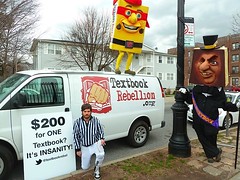
P1030513Image by textbookrebellion Speakers: Tom Caswell  & Connie Broughton

Learn how Washington's colleges went from a few system shared courses in 1997 to developing 81 courses as part of the Open Course Library.

Washington's State Board for Community and Technical Colleges (SBCTC) is currently developing the Open Course Library, an ambitious 2-year project to design open educational resources for 81 high enrolling courses. In 1997 SBCTC began developing a way to share courses with a "pooled enrollments" model. For over a decade, SBCTC's system shared courses have allowed smaller colleges to provide a variety of "long tail" course offerings through a well-organized system of online course sharing. In this presentation we will explain how our system shared courses paved the way to the Open Course Library, providing a culture of sharing as well as the technical framework to allow Washington State's colleges to engage more fully in the Open Education movement.

Notes:
Their strategic plan included shared tools, ANGEL, Tegrity, Collaborate, NW eTutoring Consortium, Professional development, and the open course library.

More information at http://techplan.sbctc.edu

"We will cultivate the culture and practice of using and contributing to open education resources."

Internet + digital content + open license = lower cost, greater access, and greater quality.

Students were averaging $1000 for textbook costs.

WA legislation in SSHB1025 asks that faculty consider the lowest cost options (all things equal) that faculty will adopt open content where possible.

Saylor Foundation adopted their courses that did not use commercial textbooks. They also fixed the broken links and put much of the material into a consistent form.
Enhanced by Zemanta

Saturday, July 16, 2011

California Distance Education Report

The California State Capitol building in Sacra...Image via WikipediaThe Academic Affairs division of the California Community College's Chancellor's office came out with their latest Distance Education Report. They have been doing these every two years since 2002. It give the breakdown on how many students are taking DE classes, demographics, and learning mode. We stack up pretty well with how things are going nationally - California seems to be following national trends - the enrollments in DE are steadily increasing and this last year, there was a 5.96% drop in face-to-face enrollments and a 5.82% increase in online. Then there is that 10% gap between the success and completion rates that I have been chasing since I have been involved in distance ed. I think studies in distance education and interactivity have been addressing some of the issues.  There have been some breaks in that as well. The Instructional Technology Council released a report that said that "The gap between distance learning and face-to-face student completion rates has narrowed significantly, and individual campuses are reporting real progress in exceeding traditional completion rates."

Enhanced by Zemanta

Tuesday, June 14, 2011

Faculty Development: It is more than technology training!

Johns Hopkins Monument, Johns Hopkins Universi...Image via WikipediaI am interested in this because we have a lot of issues around professional development at College of the Redwoods.

At Hopkins, Denille works in a graduate engineering program. The teachers are adjunct. She has 9 on staff. Previously, they had outsourced instructional design, used WebCT, and had no pedagogy instruction. No targeted faculty development. They created 30-35 courses in five years. Online instructors had different needs: tech, distant, pedagogical, changing roles, and misconceptions. The changing roles were "sage on the stage" to online facilitator. There was no consistent quality online. Faculty and students were very frustrated.

They needed ongoing development - they hired additional staff, designed a course dev process, offered more training to faculty.

They adopted the quality matters rubric.

They used a cohort-based course development process. They put up tutorials but still not thinking about a formal faculty development program.

After five years there was increased quality and consistency, knowledge of tech increased.

A survey after five years of faculty said that they felt their needs were not being met, 100% thought that targeted prof dev would be useful. They wanted opportunities to learn teaching skills and best practices.

How to meet the demands? Improve the course dev process. They put together a course that taught online course development. Focused on best practices, not technology. Subliminal goals - teach them the tools by using them.

The course consisted of 6 modules
Intro to online teaching
online course component
writing learning objectives
preparing content
learning activities
assessments

They found that 2 weeks was not enough time, enjoyed interacting with their peers, caught on quickly, prepared for course development, more open to new ideas.

Room for improvement: More examples, less eduspeak, extended duration. Increasing dev opportunities, we shouldn't stop here; consider the muddiest points.

Redesign Intro to Online Development (FA 11)
Revised learning topics, learning activities, added periodic and final deliverables.

Next steps: evolve standards, increase faculty dev, increase fac dev for retention, need more just-in-time opportunities, and create blended and peer-led opportunities.

Later will create courses such as Engaging Online Learners, Learning activities, Creating better Assessments.

The cohorts are 12 faculty. They are paid - part of the development stipend is that they have to take this course. The faculty receive a generous stipend.

Why is faculty development important?
Most faculty were not trained to teach.
Faculty are important to student retention and recruitment.

In the conversation, we talked about sharing professional development resources: denille@jhu.edu

Presenter:
Denille Williams (Johns Hopkins University)

Description:
Faculty development is critical to the quality and success of online programs. The quality of development and delivery of online courses can be greatly enhanced by providing opportunities for faculty to learn best practices and increase faculty knowledge of online teaching and learning. During this session you will learn about the evolution of faculty development for online instructors at Johns Hopkins Engineering for Professionals as we present the past, present, and future of the JHU-EP online faculty development efforts. JHU-EP will also share our findings and experiences as we work to transition our faculty development program online using Sakai to deliver a course on best practices for online course development and plan future courses to enhance online teaching skills. After learning about online faculty development at JHU-EP, share in an open discussion about the faculty development efforts at your institution and ideas for the future of faculty development.

bios: Denille Williams: Denille Williams is an instructional designer at Johns Hopkins University, Engineering for Professionals. Denille has over seven years of experience in working with faculty and students in online education, specializing in the development of online science and engineering courses. Denille is a Certified Faculty Developer and has an M.S. in Higher Education (Academic Development, Instruction, and Technology) and a B.S. in Legal Studies. Her research interests include adjunct faculty development and promoting active learning in the online environment.s)
Enhanced by Zemanta

Wednesday, April 20, 2011

OERs and Money: The revolution will happen without you.

Stewart Brand in Sausalito, California, USA Im...Image via Wikipedia"On the one hand, information wants to be expensive because it's so valuable. The right information in the right place just changes your life. On the other hand, information wants to be free because the cost of getting it out is getting lower and lower all of the time. So you have these two fighting against each other." -- Stewart Brand.

I ran across this quote while perusing some funny videos of Daedalus Howell from a while back who was eulogizing the "Ten Things Killed by the Internet." The video is from 2009 and I hope the updated version will one day include "over-priced college textbooks." This was one of those moments of serendipity because I have been reading the debate between David Wiley and Stephen Downes about whether OER should favor commercial use. OERs are "open eduction resources" such as Stephen Downes' book on critical thinking and logical fallacies. My first reaction to the debated question is "no." Why should an open license "favor" the very mechanism that it is trying to subvert? And my second reaction is "So what?" The kind of education that "favors" commercial licenses is going the way of the video store.

I do not envy David Wiley. Going up against Stephen Downes in a debate is no mean feat. Wiley has the credibility gap to over-come with his connection to commercial publishing, and Downes has been a long time OER advocate and contributer who has been writing on this from the beginning.

I personally feel strongly that learning materials should be created by the community that uses them. The publishers just get in the way. We have a number of examples right here at College of the Redwoods of a community of educators getting together to create a textbook and online testing system that works better than anything that a publisher could offer us. Why? Because it is customized and built from the ground up with the needs of the local community in mind. With commercial textbooks, one has to amend, adapt, and supplement. There is nothing wrong with that; it is just not better than community authored. No body ever said "Hey, lets go with the Pearson textbook; they have our students' best interest at heart."

There are good commercial text books, but there are some atrocious ones that cost just as much! And meanwhile, more and more textbooks and learning objects are being created and openly licensed to world. There are companies positioning themselves to facilitate open textbooks and they will be profitable for a while. They are poised to become the Netflix of education. How long will that paradigm last? Who knows. I find it hysterical that with the economy in the shape that it is, with education costs rising faster than inflation and healthcare that commercial publishers feel they have to protect and defend corporate profits in a debate. And it is all available to you for free.
Enhanced by Zemanta

Friday, March 04, 2011

Smarthistory: a Kickstarter success story

Beham, (Hans) Sebald (1500-1550): Dialectica (...Image via WikipediaI was really glad to see that people have stepped up and supported Smarthistory - this is a really amazing site that needs and deserves our support. Their Kickstarter page is here, but PLEASE contribute; this is an incredible project that can really promote art history and online education, and despite reaching their financial goals, we have to think about on-going support. These are just the kinds of courses that are on the chopping block right now in these hard economic times and we need to step up.

We don't know what is going to happen as we lose liberal arts education. This used to be one of the most important parts of learning: participating in a shared culture. When we lose the liberal arts, we lose our sense of history. Being able to access arts on the web means that students in schools across the world get to benefit from the curation of professional art historians. Yes, looking at pictures on the web is not the same as being there. But this is the next best thing. It is also something completely different. It is a guided view of art and art history scholarship that you could not get in a static textbook. Also, I have seen paintings here for the first time that I could not get to experience any other way. Please support this site!


Enhanced by Zemanta

Wednesday, March 02, 2011

OER Africa: Course Development Handbook

The OAR model is an Instructional Design model...Image via WikipediaI am currently reading Santosh Panda's textbook Handbook on In-House Style for Course Development.  This would be recommended reading for new course developers or distance education admins who are new to the field or need to develop a systematic course development program
 with new staff. I am always on the look-out for possible training materials for new instructional designers or ways to enhance or streamline the course development process. This handbook contains a lot of useful materials and seems to be written with an awareness of what actually happens in online classes. It is light on theory and heavy on the practical. I have been in presentations on instructional design where the why was the focus instead of the what and the how. This inevitably leads to having a teacher stand up and say "Great. How does this actually supposed to work?" This not to say that Panda's book is theory-free somehow - the book models a lot of good theory through its use of concept maps and emphasis on course structure, and his discussion of constructivism. I would like to see more examples of student interaction in the example assignments but again, this is a practical handbook for getting things off the ground.

To think I had to travel all the way to Africa to find a book that was written in our own backyard :-) I am always looking for good instructional design materials. If you have a favorite online, please post a link to it in the comments.

Enhanced by Zemanta