Showing posts with label visuallearning. Show all posts

Thursday, December 30, 2010

Orbis Pictus: The earliest picture textbook for children

Johan Amos Comenius (1592-1671) Källa: Aug. Sc...Image via WikipediaI have been ranting all holiday about John Comenius' textbook, Orbis Pictus, from 1658. It is the first known illustrated text book for children. It has 240 short chapters with an illustration and text that corresponds to the picture with letters or numbers. I have been looking at the English translation by Hoole from the 1659 from Gutenberg's copy of the Orbis Pictus.

"Comenius advocated relating education to everyday life by emphasizing contact with objects in the environment and systematizing all knowledge. He did not regard religion and science as incompatible. Teaching was to be in the vernacular rather than in Latin, and languages were to be learned by the conversational method. He worked for a universal system of education offering equal opportunities to women." - The Free Dictionary

We are familiar with that teaching method in the K-12 schools where the instructor asks the students questions about a picture and the text gives the students the vocabulary and images to refer to and answer the questions. It is a very effective technique and it is amazing that with all of our technological advances this level of interaction is still missing from much of online learning (and our face-to-face classes!).

What is interesting about the book is the visual learning aspect and also the fact that it is a good review of Latin. It also provides interesting insights into the society and time that produced the book, and what Comenius' and educators must have thought of children and society. Each chapter gives a picture of some aspect of the world or a description of an occupation. The first chapters deal with creation and the natural world and moves on to farming, hunting, religion, etc. A student in the 1650s (and for nearly 200 years after) would be introduced to the world and society including "The tormenting of malefactors." The description of Islam is particularly interesting, but they sum up the religion of the Native Americans as devil worship. In 1727 the book was put into the two-column format with English and Latin.

"The most eminent educator of the seventeenth century, however, was John Amos Comenius . . . . . . His Orbis Sensualium Pictus, published in 1657, enjoyed a still higher renown. The text was much the same with the Janua [a text he also wrote], being intended as a kind of elementary encyclopædia; but it differed from all previous text-books, in being illustrated with pictures, on copper and wood, of the various topics discussed in it. This book was universally popular. In those portions of Germany where the schools had been broken up by the “Thirty years’ war,” mothers taught their children from its pages. Corrected and amended by later editors, it continued for nearly two hundred years, to be a text-book of the German schools." (History and Progress of Education, by Philobiblius, N.Y., 1860, p. 210.) The English translation was a standard textbook in English and American schools and Comenius was so respected as an educator that he was invited to become the president of Harvard. 


Enhanced by Zemanta

Thursday, November 18, 2010

Concept Maps & Visual Pedagogy

This was the presentation for the Global Education Conference.: "This presentation will explore concept mapping and brainstorming tools for classroom discussion, discovering knowledge, and problem-solving. I will present a brief history of visual pedagogy from different cultures to show how concept maps work. We will explore teaching techniques using these methods. The tools we will look at will include everything from pencil and paper, free mind mapping software, online collaborative concept mapping, and 3-d concept mapping in virtual worlds like Second Life." It was a good session but I think that I need to work on developing presentations that encourage more feedback from the participants. I love this conference though. I have met a lot of people from around the world that I would not have had a chance to meet otherwise. Diversity of viewpoints is what it should be all about.

Enhanced by Zemanta
Here is the same presentation in a less linear form as a concept map.

Thursday, October 21, 2010

Of Concept Maps and Crucifixions

I visited the National Gallery earlier this year and I spent a lot of time looking at a few paintings of crucifixion or passion paintings. I was particularly interested in a few early renaissance paintings. These paintings come from a time when art served a teaching and learning function; they had a didactic purpose and not just decorative or expressive one. Paintings that fit this bill will have the crucified Christ at the center and in the landscape behind him, arranged radially, will be scenes that illustrate the life of Christ or the events of the Passion. One example that is in Wikimedia is Hans Memling's "Tafel mit Szenen der Passion Christi"

 
This is a painting of Jerusalem and at the center of the painting is the scourging of Christ. All of the scenes around it, in various parts of the city represent different events in the arrest, trial, and execution of Jesus. There are even two scenes representing the crucifixion; one with him dying on the cross and another on the next hill, of him being taken off the cross. There is even a resurrected Christ in the lower right corner about to harrow hell. This is all typical of Flemish painting especially.In the extreme lower right and left corners, I believe we have the devout patrons of this painting.

The point of all this is that the painting represents a central idea, The Passion of the Christ. It has a series of connected stories that are all related to that central idea - spatially and temporally. This painting represents a concept map of that narrative. Concept maps allow us to see connections to different ideas in new ways, but they also help us describe knowledge in a way so that we see how all of the pieces are connected. There are many examples of this throughout history and the world. Art is used to share ideas and their connections in the tangka paintings of Tibet and the Navaho sand paintings. Concept maps and "mind mapping" are not something new, they are an integral method of sharing knowledge and ideas.
Enhanced by Zemanta

Thursday, July 24, 2008

Connectivism is Nothing New

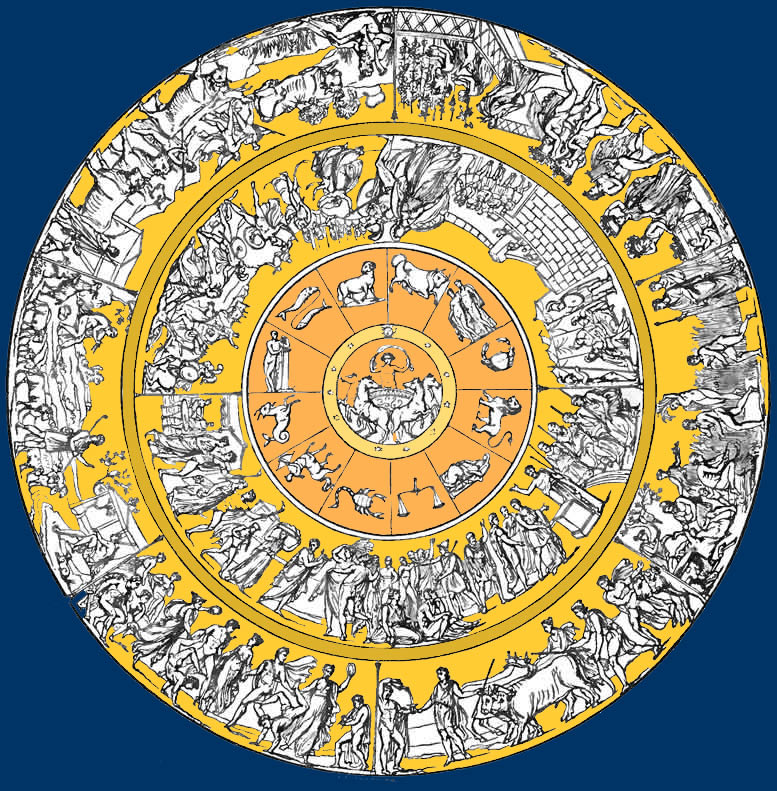
To quote Wikipedia "A hyperlink is a reference or navigation element in a document to another section of the same document or to another document that may be on or part of a (different) domain." The act of linking two things together is a critical act. The connection is first created (connectivism?) in our mind based on other connected thoughts that are in turn linked to our personal experience, social, and historical milieu (constructivism). Creating references between two "documents" is as old as recorded history. And what is a document? According to Wikipedia, "Anything serving as a representation of a person's thinking by means of symbolic marks." There are many instances of documents through out human history of containing "hyperlinks" to other documents. In the east, many of the sutras are actually written references or guides to mandalas and other art. One of my favorite chapters of the Illiad is the shield chapter (18:478) where I have long felt that the description of the shield is obviously a reference to another work of art, a sculpture perhaps, and in turn, the arrangement of images in the shield is a critique of the society and world that created it. So the Illiad was an oral tradition, referred to by a written document which also refers to a work of art (the Shield of Achilles). The shield itself was a graphical representation of the complex relationships of humanity and the cosmos. Now if that is not a hyperlinked text what is?