Showing posts with label csubioeacademy. Show all posts

Wednesday, October 23, 2013

Biology eAcademy: Blackboard Collaborate and Our PLCs

Humboldt State University campus, Arcata, Cali...
The CSU is using Blackboard Collaborate for 19 campuses. The Professional Learning Communities that are coming out of the eAcademies will be meeting  every two weeks in Collaborate. The Biology eAcademy will be continuing using Collaborate. http://tinyurl.com/csu-plc

Brett Christie opened up Collaborate and uploaded his PowerPoint presentation to the Collaborate whiteboard.

Collaborate is online meeting software. It includes video, audio, text chat, and a whiteboard. It has polling functions, the ability to share resources, give web tours, screen and application sharing, and many other useful features. You can use Collaborate to capture lectures and screencasts. It allows for breakout rooms, multimedia playback, and sharing files.

We use Collaborate at Humboldt State and any of our faculty can contact me, Morgan Barker, or Margaret Arroyo for support. It is also integrated with our installation of Moodle. Instructors have used Collaborate for optional weekly meetings, online office hours, mid-term and finals review sessions.

Information on using Blackboard Collaborate for screensharing: http://www.blackboard.com/docs/documentation.htm?DocID=504001PDF


Enhanced by Zemanta

Biology eAcademy: Using TurnItIn

Turnitin
The CSU has a license for TurnItIn http://turnitin.com

This has become so much more than just plagiarism software. It allows instructors to do extensive mark-up and commenting on papers. It has a powerful rubric tool, it allows instructors to insert audio comments, and it will save your text comments - comments that you commonly use to help save instructors time. It is integrated with many LMSs including Moodle.

It allows for paper assignments, peer reviewed assignments, revision, and reflection assignments.

It will scan papers for plagiarism and give the student a report. It will also scan papers from grammar.  The grammar checker is available from the site but not through the LMS because the grammar checker is in beta.

The presenting instructor says that this tool saves her a significant amount of time in grading papers.

One instructor recounted a time when TurnItIn did not catch something really obvious. We discussed the importance of the instructor being engaged in the process vs. just relying on software.

"It saves trees!"
Enhanced by Zemanta

Tuesday, October 22, 2013

Biology eAcademy: Course Accessibility and Universal Design

English: Braille laptop. Universal Learning De...
Presented by Brett Cristie - Lets talk about Universal Design for Learning because we are talking about course redesign.

Accessible Technology Initiative
From a Jan. 1, 2006:

"Information Technology Procurement and Accessibility for Individuals with Disabilities"

Instructional Materials Accessibility

Are My Course Materials Accessible?
Your syllabus is the gateway, it should serve as a map and compass
If not accessible, some students will be at a disadvantage

There are simple things that you can do to make things in your course more accessible (using styles, etc.).
Textbooks and course readers should be accessible
Video and audio resources need to be captioned or transcribed
Library electronic reserves and internet resources that are used in classes should be accessible
Learning management systems - the ones that that we use are all basically accessible.

We have a state-wide contract with AutoSync that brings down the captioning cost to $1.35 a minute.

We have resources at at the Chancellor's offce here: http://teachingcommons.cdl.edu/access/ and on Universal Design for Learnin ghere: http://udluniverse.com

Enhanced by Zemanta

Biology eAcademy: SmartScience Demonstration & Exploration

History of SmartScience - http://www.smartscience.net/SmartScience/SmartScience.html
English: Students completing a lab experiment ...
English: Students completing a lab experiment in Fisher Hall. (Photo credit: Wikipedia)

What makes a great science lab experience? Edmund Hall wrote a book on science on teaching science - gave an ideal vision.  A good experience:
  • Proper background and context
  • Inquiry style learning
  • Data measurement and analysis "hands on"
  • After the lab, cement the learning
  • Accessible and effective
SmartScience as a choice, what it can do
  • It will not do everything you want it to do but it will do what it does well.
  • Students choose an experiment
  • Allows students to create a hypothesis
  • Analyze results and write a report
SmartScience and the CSU
  • Offering virtual labs for a number of possibilities - use them for what you need them for
  • An online lab keeps the sensibilities of real science
  • Customizes lab experience per professor
  • Some analytics
How It Works

SmartScience is is in Java and is now in an HTML 5 version that is mobile and tablet friendly.

Each module has a reading, warm-up questions (to prepare the student for the lab), the students watch a video, they then make a hypothesis (they can add hypothesis), they then watch a video that gives them the results of the experiment, students can click on the screen to make selections and gather data, the data is automatically plotted. The method asks the students to analyze the data to see if their hypotheses were supported. There is a final assessment - multiple choice questions about the data. The assessments are automatically corrected and will include feedback. The students write a lab report. The students writing and assessments are bundled up into a .pdf for the instructor.

Students can also decide to perform the experiments at home, upload their data, and a picture.

Instructors can pre-write hypotheses.

Built in vocabulary (glossary) tool.

Each lab includes a profile of a scientist.

One instructor asks the students to keep working on their lab reports until they get an A.

Let us know if you want to be in the pilot - there is one in the CSU
Supply them with name, campus, courses - they will then create a campus site for us.

The instructors create their own course pages. Faculty can look at the data from the experiment, the reports and assessments. Teachers then can add scores and comments.

Discussion - an instructor points out that the images need to not be orphaned. They need a legend and figure description. 


Enhanced by Zemanta

Biology eAcademy: Further Discussions on Teaching with Simulations

Students in the incubation room at the Woodbin...
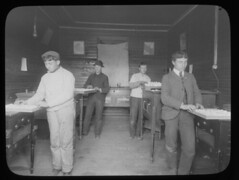
Students in the incubation room at the Woodbine Agricultural School, New Jersey (Photo credit: Center for Jewish History, NYC)
The group seems to have come to a consensus tha tthe online "labs" are really simulations and not labs. They can meet the same outcomes as labs though. Bob G. is not sure that the simulations in BiologyLabsOnline and ScienceCourseWare.org should be for more advanced students. Paul said that it is an experiment. They have used this with non-majors for three years with some success. There was a paper written that shows the program used with Middle School students.

Nathan A. has used the fly lab since 1995. He found it useful and the students found it challenging. He used it in a junior level genetics course to map genes. The key to the success is the support materials. The "teaching commons" will be an important piece in getting the right curriculum to the right students. He also like the report feature. It is a good exercise in how to create a lab report. They suggest creating a stand alone program just for lab reports.

Some of the exercises presented are complex, but instructors should be able to scaffold the experiments to help the students through the work. The preparation of materials takes time because there is a self-guided aspect to some of the online learning.

The discussion really speaks to the fear that somehow online learning will eliminate instructors but what we have seen here is that the role of the instructor as a guide through the experiments is essential. The creation of materials, the design of accompanying assignments, focusing the assessmemts all require a high level of faculty engagement.

Michael C. suggested that we create modular tools that would allow us to create our own experiments.


Enhanced by Zemanta