Showing posts with label Learning Theories. Show all posts

Friday, April 11, 2014

Connectivism, Neuroscience, and Education

English: Human brain.
I have never been comfortable with proclamations by educators or scientists (and yes, there is a difference) about how the brain works. The logical fallacy goes something like this: "we have isolated a mechanism in the brain, learning takes place in the brain; therefore, we now know how learning works." Whenever a psychologist says something smug like "the brain doesn't work that way" (around 1:21), I want to pull my hair out. The latest theories about how the brain supposedly works also include huge gaps in our understanding of how the brain supposedly works and plenty of lines of research that may one day soon give us a more complete picture of how the brain supposedly works. The idea is that if we know how the brain is supposed to work, then we will somehow know how we learn. There are so many layers here though that it seems to be an impossible task. First, it assumes a purely mechanistic view of the mind and learning. Not that we have to get metaphysical, but this could be something that is so complicated that thinking of the mind as a flow chart or a network may not even scratch the surface of what is really happening. When educators talk about what neuroscience has to say about learning, we have to remember that neuroscientists aren't even sure what neuroscience has to say about neuroscience. It is a difficult field because each year brings in a new raft of technologies that reveals more and more about the physical properties, chemical reactions, and neural connections in the brain. But I think there is some promising work in neuroscience that we should be keeping an eye on as educators. One of the more interesting lines of research includes the mathematical models around "deep learning." I think this is finally getting at the complexity necessary to account for the complexity of thinking, language, and learning.

Deutsch: Phrenologie
I think there are some promising avenues of discovery in the work of Gary Marcus that could one day help address how we learn. Gary Marcus describes deep learning this way: "Instead of linear logic, deep learning is based on theories of how the human brain works. The program is made of tangled layers of interconnected nodes. It learns by rearranging connections between nodes after each new experience." In other words, the brain is not seen as a series of connected flowcharts but as intersecting nets of connections that create patterns.

Additionally, Geoffrey Hinton describes the brain as a holograph. Daniela Hernandez writes about Hinton in Wired saying that "Hinton was fascinated by the idea that the brain stores memories in much the same way. Rather than keeping them in a single location, it spreads them across its enormous network of neurons."What I like about Hinton is that he says that his work involves creating computer models of intelligence and he seems to avoid the heavy handed proclamations of discovering how learning works. His work discusses "machine learning" which is an entirely different concept. I think it is very important to remember that we are talking about models and not "how the brain works." The networks involved in learning are even more complex than his model because our layers include language, behavior, culture, society, etc. Never mind the chemical and quantum connections in the brain. It is just possible that one day Hinton's work can speak to the complexity of the interplay of all of those networks and their seemingly infinite interrelations.

How does this shape my practice as an educator? I teach workshops on concept mapping and have used concept mapping in my classes, not because I feel that they somehow mimic the way the brain learns but because it is an engaging learning and teaching method that provides opportunities to utilize visual and kinesthetic learning modalities as well as using critical analysis. In other words, it is a method of teaching and learning that engages multiple ways of knowing. And it may also be a good metaphor for how learning may occour in networks, including neural networks. I have seen this discussion around the learning theory, Connectivism. I think we could go into any learning theory and use it, somewhat clumsily, as a way to discuss how learning arises out of the formation and interplay of network, but fortunately George Seimens and Stephen Downes have done a better job with their work around Connectivism.
Enhanced by Zemanta

Thursday, September 23, 2010

Connectivism and the Evolution of Pedagogy

Trotsky, Lenin, and Kamenev (from left to righ...Image via WikipediaIn some recent postings on connectivism and constructivism (see links below), educators and researchers write as if these models are oppositions; as if constructivism is early Bolshevist and connectivism is free market socialism. Pedagogy does not come from research and theorizing but from practice. The learning landscape changes over time and as the technology changes, we need new models to describe how people are learning. Connectivism is the next step in understanding how people learn in the digital age. Behaviorist and constructivist pedagogies describe a certain kind of learning that takes place in a particular milieu. Networks have changed a lot about the learning landscape, but on the other hand, much of how humans communicate and engage with one another has not. It happens faster, more often and over a wider population. I am talking to educators in India, China, and South America. I would not be talking to as many people around the world without the internet. There is a synergistic aspect to networks - we are smarter together than we are individually. There are network behaviors that are very different than purely social behaviors. Constructivist teaching is also occurring in networks. Connectivist learning is also happening. Will constructivist teaching fade away like feudal economies of old Europe?
An important point that should be made is that the social dimension of learning in constructivism isn't negated by connectivism. There is much that is complementary. To over-simplify, Connectivism accounts for the networks and learning in networks; constructivism accounts for what happens in them. Networks are only a means. Communication, interaction, and engagement all have to take place before anyone learns anything. Information itself is not knowledge. Forming a connection does not mean that any kind of engagement must or will take place.

In some of the online classes I have experienced with George Siemens (which I highly recommend), I see much of the constructivist pedagogies at work:
  • students are actively involved, rather than passively absorbing information;
  • the learning environment is democratic,the teacher is not seen as an authority figure as much as a learning guide;
  • the activities are interactive and student-centered instead of being lesson-centered;
  • a teacher facilitates activities in which students are responsible for their own learning and are autonomous from one another.
All of these are classic characteristics of the constructivist classroom (as opposed to the "sage on the stage" students-as-empty-vessel model). But I also learned as much or more from the connectivist aspects of his classes - the networks. My teaching, learning, and professional life have been immeasurably enriched by the people, communities, and networks I discovered through his classes.
All of the conversations about tools and personal learning networks presuppose an individual with some technical skills, facility with managing information and networks, the critical thinking skills to interpret that information, and a fairly high degree of motivation. All of these seem to be taken for granted - in the community college system (at least here in Humboldt Co.) and in less developed countries, one cannot make the assumption that networks in themselves will lead to learning. I am going to have to use all of the techniques of constructivist learning to show the value and purpose of these networks. I need to bring in the students prior knowledge and experience and guide them in applying that to new information and skills.
Enhanced by Zemanta

Monday, September 28, 2009

Notes Towards a Connectivist Instructional Design

Illustration of spacetime curvature.Image via Wikipedia

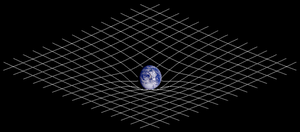
Connectivism is a new theory of knowledge that reflects the new ways that people are currently communicating and learning in a networked world. As George Siemens puts it in his ground-breaking essay, "Over the last twenty years, technology has reorganized how we live, how we communicate, and how we learn. Learning needs and theories that describe learning principles and processes, should be reflective of underlying social environments." It is contrasted with Constructivism, which says that people construct meaning from relating knowledge to past experience and new information. I am still unclear why those two projects must necessarily be opposed or contrasted with one another, and I mean that sincerely. Often, Connectivism actually sounds like a means to construct meaning. Constructivism says that in order to teach, we must understand the mental models that students use to perceive the world and the assumptions they make to support those models. Why can't one of those "mental models" be a networked model? I like to think of the contrast between Connectivism and Constructivism like the one between the Theory of Relativity and the Copernican model. The theory of relativity is more accurate and complete, but engineers are still using the Copernican model to put satellites in orbit and to land spacecraft on the moon. Connectivism is able to account for the more complex relationships in the networked world

As an instructional designer, I see so many intersections between what a Connectivist classroom would look like and a Constructivist one. Constructivism calls for the elimination of a standardized curriculum. A Constructivist curriculum is customized to the students’ prior knowledge and provides opportunities for students to discuss new knowledge and frame it to their own experiences.

In the same way, I envision a Connectivist learning theory (actual content may vary from illustration on the box and contents may have settled during shipping), in Constructivist classrooms, instructors facilitate connections between information and ideas and foster new understanding in students. This is a student-centered environment where instructors shape their teaching strategies to student responses. Constructivist teaching encourages students to critically analyze, interpret, and predict information. Teachers also rely on open-ended questions, collaborative learning, problem-based learning, and promote student-student interaction. This is exactly what happens in the Connectivist classroom as I understand it.

Constructivism has little room for grades and "standardized" tests. In Constructivism, the learning process is the assessment. Students play a significant role in assessing their learning through reflective assignments, peer review, and self-evaluation. This is often through projects and portfolios which measure a student's progress over time. Projects can also measure, interestingly enough, a student's ability to build a smart network. Portfolios are seen as a greater measure of a student's skill and abilities than a single examination because portfolios tell us where a student has come from and where they are going. How long do students retain information from a test? (That is another post.)

So Connectivism does a little bit of all of this but the real jumping off point is in collaborative work. Students take control not only of their own learning but of the curriculum as well. As an instructional designer, I have to build assignments that encourage, facilitate, enable and empower students to work together and build connections. The students need the critical thinking skills not only to evaluate what they are seeing online, but to know what connections are worth making - they need critical network evaluation skills. Not all networks are created equal. Siemens and Downes are right when they say that there is learning in networks. There is a lot of stupidity too because the networks are made up of people. There is nothing inherently clever about a network. The students need new skills that ask:

  • who should I be connecting to?
  • what makes an "intelligent network"?
  • how do I make useful connections?
  • is this connection worth making?
  • is this network worth keeping?
  • how do I know when my networks are working for me?

This is different from Constructivism in that even more power is put into the hands of the learner, not by the teacher, but by the networks themselves. Students who are connected in the right way will often solve problems for teachers such as, learning how to broadcast a workshop into Second Life and pull in more people, or those moments when a student is able to introduce a source or expert in the field that the instructor has not met before. Connectivism takes the faith in the students' ability to learn to a whole new level and moves it to the networks' ability to teach as well. As an instructional designer, this is very exciting - curriculum becomes a handbook for cells and learning nodes - like Maoists or AA meetings.

An ironic note to all of this is that Constructivism is still seen in many places as a revolutionary act. Taking the sage off the stage and turning him/her into the guide on the side (as cliche as that is) has not happened in most classrooms. Student-centered learning is seen as a great threat to certain kinds of teachers. It is a shame because never before have we had a greater array of tools available to us to take advantage of the network-building skills that students are already using.

Reblog this post [with Zemanta]