Showing posts with label Google. Show all posts

Wednesday, November 20, 2013

New Google Classes for Educators

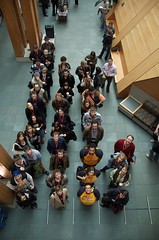
English: This is Juniper Hall at Humboldt Stat...
Juniper Hall at HSU. (Wikipedia)
Even though most of what I work with here on this blog is open education resources, I often post what is happening at Google because the college I work for, Humboldt State University, made the wise choice of outsourcing their email to Google. There are so many reasons why this is such a good idea for small to medium-sized universities: reduce cost of servers and infrastructure; Google is better at redundant digital back-ups and storage and data security than we are; they include many software programs that run in the cloud that we could not afford to buy, develop, or maintain - the list goes on. Many of the students are already using Gmail, Google Drive, Google Sites and Hangouts, etc. On top of that, Google  also offer free training for instructors.

They are offering five new, free self-paced courses to introduce teachers to Google Apps: Internet 101, Google Apps for Education Overview, Gmail for Educators, Google Drive for Educators, Chrome and Chromebooks for Education:

Learn how Google apps and other web tools can help you meet your teaching and learning goals. Your educator peers have created a set of self-paced online courses to help you learn when it's convenient for you. Review videos, toolkits, and reflection questions to build your skills and confidence in using the right technology to meet students' needs for today and the future.

My one beef with them is that I would like Google to start paying more attention to ADA 508 compliance issues. In the past they rushed a lot of things out of the chute for education without paying attention to compliance. They seem to be attending to that now but I need to do more research on that.

If you have any opinions or insight on Google accessibility, feel free to post a comment or email me and I will include the info in a later post.
Enhanced by Zemanta

Monday, July 01, 2013

RIP Google Reader; Long Live Feedly!

Today is the last day of Google Reader. Many of you may not know about it which explains some of why it is going away. It is not the flashiest RSS aggregator out there but certainly the most functional and useful: qualities not valued much in our post-iPad world. I explored a lot of options - there are some articles at the bottom of this post that point to some reviews. I found that this reader was the one that best integrated with my Android phone, iPad, and the Chrome browser. I liked that all I had to do was log-in with my old Google Reader credentials to get it to work.

This was my old Google Reader:


This is my new Feedly reader:


I am now an iPad user and I will say that the Feedly interface is superior to most readers on the iPad, but I am still willing to experiment. If you have a tool that you think we absolutely must try, feel free to email me or post a comment here below. I would also recommend checking out Stephen Downes posting on this if you have not checked it out yet - and if you haven't - you should think about getting a feed reader to manage all those blog posts you haven't read!

In the meantime, past Google Reader users, check out Feedly, they will be expecting you.

Enhanced by Zemanta

Friday, June 01, 2012

Is the Internet making us stupid?

Marshall McLuhan caused wide irritation with h...
Marshall McLuhan caused wide irritation with his statement that the traditional, book-oriented intellectuals had become irrelevant for the formulation of cultural rules in the electronic age. (Photo credit: Wikipedia)
This is an article I wrote for the Times-Standard "Tech Beat" column:

Is the Internet making us stupid? Variations on this argument have been floating around since Nicolas Carr first wrote “Is Google Making Us Stupid?” in the Atlantic Monthly back in 2008. His idea is that the more we rely on computers to do our “thinking” for us, the weaker our brains become.

These arguments rely on a shallow definition of thinking. If I believe that the only way to express intelligence is through writing 20-page papers or consuming information in the same way that my grandparents did, then I am not that smart. Carr and others believe that if someone grows impatient with books, that person is experiencing some kind of cognitive deficit.

One problem with this argument comes from the fact that we really know little about cognition in the first place. Cognitive science is still in its relative infancy. This field is rapidly changing as technology advances, so making some kind of declaration on how we think and learn based on this new science is a bit premature.

And what if technology does change the way that we think? Is this necessarily a bad thing? Maybe that is how we evolve. We develop technologies to deal with problems in our environment, and as Marshall McLuhan says, “we shape tools and then our tools shape us.” He says that technology is just an extension of our natural faculties and abilities. We have the intelligence to invent fire and bicycles. Does this make us slower and weaker? Or did we invent stuff to make up for our weaknesses?


The Hansen Writing Ball, the first typewriter ...
The Hansen Writing Ball, the first typewriter sold commercially, invented by Rasmus Malling-Hansen around 1865, first manufactured in 1870. This was a model from 1878. (Photo credit: Wikipedia)
Carr recounts the story of the philosopher Nietzsche's introduction to the typewriter, and he says that “under the machines' sway” Nietzsche's writing became more terse and “telegraphic.” I think this is a good thing. It is refreshing when a philosopher can get to the point. My uncle Ed, also a writer, once said to me that “the word processor is to words what the chainsaw is to wood.” I knew exactly what he meant because I wrote a book in 1990-91 using a typewriter. It was the last major project I did using a typewriter. The typewriter had me on the floor literally cutting and pasting pages and paragraphs together. I may have enjoyed the process at the time, but I would never go back.

Carr discusses McLuhan in his article: “Media are not just passive channels of information. They supply the stuff of thought, but they also shape the process of thought.” I agree with this. At various times in human history, our media, from the cave paintings of Chauvet-Pont-d'Arc to the Internet, has gone from being an oral and visual culture to a written culture and now back into a visual medium of connections. We are connected to the information, connected to one another, and connected to the means of producing information.

We have to let go of the idea that there is some kind of privileged media. Socrates distrusted writing because it removes people from how he thought we really learn, by having conversations. Carr talks about “deep reading” and that somehow, with all of this access to information, our reading will become shallow and sporadic. He seems to forget the mountains of trash that have made it into print (novelizations of television shows, for instance). Someone can read books their entire life and not make it out of the shallows.

Thomas Claburn wrote an article in the Oct. 15 edition of Information Week called “Is Google Making Us Smarter?” where he cites a study showing that there may be some benefits to computer use, especially with older adults. The study involved 24 volunteers between the ages of 55 and 76, half of whom had prior Internet search experience. According to the article, “Participants' brains were scanned using functional magnetic resonance imaging (fMRI) scans while they conducted Internet searches and read books. The study participants showed similar brain activity when reading, but when searching online, those with prior Internet experience also showed activity in the frontal, the temporal, and the cingulate areas of the brain, areas associated with complex reasoning.”

We are in a new era. But despite the fear we may have of new media, according to publisher Timothy McSweeny, “... there isn't as much bad news as popularly assumed. ... Book sales are up, way up, from twenty years ago. Young adult readership is far wider and deeper than ever before. Library membership and circulation is at all-time high.”

The latest technologies include new definitions of what a book might be. They might not be in traditional print. They might come on Kindles, Nooks, iPhones and iPads, and the Internet itself. But people are reading. Between Harry Potter and all of the vampire novels, the future of literacy is assured.

Geoff Cain is a member of the Redwood Technology Consortium and director of distance education at College of the Redwoods. Contact him at geoff-cain@redwoods.edu.
Enhanced by Zemanta

Wednesday, October 26, 2011

Openness and Learning Analytics

Human Graphing - 20Image by nep via FlickrSpeakers: John Rinderle Norman Bier
Revise/Remix can build a 1000 points of OER light. Can these lights converge to fire authentic learning analytics & share-alike data models?

Conventional wisdom in the OER community maintains that one of the more important features of the open education approach is the malleability and customizability of materials, allowing freely available component resources to be remixed, adapted and modified to suit specific institutional directives, student needs or faculty interests. These features are important enough that the ability to revise and remix content is a core part of the commonly accepted 4R framework that defines open content. While the ability to tailor OER to meet changing or specific needs is one compelling part of the open model, the infinity variety that this encourages creates serious obstacles for another expected benefit of openness: using learning analytics to drive adaptive teaching and learning, support iterative improvement, and demonstrate effectiveness.

The ability to deliver meaningful learning analytics has been one promise of the open education approach. A use-driven design process for OER depends on the resources being used by a large number of students with varied background knowledge, relevant skills and future goals—a student population that open and well-used resources should be able to provide. Such a process can use such interaction data to iteratively improve courses in a meaningful and empirical way. Beyond improvement analytics, this same data can be used mid-stream to improve the effectiveness of learners and instructors.

Despite this promise, the OER community has not been able to create or take advantage of widespread, generally applicable learning analytics tools. While some organizations have had success in developing analytics platforms and approaches, such successes have tended to focus on specific resources, often developed with data collection in mind and not always falling at the “most open” end of the open content continuum. One barrier to more widespread analytic tools has been the variety of OER afforded by remixing and revising.

This presentation will explore the benefits and trade-offs to be made between adaptability and analytics. In the course of this exploration, we will argue that the benefits to be had from an approach that places a higher priority on analytics may outweigh those to be gained from endless variety in the OER space. Similarly, we will discuss some approaches to better harness open education’s promised ability to drive learning analytics, with greater and lesser compromises to the adaptability of OER. We will propose open communities of use and evaluation coalesced around individual OERs using learning analytics to improve the resource through coordinated revision and remix. Open education has embraced share alike licenses for materials. The next logical step is the open exchange of learning data and evidence of effectiveness, to “share alike and share data”. We will also suggest approaches to integrating disparate analytics-enabled OER into common platforms and the development of OER to published standards for learning analytic data.

Notes:
Open Learning Initiative:
Produce and improve scientifically-based courses and course materials which enact instruction and support instructors

Outcomes:
Shared understanding of challenges, tensions, and possibilities in learning analytics
Describe community-based analytics plans

Driving feedback loops. We have a huge opportunity to use assessment data around OERs. There are enormous amounts of data available.  "Infinite points of light" around all the OER repositories and initiatives.

Infinite proliferation

The 4 Rs

  1. Reuse
  2. Redistribute
  3. Revising
  4. Remix

Not recreate but to evaluate - recreate is a barrier to reuse.

What drives change in these settings?

  • Data 
  • Intuition
  • Market demand
  • Instructor preferences - change happens because an instructor gets bored with material, but with no real idea if the changes are improving the course.
Effectiveness: An OER is effective when it demonstrably supports students in meeting articulated, measurable learning outcomes in a given set of contexts. 

They are also looking at new forms of assessment for gathering data.

Rory McGreal asked whether or not there was a clearer way to talk about what is demonstrable. There are a lot of variables in the initial statement.

Why have we not been doing this?
  • It's hard
  • Costly
  • Individual faculty need support
  • It can be threatening to educators
  • Disparate systems for collecting data

What do we mean by "learning analytics"?
Proxies vs. authentic assessment and evaluation

Analytics Definition
Data collection > reporting > Decision making > Intervention > Action
Collecting data is not enough. We also need to make sense of it in ways that are actionable.

Types of analytics
Education/classroom management
Learning outcomes

We need common, agreed upon standards, a core collection, and a space for exploration.

Problems include privacy and technical issues.

Tools that already exist:
DataShop, Evidence Hub, Learning registry, and communities of evidence

Community College Open Learning Initiative

And build new things:
We need better mechanisms to share data.
We need a community-based approach.

Learning Intelligence Systems
What would be giving up? This approach forces us to allow our minds to be charged by evidence.

Next Steps?
Innovate
Standardize
Scale

  • Commitment to assessment and evaluation
  • Community definition of analytics enabled OER
  • Common approach to data
  • Shared and private analytics platforms

Enhanced by Zemanta

Saturday, August 27, 2011

Open Learning and the Next Generation LMS

Onderwijsdagen 2007 - Keynote - Stephen DownesImage by moqub via FlickrWe have been talking at work about what the next generation of LMSs (learning management systems) should look like. In the education blog world, LMSs are considered pretty old fashioned because they tend to be proprietary silos, built on old code (by committee), and do not empower students to facilitate their own learning. Once the class is over, the LMS shuts the door behind the student. We agree with all of that. We find it particularly hard to get really meaningful information in and out of most LMSs. We are all in favor of "personal learning networks" - the way LMSs generally attempt to integrate Web 2.0 or social networks is pretty laughable. It is usually misunderstood and bolted on as an after-thought. But LMSs can be important to institutions because they provide a consistent interface for students who may not have any experience with technology. I got the idea to email Stephen Downes about this because I have been reading his blog and newsletter since I have been involved in teaching and education. I asked him what he thought the next generation of LMSs would look like and he was gracious enough to send us this response:


"I guess my short answer to the query is that I think the future LMS will look like what gRSShopper will look like when it's done. Because I've been developing gRSShopper for the distributed and open model of learning for some time now, in other words, exactly where I think institutions should be going. Of course I'm not a great programmer so gRSShopper is far from complete. But it gives a bit of a model of what the future LMS should look like.

In particular, gRSShopper supports a distributed environment, This allows the institution to aggregate student content from wherever it's posted. gRSShopper also supports syndication. So content can be distributed by email or RSS into pretty much any environment. The idea is that the LMS isn't a destination that people have to visit, but rather a clearing house that manages content aggregation, indexing and redistribution.

This is what I've been building out on gRSShopper - but because web 2.0 has migrated away from standards and toward proprietary APIs I need to do a lot more to extend it. But any LMS should be working with remote content minimally with RSS/Atom, DC, LOM, iCal, FOAF, and various other standards, as well as the Google, Yahoo, Facebook, Twitter and related APIs. gRSShopper is a tool for managing things like MOOCs, and should support open online course content.

In addition, student access is ideally managed witgh a personal learning environment (PLE). This is a bit like a gRSShopper for idividuals, but with better management for personal accounts on remote systems. It would also have a more robust player - it would be a PLE that plays cartridges, not LMSs (though PLEs should report to LMSs any results). PLEs contain permanent records for student - all bookmarks, references and readings, created work, etc., is stored (or indexed, if stored in the cloud) locally, so the student can always retrieve it.

That's a short answer. A long answer would be consideraly more in-depth, but along these lines.
"


We would love to gather more ideas from others. If you have some thoughts on what you think the next generation LMS should look like or not look like, send us an email or leave a comment below.
Enhanced by Zemanta

Friday, July 22, 2011

Finding Creative Commons Videos on YouTube

We are in the middle of helping faculty develop courses for a grant that requires that all of the content be openly licensed: Creative Commons or public domain. YouTube is making it easier to find such content:


The "Filter & Explore" link lets you find content that is licensed as Creative Commons as well as find content that is closed captioned.


Enhanced by Zemanta

Friday, June 03, 2011

Google Music: Bask in the market socialist sunshine!

Ludwig van Beethoven in 1820Image via WikipediaAs you are probably aware, I am a big fan of Google. I have been using and writing about their products from very early on. In fact, this blog was acquired by Google way back when. They are a real conundrum for me at times; they represent the best of what I think companies should be and yet they are still corporate; they are not a foundation or an open source organization, but they have open source projects, products, and contribute to the open source community. Tonight I am loading Google Music on my computer. Interestingly enough, Google's Music Manager relies on about 26 open source projects to do what it does. I recommend reading the licensing documentation because that will really tell you what you can expect from this new tool/service. What Google Music is meant to do is to upload all of your music from all of your devices and host them in one spot which you can then access from any device (phone, computer, etc.). And yes, this means iTunes. I am not sure how Apple is going to take this. This means the iTunes at my work PC, my iTunes on my home computer can now be combined in one service. It all goes from the locked down silos at Apple into the socialist free market sunshine of the cloud. How does this effect the digital rights? If I bought something from Apple to be played in an Apple platform did I also buy the right to reproduce that where ever I want? I am really curious to know how this is going to play out legally.

For now, Google's Music Manager is churning through my 21 days of music and has uploaded most of Beethoven and rejected nearly 350 songs. I am not sure what that is about yet, but I will post updates to my installation and cloudification of my music on Twitter - I am at geoffcain in the Twittersphere. If you have already installed Google Music and are using it, post your insights to the comments below or email me - I am interested to know how it worked for you too.

Enhanced by Zemanta

Tuesday, February 01, 2011

The Google Art Project

The Google Art Project has created a "street view" visit to a dozen museums and put up a library of high definition images from the participating museums. This will be a great resource for art and history instructors and everyone interested in art. Resources like these would also make an interesting low cost alternative to a "textbook" - art history textbooks are fairly expensive and lack the magnification and resolution possible with HD computer screens.

For now the following museums are included in the project:

  • Alte Nationalgalerie, Berlin - Germany
  • Freer Gallery of Art, Smithsonian, Washington DC - USA
  • The Frick Collection, NYC - USA
  • Gemäldegalerie, Berlin - Germany
  • The Metropolitan Museum of Art, NYC - USA
  • MoMA, The Museum of Modern Art, NYC - USA
  • Museo Reina Sofia, Madrid - Spain
  • Museo Thyssen - Bornemisza, Madrid - Spain
  • Museum Kampa, Prague - Czech Republic
  • National Gallery, London - UK
  • Palace of Versailles - France
  • Rijksmuseum, Amsterdam - The Netherlands
  • The State Hermitage Museum, St Petersburg - Russia
  • State Tretyakov Gallery, Moscow - Russia
  • Tate Britain, London - UK
  • Uffizi Gallery, Florence - Italy
  • Van Gogh Museum, Amsterdam - The Netherlands


Enhanced by Zemanta