Showing posts with label UNESCO. Show all posts

Friday, June 01, 2012

Open Content Licensing for Educators Workshop

Image representing Creative Commons as depicte...
Image via CrunchBase
This is from Cable Green: 

2012 is a significant year for open education and OER. We are celebrating 10 years since UNESCO coined the term "Open Educational Resources".

In joining the global celebrations, the OER Foundation will host a free online training workshop on OERs, Copyright and Creative Commons licensing.

When: 20 June -  3 July 2012 (to coincide with the UNESCO World OER Congress in Paris).
Where: Online
Cost: Free. Registrations for this celebratory online workshop are now open:  Register today to reserve your seat.

We are aiming to break our previous #OCL4Ed record of 1067 registrations, so please share the gift of knowledge and invite colleagues and friends to join us.

We welcome graduates of former OCL4Ed workshops to join our lead facilitators and assist with peer-learning support for educators around the world who want to learn more about OER and open licensing.  More info on how you can assist coming soon. 

We look forward to welcoming you to OCL4Ed 2012.06.

With kind regards

The OER Foundation team
COL Chair in OER at Otago Polytechnic
UNESCO-COL Chair in OER at Athabasca University
Enhanced by Zemanta

Monday, March 26, 2012

OER Policy Registry: Request for Help

Image representing Creative Commons as depicte...Image via CrunchBaseCable Green just lit the Bat Signal!

Greetings Open Colleagues,

The open community shares a need for more information to help us with our work. We know, for example, that there are many policies supporting open education at institutions and governments throughout the world. Many of us know of some of these policies, but it would be extremely helpful if we had a single database of open education policies that the entire community could access and update.

To meet this goal, Creative Commons has received a small grant to create an “OER Policy Registry.” The Open Educational Resources (OER) Policy Registry will be a place for policymakers and open advocates to easily share and update OER legislation, OER institutional policies and supporting OER policy resources. We have begun to enter OER policies into the registry, but we need your help to make it a truly useful global resource.

The open movement is reaching a stage where we’ve had some real, concrete OER policy victories and there is the potential to achieve many more. Sharing our collective knowledge of existing OER policies, in the same way we believe in sharing educational resources, will help advocates and policymakers worldwide be more successful.

Please join the effort:
(1) Contribute any OER policies you know about via this Google form.
  • We are collecting both legislative AND institutional (non-legislative) OER policies from around the world. Your form submissions will be added to the draft list of OER policies.
(2) Review the draft list of OER policies. (Google doc)
(3) Forward this message to your colleagues, lists, blogs, and other channels, to ensure that we get as much input as possible. As the OER movement is global, it is critical that we capture OER policies from around the world.

Anyone can add OER policies to the Google form through the next month. Beginning May 1, the OER Policy Registry will move to the Creative Commons wiki. At that point, anyone will be able to edit and update the OER Policy Registry on the wiki, and all contributions will be licensed under CC BY.

We’re starting with a Google form because (a) it’s easy and (b) wikis require you to create an account before editing, and that may be a barrier to participation.

CC is in contact with other projects that collect similar information, including UNESCO, CoL, the Florida Distance Learning Consortium, EU OCW and a project in New Zealand. We will add OER policy data they gather as it becomes available. If anyone knows of other efforts to gather OER policies, please send them to Anna Daniel (anna@creativecommons.org) and we will reach out to them too.

If you have any suggestions or feedback on the content and/or framework, please let us know.

Warmest regards and thank you!

Cable
Enhanced by Zemanta

Monday, December 12, 2011

Open Content Licensing for Educators Workshop

Image representing Creative Commons as depicte...Image via CrunchBaseThis in from Cable Green: Creative Commons, the OER Foundation and Ako Aotearoa announce an international professional development opportunity for all educators.

What: Open content licensing for educators workshop (#OCL4Ed)
Where: Online
When: 23 -27 January 2012
Cost: Free
Registration: Open (register today)
Facilitators:
  • Cable Green, Director Global Learning, Creative Commons
  • Jane Hornibrook , Public Lead, Creative Commons Aotearoa New Zealand
  • Wayne Mackintosh, Director, OER Foundation.
Open content licensing for educators (#OCL4Ed) is a free online workshop designed for educators who want to learn more about open education resources, copyright, and creative commons licenses.
Wikieducator logo.Image via WikipediaThe course materials were developed as a collaborative project by volunteers from the OER Foundation, WikiEducator, the OpenCourseWare Consortium and Creative Commons with funding support from UNESCO. The course will provide prerequisite knowledge required by educators to legally remix open education materials and help institutions to take informed decisions about open content licenses.

Visit: http://wikieducator.org/Open_content_licensing_for_educators/About

Please spread the word through your networks. Give the gift of knowledge and invite a friend to join you.
Download and share this poster with your colleagues.

We look forward to meeting you during the workshop and extend our thanks to Ako Aotearoa, New Zealand's National Centre for Tertiary Teaching Excellence for sponsoring this professional development opportunity.
Enhanced by Zemanta

Wednesday, November 16, 2011

Call for Open Education Practices

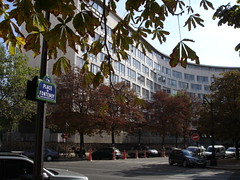
UNESCO Headquarter, ParisImage by Matthias Ripp via Flickr
This is from Abel Caine:

UNESCO is a member of the Open Educational Quality Initiative (OPAL) which aimed to create a new open educational practices (OEP) framework.

Open educational practices were defined as practices which support the production, use and reuse of open educational resources (OER) which help learners, educational professionals, organizational leaders, and policy makers to improve quality in higher education and adult education and training.

UNESCO's responsibility within the OPAL Initiative was to:
1.   Build a Clearinghouse of at least 100 of the best open educational practices; and
2.   Assist at least 50 organizations to apply an OEP Maturity self-assessment

We are close to achieving our goal and with the Initiative ending on 31st December 2012, we are making a final big Call to all members of the global OER community.

If you are currently working with OER or open educational practices, we would like to invite you to submit your practice to the OPAL Clearinghouse.

This is a very quick fill-in-form (approximately 5 minutes) which allows you to share your best practices.

If you feel your organization already practices open education or is ready to move into open educational practices, then please take the time to complete the OPAL Maturity Assessment:

This is a comprehensive mapping exercise based on the OPAL Guidelines (approximately 25 minutes).

Please excuse any cross-posting and don’t hesitate to contact both myself or Ms. Molly Malone (m.malone@unesco.org) for any help to complete the uploading of a practice or the self-assessment. We'd appreciate it if you could please also forward this message to your OER colleagues and look forward to your submissions.
Enhanced by Zemanta

Friday, October 28, 2011

Jim Groom: The Wild Man of OER Made My Year

I was at the Open Education 2011 conference this week and David Wiley had the good sense to invite Jim Groom in to rattle cages and shake the chains. I have been reading his stuff for sometime. You can follow him on twitter here and his blog is always worth reading, but it is really a whole other experience to meet him in person. As a distance education director, I almost never say that. He is the favorite exuberant uncle who occasionally breaks the furniture. His mind is clear but his soul is mad. and here he is at his Dionysian best:


We need folks like Jim to remind us that there are political consequences to our choices and that passion matters.
Enhanced by Zemanta

Wednesday, October 26, 2011

Assessment and Accreditation of an OER Learner

A Wikiversity Logo for Open Educational Resour...Image via WikipediaSpeakers: Rory McGreal, Wayne Macintosh
Learners accessing OER can acquire knowledge formally or informally. This project reports on assessment and accreditation policies worldwide.

A major function of colleges and universities is to validate and credentialise learning by conferring qualifications and degrees. They are well equipped and experienced in the process of assessing the quality of learning for formal academic or professional credit. However, digital media are transforming the ways individuals create, share and learn both formally and informally from content and applications available on the web. There is considerable ambiguity regarding the validity of this type of learning or self-study online and the use of individualized learning paths. The problem is that learners who access OER on the Web and do acquire knowledge and skills either formally or informally, alone or in groups, cannot readily have their learning assessed and subsequently receive appropriate academic recognition for their efforts. So, there is a need for ongoing research in order to understand the different ways that institutions are addressing the needs of this growing learner population.

This paper will report on a Canadian Social Sciences and Humanities Research project. The project is original in that it will research existing and nascent international protocols and practices leading to formal academic credit for non-traditional learners. This provides a framework to evaluate the transferability and applicability of these means for assessing OER learning on the web leading to formal credentials. Existing organisational and policy barriers will be identified and categorized. The project proposes a conceptual framework to overcome these barriers for widening access to post-secondary education through digital learning in ways, which are more accessible cost-effective and responsive to the diverse, changing needs of the knowledge economy and society.

This research is significant because the core mission of any modern university is to contribute to society. Many universities incorporate the mission of community service, as publicly funded institutions, to serve the wider interests of society by sharing expertise and scholarship. An understanding of how different institutions are approaching the recognition of non-formal and informal digital learning can provide change agents with new knowledge on how to expand their community service and learning missions by creating flexible pathways to credentialise learning for non-traditional students.

Recent transformational advances in digital media, the web and mobile devices have changed the learning landscape, ensuring that this research project is different. The exponential increase in accessibility to quality educational as OER provides unprecedented opportunities for learning. Thousands of course modules are presently available online, as OER from respected institutions, along with millions of websites that can be used to support a wide variety of learning objectives. This exponential growth has opened up opportunities for learners leading to potential obligations from our institutions.

The UNESCO/COL Chair has partners on all continents. This project will contribute to the advancement of knowledge of the assessment of learning experience for non-traditional learners. The outputs of this research could potentially have wide social impact in expanding access to learning opportunities for those students currently under-served by the formal sector while enhancing the efficiency of taxpayer funded institutions by refining existing mechanisms for assessment and accreditation or non-traditional learners.

Notes:
Their work in OERs was driven by digital rights management issues, digital licenses, and the idea that a license is a privilege not ownership. These are not conditions that encourage education.

Going to open education is not a choice - we must get away from proprietary materials.

Research objectives
Map existing projects on assessment/accreditation

They are building an open education resource university - OERU
This is to accredit students who are using open ed resources. Learning is free but you pay for the accreditation. To guarantee the credibility the assessment process must be strictly equivalent to that for mainstream students.

Participating institutions, they must have credible local accreditation. They are working with agencies to ensure quality assessment standards.

Learners access courses based solely on OER. Open students supported via "Academic Volunteers" and possible student mentors. Open assessment from participating institutions. Participating inst. grant credit and degrees.

They want to accredit all forms of learning, informal, formal, non-formal, and previous learning - also will include transfer credit, challenge for credit, and portfolio learning.

Research Questions?
Is a MOOC formal learning?
How does a "badge" system fit in?
How do we assess prior learning?

Breaking the "Iron Triangle" you can increase quality and lower cost.

University of London has been doing this for years.

"The Tragedy of the Commons" - the commons still exists in Britain and Canada. They really didn't take away the commons - private property is what is robbing people.

OER Red Herrings:
Quality issues
No credible credentials
Too rigid/flexible

Enhanced by Zemanta

Tuesday, October 25, 2011

UNESCO Chairs in OER Programme and International Network

Photo of Athabasca UniversityImage via WikipediaSpeakers: Rory McGreal Fred Mulder Susan D\'Antoni
The UNESCO Chairs in OER explain their programme, goals and objectives in supporting an international network of OER users.

In Nov. 2006, ICDE launched its Global Task Force on OER at the UNESCO HQ in Paris with strong support from UNESCO. In March 2009 an OER Seminar was organised by the EADTU OER Task force and UNESCO, again at UNESCO HQ. It seemed a natural step for UNESCO to establish UNESCO OER Chairs, which were granted to Fred Mulder and Rory McGreal, both active in the OER community. The Canadian Chair is focusing on stimulating OER capacity building and awareness raising, particularly in Africa, Asia and Latin America and specifically with the world's Open Universities. The Dutch Chair embraces research to underpin and give guidance to the exploration, introduction, implementation and exploitation of OER in a variety of societies at the national level.
The aim of this Panel is to discuss the Activity plans of both Chairs and to amend them where necessary. This under explicit consideration of the continental and national differences and of the self-learning mode as a promising perspective in relation to OER.

Notes:
The goals of UNESCO include universal education. They are creating an international network of OER chairs for action.

There are chairs in Canada and the Netherlands.

They are building a collaborative mapping of OER initiatives world-wide.

Rory McGreal is the UNESCO chair from Athabasca University. They are supporting OER in Africa and they are partners with UNISA, Africa's online university. They are supporting gender equality. They are promoting OERs to educate youth. They are working on getting chairs in Oceania, Brazil and elsewhere for more chairs. They are active in policy research.

AU Press Open Access Book will be announced soon. They are looking for OER-relevant topics. The OER book will be in the Issues in Distance Education edited by Terry Anderson.

Fred Mulder described an global OER graduate school initiative. There is a substantial need for more research in OERs. Very broad research objectives. The key researchers are PhD candidates under joint supervision by three OER experts.

They want them to spend time doing research abroad but they want that virtually.
Enhanced by Zemanta

Open Ed Conference: Towards an aggregated profile of the Global OER and OCW audience

Speakers Mary Lou Forward, Meena Hwang and Una Daly

Developing a profile of our global audience through aggregated surveys of OER and OCW users worldwide.

What are the demographics of those looking of open education resources and open courses? based on their surveys, most of the people visiting http://www.educationportal.com are mostly over 40. They are getting mostly life-long learners. Only a third of the visitors are there to support their studies. The most popular answer to their survey was "to update my job skills."

People were visiting from 57 different countries.

All of this points out the importance of translations.,

Survey data is up at http://www.ocwconsortium.org

There was then examples of a wide variety of users who provided comments about how folks are using OCW.  There are huge communities being built around open content around the world. One site in China that hosts ed videos and a microblogging has 1.4 million followers. One study group has 3000 members.

Una Daly got up to talk about who is using the open repositories.  She discussed the OER advocate training programs, online communities of practice, and adopter communities. She mentioned the grant around adoption of OERs and the Hoopa Tribe Reader.
Enhanced by Zemanta

Wednesday, April 20, 2011

OERs and Money: The revolution will happen without you.

Stewart Brand in Sausalito, California, USA Im...Image via Wikipedia"On the one hand, information wants to be expensive because it's so valuable. The right information in the right place just changes your life. On the other hand, information wants to be free because the cost of getting it out is getting lower and lower all of the time. So you have these two fighting against each other." -- Stewart Brand.

I ran across this quote while perusing some funny videos of Daedalus Howell from a while back who was eulogizing the "Ten Things Killed by the Internet." The video is from 2009 and I hope the updated version will one day include "over-priced college textbooks." This was one of those moments of serendipity because I have been reading the debate between David Wiley and Stephen Downes about whether OER should favor commercial use. OERs are "open eduction resources" such as Stephen Downes' book on critical thinking and logical fallacies. My first reaction to the debated question is "no." Why should an open license "favor" the very mechanism that it is trying to subvert? And my second reaction is "So what?" The kind of education that "favors" commercial licenses is going the way of the video store.

I do not envy David Wiley. Going up against Stephen Downes in a debate is no mean feat. Wiley has the credibility gap to over-come with his connection to commercial publishing, and Downes has been a long time OER advocate and contributer who has been writing on this from the beginning.

I personally feel strongly that learning materials should be created by the community that uses them. The publishers just get in the way. We have a number of examples right here at College of the Redwoods of a community of educators getting together to create a textbook and online testing system that works better than anything that a publisher could offer us. Why? Because it is customized and built from the ground up with the needs of the local community in mind. With commercial textbooks, one has to amend, adapt, and supplement. There is nothing wrong with that; it is just not better than community authored. No body ever said "Hey, lets go with the Pearson textbook; they have our students' best interest at heart."

There are good commercial text books, but there are some atrocious ones that cost just as much! And meanwhile, more and more textbooks and learning objects are being created and openly licensed to world. There are companies positioning themselves to facilitate open textbooks and they will be profitable for a while. They are poised to become the Netflix of education. How long will that paradigm last? Who knows. I find it hysterical that with the economy in the shape that it is, with education costs rising faster than inflation and healthcare that commercial publishers feel they have to protect and defend corporate profits in a debate. And it is all available to you for free.
Enhanced by Zemanta