Showing posts with label Methods and Theories. Show all posts

Friday, July 12, 2013

Mobytes Instructional Design App

English: This is Juniper Hall at Humboldt Stat...
Juniper Hall at Humboldt State University.
(Photo credit: Wikipedia)
One of our technologically ever-vigilant instructional designers here at Humboldt State (Kim Vincent-Layton) shared an interesting Android app with us the other day - Mobytes Instructional Design App. The app is a handy collection of articles and templates on instructional design. What is a "mobyte"? A mobyte is a "just-in-time chunk of learning designed for just-enough knowledge to learn or apply while performing a task. It can be used for learning from scratch, refreshing and updating knowledge while on the move." I like this app because it covers, at a basic level, the current understanding and definition of instructional design that any student of education would find in a instructional design class. I would like to share this app with administrators and teachers to help promote a deeper understanding of instructional design and its possibilities. The author, Madhuri Dubey, has distilled five topics into the app:
  • Instructional Design (ID) basics 
  • Evolution and application 
  • Learning theory and styles 
  • Instructional theory 
  • Getting started with ID 
This reference would be useful for instructional design teams to all get on the same page as well as for instructors who would find it useful for a better understanding how teaching and learning work. It covers Gagne, ADDIE, Clark, Merrill, Bloom's and the usual suspects.

If you are not an Android phone person, much of the information here is available on Madhuri Dubey's blog.
Enhanced by Zemanta

Wednesday, March 02, 2011

OER Africa: Course Development Handbook

The OAR model is an Instructional Design model...Image via WikipediaI am currently reading Santosh Panda's textbook Handbook on In-House Style for Course Development.  This would be recommended reading for new course developers or distance education admins who are new to the field or need to develop a systematic course development program
 with new staff. I am always on the look-out for possible training materials for new instructional designers or ways to enhance or streamline the course development process. This handbook contains a lot of useful materials and seems to be written with an awareness of what actually happens in online classes. It is light on theory and heavy on the practical. I have been in presentations on instructional design where the why was the focus instead of the what and the how. This inevitably leads to having a teacher stand up and say "Great. How does this actually supposed to work?" This not to say that Panda's book is theory-free somehow - the book models a lot of good theory through its use of concept maps and emphasis on course structure, and his discussion of constructivism. I would like to see more examples of student interaction in the example assignments but again, this is a practical handbook for getting things off the ground.

To think I had to travel all the way to Africa to find a book that was written in our own backyard :-) I am always looking for good instructional design materials. If you have a favorite online, please post a link to it in the comments.

Enhanced by Zemanta

Monday, December 20, 2010

Instructional Design: Beyond the Formulas

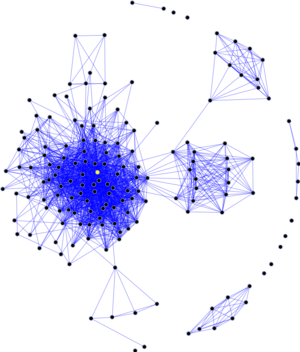
A social network diagramImage via WikipediaI am reviewing ID literature and textbooks, and I am dissatisfied with the formulaic approaches that assume things like uniform standards, that the stake-holders know what the standards are, all the students will meet the same outcomes the same way, etc. You can read many of these books and articles and actually pretend that the Internet never happened. There has not been much progression beyond ADDIE. Instructional design, seen from the standard literature, feels mechanistic and trapped in a behaviorist input-output model. The huge holes in current thinking on instructional design include the Internet, social networks, and new media. The other missing piece is the social milieu of the individual schools and programs: each school has a different student population, different teachers with different backgrounds and experiences. I am still having conversations with teachers and other ID folks on constructivist (student-centered) approaches to teaching and learning versus behavioralist (carrot and stick). Meanwhile, current instructional design models and their proponents are all looking at what is happening online and trying desperately to hammer it into our conceptions of pedagogy that were not just created before social networks but before the internet. I read about a model that was being proposed in a copy of "eCampus" a while back and it included all of these great interlocking circles and arrows about content and visual pedagogy (on top of the usual behaviorist model) and no where in the model was there a connection between the students and teachers.

We have an opportunity in course design, to bring all of the stake-holders to the table. Course design should not just be up to a dept. or a single teacher. Course development can be an opportunity to bring in a librarian, someone from student advising, disabled student services and programs, and developmental education. A course design process can show an instructor how to connect their classroom with other students, instructors, and experts in the field. It can be an opportunity to connect students with professional networks as well as other colleges and schools.  What I have been finding is that when you bring everyone to the table to talk about a course, you can discover many different ways to connect your course to the community than you would have ever thought of yourself.

I would like to write (or facilitate) a course development guide that will incorporate open education resources and social networks and connectivism. This project will be hosted in Google Docs or on a wiki. If you are interested in participating, leave a comment below and I will include you on the list.
Enhanced by Zemanta