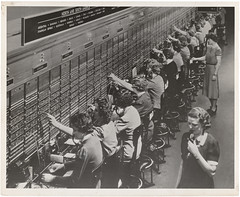
 Image by The U.S. National Archives via Flickr"Because we do not understand the brain very well we are constantly tempted to use the latest technology as a model for trying to understand it. In my childhood we were always assured that the brain was a telephone switchboard. ('What else could it be?') I was amused to see that Sherrington, the great British neuroscientist, thought that the brain worked like a telegraph system. Freud often compared the brain to hydraulic and electro-magnetic systems. Leibniz compared it to a mill, and I am told some of the ancient Greeks thought the brain functions like a catapult. At present, obviously, the metaphor is the digital computer." — John R. Searls.
I don't think there is anything particularly wrong with this. Humans connect with the world using language, and language is not about facts. Language really isn't information. Language describes. We understand the world through metaphors. Our metaphors are about as accurate as poetry, not geometry. Although as far as language goes, poetry is often a more complete description of a thing than the measurements of it.
I think we are moving on in our metaphors to networks. This metaphor suits me fine - it is as good as any of the other metaphors. A metaphor becomes a tool that allows us to talk about phenomena that we really have little understanding of. We know a lot more about the mechanics of the brain - we have gotten better at measuring parts of it. We see networks in the brain because that is how we understand modern communication and language.
We see the world through a complex of metaphors - through a shifting lens of definition. MRIs of brain events show that memories, sensation, and learning are all non-local events. Various sections of the brain light up and pulse like the shifting colors of a cuttlefish. I am always amazed that there are researchers that feel that they can take a limited model of how the brain supposedly works and then leap out to how we should therefore learn. I am thinking here of "Brain-Based Learning" theories where the fundamental principle is that the brain is a "parallel processor." Social cognitive theories and psychology are a little more useful because they examine interactions between people which, ideally, is something that happens in education.


