Showing posts with label technology. Show all posts

Wednesday, December 04, 2013

DET/CHE: Teaching in the Digital Age

Azusa Pacific University
Azusa Pacific University (Photo credit: Wikipedia)
Mike Truong, Founding Executive Director, Office of Innovative Teaching and Technology, Azusa Pacific University
 
The demands faculty teaching in the digital age face are immense rom keeping distracted students engaged (high touch) to keeping current on the latest technologies (high tech).
This presentation will provide some proven strategies on helping faculty meet these challenges.
Specific ideas participants will take away from the session
...
•  Articulate the challenges of teaching in the digital age.
•  Explain how technology can meet some of these challenges.
•  Emplo best- practices for teaching with technology.

Where as other voices are overly critical of MOOCs or on the other extreme overly Utopian, Mike says he is in the middle, looking at technology pedagogically.

He gave an extensive quote from Hamlet's Blackberry.
We need space between our tasks to reflect.

He then talked about the "really cool" Domino's pizza app. "It is
amazing what you can do with ordering pizza now a days."

He is excited about the apps that allow you to buy glasses and take a
picture of a paycheck and electronically deposit it.

You can buy a house online - you can buy a house without even looking  at it.

"We are immensely better because of technology."

We can learn any time, place, and device.

Students are demanding that faculty use more and more tech in the classroom.

Pedagogy - gains, losses, and implications

The essay is a good model for learning critical thinking  - but it is too alphabetic-centric. Word processing helps us but it promotes linear thinking.

Technology - Jose Bowen - technology maximizes teachers face-to-face contact with students. Henry Jenkins says that technology encourages participation. Sugata Mitra - technology self-educates.

He makes the claim that "the internet harms our ability to engage with difficult text and complex ideas" a quote from Nicholas Carr. Clifford Nass says that "Media multitasking impairs our focus, productivity, and creativity." We are losing the ability to focus on one task at a time. He gives the argument of Sherry Turkle's Connected Alone.

He comes back to Wiliam Powers Hamlet's Blackberry.

He then talked about the story in Wired "Minimally invasive learning." - the issue that has "The Next Steve Jobs" on the cover.

Technology's proper role is to supplement the learning.
Enhanced by Zemanta

DET/CHE: What Students Really Want

California State Student Association
California State Student Association (Photo credit: Wikipedia)
Anthony Gibson, Chief of Staff, California State Student
Association, CSU Sacramento
James Harrison, Technology Affairs Senator, Santa Clara University
Dwayne Mason Jr., California State Student Association, CSU Fullerton
Brett Roberts, Technology Officer, California State Student Association, CSU Monterey Bay
Specific ideas participants will take away from the sessio
 
A broader understanding of student activism 
 
Student thoughts on
  • student access,
  • mobile computing and online learning initiatives 
  • Components of the student initiated CSU technology strategic planning
Online education - Anthony Gibson
        "It is not about the past, its about the future."
        The CSSA is publishing a white paper.
Required Learning - it can't be mandatory
Implementation - it is not about replacing the current system but
about giving instructors a tool to make it better.
Encouraging the flipped classroom EdX vs. Udacity
Quality - online education is more than a YouTube video
Faculty - an essential component to the solution
        No faculty member should be forced to teach online
The Platform
        Like a university campus, its what allows online education to exist.
The student showed an iPad commercial and talked about the rapid
change in technology.

Classroom technology - Brett Roberts
Current
        Cannot be outdated
        Incorporate popular technologies
        Breaks learning curve for students
Call to action:
        Keep up with popular technologies

Affordability
        Technology is expensive
        Free online resources
                www.merlotx.edu
        The students need to know!

Accessible
        Computer labs, rental programs
        Most students have smartphones but not all
        Implement technology and train users

General requests - Jimmy Harrison
        Important to understand student sentiment
        Students and faculty come from different times

        Guest wifi networks
                For visiting parents
                For visiting competitors
        Student wifi
        Consolidated Internet Hub
                One portal for all online education
                Email, Files, discussions
                One log-in for students=increased participation
        Mobile Interaction
                Social Media interaction
                Connect students to various events on campus

        A lot of faculty feel that technology is an annoyance and inconvenient
        The teachers need trainin
Enhanced by Zemanta

Sunday, August 21, 2011

Digital Native Mythology

Howard RheingoldImage via WikipediaI was glad to see some research this week on the so-called "Digital Native" in the article "Open University Research Explodes Myth of 'Digital Native.'" The whole idea of a "net generation" is ridiculous - the idea that because you were born after a certain year, you have some latent super-powers as far as technology is concerned. What the research shows is that it depends more on money, class, and access then on when you were born. Much of what is written about digital natives and the net generation is true only for the upper-middle classes and above or in areas where there is consistent access to technology. There is a whole body of literature that has grown up around this so-called generational relationship to technology and it is just hogwash. I agree that there are skills that we need around technology, I will even call them 21st Century Skills if someone wants to engage in buzz words. I love that the Open University is actually researching this rather than engaging in the anecdotalism that passes for research in much of education. Some of the more astute observers in this area include folks like Howard Rheingold who sees that though youngsters have some skills in technology, they still need to learn the critical thinking and focused attention skills required to engage in technology in a meaningful way. We do have to teach the current generation differently than the previous - not because they have wicked mad tech skills but because without the focus and discipline required to make sense of the media, they become mere consumers of media - passively disengaged in the world.

More on this can be found at http://www.netgenskeptic.com/
Enhanced by Zemanta

Tuesday, August 16, 2011

Flash Robs and the Darker Side of Human Nature

Free twitter badgeImage via WikipediaAfter weeks of Twitter fuled violence, rioting and crime, the British government is considering shutting off social networks. With similar problems, the mayor of Philadelphia is appealing to youths shape up combined with increased "stop and frisk" policies. Just as networks like Twitter and Facebook can be used to create art and topple governments, it turns out that they are good at quickly, nearly spontaneously  organizing gangs of criminals. The same technology that is used to form learning networks is the same technology that youths are using to organize robberies. I have links to the relevant stories at the bottom of this page. I originally wanted to join in on the rhetorical fun and talk about the "darker side of social networks" but this is really, once again, a case of the media missing the point. It is not the technology: the same press that publishes the works of Ghandi also can publish "Mein Kampf." The same phone technology that can announce a Nobel prize can direct a terrorist attack. Guess what? The problem is not the technology and stopping the technology will only spur further innovation and technological change that the authorities will understand even less. Attempting to close down communication is a lot easier than addressing poverty, unemployment, and the escalating crime rates. The technology is already here to monitor twitter and track who is tweeting and what they are tweeting. I am not condoning this, but it shows you how far behind the curve the British and Philadelphia are that their own police are not using Tweeps Around type software as a crime radar. Twitter is basically an open channel. Why aren't there flash mobs to prevent crime? Why do the police still look like they are barely above the phone-box-on-the-corner level of technology? But before they attempt to boot-block communications, I hope they do something about the roots of these crimes and address the needs of these desperate communities.


Enhanced by Zemanta

Tuesday, June 28, 2011

Cave of Forgotten Dreams

Director Werner Herzog at a press conference i...Image via WikipediaI know this is not a movie review blog, but this is not really a movie review. I am on "vacation" in Chicago this week and one of the things I like to do on vacation is catch up on movies. German movie director Werner Herzog has shown up in this blog previously for his "Rogue Film School" and here in Chicago, I finally got around to seeing "Cave of Forgotten Dreams." There are so many reasons why this is an important film. The first of which is that it is a record of the oldest known artistic production of our species. The cave paintings are 35,000 years old, twice as old as the cave paintings in Lescaux. The cave is being protected by the French government because of what tourism has done to the paintings in Lescaux. The movie is filmed in 3-d. For myself, I think this is the first real use of 3-d since we have been making 3-d films. There are a couple of entertaining 3-d films out there, but this is the first time the technology has been used to completely situate one's experience of the film's subject matter. The 3-d technology is not just used as an effect or a gimmick; it is the core experience of the film from beginning to end. By using 3-d even in interviews with people in their offices or outdoors, it allows the viewers the chance to orient themselves to the medium when he is filming in the cave. I found the experience profoundly moving. The film has its eccentricities: philosophical hyperbole and a bizarre post-script, but this is a film by an artist, not National Geographic. And that is my next point: I always thought that NASA should send artists, musicians, and/or poets into space. Monkeys, test pilots, and chemists all seem to be unable to really communicate the significance or the meaning of their work. They do not seem to be interested in that at all anyway. In the past, art and science were a lot closer (I am thinking of Leonardo for instance). The French government made a brilliant decision by letting Werner Herzog have access to the cave.

Cave hyena (Crocuta crocuta spelaea) painting ...Image via Wikipedia
Enhanced by Zemanta

Friday, April 08, 2011

New Education Technology Changes Everything


I am reading a book on a "new" educational technology. Everything in the book is hauntingly familiar. We have heard these warnings about technology and education before. Its "...importance as an instrument of instruction in the common school, has been insisted on in every periodical on education which I have seen, either of this country or Europe; as well as in almost every recent treatise on the same subject. It has also been introduced into most of our improved schools, of every grade, especially in New England and New York. In many of our common schools, however, it has been but barely introduced; the teacher knows almost as little how to use it as his pupils. It is vain or nearly in vain that our more intelligent Committees and even the Secretaries of our Boards of Education urge the importance of its use, from year to year, so long as no instruction is given concerning its use."

We hear this all the time: why are we providing technology but not providing instruction in its proper use?

"It is in this view that I have prepared the following manual. It is, of course, not designed for pupils, but solely for teachers. Nor is it intended to be used blindly, even by teachers themselves. Let such only of its methods be tried as seem adapted to the circumstances of the teachert and let even those be modified to meet the peculiarities of his own school room. Hardly any mistake could be greater than for the teacher, who should take up a book like this, to adopt its various methods without reference to existing circumstances."

So in other words, there is no one implementation of technology, but possible technological solutions to particular problems.

If you haven't guessed, the technology is the slate black board. The book is The Slate Blackboard &; Exercises by William A. Alcott from 1843.
Enhanced by Zemanta

Wednesday, March 09, 2011

Net Generation Myth

TRS-80 Model IIIImage by John Biehler via FlickrThe ETC blog has an  interesting post by Jan Schwartz on the net gen myth. The article talks about Prensky and Tapscott's research which Marc Bullen, in a presentation to the British Columbia Institute of Technology found to be mighty thin - small samples and biased. What is the Net Generation myth? By accident of birth, all those born after a certain year, somehow have these wicked mad technology skills because, regardless of economic class or geographic location, the kids are surrounded by technology and just intuitively get it. This may be pretty much true for a certain strata of middle class kids and possibly for those in urban areas but the rest of the world, which represents a huge population, just does not experience the world that way. I live in Humboldt Co. California. We are five hours plus away from San Francisco. We are pretty isolated and since the
British Columbia Institute of TechnologyImage via Wikipediacollapse of fishing and lumber, economically depressed. Currently, the students here do not have the kind of infrastructure to support smart phones and internet access is expensive and patchy (better than when I arrived a couple of years ago but not by much). But I will not take the students' situation today, look at how they communicate with what little infrastructure we have and then extrapolate a generalization about how ALL learn or relate to technology - it just isn't warranted. I recognize that internet access and web-enabled phones are rapidly spreading. But critical expertise in the use of these tools is not going to happen just because someone is currently a teen. We cannot afford to make assumptions because the digital divide still exists for many. We need a curriculum strategy that integrates the tools students will need to be successful in the growing world of networked knowledge based on actual assessment, research, and experience, not accidents of birth.

While teaching health information management and English, I found that there were Baby Boomers like myself who were more comfortable with technology than any of the students. A few of the students knew how to chat online, download music and play some games but they had no idea what academically reliable information looked like, how to contact experts in the field, how to collaborate online, or anything else that was not related to entertainment, and no, for those few, not many of those skills were transferable. In the high schools, IF a student went to a high school that used technology it was something to be heavily filtered, managed and feared. They were not comfortable with the technology at all. We changed that by creating lessons that used the tools in a scaffolded way (something like the 23 things), not by making assumptions based on their age. I feel the same way about digital native/digital immigrant stuff although just to be on the safe side I got my digital immigrant green card:


Enhanced by Zemanta

Thursday, September 23, 2010

Connectivism and the Evolution of Pedagogy

Trotsky, Lenin, and Kamenev (from left to righ...Image via WikipediaIn some recent postings on connectivism and constructivism (see links below), educators and researchers write as if these models are oppositions; as if constructivism is early Bolshevist and connectivism is free market socialism. Pedagogy does not come from research and theorizing but from practice. The learning landscape changes over time and as the technology changes, we need new models to describe how people are learning. Connectivism is the next step in understanding how people learn in the digital age. Behaviorist and constructivist pedagogies describe a certain kind of learning that takes place in a particular milieu. Networks have changed a lot about the learning landscape, but on the other hand, much of how humans communicate and engage with one another has not. It happens faster, more often and over a wider population. I am talking to educators in India, China, and South America. I would not be talking to as many people around the world without the internet. There is a synergistic aspect to networks - we are smarter together than we are individually. There are network behaviors that are very different than purely social behaviors. Constructivist teaching is also occurring in networks. Connectivist learning is also happening. Will constructivist teaching fade away like feudal economies of old Europe?
An important point that should be made is that the social dimension of learning in constructivism isn't negated by connectivism. There is much that is complementary. To over-simplify, Connectivism accounts for the networks and learning in networks; constructivism accounts for what happens in them. Networks are only a means. Communication, interaction, and engagement all have to take place before anyone learns anything. Information itself is not knowledge. Forming a connection does not mean that any kind of engagement must or will take place.

In some of the online classes I have experienced with George Siemens (which I highly recommend), I see much of the constructivist pedagogies at work:
  • students are actively involved, rather than passively absorbing information;
  • the learning environment is democratic,the teacher is not seen as an authority figure as much as a learning guide;
  • the activities are interactive and student-centered instead of being lesson-centered;
  • a teacher facilitates activities in which students are responsible for their own learning and are autonomous from one another.
All of these are classic characteristics of the constructivist classroom (as opposed to the "sage on the stage" students-as-empty-vessel model). But I also learned as much or more from the connectivist aspects of his classes - the networks. My teaching, learning, and professional life have been immeasurably enriched by the people, communities, and networks I discovered through his classes.
All of the conversations about tools and personal learning networks presuppose an individual with some technical skills, facility with managing information and networks, the critical thinking skills to interpret that information, and a fairly high degree of motivation. All of these seem to be taken for granted - in the community college system (at least here in Humboldt Co.) and in less developed countries, one cannot make the assumption that networks in themselves will lead to learning. I am going to have to use all of the techniques of constructivist learning to show the value and purpose of these networks. I need to bring in the students prior knowledge and experience and guide them in applying that to new information and skills.
Enhanced by Zemanta

Wednesday, July 21, 2010

Just Another Cell in the Brain?: The Internet and Education

Internet Map. Ninian Smart predicts global com...Image via Wikipedia

Recently, Robert Wright, journalist and author of various books including The Evolution of God and Nonzero: The Logic of Human Destiny, penned an op-ed in the New York Times in which he contemplates the Internet in all its ubiquitous (albeit Big Brotherish) glory. Wright suggests:

"...technology is weaving humans into electronic webs that resemble big brains — corporations, online hobby groups, far-flung N.G.O.s. And I personally don’t think it’s outlandish to talk about us being, increasingly, neurons in a giant superorganism..."

While Wright's rhetoric seems a bit Huxley-esque, his message in a nutshell is that the overall social impact of the Internet won't necessarily be a sinister one. Nor does Wright kowtow to technology extremists who praise the Internet as if it's the Second Coming.

While it can be difficult to see what, exactly, is so great about being another cell in a cosmic, web-like superbrain, Wright makes a compelling case that stands in stark contrast to Internet denouncements that have recently been proferred by the likes of Nicholas Carr, author of the now-infamous article, "Is Google Making Us Stupid?" (as well as an accompanying book just out--The Shallows: What the Internet is doing to Our Brains)

Wright argues that while sure, we waste a lot of time on the Internet, these temporal inefficiencies are negligible when we compare them to the incredible social efficiencies that enable any user, anywhere at any time to connect with like-minded people and to disseminate, search for, and digest information on just about anything.

For education as a whole, the implications of these efficiencies cannot be overemphasized. While some are hesitant to embrace the open education movement, let us conceptually stand for a moment at the intersection of education and the Internet. Imagine a library that is so vast, it defies mapping, a digital, ethereal, tangled web of people and information that, when properly channeled, has the ability to make self-education a reality for anyone who is willing to learn?

It is these things that we should consider before we write off the technology that some have too readily dismissed. Of course, with every technological blessing, there will be roadblocks, and with the Internet, it's minefields of frivolous distraction. But not all distractions are created equally, and sometimes it is precisely distraction that will lead to new fields of inquiry.

After all, perhaps the ultimate goal of education is to foster a passion for continued learning that extends beyond formal schooling, no matter what the subject. And no one can deny that the Internet is perhaps the one medium that has most furthered this goal for the greatest amount of people globally.

This guest post is contributed by Kate Cunningham, who writes on the topics of online university rankings. She welcomes your questions and comments at her email Id: cn.kate1@gmail.com.

Enhanced by Zemanta

Friday, March 05, 2010

Stephen Fry on Technology and Change

I have been checking out the BBC interviews on technology from the series called "The Virtual Revolution." Stephen Fry talks about how the driving force behind all the technological change isn't the technology but the inherent human will to connect. He backs this up with some interesting stories about how letter writing, the post box, and novels changed society. I have written some similar ideas here about Twitter - how the press and others miss how it works (it is not an information distribution platform but a network creation tool). Anyway, I highly recommend the series because it represents a wide variety of interesting view points on technology.


Reblog this post [with Zemanta]

Wednesday, February 24, 2010

On the Greatly Exaggerated Death of Culture

I really thought Culture (I mean the exclusive education of privilege maintained by privilege) would have died years ago. Sven Birkerts and others have been predicting the death of The Book, Google is supposed be making us stupid, and instant messaging is supposed to turn us into twittering idiots, yet somehow things are not quite working out that way. Instead, books are more available than ever, social networking makes the authors and experts more accessible, and those same networks allow us to connect with others who are working along the same lines (or cause us to think differently). The same impenetrable silos of knowledge (The Ivy League) are now adopting an open courseware model because they are beginning to understand that information is not knowledge until someone applies, discusses, uses, and shares it. They really want an underprivileged high school student to be curious about New Media classes at MIT and to read their stuff.

Lawrence Ferlinghetti at the San Francisco Int...Image of Ferlinghetti by Steve Rhodes via Flickr


Imagine my surprise when I open up the Chronicle of Higher Ed and read in an article called "The New Math of Poetry" by David Alpaugh that there is too much poetry in the world. That's right: because of technology, there is too much poetry in the world:

"Len Fulton, editor of Dustbooks, which publishes the International Directory of Little Magazines and Small Presses, estimates the total number of literary journals publishing poetry 50 years ago as 300 to 400. Today the online writers' resource Duotrope's Digest lists more than 2,000 'current markets that accept poetry,' with the number growing at a rate of more than one new journal per day in the past six months."

His complaint is that with all that poetry, we may miss the new Blake or Dickinson because the traditional filters of Culture (and please, do not reach for that revolver) are no longer in place. He says that no one can possibly read that much poetry and that

"professionals can ignore independent poets and reserve the goodies—premiere readings, publications, honors, financial support—for those fortunate enough to be housed inside the professional poetry bubble."

That is already the case. That has been the case for far too long. How many Blakes or Dickensons have we lost because they could not get into Yale or any college for that matter? Or didn't have the proper letters of recommendation to get through the doors of a publishing house? He does admit that Thoreau and Whitman were self-published. Yet he doesn't tell us how a volunteer army nurse and bum (Whitman) would get published in the academic poetry world before print-on-demand, lets say in the 1950s. Whitman would have died in obscurity if he waited to communicate. He continued to publish, not because he had the imprimatur and nihil obstat of Harvard, but because people read his poetry and bought his books. Emerson praised his work but the universities thought his work obscene and he had only one poem anthologized (a mummification process for poets) in his lifetime.

I also know some really great poets who only recently have made it into the anthologies because their poetry did not come out of the conservative academic tradition: they sinned by becoming popular before they were critically acclaimed. The first time I saw Ferlinghetti in a college anthology was in the early 90s for a single poem. There are a couple sides to poetry and one of them is the academic scene where the Status Quo gets to decide who is and who is not a poet. There is the MFA side where those who join the lodge publish fellow lodge members (secret handshake revealed upon final tuition payment). And then there is everyone else, who, despite themselves, can't help writing poetry, making videos, recording podcasts and producing art because that is what humans do and have been doing for 10,000 years. That is the frightening news flash: we are all poets. Ferlinghetti used to call for poetry to be recognized as a universal language, he opened his "Populist Manifesto" with

Poets, come out of your closets,
Open your windows, open your doors,
You have been holed up to long
in your closed worlds.

Technology is an opening of that window. More people can communicate and in a wider array of media than ever before. We should not be sitting on the ground telling sad tales of reading and the death of reading: people are reading and writing more than ever. They are just not reading and writing along the old model. People are creating videos, journals and blogs and listening to poetry in new ways that allow everyone to participate. And no, the professors will not have time to tell us who to include and who to exclude. It is up to us now.
Reblog this post [with Zemanta]

Saturday, August 01, 2009

Revisting the Digital Divide

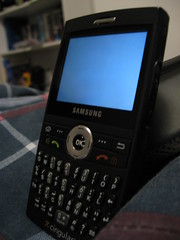
My Samsung BlackjackImage by Dillon K. Hoops via Flickr

I was looking back at some bookmarks and materials that I had on an old computer and it was fascinating to me how the questions around technology have changed. When educators were talking a lot about the "digital divide" back in the early 2000s, the questions were around how were we going to get these expensive machines and infrastructure to the poor. They needed lots of power, cables, expertise and money. Computers were huge and expensive and they still can be today. But we now define a whole other class of machines as computers, including phones, netbooks and PDAs. The most important of these right now are the phones. According to a report by the International Telecommunications Union back in March of this year, at the end of 2008 there were there were an estimated 4.1 billion phone subscriptions world-wide, compared with about 1 billion in 2002. And the definition of a phone has certainly changed since 2002. Phones now play media and connect to the internet and allow for a whole new kind of connection to learning materials. We no longer need to distribute media through CDs or laser discs. Data storage and new kinds of programming (java, ajax, web2.0 tools, etc.) combine to make distributing media easier than ever. Technology is still not absolutely universal, but the wide variety of tools that are now available for communication, the availability of netbooks for under $200, the low-cost of connectivity via WIFI and phone networks means that the real digital divide is one of the imagination. We need to bridge the gap between how we think of learning networks and teaching and the wide variety of tools and technology that are now available.


Reblog this post [with Zemanta]

Wednesday, May 13, 2009

The Future of Learning

I love the opening of this video where he says that we can finally get technology to do what we want, now the real question is what do we want to do."


I like that this video used archival footage and vj clips - both of which are freely available and can be found online at places like www.archive.org. A video of this quality is not beyond the reach of anyone at Tacoma Community College. This week (5/15/09), I will be presenting a workshop on the Flip video camera. A little camera that puts film making and editing into the hands of teachers and students at a very low cost. It comes with editing software built into the camera (it installs it on the computer). It also will create a direct link to your YouTube account and upload the finished film. I will post a link to the presentation the and its resources here.


Reblog this post [with Zemanta]

Friday, April 24, 2009

On Closed and Open Sytems

James Burke, the creator and host of Connectio...Image via Wikipedia

I have a couple emails from the James Burke web asking me why all of a sudden there has been this increase in traffic to his YouTube page. I am not sure why they are asking me. But I did recently subscribe and put him on my favorites list. The answer was that recently a couple of educators mentioned on Twitter that his videos were on YouTube and it is a real testament to the power of Twitter that enough people went and subscribed or downloaded the videos enough for someone to notice. James Burke is the journalist/historian that did the BBC show "Connections" and "The Day the Universe Changed." I was pleasantly surprised to see how his shows from the late 70s and early 80s held up. The shows were popular and I found them very interesting, informative, and fun. The fact that he could hold the interest of a late teen with a mixture of history and science is a real credit to his work. The principles behind his work still holds up today. His latest project is something he calls the "K-Web" or "Knowledge Web." The K-Web, so far, is a collection of over 200,000 thousand entries in a database of people and technology. All of them are interconnected in time, events and other people and objects. It is like a large encyclopedia of connected information. He is talking to the people who created "TheBrain" mindmapping and presentation software which I think is a terrific piece of programming and a great presentation tool. I have embeded a film below of his description of the project. There are some comments at his YouTube page from a few people who are wondering if this project is still active and I have a few ideas about why it might not be or at least why it might be going slowly. You have a great teacher and communicator (James Burke), a lot of information, and some great tools. The problem is going to come in with the creation of yet another closed information system. My impression of the project (and I hope I am wrong) is that they are creating a dynamic, interconnected encyclopedia. And that is the problem - we don't need another encyclopedia. We don't need another database of information (we have Wikipedia). We don't need another closed commercial project that will separate users and knowledge creators from sharing information. What is really special about the idea of the K-Web is that it implies a set of semantic rules that can show us how information, technology and people are interconnected. And that is exciting. I would be interested in an XML/RDF schema that authors could apply to information (metadata) that databases could then gather and assemble according to programed rules. This is essentially the idea of the semantic web. There is an information entropy in closed systems such as MERLOT (of which I am, nevertheless, a participant and believer) because it needs an easier way for people to connect information with people besides memberships and subscriptions. Projects like the K-Web can be a lens through which we really see and make sense of all of the information. I just hope it doesn't get locked up in commercial software. He says here that he sees it as open to education but I mean open as far as people being able to contribute and edit. I like his criticism of concept mapping as too hierarchical to really represent information.

Note: Occasionally I read criticisms of Burke saying that at times the connections he discusses between ideas, technology, information, and people are superficial. But his philosophy is that we are all interconnected and so we are participating, even in small ways, in all of this knowledge building, creating, and inventing. In the past, some of the smallest interconnections have led to the biggest changes. This is especially true in this age of collaboration and communication.


Reblog this post [with Zemanta]

Monday, February 16, 2009

A Treatise on the Astrolabe

I have attempted in a few postings here to talk about art and science. I have been asked more than once about the connection between instructional design and art (other kinds of design) or how I find the time to create when I am writing and working so much for others. There are a couple of answers to those kinds of questions and I think the real trick is to understand that there is no difference between the art we create and the work that we do (another answer is "I never have enough time!"). It is all fine and good to be a poet and an artist, but the real genius is to see the poetry and art in all that we do; to give ourselves to our work in such a way that our creativity or playfulness is found even in the most serious of things. I am only sometimes successful in doing this. This is why I love people like Da Vinci, Chaucer, Dante, and Cheng Man-Ch'ing - the polymathic autodidacts of the world. It is a stunning thing to find out that a favorite poet worked in a bank or was a family physician. Or to read the complete works of Chaucer and run across "A Treatise on the Astrolabe." This would not be too far off from reading a GPS handbook by Umberto Eco. The astrolabe is really an early astronomical computer. It has programmed data (the star positions on the rete) and an input (the alidade or rule). With that, you can find our information about where you are, what time it is, how fast you are going; vital information for both navigating or practicing Islam. Writing something like this was all in a day's work for Chaucer because he was interested and enthusiastic about so many things and was interested in bringing those ideas to others. His "Treatise on the Astrolabe" is a fine example of early technical writing. It is written in very clear, direct prose. The economy of style would fit right in with standard guidelines at NASA. This treatise was written by Chaucer for his son, Louis: "Lyte Lowys my sone, I aperceyve wel by certeyne evydences thyn abilite to lerne sciences touching nombres and proporciouns; and as wel considre I thy besy praier in special to lerne the tretys of the Astrelabie." What is interesting here is that he is writing the treatise for someone he knows to already have a gift for science and math. In other words, he is shaping the document for his audience. He also had the astrolabe calibrated for Oxford because unlike a sextant, an astrolabe is only accurate for one line of latitude. The treatise is unfinished (at least according the latest textual evidence) but it looks finished enough to actually get a working knowledge of the astrolabe. My point here is that this text was used for teaching. It was the second most published of Chaucer's text apart from the "Canterbury Tales" and it is not just a manual for a scientific insturment but a record of an early form of technical writing, teaching, and translation (from Latin sources) from a major poet.
Note: Yes, my father was an English teacher and named me for Chaucer.

Wednesday, October 01, 2008

Histories of the Internet

This is an expansion of the a posting I made in the Moodle forum for Connectivism and Connective Knowledge.

In any discussion of the "history of networked learning" I think we need to look at learning networks in a broader, historical sense that is not really covered by the "march of progress" time-lines we usually see on the internet concerned with the history of the internet; maybe it is because I began my education as an English major with an interest in psychology and history. The technology that facilitates the current version of learning networks is only that: the current version. It is important to remember the milestones of the traditional history but they always leave out pornography, spam, games, advertising, conspiracy theorists, hackers, crackers, d&d, and the nigerian scams as forces that significantly shaped the networks as we know them today. I think we need a history of the internet that includes that.

All of that may sound like I am being funny but lets just take hackers for instance. You cannot go to hacker school. Your success as a hacker will depend on the networks you create with other hackers and what kind of information those networks provide.

I am still trying to wrap my head around the idea of a knowledge existing in a network as something empirical: it is suspect (as all "scientific" theories should be). I wonder how much of seeing the mind as a network may have more to do with our mammalian bilaterial symmetry and breaking the world into a three-dimensional order based on the limitations of our perception in the face of randomness and chaos of the world than any actual truth about the nature of mind. What does a learning network look like to a being with radial symmetry?

One of my favorite "histories of the internet" is Philippe Codognet's The Semiotics of the Web which includes hints of the proto-internets that lay archetypically in the human mind throughout history.

Sunday, July 13, 2008

Theatre and Technology

I made some flip remark on Twitter after looking at Stickam.com that I have a theatrical relationship to technology. Scott had asked us if anyone had been using the video conferencing chat site www.stickam.com for education. All I saw there were young people in chatrooms. It looked very 1997 (I have to stop using that as a critical term). I logged into a chat room there with the screen name "DatelneNBC" -- someone there said that half the room left when I did that. We then joked around for a few minutes about how if I was actually there with Chris Hanson that I did not have anything to worry about and that I was free to leave. Back in 97 I used to go on CUSeeMe with my Mac SE next to my real computer. At the time, the SE would in no way support the net in such a way that teleconferencing was possible -- but it looked like I had the SE actually teleconferencing. I also occasionally had an alien puppet with me. My primitive b/w camera made it look really cool. It would occasionally trip people out.

I was told later that I was completely on the social end of stickam.com and that it really is worth looking at as a teaching tool/meeting room.

It did get me to thinking about Grotowski's idea about the "Theatre of the Poor." That basically theatre can occur where ever two or more are gathered. Things like sets are in the end extraneous. Theatre, according to G, is a series of choices about communication and expression. We engage in theatre in our face-to-face life all the time -- we decide what role we are in and then make choices about how we choose to express ourselves. Those same choices happen online. You can consciously choose a role or persona (and maybe something absurd like alien puppets) and make discoveries or critiques of communication. But in the end the technology is superfluous -- it is the communication. Grotowski was not a huge fan of technology, especially in the theatre, but I saw one of his sets that had two chairs and a single light so even he relied on technology :)

I present myself to my family in one way, my students in another, and old college chums in yet another. I think I have a blog or other web application to support all of those roles. I had one of our students in my summer class first follow me on "geoffcain" at twitter and I warned her that most of those postings were about instructional design, and I don't think I am going to issue that caveat again. I really don't want to discourage people from getting to know me. My intent was not to have her not follow me but to warn her that she might get a bunch of postings on how to adjust settings in photoshop. But then why shouldn't she see that that? It is part of who I am! I have to learn to own that. It is funny how conscious I was about those roles. LiveJournal is great because I can post recipes to my family or talk about golf with others and not have to subject people I work with to those postings -- I can target many audiences with one tool.