A few days ago, I was thinking about Connectivism (the theory of life, the universe, and everything) and was trying to think about how such a theory would account for music: nothing huge, a simple theme from the aria in the Goldberg Variations, for instance. I am not talking about anything complex - something that any child could pick out on the recorder. There isn't anything in my experience of music that suggests a linear, sequential, experience of music that could be plugged in successfully to a concept map. What I mean by successfully is that it would account, even partially, for the experience. I experience music with my whole body and mind (are they really separate?) emotionally, intellectually, and with some music, even a simple tune, to the deepest psychological core of my being. I don't know if I can really account for all of that. Maybe a Buddhist monk has the awareness, time, and focus. I am fully ready to admit my intellectual short-comings. How much of this kind of exercise is an attempt to lift one's self up with one's bootstraps? How does the knower know the knower or the act of knowing? Why are we reading materials that name-drop philosophers and their theories like so many baseball cards? I do not believe that anyone can "simply read modern epistemology" and find anything evident (not with a simple reading). Our knowledge of ourselves and the world around us is much too dynamic for that anyway.
Okay, so in a not impossible but highly improbable coincidence, I turn on the radio and there is Oliver Sacks talking about some of the same issues. He was talking about what our experience of music tells us about the human brain. He talked about what the brain experiences when we experience music. He says that MRIs show that there is no one place in the brain that is active when we are listening to music. There are 20 to 30 places in the brain that show activity: auditory, analytical, temporal, etc. and what is more interesting is that he says that it is never then same areas in any one person. My point about this, and I have made it before, is that the human brain may be too complex to be reduced to a neuron+neuron=learning formula. That a two dimensional, or three dimensional representation can at best only be a metaphor and not a wiring diagram of the mind. But what is wrong with admitting that it is a metaphor? The one of the messages of some of the sutras (and some western philosophers) is that we are metaphors for Being-Itself.
For me, Connectivism answers questions about networked relationships, how learning occurs between conscious beings in a network, how technology is changing the way we learn and think. Those are huge concerns. I think the idea that it is going to account for psychology, semiotics, and epistemology is a little ambitious - especially for a single class! I am not here to "influence" (unless it means to annoy the credulous, then yes) or to be a nay-sayer. I think that before we say something is the Ultimate Answer, we had better be clear about the questions we are asking and answering. You also don't get to pick and choose what questions are in or out of the realm of Connectivism's concern - that is too convenient. If it is a theory of knowledge, then it has to account for all the ways that we know things.
Saturday, October 04, 2008


Wednesday, October 01, 2008
Histories of the Internet
This is an expansion of the a posting I made in the Moodle forum for Connectivism and Connective Knowledge.
In any discussion of the "history of networked learning" I think we need to look at learning networks in a broader, historical sense that is not really covered by the "march of progress" time-lines we usually see on the internet concerned with the history of the internet; maybe it is because I began my education as an English major with an interest in psychology and history. The technology that facilitates the current version of learning networks is only that: the current version. It is important to remember the milestones of the traditional history but they always leave out pornography, spam, games, advertising, conspiracy theorists, hackers, crackers, d&d, and the nigerian scams as forces that significantly shaped the networks as we know them today. I think we need a history of the internet that includes that.
All of that may sound like I am being funny but lets just take hackers for instance. You cannot go to hacker school. Your success as a hacker will depend on the networks you create with other hackers and what kind of information those networks provide.
I am still trying to wrap my head around the idea of a knowledge existing in a network as something empirical: it is suspect (as all "scientific" theories should be). I wonder how much of seeing the mind as a network may have more to do with our mammalian bilaterial symmetry and breaking the world into a three-dimensional order based on the limitations of our perception in the face of randomness and chaos of the world than any actual truth about the nature of mind. What does a learning network look like to a being with radial symmetry?
One of my favorite "histories of the internet" is Philippe Codognet's The Semiotics of the Web which includes hints of the proto-internets that lay archetypically in the human mind throughout history.
In any discussion of the "history of networked learning" I think we need to look at learning networks in a broader, historical sense that is not really covered by the "march of progress" time-lines we usually see on the internet concerned with the history of the internet; maybe it is because I began my education as an English major with an interest in psychology and history. The technology that facilitates the current version of learning networks is only that: the current version. It is important to remember the milestones of the traditional history but they always leave out pornography, spam, games, advertising, conspiracy theorists, hackers, crackers, d&d, and the nigerian scams as forces that significantly shaped the networks as we know them today. I think we need a history of the internet that includes that.
All of that may sound like I am being funny but lets just take hackers for instance. You cannot go to hacker school. Your success as a hacker will depend on the networks you create with other hackers and what kind of information those networks provide.
I am still trying to wrap my head around the idea of a knowledge existing in a network as something empirical: it is suspect (as all "scientific" theories should be). I wonder how much of seeing the mind as a network may have more to do with our mammalian bilaterial symmetry and breaking the world into a three-dimensional order based on the limitations of our perception in the face of randomness and chaos of the world than any actual truth about the nature of mind. What does a learning network look like to a being with radial symmetry?
One of my favorite "histories of the internet" is Philippe Codognet's The Semiotics of the Web which includes hints of the proto-internets that lay archetypically in the human mind throughout history.
Sunday, September 28, 2008
Learning Networks: Theory into Practice
For readers of this blog who are not in the Connectivism class, I highly recommend this short but brilliant presentation. I listened to the audio and followed along with his slides.
I was going to wait until I had finished more of the readings before I wrote about this but I am pretty excited about this presentation and need to write about this and get some things out of my notes and into my network. Stephen Downes presented on Learning Networks: Theory and Practiceon March 8, 2005 to the International Conference on Methods and Technologies for Learning, in Palermo, Italy. Maybe I am so excited by this because it is more about practice than it is theory. This is a clear explication of how Connectivism works. There are still seeds of Constructivism in this presentation. In the beginning, he talks about how Connectivism gives people the "capacities" and allows them to create their own learning which is one of the central tenets of Constructivism. But Downes emphasis is on how technology shifts the view of learning from a controlled and managed deliverable to people creating their own learning. Learning is not something you get from the library "and put in people's heads." He says that "Learning is a conversation." And this has been missing from the discussions of Connectivism in the first couple weeks of our class, the social dimension of Connectivism. According to this presentation, meaning is not inherent in the signal - it must be "received and interpreted" by an entity. (This is why I think knowledge is more than a network.) From this perspective, there is a small but significant overlap in the Venn diagram between these learning theories. His description of a network is useful. It actually shows that some entity has to be in there somewhere for learning to occur.
Okay, here is the really useful part, this is brilliant - his Network Design Principles. As a teacher and instructional designer, I am always looking at the why behind how something works. If something works, we want to be able to reproduce it or to facilitate the conditions that allow learning to happen in that particular way for others. At Tacoma Community College, we are in the middle of teaching what we boldly call a "Connectivist class." Downes eight principles will allow us to build a Connectivist rubric that we will be able to apply to our assignments and materials just as we would apply a rubric that measures interactivity in our course development process in the eLearning Department. His principles are:
One of my goals for this class will be to take this list and put it into some kind of rubric that will allow us to ask of each assignment "to what degree does this assignment allow us to implement X principle?" I think I may rework some of the language: what is the positive action behind "disaggregating"?
His talk ends with the observation that there is no one person that knows how to build an aircraft - that it is a network of people with diverse skills that are all working within a network that creates the aircraft. This is one of my problems about traditional English classes (I also teach English): what are we teaching the students when we look at the ten page paper as an end to itself? What context do this papers exist in? I have never been asked in my entire working life to write a ten page paper. I have been asked to contribute to the learning of a group and that has sometimes involved writing but there was some connection to the collective intelligence of others.
I was going to wait until I had finished more of the readings before I wrote about this but I am pretty excited about this presentation and need to write about this and get some things out of my notes and into my network. Stephen Downes presented on Learning Networks: Theory and Practiceon March 8, 2005 to the International Conference on Methods and Technologies for Learning, in Palermo, Italy. Maybe I am so excited by this because it is more about practice than it is theory. This is a clear explication of how Connectivism works. There are still seeds of Constructivism in this presentation. In the beginning, he talks about how Connectivism gives people the "capacities" and allows them to create their own learning which is one of the central tenets of Constructivism. But Downes emphasis is on how technology shifts the view of learning from a controlled and managed deliverable to people creating their own learning. Learning is not something you get from the library "and put in people's heads." He says that "Learning is a conversation." And this has been missing from the discussions of Connectivism in the first couple weeks of our class, the social dimension of Connectivism. According to this presentation, meaning is not inherent in the signal - it must be "received and interpreted" by an entity. (This is why I think knowledge is more than a network.) From this perspective, there is a small but significant overlap in the Venn diagram between these learning theories. His description of a network is useful. It actually shows that some entity has to be in there somewhere for learning to occur.
Okay, here is the really useful part, this is brilliant - his Network Design Principles. As a teacher and instructional designer, I am always looking at the why behind how something works. If something works, we want to be able to reproduce it or to facilitate the conditions that allow learning to happen in that particular way for others. At Tacoma Community College, we are in the middle of teaching what we boldly call a "Connectivist class." Downes eight principles will allow us to build a Connectivist rubric that we will be able to apply to our assignments and materials just as we would apply a rubric that measures interactivity in our course development process in the eLearning Department. His principles are:
- Decentralize
- Distribute
- Disintermediation
- Disaggregating
- Dis-integrating
- Democratize
- Dynamize
- Desegregate
One of my goals for this class will be to take this list and put it into some kind of rubric that will allow us to ask of each assignment "to what degree does this assignment allow us to implement X principle?" I think I may rework some of the language: what is the positive action behind "disaggregating"?
His talk ends with the observation that there is no one person that knows how to build an aircraft - that it is a network of people with diverse skills that are all working within a network that creates the aircraft. This is one of my problems about traditional English classes (I also teach English): what are we teaching the students when we look at the ten page paper as an end to itself? What context do this papers exist in? I have never been asked in my entire working life to write a ten page paper. I have been asked to contribute to the learning of a group and that has sometimes involved writing but there was some connection to the collective intelligence of others.
Thursday, September 25, 2008
Technology Lesson
In our class, Connectivism and Connective Knowledge, we were subjected to Barry Wellman's powerpoint presentation as if it were an actual paper. What is wrong with that? Well, it is 116 slides long, has migrane inducing color combinations and will use more than 30 bullet points on one slide. It is enough to make one retire to a monastery in the Alps and dedicate ones life to recopying the works of Tufte on vellum. Without his notes, voice, or narrative it reads like a brief outline of network theory that also trots out some pretty hateful made up words like "glocalization." Must we do this to the language? It opens portentiously enough with the slide that says that there are three ways of looking at reality (yes, Michio Kaku, only three) and they are "categories," "groups," and "networks" with no explanation why any of those three would need to be exclusive of one another. Some views and theories actually feed and replenish one another. Jung himself would admit that he would be no where without Freud and would say that Freud's theories best explained human development. And Freud's later theories are certainly informed by Jung's exploration of mythology.
Wellman needs toready read Tufte!
Wellman needs to
Sunday, September 21, 2008
Wake Up Mr. Chips its the 20th Century!
Mark Edmundson, English teacher at the University of Virginia, has written an anti-educational technology essay in the New York Times called "Geek Lessons." His major claim against technology is that it is merely an attempt for teachers to become popular: they are just pandering to the students. He has a lot to say about what good teaching is - predictably, it is all about the professor. It is clear from the article that he has no experience with technology in the classroom or what teaching with technology is about. He says that "good teachers perceive the world in alternative terms, and they push their students to test out these new, potentially enriching perspectives." Why can't someone do that using technology?
We use technology not because it is new, cool, or fun (although it can be all three), but because it is an opportunity to teach multi-modally (visual and audio learning), extend the community of the classroom beyond the walls of the brick and mortar classroom, to democratize education by making it available to those in remote areas or who must work and raise families.
One of the reasons why there are so many grants around for technology and fewer to send professors off to Europe for a semester is that technology can, for instance, solve real problems like making education accessible to those with disabilities. Other reasons that administrators may like technology is that the research shows that the higher the interactivity of a class, the higher the retention rates; technology can be a tool for making courses interactive.
I find teachers like Edmundson a bit sad - if their teaching style is such that it would not survive a laptop in their classrooms, what does that say about what is being taught and most importantly, how it is being taught. Edmundson gets that the culture is changing and the students expectations are changing. They are no longer satisfied with the "sage on the stage" style of teaching. They are no longer satisfied having to learn using three hundred year old methodologies. Does Edmundson accept handwritten papers? I doubt it. He does himself, tech-friendly faculty, and his students a great disservice by dismissing these cultural changes as merely selfishness on the part of the students.
I agree with Edmundson when he says that "Good teachers...can induce to struggle to affirm intelligently what you've previously believed in indolent, unconsidered ways." This includes an uncritical relationship to technology. By leveraging new technologies in our teaching, in thoughtful ways, we show the students that technology can be used thoughtfully. Edmundson's essay assumes that technology is a tool of passive consumption. He does not have that thoughtful, critical relationship to technology so he assumes that others don't either.
I hope that the editors of the Times will seek to balance this perspective by talking to other professors out there who have this critical engagement with educational technology like David Silver at the University of San Francisco or George Seimens at the University of Manitoba.
We use technology not because it is new, cool, or fun (although it can be all three), but because it is an opportunity to teach multi-modally (visual and audio learning), extend the community of the classroom beyond the walls of the brick and mortar classroom, to democratize education by making it available to those in remote areas or who must work and raise families.
One of the reasons why there are so many grants around for technology and fewer to send professors off to Europe for a semester is that technology can, for instance, solve real problems like making education accessible to those with disabilities. Other reasons that administrators may like technology is that the research shows that the higher the interactivity of a class, the higher the retention rates; technology can be a tool for making courses interactive.
I find teachers like Edmundson a bit sad - if their teaching style is such that it would not survive a laptop in their classrooms, what does that say about what is being taught and most importantly, how it is being taught. Edmundson gets that the culture is changing and the students expectations are changing. They are no longer satisfied with the "sage on the stage" style of teaching. They are no longer satisfied having to learn using three hundred year old methodologies. Does Edmundson accept handwritten papers? I doubt it. He does himself, tech-friendly faculty, and his students a great disservice by dismissing these cultural changes as merely selfishness on the part of the students.
I agree with Edmundson when he says that "Good teachers...can induce to struggle to affirm intelligently what you've previously believed in indolent, unconsidered ways." This includes an uncritical relationship to technology. By leveraging new technologies in our teaching, in thoughtful ways, we show the students that technology can be used thoughtfully. Edmundson's essay assumes that technology is a tool of passive consumption. He does not have that thoughtful, critical relationship to technology so he assumes that others don't either.
I hope that the editors of the Times will seek to balance this perspective by talking to other professors out there who have this critical engagement with educational technology like David Silver at the University of San Francisco or George Seimens at the University of Manitoba.
Monday, September 15, 2008
Learning Modality vs Learning Theory
I have used learning theory, Constructivism, to create course materials and assignments. I have used the theory to produce particular results. As quoted in Mergal's paper:
What is a theory?
* A theory provides a general explanation for observations made over time.
* A theory explains and predicts behavior.
* A theory can never be established beyond all doubt.
* A theory may be modified.
* Theories seldom have to be thrown out completely if thoroughly tested but sometimes a theory may be widely accepted for a long time and later disproved.
(Dorin, Demmin & Gabel, 1990)
I have seen all of this at work in one way or another with Constructivism and I haven't yet with Connectivism. This class is one experiment and what Char Gore and I are doing in HIM101 is another. It is to new of a theory to say it has been adequately tested - one can't reject an untested theory, one has to test it!
This is not a defense of Constructivism or a Constructivism vs. Connectivism aaproach. I just think it is important to talk about what people do as teachers and instructional designers and put Connectivism into that framework. In a simple form, Constructivist teaching is teaching that provides students the opportunity to put the information being taught in their own words and apply it to their lives. How is that not "connecting"?
I think the same thing is happening in a way with Connectivism, but it does not help that the vocabulary around it all has not really been nailed down. What do George and Stephen mean by "knowledge"? Berkeley? Hume? Kant? Buddha? Never mind how knowledge can exist in inanimate objects; how can you have knowledge without a knower? How can inanimate objects contain "learning"? There are some phenomenal changes happening in technology and culture and those changes are changing how I teach in some dramatic ways, but it is not clear yet if we are looking at technology, a new learning modality, or a theory. If students have visual resources available to them in an unprecedented way (movies, overhead projectors, photography) do we need a new learning theory to account for that learning modality (visual learning vs, traditional read/write) or do we adapt theories for the new media?
Any "scientific" picture of the mind has wound up not being how the mind actually works but being a model or metaphor that accounts for our current understanding of how we think it works. Connectivism will have to be able to account for the changes in that metaphor if it is going to keep the claim that it is a learning theory that reflects how the mind actually works.
A book doesn't even contain learning. Learning is what someone can do with information. Someone can read a book and not learn anything. There are no people in my telephone either, I have to actually call them.
Mergel, Brenda.(1998) Instructional Design & Learning Theory. University of Saskatchewan. http://www.usask.ca/education/coursework/802papers/mergel/brenda.htm
What is a theory?
* A theory provides a general explanation for observations made over time.
* A theory explains and predicts behavior.
* A theory can never be established beyond all doubt.
* A theory may be modified.
* Theories seldom have to be thrown out completely if thoroughly tested but sometimes a theory may be widely accepted for a long time and later disproved.
(Dorin, Demmin & Gabel, 1990)
I have seen all of this at work in one way or another with Constructivism and I haven't yet with Connectivism. This class is one experiment and what Char Gore and I are doing in HIM101 is another. It is to new of a theory to say it has been adequately tested - one can't reject an untested theory, one has to test it!
This is not a defense of Constructivism or a Constructivism vs. Connectivism aaproach. I just think it is important to talk about what people do as teachers and instructional designers and put Connectivism into that framework. In a simple form, Constructivist teaching is teaching that provides students the opportunity to put the information being taught in their own words and apply it to their lives. How is that not "connecting"?
I think the same thing is happening in a way with Connectivism, but it does not help that the vocabulary around it all has not really been nailed down. What do George and Stephen mean by "knowledge"? Berkeley? Hume? Kant? Buddha? Never mind how knowledge can exist in inanimate objects; how can you have knowledge without a knower? How can inanimate objects contain "learning"? There are some phenomenal changes happening in technology and culture and those changes are changing how I teach in some dramatic ways, but it is not clear yet if we are looking at technology, a new learning modality, or a theory. If students have visual resources available to them in an unprecedented way (movies, overhead projectors, photography) do we need a new learning theory to account for that learning modality (visual learning vs, traditional read/write) or do we adapt theories for the new media?
Any "scientific" picture of the mind has wound up not being how the mind actually works but being a model or metaphor that accounts for our current understanding of how we think it works. Connectivism will have to be able to account for the changes in that metaphor if it is going to keep the claim that it is a learning theory that reflects how the mind actually works.
A book doesn't even contain learning. Learning is what someone can do with information. Someone can read a book and not learn anything. There are no people in my telephone either, I have to actually call them.
Mergel, Brenda.(1998) Instructional Design & Learning Theory. University of Saskatchewan. http://www.usask.ca/education/coursework/802papers/mergel/brenda.htm
Saturday, September 13, 2008
Critiques of Connectivism
Constructivism represented a revolution in online learning. It changed the online classroom model from "sage on the stage" to "guide on the side" or course facilitator. What happened to online education was that the focus went from point and click online textbooks to people focusing on creating community (e.g. Paloff and Pratt). Despite that, there are people out there who call themselves "Constructivist" teachers who still use punishment and reward based learning. I think there will be a period like that with Connectivism. I do think that Connectivism will be better defined in the future and supported by research, an historical perspective, and a fully-realized pedagogy. You don't go from a single essay to fully realized idea overnight - Connectivism will have its version of "Being and Time." I think we are seeing the birth of a system of thought that will account for our new relationship to technology. Connectivism will have its different schools of thought just as Constructivism does.
The claim that Constructivism is some how vague is a little simplistic - that is like saying Existentialism is vague. There are a handful of principles one may take from Connectivism and transform a department or school -- people have.
Bill Kerr makes some good points about what Connectivism means to learning theory: There are other theories that account for Connectivism. Distributed cognition theories are over ten years old. There is a lot of re-inventing the philosophical wheel in Connectivism. Connectivism does not adequately account for social/psychological dimensions of learning (or YET account for). I think our HIM 101 class is an opportunity to create a Connectivist laboratory for working out for Constructivist curriculum and pedagogy.
There is a more philosophical account of Connectivism in one of Downes essays. The link to the version of the essay with citations is actually working so I will give a review of that article here later.
The claim that Constructivism is some how vague is a little simplistic - that is like saying Existentialism is vague. There are a handful of principles one may take from Connectivism and transform a department or school -- people have.
Bill Kerr makes some good points about what Connectivism means to learning theory: There are other theories that account for Connectivism. Distributed cognition theories are over ten years old. There is a lot of re-inventing the philosophical wheel in Connectivism. Connectivism does not adequately account for social/psychological dimensions of learning (or YET account for). I think our HIM 101 class is an opportunity to create a Connectivist laboratory for working out for Constructivist curriculum and pedagogy.
There is a more philosophical account of Connectivism in one of Downes essays. The link to the version of the essay with citations is actually working so I will give a review of that article here later.
Thursday, September 11, 2008
Health Information Management 101
I am very excited about this syllabus I wrote with Charlene Gore for a class that we co-teach, Health Information Management 101. This course is a credit/no credit, two unit, student success course where we teach the students all of the technology they will need to be successful in the HIM program: their learning management system, web 2.0 tools, and Second Life (it is used on campus). The idea is to get all of the technology, formation of learning networks, and information access all in one class. This lets the teachers leverage the technology without having to teach it. We hope that this is rolled out campus-wide one day. The bump in the road is that it takes teachers willing to embrace web 2.0 technologies, a leaderless model ala "The Starfish and the Spider" (learning is lead by students in small groups facilitated by teachers), and portfolio assessment. The course is still in refinement and we would love feedback from others who share a similar vision.
Saturday, September 06, 2008
SLED CC '08 Presentation
View the presentation at Slideshare to get my notes. This was my small contribution to "Training for Medical Professionals in Virtual Worlds" with John Miller et alia.
Saturday, August 30, 2008
Ubiquitous Interfaces, Ubiquitous Functionality at Toolness
Ubiquitous Interfaces, Ubiquitous Functionality at Toolness
Ubiquity is a new plug-in for Firefox that integrates multiple tools as key commands right in your browser. When you are at a restaurant web page, for instance, you can bring up a map from Google, a review from Tripadvisor, and translate the page from the Spanish all by typing into your web-browser. When you are using the plug-in, you do not even see those other services, they all just get bundled into your browser in a way that you can send to other people.
This particular plug-in is not the future of web-browsers but it will be something very close to this. Most of the faculty I work with balk at all of the log-ins they must manage and this is not only a way to overcome that, but is a new way of using information on the internet.
Sidenote on Logophobia: So I do not believe that Web 2.0 is the future. I believe that seamless, user-generated mash-ups are. I need to teach Web 2.0 tools to help students and faculty learn to create content on their own and not wait for information and services to be delivered. In other words, someone who is taught how to use the net critically and knows how to use Web 2.0 tools will be ready for what's next. I am going to use the word "Web 2.0" because people know what I mean when I say that. They may not know what I mean when I say "social media tools" (media? really?), or "Meta-cognitive connectivist hyper-collaboratogy." The phrase "Web 2.0" is not a particularly elegant phrase: it does not concisely define anything, but we are talking about a broad collection of tools. When someone talks about Web 2.0, I know they are not talking about the old Yahoo!, web pages made with Netscape Communicator, or Compuserve. We can call the next stage Web 3.0 or what ever word falls into common usage. I have an education book from the 60s called "The Rasberry Experience." The name was an attempt to break out of the semantic games of educational research. They failed.
Ubiquity is a new plug-in for Firefox that integrates multiple tools as key commands right in your browser. When you are at a restaurant web page, for instance, you can bring up a map from Google, a review from Tripadvisor, and translate the page from the Spanish all by typing into your web-browser. When you are using the plug-in, you do not even see those other services, they all just get bundled into your browser in a way that you can send to other people.
This particular plug-in is not the future of web-browsers but it will be something very close to this. Most of the faculty I work with balk at all of the log-ins they must manage and this is not only a way to overcome that, but is a new way of using information on the internet.
Sidenote on Logophobia: So I do not believe that Web 2.0 is the future. I believe that seamless, user-generated mash-ups are. I need to teach Web 2.0 tools to help students and faculty learn to create content on their own and not wait for information and services to be delivered. In other words, someone who is taught how to use the net critically and knows how to use Web 2.0 tools will be ready for what's next. I am going to use the word "Web 2.0" because people know what I mean when I say that. They may not know what I mean when I say "social media tools" (media? really?), or "Meta-cognitive connectivist hyper-collaboratogy." The phrase "Web 2.0" is not a particularly elegant phrase: it does not concisely define anything, but we are talking about a broad collection of tools. When someone talks about Web 2.0, I know they are not talking about the old Yahoo!, web pages made with Netscape Communicator, or Compuserve. We can call the next stage Web 3.0 or what ever word falls into common usage. I have an education book from the 60s called "The Rasberry Experience." The name was an attempt to break out of the semantic games of educational research. They failed.
Friday, August 22, 2008
Translation Technologies in Second Life
I was really thrilled to find the "Simbolic Translator" in Second Life ( Simbolic Translator: http://slurl.com/secondlife/Cupo/102/120/36). About ten years ago, I worked with Lou Spaventa at Santa Barbara City College to help him use a MUD (text based virtual worlds) to participate in the United Nation's World Youth Day. We had people who were learning English from around the world all meeting in various "rooms." The rooms were listed by country and it was really eye-opening because we thought that all of the French people would be in the "France" room, etc. But it was much more dynamic and evolved that than. There were a lot of Egyptians and Israelis talking for instance, it became very political but all very positive. In a single day, a lot of friendships were made and email penpals made. It was a fascinating process. Lou Spaventa is an extremely dynamic and intelligent person. The technology, though, was a lot for him - probably most of us. It was very sophisticated for its time and Lou found it all very stressful. I see this all the time. The technology changes but our relationship to technology doesn't seem to change. It can be very stressful - it is new, complicated, resource-heavy, and you have to trust that a lot of people really know what they are doing to really make it work. And failure has to be an option. People today would probably laugh at that technology: terminal programs all logging in to a single server.
Anyway, in Second Life there is this program that will translate any text in and out of about 22 languages. It handles Asian, Slavic, Greek, Arabic and pretty much all of the romance languages. I have used it to communicate with Asian and French people and have invited some to participate in some of our projects at Evergreen Island. I think it is time to revisit an idea like "World Youth Day" but change it to something like "World Student Day" to include the wide-variety of ages that are represented in education. I wound up giving the creator of Simbolic Translator a thousand lindens which is about $5 American in Second Life. The creator, Tragix Wilder, made a big deal about my donation but I have paid for things in SL that did a tenth as much and work like his really deserves recognition.
Anyway, in Second Life there is this program that will translate any text in and out of about 22 languages. It handles Asian, Slavic, Greek, Arabic and pretty much all of the romance languages. I have used it to communicate with Asian and French people and have invited some to participate in some of our projects at Evergreen Island. I think it is time to revisit an idea like "World Youth Day" but change it to something like "World Student Day" to include the wide-variety of ages that are represented in education. I wound up giving the creator of Simbolic Translator a thousand lindens which is about $5 American in Second Life. The creator, Tragix Wilder, made a big deal about my donation but I have paid for things in SL that did a tenth as much and work like his really deserves recognition.
Sunday, August 17, 2008
Study: Fastest Growing US Companies Rapidly Adopting Social Media - ReadWriteWeb
Study: Fastest Growing US Companies Rapidly Adopting Social Media - ReadWriteWeb: "A one year follow up on a study of social media adoption at 500 of the fastest growing companies in the US has found that familiarity with and use of blogs, podcasting, wikis, online video and social networking has skyrocketed in 2008 to nearly double what it was in 2007. 77% of respondents now report at least some use of a social media tool in their business."
I did not find the results of this study surprising at all. I was talking to some people at Harcourt once about a new hire. They had two nearly identical candidates both with internships and a freshly minted degree. They went for the candidate who was comfortable with blogs. Creating a student success like our HIM 101 course at Tacoma Community College is not just an eccentric choice of technologies; using social media tools for teaching and learning prepares the students for the actual workplace. In all my years in the private sector as an employee or consultant, no one has ever asked me to take a multiple choice test or write a ten page paper. There are things that need to be written, but they are almost always written collaboratively. We do a great disservice by not including those skills in our teaching and assessment.
I did not find the results of this study surprising at all. I was talking to some people at Harcourt once about a new hire. They had two nearly identical candidates both with internships and a freshly minted degree. They went for the candidate who was comfortable with blogs. Creating a student success like our HIM 101 course at Tacoma Community College is not just an eccentric choice of technologies; using social media tools for teaching and learning prepares the students for the actual workplace. In all my years in the private sector as an employee or consultant, no one has ever asked me to take a multiple choice test or write a ten page paper. There are things that need to be written, but they are almost always written collaboratively. We do a great disservice by not including those skills in our teaching and assessment.
Monday, August 11, 2008
Everything Old is New Again
Something about these old books from the 60s makes me sneeze. They really don't make paper like they used to. Some salient quotes from R. Buckminster Fuller's Education Automation (1962):
"I would say, then, that you are faced with a future in which education is going to be a number one amongst the great world industries, within which will flourish an educational machine technology that will provide tools such as the individually selected and articulated two-way TV and an intercontinentally net-worked, documentaries call-up system, operative over any home two-way TV set."
This sounds like YouTube. I am sure though he was not thinking it also hosting re-runs of "Hogan's Heroes." There are some great pieces of film that are winding up on YouTube that you just can't find anywhere else (like "Why Man Creates").
"We would also find that generally speaking the geographically larger the physical task to be dome, the duller the conceptual brain that is brought to bear upon the integration of the scientific discoveries and their technically reaqlized applications."
The above is an early argument for open source. There is no way that one person, one company or even a handful of governments is going to bring education to those that need it most. The message that fuller has is that we need to give people access to the information and the networks (two-way TV set). Today's education is still a system of one-way delivery. The interaction that is inherent in the network is everything.
"I would counsel you in your deliberation regarding getting campuses ready now to get general comprehensive environmental controls that are suitable to all-purposes like a circus. A circus is a transformable environment."
This is why I like what Howard Rhiengold is doing with his "Co-Lab." It is an extremely flexible collection of tools. It can be added on to a commercial learning management system (the "duller conceptual brain" that Fuller was writing about) or be used as a stand-alone LMS itself. I like being able to chose what tools I use rather than having them chosen for me out of the box.
"You don't need a detailed drawing; we do not make that kind of communication to craftsman anymore; but all of the schools go on teaching that we do. The data no longer goes to the craftsman; it goes to the tools...What we want is the man who gets the fundamental concept, the information significance, and can do some comprehensive thinking regarding that information. He will put the data into the information machines, and it will be processed by automation into physical realization of his effective thinking. We don't need many of the myriad of 'things' we have had in schools."
A side note about Connectivism: So whenever I am faced with a new theory of learning, the first question I ask is "So what?" How does this theory describe what we do? How can this theory tell me about how people learn, and therefore, how I should teach? I want any new theory to be like an information machine; I can give it my data and get out of it a realization of effective thinking. Knowing that some information is more significant than other information is currently one of the top critical skills. I know how constructivism approaches this problem: we apply information to our experiences and the experiences of others and we create new knowlege. The goal of education is to create places in space and time where this can happen. Teaching is to facilitate this interaction. This fits my experience in the classroom and online. My questions about constructivism (and they are questions because they are unanswered - there is nothing rhetorical about this) ask if the creation of a network isn't just the future of constructivism? Is it focusing on the network rather than the people and experiences? The connection rather than the connected?
"I would say, then, that you are faced with a future in which education is going to be a number one amongst the great world industries, within which will flourish an educational machine technology that will provide tools such as the individually selected and articulated two-way TV and an intercontinentally net-worked, documentaries call-up system, operative over any home two-way TV set."
This sounds like YouTube. I am sure though he was not thinking it also hosting re-runs of "Hogan's Heroes." There are some great pieces of film that are winding up on YouTube that you just can't find anywhere else (like "Why Man Creates").
"We would also find that generally speaking the geographically larger the physical task to be dome, the duller the conceptual brain that is brought to bear upon the integration of the scientific discoveries and their technically reaqlized applications."
The above is an early argument for open source. There is no way that one person, one company or even a handful of governments is going to bring education to those that need it most. The message that fuller has is that we need to give people access to the information and the networks (two-way TV set). Today's education is still a system of one-way delivery. The interaction that is inherent in the network is everything.
"I would counsel you in your deliberation regarding getting campuses ready now to get general comprehensive environmental controls that are suitable to all-purposes like a circus. A circus is a transformable environment."
This is why I like what Howard Rhiengold is doing with his "Co-Lab." It is an extremely flexible collection of tools. It can be added on to a commercial learning management system (the "duller conceptual brain" that Fuller was writing about) or be used as a stand-alone LMS itself. I like being able to chose what tools I use rather than having them chosen for me out of the box.
"You don't need a detailed drawing; we do not make that kind of communication to craftsman anymore; but all of the schools go on teaching that we do. The data no longer goes to the craftsman; it goes to the tools...What we want is the man who gets the fundamental concept, the information significance, and can do some comprehensive thinking regarding that information. He will put the data into the information machines, and it will be processed by automation into physical realization of his effective thinking. We don't need many of the myriad of 'things' we have had in schools."
A side note about Connectivism: So whenever I am faced with a new theory of learning, the first question I ask is "So what?" How does this theory describe what we do? How can this theory tell me about how people learn, and therefore, how I should teach? I want any new theory to be like an information machine; I can give it my data and get out of it a realization of effective thinking. Knowing that some information is more significant than other information is currently one of the top critical skills. I know how constructivism approaches this problem: we apply information to our experiences and the experiences of others and we create new knowlege. The goal of education is to create places in space and time where this can happen. Teaching is to facilitate this interaction. This fits my experience in the classroom and online. My questions about constructivism (and they are questions because they are unanswered - there is nothing rhetorical about this) ask if the creation of a network isn't just the future of constructivism? Is it focusing on the network rather than the people and experiences? The connection rather than the connected?
Saturday, August 09, 2008
Edupunk is Dead: Long Live Ednuwave
 Who are you trying to kid? The era is over. Edupunk is fine but the insurance liability of the moshpit (workshop) got pretty stiff. And it got repetitious, the same old vomit into your keyboard and swing at the dean. And after the violence of the SoHo edupunk riots in the late 70s, I began to feel, as wikipedia puts it a certain sense of the experimental, a lyricism that I wasn't finding in my Sex Pistols approach to education technology. Those boots were killing my feet. I want the edgy creativity of the Talking Heads, the soulfulness and hair of Flock of Seagulls, and the emotional intelligence of the B-52s. The EdNuWave is
Thursday, August 07, 2008
Favorite Recipes of HIM 101
We had a file sharing exercise in the Health Information Management class I am co-teaching and the files we shared were favorite recipes. Here are the results:
Armchair astronomer discovers unique 'cosmic ghost' - CNN.com
Armchair astronomer discovers unique 'cosmic ghost' - CNN.com: "During the last year, more than 150,000 armchair astronomers from all over the world volunteered their time, submitting more than 50 million classifications."
This is the story about one amateur astronomer who made a discovery. The discovery is important enough to warrant the attention of the Hubble Space Telescope and professional astronomers. But the real story is how the discovery was made. A couple of scientists were trying to classify one million images of from telescopes. They asked for help from the amateur astronomy community.
"The public's collective wisdom -- the same principle that guides jury trials, or Wikipedia -- proved remarkably astute, Schawinski said. For example, if 33 of 36 volunteers thought a galaxy appeared elliptical, then astronomers could be confident the classification was correct, he said."
This is similar to the same process that goes on with bird counts. Professionals rely on data collected from many amateurs to determine migration patterns, habitat health, and bird population levels.
The article goes on to describe the discovery but as I said, the real discovery is that scientists are learning to rely more on the collective intelligence of people.
This is the story about one amateur astronomer who made a discovery. The discovery is important enough to warrant the attention of the Hubble Space Telescope and professional astronomers. But the real story is how the discovery was made. A couple of scientists were trying to classify one million images of from telescopes. They asked for help from the amateur astronomy community.
"The public's collective wisdom -- the same principle that guides jury trials, or Wikipedia -- proved remarkably astute, Schawinski said. For example, if 33 of 36 volunteers thought a galaxy appeared elliptical, then astronomers could be confident the classification was correct, he said."
This is similar to the same process that goes on with bird counts. Professionals rely on data collected from many amateurs to determine migration patterns, habitat health, and bird population levels.
The article goes on to describe the discovery but as I said, the real discovery is that scientists are learning to rely more on the collective intelligence of people.
Monday, August 04, 2008
When a Syllabus Is Not Your Own - Chronicle.com
When a Syllabus Is Not Your Own - Chronicle.com
Okay, when I started teaching English, I would not have made it at all without the spirit of collegiality (the old school tie, insert secret handshake here). I had to teach a course I had never taught before and I asked an instructor for help and she gave me her syllabus. I said "you are just giving me this?" and she said "syllabi don't teach, teachers teach." In other words, the syllabus is merely a skeleton and the oh so delicate flesh makes all the difference. I freely hand out my syllabus online. I do ask that if you take a syllabus, workbook, or assignment that you send me a copy of your adaptations but if you don't - it is on you. I once wrote a manual that I copy-lefted to the world. It was a handbook on writing with computers for English students. I did not have time to update it every semester. By making it freely available, I had people update it for me, use it in their courses, give me the updates and suggestions for new assignments. The sage-on-the-stage attitude of the author of "When a Syllabus is Not Your Own" is elitist and demonstrates an ignorance of copyright law and is incredibly naive about how information moves in the modern world. Nobody's, and I mean nobody's, syllabus is all that.
Okay, when I started teaching English, I would not have made it at all without the spirit of collegiality (the old school tie, insert secret handshake here). I had to teach a course I had never taught before and I asked an instructor for help and she gave me her syllabus. I said "you are just giving me this?" and she said "syllabi don't teach, teachers teach." In other words, the syllabus is merely a skeleton and the oh so delicate flesh makes all the difference. I freely hand out my syllabus online. I do ask that if you take a syllabus, workbook, or assignment that you send me a copy of your adaptations but if you don't - it is on you. I once wrote a manual that I copy-lefted to the world. It was a handbook on writing with computers for English students. I did not have time to update it every semester. By making it freely available, I had people update it for me, use it in their courses, give me the updates and suggestions for new assignments. The sage-on-the-stage attitude of the author of "When a Syllabus is Not Your Own" is elitist and demonstrates an ignorance of copyright law and is incredibly naive about how information moves in the modern world. Nobody's, and I mean nobody's, syllabus is all that.
Sunday, August 03, 2008
Hyperpolitics, American Style (Live Version)
Hyperpolitics, American Style (Live Version)
Okay, the information in this video is astounding because it shows that the modern education system is headed for a significant failure if it does not account for the creation of networks as a part of education. We have to go from being a top-down hierarchical delivery system to a distributed network of learning. Humans sent 43 billion text messages to one another -- why aren't more educators tapping into this?
Okay, the information in this video is astounding because it shows that the modern education system is headed for a significant failure if it does not account for the creation of networks as a part of education. We have to go from being a top-down hierarchical delivery system to a distributed network of learning. Humans sent 43 billion text messages to one another -- why aren't more educators tapping into this?
Saturday, August 02, 2008
Slideboom Presentation on iTunes
This is a brief presentation on iTunes that I did for my class using Slideboom. It does not auto-advance, you have to click through it.:
Wednesday, July 30, 2008
Our Online Course Development Process
This is a posting of an early draft of our online course development process. I am posting it here as an example of sharing documents for the Health Information Management class I am co-teaching this summer. BUT, if you have any questions or comments on our process, I would appreciate any input.
Tuesday, July 29, 2008
Conceptualizations of Information

Luddites often fear technology because of the sense that it is something alien to human nature. There is this feeling that if we are using technology that somehow we are moving away from something essentially human. I would argue that our use of technology is part of our humanity and that the Rousseauist ideal of man in harmony with nature is a myth that never was. We invented fire as soon as humanly possible because it was damn cold. How do we communicate this new, vital information with others? We invented languages, drew pictures, and held workshops! Seriously though, our minds are so complex, they take in a huge amount of information at anyone time (consciously and unconsciously) that organizing information is probably the world's third oldest profession. I would like to look at one particularly early ordering of information. My wife, the most rational animal I know, hates hearing me talk about this because the idea sounds like I am saying that the ancient Chinese invented programming and computers. She believes, with little other evidence, that this is some marijuana-induced ramble from the 70s. Even if it were, it would only be additional proof of the archetypal nature of organizing information from chaos. Care for a brownie? Let us continue then.
The I Ching, the book of changes, consists of 64 chapters. The chapters contain cryptic poems describing our possible relationships to nature and one another. Each chapter is titled with two hexagrams made up of trigrams, each trigram is named after an element or a condition of an element (water, air, mountain, etc.). Each trigram is generated by three lines that are either yin or yang, female and male, dark and light, the bianary opposites. One is meant to randomly access the information using a stick gather method or the throwing of three coins to generate the lines. (The lines can be classified as static and moving as well.) The earliest methods of generating the trigrams come from the reading of heated tortoise shells thrown into cold water. The cracks were then interpreted and the appropriate poem or reading recalled or read. (A true master could see the cracks in a rock and refer them back to the I Ching!) So here we have a database of information, a formula or program to access the information (that even starts in a binary code!), and action taken based on the information. The idea was that the user was engaging in a random process (all randomness guided by the tao) and that by freezing that moment in time by the throwing of coins, one could get of sense of where it was going and where it had been.
You do not have to think that this is a computer. But it is a formal system for organizing and retrieving complex sets of information. It is probably 1200 years old and there are earlier examples than this. It shows that this is what the human mind does; this is what it was meant to do. Creating methods of visually communicating information is as natural to us as a walk in the woods.

Thursday, July 24, 2008
Connectivism is Nothing New
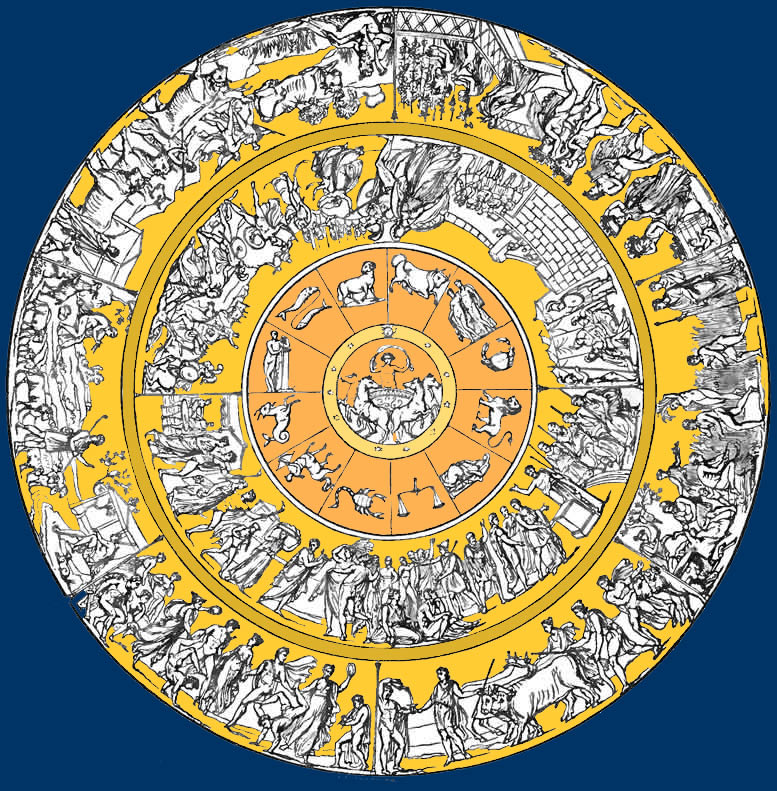
To quote Wikipedia "A hyperlink is a reference or navigation element in a document to another section of the same document or to another document that may be on or part of a (different) domain." The act of linking two things together is a critical act. The connection is first created (connectivism?) in our mind based on other connected thoughts that are in turn linked to our personal experience, social, and historical milieu (constructivism). Creating references between two "documents" is as old as recorded history. And what is a document? According to Wikipedia, "Anything serving as a representation of a person's thinking by means of symbolic marks." There are many instances of documents through out human history of containing "hyperlinks" to other documents. In the east, many of the sutras are actually written references or guides to mandalas and other art. One of my favorite chapters of the Illiad is the shield chapter (18:478) where I have long felt that the description of the shield is obviously a reference to another work of art, a sculpture perhaps, and in turn, the arrangement of images in the shield is a critique of the society and world that created it. So the Illiad was an oral tradition, referred to by a written document which also refers to a work of art (the Shield of Achilles). The shield itself was a graphical representation of the complex relationships of humanity and the cosmos. Now if that is not a hyperlinked text what is?
Sunday, July 13, 2008
Theatre and Technology
I made some flip remark on Twitter after looking at Stickam.com that I have a theatrical relationship to technology. Scott had asked us if anyone had been using the video conferencing chat site www.stickam.com for education. All I saw there were young people in chatrooms. It looked very 1997 (I have to stop using that as a critical term). I logged into a chat room there with the screen name "DatelneNBC" -- someone there said that half the room left when I did that. We then joked around for a few minutes about how if I was actually there with Chris Hanson that I did not have anything to worry about and that I was free to leave. Back in 97 I used to go on CUSeeMe with my Mac SE next to my real computer. At the time, the SE would in no way support the net in such a way that teleconferencing was possible -- but it looked like I had the SE actually teleconferencing. I also occasionally had an alien puppet with me. My primitive b/w camera made it look really cool. It would occasionally trip people out.
I was told later that I was completely on the social end of stickam.com and that it really is worth looking at as a teaching tool/meeting room.
It did get me to thinking about Grotowski's idea about the "Theatre of the Poor." That basically theatre can occur where ever two or more are gathered. Things like sets are in the end extraneous. Theatre, according to G, is a series of choices about communication and expression. We engage in theatre in our face-to-face life all the time -- we decide what role we are in and then make choices about how we choose to express ourselves. Those same choices happen online. You can consciously choose a role or persona (and maybe something absurd like alien puppets) and make discoveries or critiques of communication. But in the end the technology is superfluous -- it is the communication. Grotowski was not a huge fan of technology, especially in the theatre, but I saw one of his sets that had two chairs and a single light so even he relied on technology :)
I present myself to my family in one way, my students in another, and old college chums in yet another. I think I have a blog or other web application to support all of those roles. I had one of our students in my summer class first follow me on "geoffcain" at twitter and I warned her that most of those postings were about instructional design, and I don't think I am going to issue that caveat again. I really don't want to discourage people from getting to know me. My intent was not to have her not follow me but to warn her that she might get a bunch of postings on how to adjust settings in photoshop. But then why shouldn't she see that that? It is part of who I am! I have to learn to own that. It is funny how conscious I was about those roles. LiveJournal is great because I can post recipes to my family or talk about golf with others and not have to subject people I work with to those postings -- I can target many audiences with one tool.
I was told later that I was completely on the social end of stickam.com and that it really is worth looking at as a teaching tool/meeting room.
It did get me to thinking about Grotowski's idea about the "Theatre of the Poor." That basically theatre can occur where ever two or more are gathered. Things like sets are in the end extraneous. Theatre, according to G, is a series of choices about communication and expression. We engage in theatre in our face-to-face life all the time -- we decide what role we are in and then make choices about how we choose to express ourselves. Those same choices happen online. You can consciously choose a role or persona (and maybe something absurd like alien puppets) and make discoveries or critiques of communication. But in the end the technology is superfluous -- it is the communication. Grotowski was not a huge fan of technology, especially in the theatre, but I saw one of his sets that had two chairs and a single light so even he relied on technology :)
I present myself to my family in one way, my students in another, and old college chums in yet another. I think I have a blog or other web application to support all of those roles. I had one of our students in my summer class first follow me on "geoffcain" at twitter and I warned her that most of those postings were about instructional design, and I don't think I am going to issue that caveat again. I really don't want to discourage people from getting to know me. My intent was not to have her not follow me but to warn her that she might get a bunch of postings on how to adjust settings in photoshop. But then why shouldn't she see that that? It is part of who I am! I have to learn to own that. It is funny how conscious I was about those roles. LiveJournal is great because I can post recipes to my family or talk about golf with others and not have to subject people I work with to those postings -- I can target many audiences with one tool.
Friday, July 11, 2008
Should we use publisher content in online courses?
I think it is fine if instructors use publisher content. The problem comes in when inexperienced online teachers confuse content for teaching. We try to show through our course development process at Tacoma Community College that the instructor is there to facilitate interaction and not just deliver content. There has to be a process in place where instructors understand what an online course is and how to review content for interactivity as they create the course.
Also on the downside are the fees that publishers charge the students for this content. I personally do not like access fees on top of what they are already paying — but if we don’t mind supporting courses with $200 textbooks, why should be be concerned with the fees? Again, I think we should be using open sources texts and course materials. In the best cases, some of the commercial material really supports the teaching and is appeals to a wide variety of learning styles; more often than not, they are test banks and hastily thrown together multimedia or flash objects. In a consumer culture, we tend to think we have bought an end product and say “how do I adapt my course and teaching style to these materials?” In an open source culture, we get the product and say “great, how do we get started in adapting this to our needs?”
Often, publisher materials are no bargain — the instructors (the better ones) still have to wade through the .pdf libraries and test banks to cull and adapt the best materials and to check and see if the material meets the course objectives. I have seen course cartridges loaded into courses only to watch instructors, over the course of a year or two, significantly edit and adapt the material: in other words, the material did not match the goals of the course or the teaching style of the instructor until that instructor put in the work anyway. In the meantime, the course is no bargain for the students either.
Also on the downside are the fees that publishers charge the students for this content. I personally do not like access fees on top of what they are already paying — but if we don’t mind supporting courses with $200 textbooks, why should be be concerned with the fees? Again, I think we should be using open sources texts and course materials. In the best cases, some of the commercial material really supports the teaching and is appeals to a wide variety of learning styles; more often than not, they are test banks and hastily thrown together multimedia or flash objects. In a consumer culture, we tend to think we have bought an end product and say “how do I adapt my course and teaching style to these materials?” In an open source culture, we get the product and say “great, how do we get started in adapting this to our needs?”
Often, publisher materials are no bargain — the instructors (the better ones) still have to wade through the .pdf libraries and test banks to cull and adapt the best materials and to check and see if the material meets the course objectives. I have seen course cartridges loaded into courses only to watch instructors, over the course of a year or two, significantly edit and adapt the material: in other words, the material did not match the goals of the course or the teaching style of the instructor until that instructor put in the work anyway. In the meantime, the course is no bargain for the students either.
Wednesday, July 02, 2008
Slideboom
Okay, I look at a lot of widgetware every week but I am really excited by this. This is not a new tool exactly -- they have been around for a bit but this is the first (to my knowledge) web 2.0 tool that allows you to share Power Point presentations with embedded sounds and music. I typically use slideshare.com (which now allows you to link a podcast with a presentation), but this seems like an easier solution.
Sunday, June 22, 2008
Then what could Connectivism be?
Thinking more about the inherent instability of information, Connectivism may not be a learning theory but a means of addressing/mediating this instability. But then again, could that be one of the roles of learning theory itself and Seimens has just hit upon the latest iteration?
The Library in the New Age by Robert Darnton
This article makes some important points about our relationship to information and technology that are particularly relevant to Connectivism and what is happening at Tacoma Community College 's news site -, the Tacoma Challenge. In the article, Robert Darnton argues that every age was an "Information Age" and that information has always been unstable. Each generation, whether from print, telegraph, radio, TV, computers, deals with its own "future shock." This is one of the challenges to Connectivism: is it a learning theory (with a complete epistemology)? or does it merely describe our relationship to networks and information? Does Connectivism give us a theory or explain a learning modality? As media became more pervasive, it became important for educators to understand how people learn via the modalities of sound, vision, etc. As networks and information become more pervasive, it becomes more important to explore how the mind uses networks for learning.
The second part of the article deals with the nature of the news; he says that news has always been an artifact and never corresponded exactly to what has actually happened. One of the criticisms I hear about the Challenge is that it is not run by AP trained professionals as if this is some kind of assurance of integrity. I appreciate the journalistic ideal of the truth but I have read enough news to appreciate it as an ideal and not reality. Traditional reporting in my view has as much integrity as the collective wisdom of the community captured over time as a single report hurriedly scratched out on a deadline and then repackaged by an editor. The Challenge has moved from traditional newspaper to student run news site. The goal is to create a network of information that will have some of the traditional journalistic ideals but not dependent upon them. There will be no single story but people reporting on events, sending in pictures, and responding to postings: a collective story created by the community, not handed down by an authority.
The second part of the article deals with the nature of the news; he says that news has always been an artifact and never corresponded exactly to what has actually happened. One of the criticisms I hear about the Challenge is that it is not run by AP trained professionals as if this is some kind of assurance of integrity. I appreciate the journalistic ideal of the truth but I have read enough news to appreciate it as an ideal and not reality. Traditional reporting in my view has as much integrity as the collective wisdom of the community captured over time as a single report hurriedly scratched out on a deadline and then repackaged by an editor. The Challenge has moved from traditional newspaper to student run news site. The goal is to create a network of information that will have some of the traditional journalistic ideals but not dependent upon them. There will be no single story but people reporting on events, sending in pictures, and responding to postings: a collective story created by the community, not handed down by an authority.
Thursday, June 19, 2008
Why reproduce buildings in a virtual world?
When first exploring Second Life, I asked that a lot. Here we have this fully scriptable, three dimensional virtual world and we are doing everything we can to reproduce the limitations of the first world (there is an old Zen master who laughs everytime I refer to Second Life as the "virtual world"). After working with instructors in Second Life and participating is some classes, I find that there are some bad reasons to create buildings and some good ones. The wrong reason is to re-create the brick and mortar classroom. Some hold class sessions in Second Life but using it as a virtual meeting is limited by the high tech requirements. Students often have to be on campus to take advantage of this as a meeting space. But creating assignments that utilize the familiar in different ways transforms a virtual meeting is to something more akin to theater. While working as an instructional designer on a courtroom simulation, I began to work and see the space more as a set designer than an instructional designer. I had been looking for courtroom furnishings in SL for months and there just does not seem to be much call for that. Harvard uses a virtual courtroom. I finally was satisfied that my own building skills would allow me to create rudimentary furniture. I have created a courtroom now that looks like it is made entirely from Ikea furniture but it is functional. It does not have to be perfect. I can get people in the right places and they get the idea about how it is supposed to work. The students will participate in the fiction with a willing suspension of disbelief because that is how they tend to approach all media, especially an avatar-based virtual world. Virtual space=theatrical space.
Wednesday, June 18, 2008
Why not Second Life?
I was just reading Kapp's blog where he says that we should be thinking virtual worlds, not just Second Life. I am all for that. I think that most of what constitutes learning in Second Life is not specific to the platform itself but in the possibilities of the virtual 3-d world. But the reason why Second Life is such a rich experience is because of all of the layers of junk (gaming, gambling, commercial brick-a-brack, etc.). It is a good education environment precisely because Second Life is not a purely educational environment. It is not even secondarily or tertially an educational environment. All of the teaching tools, scripting, and communication methods have roots in the undercurrent of gaming that propels the innovation in Second Life. This does not come from the platform but the people using the platform. I shudder to think what a 3-d world would look like that was created by and for educators. There would be a lot of forms to fill out. You would not be able to own land until you were tenured. It would only operate 35 hours a week and would be down all summer. You could teleport to other islands as instantly as you have received prior authorization from the vice-president for inter-island travel.
Tuesday, June 10, 2008
TileStack - Your Creative Playground
TileStack - Your Creative Playground: "Remember that great application that used to come with all Macs called HyperCard? Ever wished it would return, only better? Say hello to TileStack!"
I liked Hypercard. I knew people from all walks of life who used it. It was free, included with all Macs, and the scripting language was easy to learn. Users could build some fairly complex applications in a short period of time. There are a lot of tools out there that do what Hypercard can also do and the tools are used for what most people used to use Hypercard for (contacts, recipes, etc.) but the presence of a powerful but simple scripting language means that users have to ability to take it far beyond the vision of the creators. Most often, Hypercard stacks were pretty basic, but in the hands of the right user, it could really fly. For instance, in the final days of Hypercard, someone built a complete bulletin board system from nothing but Hypercard. A bulletin board was a pre-WWW system that users would dial into to leave messages, host games, and communicate with one another. BBSs were often stacks of modems in people's garages. Applications like Hypercard democratize technology.
I liked Hypercard. I knew people from all walks of life who used it. It was free, included with all Macs, and the scripting language was easy to learn. Users could build some fairly complex applications in a short period of time. There are a lot of tools out there that do what Hypercard can also do and the tools are used for what most people used to use Hypercard for (contacts, recipes, etc.) but the presence of a powerful but simple scripting language means that users have to ability to take it far beyond the vision of the creators. Most often, Hypercard stacks were pretty basic, but in the hands of the right user, it could really fly. For instance, in the final days of Hypercard, someone built a complete bulletin board system from nothing but Hypercard. A bulletin board was a pre-WWW system that users would dial into to leave messages, host games, and communicate with one another. BBSs were often stacks of modems in people's garages. Applications like Hypercard democratize technology.
Friday, May 23, 2008
Web 2.0 Student Success
Char Gore and I are creating (and co-teaching) a class for summer and fall called "Student Success" or something generic like that. It will go through the curriculum committee again with something more descriptive maybe. It is a credit only, two unit course that will be multimodal which means that the students can take it completely online or come in once a week to the lab where we will be basically doing a workshop. The whole point of the class is to give new Health Information Management students the tools to succeed in college and in real life by introducing them to the tools to manage their work, manage information, and to build communities. The class is based on the "15 Minutes" article by Stephen Abram who has a particularly useful blog. There are no papers in the class. It is portfolio assessed. The students start a blog and learn about new tools each week and embed and link to those tools in their blog and write (or record/podcast/film) about what they found helpful or difficult. They will also look for other tools like the ones we recommend and evaluate them (free research for the next iteration of the class). At the end of the class, they will have a portfolio of tools and a network of colleagues. Our goal is to eventually bring the class to the whole college. It serves as an introduction to the our learning management system and Elluminate as well.
Monday, May 19, 2008

Friday, May 16, 2008
SketchCast
This is my test of SketchCast. I got an e-mail from Cable Green, the eLearning Director Washington State Board for Community & Technical Colleges. He often sends out emails with new tools. I love that web 2.0 is figuring out how to get voice on the web so quickly. I see good things in SketchCast's future. Aspirat primo Fortuna labori is never truer than with Web 2.0 start-ups: they get a lot of initial atttention and then they either flourish or fade depending on how they respond to user feedback and more importantly how people use their product. I am all for anything that puts voice and images together on the web quickly (and for free). I would like to see more drawing tools: shapes and lines -- I would love to be able to do voice annotations on a concept map and to share it easily.
Wednesday, May 14, 2008
How Second Life Affects Real Life - TIME
How Second Life Affects Real Life - TIME
One of the more remarkable things about this article is that it is appearing in Time Magazine. I like seeing this in the mainstream press. The article looks at research at Stanford that explores how a person's avatar can effect them in "real" life. I am glad the behavioralists at Stanford are catching up. A great description of this process is already found in Carl Jung. One of the reasons that I think teaching works in SL is the phenomenon of projection and transference.
"The possibilities are — virtually — endless. Inhabit buffed-up versions of yourself to lose weight, cuter versions of yourself to gain confidence, or older versions to start putting money away for the future (that last one is being studied at Stanford now). "The most stunning part is how subtle the manipulations are and how difficult they are to detect," says Bailenson, "but how much it affects real life later on."
This research really holds up. Ever since I created an avatar in Second Life, I just get better looking everyday.
One of the more remarkable things about this article is that it is appearing in Time Magazine. I like seeing this in the mainstream press. The article looks at research at Stanford that explores how a person's avatar can effect them in "real" life. I am glad the behavioralists at Stanford are catching up. A great description of this process is already found in Carl Jung. One of the reasons that I think teaching works in SL is the phenomenon of projection and transference.
"The possibilities are — virtually — endless. Inhabit buffed-up versions of yourself to lose weight, cuter versions of yourself to gain confidence, or older versions to start putting money away for the future (that last one is being studied at Stanford now). "The most stunning part is how subtle the manipulations are and how difficult they are to detect," says Bailenson, "but how much it affects real life later on."
This research really holds up. Ever since I created an avatar in Second Life, I just get better looking everyday.
Tuesday, May 06, 2008
Spike Lee and Nokia team up for film - International Herald Tribune

Spike Lee and Nokia team up for film - International Herald Tribune: "Spike Lee and Nokia team up for film
By Laura M. Holson
Published: April 24, 2008
Who says cellphones are good only for talking? Today they are bringing together two unlikely brand names: Nokia and Spike Lee.
Lee, the director, is teaming up with Nokia, the cellphone maker, to direct a short film comprising YouTube-style videos created by teenagers and adults using their mobile phones.
By hiring Lee for the project, Nokia is seeking to combine the populist appeal of user-generated content with the power of a famous director's pedigree. The film will have three acts, each three to five minutes long, with the theme loosely based on the concept of humanity."
Friday, May 02, 2008
2008 Pacific Northwest Higher Education Teaching and Learning Conference
I had the pleasure of attending and presenting at the 2008 PNHETL Conference in Spokane. George Seimens was the plenary speaker. It was really good to hear him speak. It cleared up a lot of questions I had about his book. He had a section that talked about objects containing knowledge. And now I think he means the information in context of the objects use. Our philosophy instructor who came with us was politely quiet on the subject. I think Seimens is one of the most important writers in education right now because the field has gotten pretty calcified. He is a revolutionary and a catalyst. He eschews the typical layers of research references (although I consider him widely and well-read in the field) and actually gets down to describing what is happening in people's lives in our relation to information and what is happening in education.
Like his fellow Canadian, Stephen Downes, Seimens seems uncomfortable with virtual worlds. In his opening plenary, he made comments about how SL was "empty"; there is no one there. Downes also makes this comment. If you come to a brick and mortar college at 8:30 P.M. on a Friday night, it too will be empty, but we don't get rid of the school. Second Life is only really useful when there are people there. That is the whole point: it is actually a suite of communication tools that allow people to interact with one another and their environment in some very significant ways. His closing plenary included the statement "We do not need Second Life to provide games in the classroom" misses the point of using SL entirely. Educators in SL, and yes, there are thousands, do not see it as a game, but as a way to increase the interaction between the instructor and students, students with one another, and the students with the content of the course. Seimens did call it one of the more innovative uses of technology at the conference. He also called for administrators to support the innovators on campus and to reward their failures (that is authentic attempts to move technology and info management forward that do not always have buy-in).
Like his fellow Canadian, Stephen Downes, Seimens seems uncomfortable with virtual worlds. In his opening plenary, he made comments about how SL was "empty"; there is no one there. Downes also makes this comment. If you come to a brick and mortar college at 8:30 P.M. on a Friday night, it too will be empty, but we don't get rid of the school. Second Life is only really useful when there are people there. That is the whole point: it is actually a suite of communication tools that allow people to interact with one another and their environment in some very significant ways. His closing plenary included the statement "We do not need Second Life to provide games in the classroom" misses the point of using SL entirely. Educators in SL, and yes, there are thousands, do not see it as a game, but as a way to increase the interaction between the instructor and students, students with one another, and the students with the content of the course. Seimens did call it one of the more innovative uses of technology at the conference. He also called for administrators to support the innovators on campus and to reward their failures (that is authentic attempts to move technology and info management forward that do not always have buy-in).
Wednesday, April 30, 2008
3-d Handsfree
I think this is a very significant development. I represents an important step between the physical presence and the virtual. There is no telling where this can go but that is the true spirit of exploration and discovery.
Friday, April 25, 2008
New Media Festival
I am organizing a "New Media Festival" here at Tacoma Community College. We will design workshops for the students in new media, open source, and web 2.0 tools, have the students create media, host the media online (YouTube, PodcastPeople, iTunes, etc) but collect it all at the Tacoma Challenge. We will then give awards out in the Fall where we will show nominees and give out awards and prizes.
The purpose of this enterprise is many-fold. I am looking for a way to bring all of these great tools and resources we have on campus to the attention of the students. I want to help create cross-discipline curriculum (why can't the art dept. work with the computer music class?). I want to host all of the entries in the student news site (The Tacoma Challenge) and thereby increase the community. It will have gone from a newspaper, to a news site, to a community of people sharing ideas in completely new ways.
Tuesday, April 08, 2008
Gig Harbor Presentation
PowerPoint as an Interactive Teaching Tool
From: geoffcain, 3 hours ago

Eight principles for keeping PowerPoint real.
At a minimum, a presentation format should do no harm to content. Yet again and again we have seen that the PP cognitive style routinely disrupts, dominates, and trivializes content. Thus PP presentations too often resemble the school play: very loud, very slow, and very simple. -- Edward R. Tufte, The Cognitive Style of PowerPoint, p. 22.
PowerPoint as an Interactive Teaching Tool: Eight Techniques
by
Geoffrey B. Cain
The following techniques are not meant to replace your current use of PowerPoint as an information delivery tool, slide show, etc. These techniques are meant to apply principles of interactive teaching that you probably already use in your lectures or your class activities. These slide suggestions are meant to help you prevent the computer from interfering with your teaching.
1. Opening Slides:
“Take a moment to reflect on your experience of PowerPoint. Think of a negative example and a positive example.”
An opening slide is an opportunity to allow students to engage prior knowledge. Students learn effectively when they make connections between what they already know (prior knowledge) and new content to which they’re exposed. The opening of a lecture can facilitate these connections by helping students exercise their prior knowledge of the day’s subject matter.
Present an “opening question” on a PowerPoint slide and give students a moment to think about their response. The instructor may then ask a few students for answers. This strategy focuses students’ attention on the day’s topic. It provides the instructor with useful feedback on what students know and don’t know about the material being presented. The opening question might be a question that informs the entire lecture -- a point that can be returned to throughout the lecture.
2. Problem-Solving Slides:
Slide contains a question and the answer is left blank to let the students answer first.
With PowerPoint, the instructor can raise a question, give an example that needs correction, present a formula, and then ask the students to solve the example. When the instructor clicks the slide again the correct answer (or a correct answer) appears. The instructor can either go on to the next problem or discuss how to arrive at the correct answer. This is also an example of a non-linear teaching technique because where the lecture goes depends upon the student feedback.
3. Non-Linear PowerPoint Slides
“Three categories that should be understood together.”
PowerPoint often breaks information up into little discreet bits and breaks down meaning by extracting from the whole. In other words, some kinds of knowledge lose their meaning or significance when broken up into the bite-sized chunks that PowerPoint traditionally encourages. With use of simple animations, three columns of information can be highlighted one column at a time “on click.”
4. Focusing Activity Slides
“Think about how you might apply what you have learned today in your particular discipline. Discuss these applications with your neighbor and be prepared to share with the class.”
Interactive learning strategies like this can be used as transition points in the lecture. Employed in this way, these strategies give students an opportunity to think about and work with material just presented before moving on to new information. They also help the instructor gauge how well students have understood the content, perhaps shaping what the instructor discusses during the remainder of the period.
“List as many characteristics of a good lecture that you can.”
Focused listing is a strategy in which students recall what they know about a subject by creating a list of terms or ideas related to it. To begin, the instructor asks students to take out a sheet of paper and begin generating a list based on a topic presented on a PowerPoint slide. Topics might relate to the day’s assigned reading, to a previous day’s lecture material, or to the subject of the current session. Instructors often move around the room and look at students’ lists as they write, briefly summarizing major trends or themes as a way of closing the exercise. Others ask students randomly to share the contents of their lists before moving on with their lecture. In either case, focused listing need not take more than a few minutes.
5. Questioning Slides:
“Questions?” or “Come up with one test question based on this lecture and try to stump your partner.”
Asking students to come up with a question about the lecture before they leave the room encourages them to think about the material and form their own sense of closure to the lesson. The instructor can choose a couple of students at random and answer their questions in the remaining time. If collected in writing, the questions can also serve as a classroom assessment technique to help instructors judge how well their students are learning. When the students know that there are questions at the end of a lecture, they tend to take more focused notes.
6. The Blank Slide
“ “
One way to gain students’ attention and to remind yourself to stop for questions is to insert a blank slide into your presentation. This is a disruption that casts the student’s full attention on the lecturer. You can go to a questioning slide, check student comprehension, and move on to the next part of your lecture. You can also use the “b” key at anytime to black out the screen when you think it is an appropriate time to bring the material off the screen and into the classroom. You can hit the "w" key and get a white screen (think spotlight). Hitting those keys again returns you to the presentation
7. The Game Slide
“Jeopardy”
This, of course, does not replace assessment but can be a way to check or enhance student learning in the middle or at the end of a lecture. Questions do not have to be based on mere rote memorization (e.g. questions can be created and sorted by Bloom’s Taxonomy).
8. The Mnemonic Visual Slide
The final technique is not really a technique but an admonition to think before you use any graphic. Make sure you understand why you are using the graphic. Aesthetic reasons are often enough, but as a designer, you have another opportunity to reinforce information or create a mnemonic device for your students or yourself as a speaker. The irony here is that in the renaissance, there were handbooks on how to memorize large amounts of information. A few of those books would outline elaborate pictures that stood in for places in the mind where information could be stored. Your illustrations can do that for your lectures and in turn, help your students remember the information as well.
The real danger is not that computers will begin to think like men, but that men will begin to think like computers. -- Sydney J. Harris
SlideShare Link
Tuesday, April 01, 2008
Resource Center for Cyberculture Studies
Each month, the Resource Center for Cyberculture Studies (RCCS) publishes a set of book reviews and author responses. books of the month for April 2008 include:
Always Already New: Media, History, and the Data of Culture
Author: Lisa Gitelman
Publisher: MIT Press, 2006
Review 1: J. Patrick Biddix
Review 2: David Heineman
Review 3: Michelle Rodino-Colocino
Author Response: Lisa Gitelman
Convergence Culture: Where Old and New Media Collide
Author: Henry Jenkins
Publisher: NYU Press, 2006
Review 1: Susan Keith
Review 2: Anne Kustritz
Review 3: Darby Orcutt
Review 4: J. Richard Stevens
Author Response: Henry Jenkins
Everything Is Miscellaneous: The Power of the New Digital Disorder
Author: David Weinberger
Publisher: Times Books, 2007
Review 1: Lucinda Austin
Review 2: Geoffrey B. Cain
Review 3: Erika Pearson
Author Response: David Weinberger
Online Matchmaking
Editors: Monica T. Whitty, Andrea J. Baker, James A. Inman
Publisher: Palgrave MacMillan, 2007
Review 1: Trudy Barber
Author Response: Andrea J. Baker
Enjoy. There's more where that came from.
David Silver
david silver's blog
Always Already New: Media, History, and the Data of Culture
Author: Lisa Gitelman
Publisher: MIT Press, 2006
Review 1: J. Patrick Biddix
Review 2: David Heineman
Review 3: Michelle Rodino-Colocino
Author Response: Lisa Gitelman
Convergence Culture: Where Old and New Media Collide
Author: Henry Jenkins
Publisher: NYU Press, 2006
Review 1: Susan Keith
Review 2: Anne Kustritz
Review 3: Darby Orcutt
Review 4: J. Richard Stevens
Author Response: Henry Jenkins
Everything Is Miscellaneous: The Power of the New Digital Disorder
Author: David Weinberger
Publisher: Times Books, 2007
Review 1: Lucinda Austin
Review 2: Geoffrey B. Cain
Review 3: Erika Pearson
Author Response: David Weinberger
Online Matchmaking
Editors: Monica T. Whitty, Andrea J. Baker, James A. Inman
Publisher: Palgrave MacMillan, 2007
Review 1: Trudy Barber
Author Response: Andrea J. Baker
Enjoy. There's more where that came from.
David Silver
david silver's blog
Wikis and Emergent Roles for Teaching and Learning
I was really pleased at the turn-out for this presentation. Wikis are being used for a wide variety of educational applications in many different kinds of educational settings.
Gail Burns and David Reed are using Blackboard, Moodle, and along with Moodle they are using Atlassian's Confluence wiki software. They use it for:
1. Building knowledge bases
2. Event planning
3. Collaboration on documents
4. Meeting minutes
5. Student collaboration
David Reed trains and manages Student Technology Assistants. The STA program is a year long program. Students are paid to participate. They spend semester in training learning about:
1. Web design
2. Office productivity
3. Graphic design
4. Software training
5. LMS support
They then spend the next semester helping faculty with projects, supporting the lab, and training the next generation of STAs in STA workshops. It is a brilliant idea.
At this point, the wiki was used to post meeting minutes and announcements.
They lost their workspace and to replace it, David divided their time between face-to-face meetings and posting on to a wiki. He decided that they needed some wiki projects to bring them together. These projects included:
1. An STA mission statement (an informal document)
2. An "Open House" project where they created posters, signs, and slogans.
3. The STA workshop wiki
STAs began to post to the wiki things they wished they knew about or wanted to learn. Other STAs began to post skills they had and this began to inform the direction of formal and informal workshops.
I think our eLearning Dept. at TCC could really learn from this program. I would love for those STAs to meet some of our student workers.
Next came Barbara Shroeder, the head of the Academic Technologies dept. She came up with a "best practices" list for wikis in education:
1. Create a culture of trust - students have to learn the risk-taking involved with writing and editing online.
2. Set up guidlines (http://wikipatterns.com)
3. Create a common goal for the wiki
4. Create meaningful assignments
5. Include explicit instructions
6. Remind students of deadlines
7. Define roles
8. Examples and models of collaborative activities should be modeled
9. Clear expectations should be provided
10. Patience - students may take a while to get the hang of new tech.
Tuesday, April 01, 2008
11:45 a.m. - 12:30 p.m.
Room of the Dons, Lobby Level
Speaker(s)
* Gayle Burns, Manager of Academic Technologies, Occidental College
* David Reed, Academic Technologist, Occidental College
* Barbara Schroeder, Instructional Designer, Boise State University
* Session convener: Crista Copp, Senior Director, Educational Technology, Art Center College of Design
Abstract
Institutions increasingly encourage students to take an active role in their own learning. Wikis can facilitate this process by offering many ways for faculty and students to collaborate and create content. This panel of wiki experts from Boise State University and Occidental College will discuss their experiences in using wikis, including emergent roles in the teaching and learning process, critical to the effective use of this new technology.
Gail Burns and David Reed are using Blackboard, Moodle, and along with Moodle they are using Atlassian's Confluence wiki software. They use it for:
1. Building knowledge bases
2. Event planning
3. Collaboration on documents
4. Meeting minutes
5. Student collaboration
David Reed trains and manages Student Technology Assistants. The STA program is a year long program. Students are paid to participate. They spend semester in training learning about:
1. Web design
2. Office productivity
3. Graphic design
4. Software training
5. LMS support
They then spend the next semester helping faculty with projects, supporting the lab, and training the next generation of STAs in STA workshops. It is a brilliant idea.
At this point, the wiki was used to post meeting minutes and announcements.
They lost their workspace and to replace it, David divided their time between face-to-face meetings and posting on to a wiki. He decided that they needed some wiki projects to bring them together. These projects included:
1. An STA mission statement (an informal document)
2. An "Open House" project where they created posters, signs, and slogans.
3. The STA workshop wiki
STAs began to post to the wiki things they wished they knew about or wanted to learn. Other STAs began to post skills they had and this began to inform the direction of formal and informal workshops.
I think our eLearning Dept. at TCC could really learn from this program. I would love for those STAs to meet some of our student workers.
Next came Barbara Shroeder, the head of the Academic Technologies dept. She came up with a "best practices" list for wikis in education:
1. Create a culture of trust - students have to learn the risk-taking involved with writing and editing online.
2. Set up guidlines (http://wikipatterns.com)
3. Create a common goal for the wiki
4. Create meaningful assignments
5. Include explicit instructions
6. Remind students of deadlines
7. Define roles
8. Examples and models of collaborative activities should be modeled
9. Clear expectations should be provided
10. Patience - students may take a while to get the hang of new tech.
Tuesday, April 01, 2008
11:45 a.m. - 12:30 p.m.
Room of the Dons, Lobby Level
Speaker(s)
* Gayle Burns, Manager of Academic Technologies, Occidental College
* David Reed, Academic Technologist, Occidental College
* Barbara Schroeder, Instructional Designer, Boise State University
* Session convener: Crista Copp, Senior Director, Educational Technology, Art Center College of Design
Abstract
Institutions increasingly encourage students to take an active role in their own learning. Wikis can facilitate this process by offering many ways for faculty and students to collaborate and create content. This panel of wiki experts from Boise State University and Occidental College will discuss their experiences in using wikis, including emergent roles in the teaching and learning process, critical to the effective use of this new technology.
Space Defines Destiny: assessment of a learning studio
This presentation at the Western Regional Educause conference was particularly interesting to me because of the struggles we have gone through to get Second Life working in a lab and classroom environment, and because of conversations we have had in our department about learning spaces.
* Jim S. C. Tom, Associate Vice Chancellor for Information Technology, University of Missouri-St Louis
"This session will present the planning, use, and assessment of our first flexible technology-enhanced classroom or learning "studio"—an immediately useful yet also provocative and experimental space. We will show how the completed space itself challenged our faculty and students to redefine what learning at UMSL could mean."
They wanted to create a learning space that would challenge the typical teaching space model that includes fixed seating, "sage on the stage" teaching, and a culture of discomfort that does not invite engagement or participation.
They created a discussion group on innovative classroom design called the "Provost's Forum" that included staff, faculty, students, facilities and planning. The result was a working paper on classroom design. They decided that a learning space should be flexible, comfortable, social, and accessible. They created a team to design the space that included their IT department, faculty, a systems integrator (I want that job), and interior designer (what a relief! don't the IT dept. choose the colors!), and facilities. This is really a radical idea: get teachers to help design learning spaces with those who have to build and use this space.
They built a prototype classroom that would have assessment of the project built into its use. This is different from a culture that builds spaces but does not follow up on how they are used.
Assessment included:
1. Faculty observations
2. Blogs
3. Video recordings
4. Surveys of all users
5. Debriefing meeting with faculty
The room included two projectors facing opposite walls, a plasma screen, white boards, an area with couches, circular tables that were made of moveable quarters on wheels, a cart of laptops, sympodium, and a document camera. Their budget for the one room came in at $222,000!
They found that the rooms promoted engagement. The comfortable space was less threatening to students who said that it felt like a privilege to use the room and that it made them want to learn and participate. Faculty said that "the space is the message." Space not only determines how the students feel about learning but it also communicates how the institution feels about teaching and the students as people.
Spaces reflect the values of the institution.
The classroom had no obvious front or back. It encouraged the faculty to circulate among the students.
They learned that training teachers how to use the space was important.
* Jim S. C. Tom, Associate Vice Chancellor for Information Technology, University of Missouri-St Louis
"This session will present the planning, use, and assessment of our first flexible technology-enhanced classroom or learning "studio"—an immediately useful yet also provocative and experimental space. We will show how the completed space itself challenged our faculty and students to redefine what learning at UMSL could mean."
They wanted to create a learning space that would challenge the typical teaching space model that includes fixed seating, "sage on the stage" teaching, and a culture of discomfort that does not invite engagement or participation.
They created a discussion group on innovative classroom design called the "Provost's Forum" that included staff, faculty, students, facilities and planning. The result was a working paper on classroom design. They decided that a learning space should be flexible, comfortable, social, and accessible. They created a team to design the space that included their IT department, faculty, a systems integrator (I want that job), and interior designer (what a relief! don't the IT dept. choose the colors!), and facilities. This is really a radical idea: get teachers to help design learning spaces with those who have to build and use this space.
They built a prototype classroom that would have assessment of the project built into its use. This is different from a culture that builds spaces but does not follow up on how they are used.
Assessment included:
1. Faculty observations
2. Blogs
3. Video recordings
4. Surveys of all users
5. Debriefing meeting with faculty
The room included two projectors facing opposite walls, a plasma screen, white boards, an area with couches, circular tables that were made of moveable quarters on wheels, a cart of laptops, sympodium, and a document camera. Their budget for the one room came in at $222,000!
They found that the rooms promoted engagement. The comfortable space was less threatening to students who said that it felt like a privilege to use the room and that it made them want to learn and participate. Faculty said that "the space is the message." Space not only determines how the students feel about learning but it also communicates how the institution feels about teaching and the students as people.
Spaces reflect the values of the institution.
The classroom had no obvious front or back. It encouraged the faculty to circulate among the students.
They learned that training teachers how to use the space was important.
Monday, March 31, 2008
Educause Presentation
I was on a panel today at the Western Regional meeting of Educause speaking on Second Life. It was a very interesting presentation because the people we were presenting with originally had their presentation entitled "Second Life from the Slow Lane." Imagine their surprise when they found themselves on a panel with John Miller! But the really interesting part is that while we are working with simulations and models, these two are actually working out the human dimension to Second Life. Their work in SL is connectivity rich while we are programming rich.
Jeffery Lamb is using Second Life with his Spanish class to basically create a "semestre abroad" approach. In Second Life, his students go to a virtual Barcelona and Mexico and talk with native Spanish speakers. He also makes them use the Spanish "Segunda Vida" client so when they want to change their avatar's hair and such they have to learn the names of the various body parts and colors in Spanish. This is terrific because the students then have a natural, invested interest in learning the language. And then when their hair is right, they are hanging out with native Spanish speakers. I found this more exciting than any of the programming or widgets I have seen in SL. This is what it should really be about -- people working and learning together. I want to bring this to our college and to our state!
Here is the blurb from the program:
Teaching and Learning in Second Life
Session Details
Track 1
Monday, March 31, 2008
4:45 p.m. - 5:30 p.m.
Room of the Dons, Lobby Level
Speaker(s)
* Geoffrey B. Cain, Instructional Designer / English Instructor, Tacoma Community College
* Jeffrey Lamb, Spanish Instructor, Solano Community College
* John Miller, Nursing Instructor, Tacoma Community College
* Sandra Rotenberg, Librarian and Distance Education Coordinator, Solano Communityt
This panel discussion examines both the process and product of teaching in Second Life from the perspectives of instructors and an instructional designer. Participants will see how instructors use Second Life to teach foreign languages and nursing, illustrating the breadth of possibilities virtual reality offers to introduce students to other cultures and clinical procedures. The experience enhances students' critical thinking, decision making, and diversity awareness.
Jeffery Lamb is using Second Life with his Spanish class to basically create a "semestre abroad" approach. In Second Life, his students go to a virtual Barcelona and Mexico and talk with native Spanish speakers. He also makes them use the Spanish "Segunda Vida" client so when they want to change their avatar's hair and such they have to learn the names of the various body parts and colors in Spanish. This is terrific because the students then have a natural, invested interest in learning the language. And then when their hair is right, they are hanging out with native Spanish speakers. I found this more exciting than any of the programming or widgets I have seen in SL. This is what it should really be about -- people working and learning together. I want to bring this to our college and to our state!
Here is the blurb from the program:
Teaching and Learning in Second Life
Session Details
Track 1
Monday, March 31, 2008
4:45 p.m. - 5:30 p.m.
Room of the Dons, Lobby Level
Speaker(s)
* Geoffrey B. Cain, Instructional Designer / English Instructor, Tacoma Community College
* Jeffrey Lamb, Spanish Instructor, Solano Community College
* John Miller, Nursing Instructor, Tacoma Community College
* Sandra Rotenberg, Librarian and Distance Education Coordinator, Solano Communityt
This panel discussion examines both the process and product of teaching in Second Life from the perspectives of instructors and an instructional designer. Participants will see how instructors use Second Life to teach foreign languages and nursing, illustrating the breadth of possibilities virtual reality offers to introduce students to other cultures and clinical procedures. The experience enhances students' critical thinking, decision making, and diversity awareness.
Sunday, March 30, 2008
3-D Mind Mapping
I have always been, and probably always will be, a big fan of Inspiration. This is a fairly traditional (but extremely flexible) concept mapping software. I believe that the traditional uses of software such as this can be great for communication, brainstorming, and as presentation tools. But one claim is that such software somehow represents how we think. Software packages like this seem all too linear and flowchartish to really represent thought; especially with what we are discovering about the nature of memory, that memories are not held in single neurons or even tightly grouped neurons but are patterns distributed over the whole brain. A single part of the brain can be damaged and the brain can remap memories. I am wondering if concept maps that are movable in three dimensions are not a more accurate representation of thought. (Is there really a connection between how concept maps communicate and the structure of thought?) I am currently experimenting with Personal Brain and with some concept mapping in Second Life. What I like about Personal Brain is that the user organizes links in a 3-d virtual space where anything that is clicked on is brought to the center and the other links shift around the new center. I find that this captures my style of thinking (meta-tangential ADD?) -- I will create some films using this and Jing and see what I come up with. Ultimately what I am looking for is 3-d collaborative mind maps and I think I have found some solutions in Second Life.
Friday, February 22, 2008
Deschooling Web 2.0
I was in colleague's office this morning rambling about Ivan Illich's Deschooling Society. If you don't know who he was, he was a radical intellectual in the 60s and 70s and very popular with the alternative schooling types. One or his ideas is that schools are made to contain knowledge rather than share it. This is why school rooms in fascist, communist, and capitalist countries all look the same. Anyway, Charlie Crawford sent me a note this morning pointing to Chapter 6 which contains Illich’s “Four Networks” which is about the decentralization of knowledge but actually is also a good description of the ideal web 2.0 learning community (i.e. MERLOT and possibly some aspects of the future Tacoma Challenge?).
1. Reference Services to Educational Objects-which facilitate access to things or processes used for formal learning. Some of these things can be reserved for this purpose, stored in libraries, rental agencies, laboratories, and showrooms like museums and theaters; others can be in daily use in factories, airports, or on farms, but made available to students as apprentices or on off hours.
2. Skill Exchanges — which permit persons to list their skills, the conditions under which they are willing to serve as models for others who want to learn these skills, and the addresses at which they can be reached.
3. Peer-Matching — a communications network which permits persons to describe the learning activity in which they wish to engage, in the hope of finding a partner for the inquiry.
4. Reference Services to Educators-at-Large — who can be listed in a directory giving the addresses and self-descriptions of professionals, paraprofessionals, and free-lancers, along with conditions of access to their services. Such educators, as we will see, could be chosen by polling or consulting their former clients.
The thing that is so ironic about this is that Illich was not too keen on technology, but technology seems to be what is facilitating this vision now.
The purpose of the Challenge isn’t to be a reference service, but it could certainly be a hub where students share their learning experiences and connect to people and resources. The podcasting project and the blog tools in Drupal can facilitate this. In ancient Greece, the paideia, was not just one institution, but the whole community. The Challenge, and other open source content management systems, can be this connection.
1. Reference Services to Educational Objects-which facilitate access to things or processes used for formal learning. Some of these things can be reserved for this purpose, stored in libraries, rental agencies, laboratories, and showrooms like museums and theaters; others can be in daily use in factories, airports, or on farms, but made available to students as apprentices or on off hours.
2. Skill Exchanges — which permit persons to list their skills, the conditions under which they are willing to serve as models for others who want to learn these skills, and the addresses at which they can be reached.
3. Peer-Matching — a communications network which permits persons to describe the learning activity in which they wish to engage, in the hope of finding a partner for the inquiry.
4. Reference Services to Educators-at-Large — who can be listed in a directory giving the addresses and self-descriptions of professionals, paraprofessionals, and free-lancers, along with conditions of access to their services. Such educators, as we will see, could be chosen by polling or consulting their former clients.
The thing that is so ironic about this is that Illich was not too keen on technology, but technology seems to be what is facilitating this vision now.
The purpose of the Challenge isn’t to be a reference service, but it could certainly be a hub where students share their learning experiences and connect to people and resources. The podcasting project and the blog tools in Drupal can facilitate this. In ancient Greece, the paideia, was not just one institution, but the whole community. The Challenge, and other open source content management systems, can be this connection.
Wednesday, February 13, 2008
Open Source Textbooks
I am in the middle of a conversation elsewhere on the net about open source textbooks and open source in education in general. I think this is certainly the way to go. The print industry moves far too slowly for the field of educational tech. anyway.
And speaking of educational technology; There is an article in the Feb. 15th Chronicle called "One Way to Rein In the Cost of Textbooks: Make Them Free." It is by Paul F. deLespinasse, who is from Adrian and has four textbooks available online. He says that given modern technology, "there is no reason why textbooks could not be extremely cheap, if not free." He says that most of the cost comes from things like printing, distribution and marketing. He also said that texts that are radically innovative never make it through the publication process. I love this point "...faculty members who do not wish to rely on miracles to produce texts based on new approaches to the subjects can post their materials on the Internet. That would increase the richness and diversity of materials that instructors can choose from as they develop courses, and would benefit students both intellectually and financially.
What is interesting about his take is that I assumed that true experts in the field, seasoned, experienced scholars like deLespinasse would not be interested in open source texts. I thought that adjunct faculty or up and coming scholars would be more interested in this, but his own work proves me wrong.
He points out in his article that some of the disadvantages of online publishing is that online texts are not subject to review and the editorial process. For myself, this just points out how crucial organizations like MERLOT are.
The article is worth checking out. (Unfortunately, the Chronicle is still a very commercial publication, and to read the article online, one must have a paid subscription.)
And speaking of educational technology; There is an article in the Feb. 15th Chronicle called "One Way to Rein In the Cost of Textbooks: Make Them Free." It is by Paul F. deLespinasse, who is from Adrian and has four textbooks available online. He says that given modern technology, "there is no reason why textbooks could not be extremely cheap, if not free." He says that most of the cost comes from things like printing, distribution and marketing. He also said that texts that are radically innovative never make it through the publication process. I love this point "...faculty members who do not wish to rely on miracles to produce texts based on new approaches to the subjects can post their materials on the Internet. That would increase the richness and diversity of materials that instructors can choose from as they develop courses, and would benefit students both intellectually and financially.
What is interesting about his take is that I assumed that true experts in the field, seasoned, experienced scholars like deLespinasse would not be interested in open source texts. I thought that adjunct faculty or up and coming scholars would be more interested in this, but his own work proves me wrong.
He points out in his article that some of the disadvantages of online publishing is that online texts are not subject to review and the editorial process. For myself, this just points out how crucial organizations like MERLOT are.
The article is worth checking out. (Unfortunately, the Chronicle is still a very commercial publication, and to read the article online, one must have a paid subscription.)
Monday, February 11, 2008
Open Source Resources for WA CTCs
I was in a meeting today with Cable Green on open source. Here are the opening notes that were posted on Injenuity's blog before the meeting:
Cable Green will lead a discussion on how the Washington Community and
Technical Colleges can actively participate in and contribute to the
Open Educational Resources (OER) movement.
He doesn’t have the answers but brings a host of questions that higher
education needs to wrestle with to increase learning opportunities,
lower costs, and form a more perfect global learning space.
* How do we educate all stakeholders about open educational resources
(software, content, standards, publishing) and why they are an important
part of our system’s future?
* How do we make it easy to share learning materials, courses and
degrees?
* What are the policy implications of sharing content? Are we all so
unique that we can’t use one another’s courses? How many different
Algebra 101 courses do we need?
* Under what circumstances will faculty “receive” what has been built by
others? How do we collectively get past the issue of “I need to build it
myself?”
* Is content is a strategic advantage? Or do walled gardens wither and
die without the winds of collective input and continuous iteration?
* How much longer can our students afford traditional textbooks? Why
can’t we develop open textbooks?
* How much longer can our libraries afford buying access to articles our
faculty published? What is stopping us from an open publishing movement
for academic journal articles?
_______________________________________________________________________________
I have been interested in open source teaching materials since I have been involved in teaching or education support. We have really lost something in this age of "intellectual property" and copyright. I don't think I would be the teacher I am today if it wasn't for the other teachers who were gracious enough to share ideas, curricula and syllabi.
I am creating an open source developmental English textbook. I am going to offer it on LuLu.Com but the whole book will be in a Creative Commons rather than a restrictive copyright.
All of the teaching tools that we create in Second Life should be available to all teachers.
Faculty claim to be interested in the students welfare when they say that they do not want to have "their" students learn online because of the cost. Yet, they will assign textbooks that cost over a hundred dollars.
Cable Green will lead a discussion on how the Washington Community and
Technical Colleges can actively participate in and contribute to the
Open Educational Resources (OER) movement.
He doesn’t have the answers but brings a host of questions that higher
education needs to wrestle with to increase learning opportunities,
lower costs, and form a more perfect global learning space.
* How do we educate all stakeholders about open educational resources
(software, content, standards, publishing) and why they are an important
part of our system’s future?
* How do we make it easy to share learning materials, courses and
degrees?
* What are the policy implications of sharing content? Are we all so
unique that we can’t use one another’s courses? How many different
Algebra 101 courses do we need?
* Under what circumstances will faculty “receive” what has been built by
others? How do we collectively get past the issue of “I need to build it
myself?”
* Is content is a strategic advantage? Or do walled gardens wither and
die without the winds of collective input and continuous iteration?
* How much longer can our students afford traditional textbooks? Why
can’t we develop open textbooks?
* How much longer can our libraries afford buying access to articles our
faculty published? What is stopping us from an open publishing movement
for academic journal articles?
_______________________________________________________________________________
I have been interested in open source teaching materials since I have been involved in teaching or education support. We have really lost something in this age of "intellectual property" and copyright. I don't think I would be the teacher I am today if it wasn't for the other teachers who were gracious enough to share ideas, curricula and syllabi.
I am creating an open source developmental English textbook. I am going to offer it on LuLu.Com but the whole book will be in a Creative Commons rather than a restrictive copyright.
All of the teaching tools that we create in Second Life should be available to all teachers.
Faculty claim to be interested in the students welfare when they say that they do not want to have "their" students learn online because of the cost. Yet, they will assign textbooks that cost over a hundred dollars.
Subscribe to:
Posts (Atom)