Thursday, September 27, 2012

Jerry Brown Unlocks the Nation's Digital Future through Open Source Textbook Innovation

English: Jerry Brown's official picture as Att...
(Photo credit: Wikipedia)
Today, Governor Jerry Brown signed a monumental set of bills that create the nation's first free online textbook library, an effort aimed at alleviating the burden of rising costs to students attending California's public postsecondary institutions. California is now set to become the nation's first state to create a digital textbook library free of charge for the state's most popular college courses, says the 20 Million Minds Foundation.

Introduced by Senate President pro Tem Darrell Steinberg (D-Sacramento), SB 1052 provides for the selection, development and administration of free open digital textbooks for the most popular lower-division courses and overseen by the establishment of the "California Open Education Resources Council" (COERC). COERC, established by the legislation, will be comprised of faculty members from the University of California, California State University and Community Colleges to determine which courses merit inclusion. Its companion bill, SB 1053, creates the California Open Source Digital Library to house the open source textbooks and courseware.

Both bills place California first in the nation among states to combat higher education's growing price tag with open source software and Creative Commons open licenses so that students can access sophisticated tools and college-level information at no or low cost, allowing them to mitigate escalating college fee increases and save their money for student housing.

With the Governor's signature, California is set to create a competitive "Request for Proposals" (RFP) process inviting faculty, publishers, and others to develop high quality digital open source textbooks and related courseware. The materials will be placed under a "Creative Commons" licensing structure that allows students and faculty free access, and allows instructors to create customized materials from these textbooks and other courseware. Materials must also meet the rigorous standards of college core curricula, and will be reviewed and approved by subject matter experts. "This is a great victory for students and middle class families struggling with the ever-increasing costs of higher education," said Steinberg. "This is a major step toward using technology to cut costs for students while enhancing the quality of higher education in California."


"At a time when the cost of attending California's public colleges and universities is skyrocketing, Governor Jerry Brown recognized that by embracing our digital future with innovative technological advancements like open source textbooks we can save college students in California millions of dollars in escalating book costs," said 20 Million Minds Foundation President Dean Florez. The foundation has been supportive of policy measures to create quality open source textbooks for college students throughout the nation. "This is the first time government has come in with substantial dollars that match philanthropic efforts to create a library where students can access free textbooks and faculty can utilize their skills to remix, revise, and repurpose these textbooks for their students."

Funding for the bills also signed by the governor (SB 1028), appropriates five million dollars for the project from the state public college savings plan ScholarShare Trust fund to be matched by private entities and philanthropy.

Dr. Larry Green, Mathematics Co-Chair of Lake Tahoe Community College, who has been utilizing a free open source textbook for his students, praised the governor. "From the instructors' perspective, having access to a wealth of professional course materials to edit, use and share frees up time for pursuing more one-on-one interaction with students and more personalized learning," said Green. "Choosing to adopt an enhanced digital open textbook for my students spares them several thousands of dollars in combined textbook expenses and increases student success. I thank the Governor for recognizing the need to provide faculty with the tools necessary for remixing curriculum while preserving academic freedom by providing free quality textbook choices for college professors and their students."

The open source library will allow students to download textbooks for free or pay around $20 for a hard copy, and was the principle reason the signed bills received approval by the University of California.

SOURCE The 20 Million Minds Foundation
Enhanced by Zemanta

OERs at College of the Redwoods

These are the slides from my part of presentation "OER Adopter Communities: the Sustainability Factor in Open Education":


Enhanced by Zemanta

Wednesday, September 26, 2012

Keeping Open Education Resources Open

A Wikiversity Logo for Open Educational Resour...
 (Photo credit: Wikipedia)
What does the "open" in "open education resources" mean? What it should mean is free to reuse, remix and share. If your open education resources are locked up with a proprietary platform, they are no longer open. If they are converted into "supplements" for a "free" text, they are no longer open. This is the fear behind those who choose a license that says "not for commercial use." That does not make it less open because you are not free to lock down someone else's work and make a profit off of it.

The reason I release materials to the wild with an open license is so that other educators can use them and benefit from them; maybe even modify them (and hey, feel free send me a copy back). I want to contribute to the education community. My intention is not to enrich some business who will repackage and "improve" on my work by locking it down into a closed system and then charging for access. The claim that I am making my work less open because it is not free for commercial use is ridiculous! That is like saying animals are only free if they are also free to be in a zoo. And the only ones who really benefit from the corporate lock-down of OERs and open textbooks are the corporations.

The Creative Commons license warning that an OER is not part of a "free culture" is an unnecessary distraction. FreedomDefined. org is not helping:
"Licenses which only allow non-commercial use are not considered Free Culture licenses. This is because in practice there are many ways that Cultural works can be used and reused which would be considered commercial. Another problem is that there is no generally agreed definition of where the border line is between Commercial and Non Commercial uses with very many cases falling in the undefined area in between. In practice Share Alike or Copyleft clauses provide a restriction on commercial profits since any reuse making excessive profits will soon stimulate a bunch of copycats which will bring prices down while encouraging even wider distribution of the works - which is the objective of the free culture licenses." 
That phrase "which will bring down prices" is the funny bit here. My goal is not to keep down the prices of my work but to remove the cost barrier altogether from my work! I want it free as in free of cost to any student, now and in the future.

The claim that OERs will not benefit from corporate modification and promotion is really missing the point. That is not the only way that OERs are adapted, developed, and distributed. OERs belong to the community of teachers and learners. They should remain there. The real work being done in the OER community is by communities of educators

So why do school districts go after corporate materials that are almost, but not quite entirely, unlike open? Because they are still clinging to the old paradigm that says that if it didn't get "vetted" by a corporate press, it lacks quality, legitimacy, the imprimatur and nihil obstat of a "reputable" press. We need to redefine this legitimacy. The corporate presses have not done education any favors: the price of education is outstripping the cost of inflation and healthcare. Each semester, publishers come up with new and interesting ways to justify their $280 dollar textbooks. And the sad truth is that the instructors know these subjects better than the project managers at corporate education publishing houses. The books are not more accurate because they went through their vetting process (see OER: The Myth of Textbook Reliability). Every open textbook that I have encountered that was created in-house or by a community of scholars has been hands down superior in every way to a corporate textbook because it addresses the needs of the teachers who created it and the students who are using it, it is lower in price and more accessible.

There are new models emerging for the development and implementation of OERs and open textbooks.   There are a number of models suggested by Stephen Downes in his article "Models for Sustainable Open Education Resources" that I feel have yet to be fully explored. There is also the implementation model suggested by the Kaleidoscope Project that begins with a community of scholars working on shared student learning outcomes and assessments and only then do they adopt OERs or open textbooks. In other words, open textbooks are an opportunity to have education content driven by the SLOs of the local schools, not by commercial interests.

Fretting over whether or not an OER is free to be exploited by a corporation is a huge step backward and a great disservice to the students.
Enhanced by Zemanta

Wednesday, September 19, 2012

OER Adopter Communities: the Sustainability Factor in Open Education

Open Textbooks from the Open Course Library
Open Textbooks from the Open Course Library (Photo credit: caswell_tom)
Una Daly has invited you to the event 'September 25 OER Adopter Communities: the Sustainability Factor in Open Education' on College Open Textbooks Community!

Check out the entire Fall 2012 CCCOER Webinar Lineup

Time: September 25, 2012 from 10am to 11am
Location: online Pacific TIme zone
Organized By: Una Daly Event

Description: Please join CCCOER September 25, 1:00 pm Eastern to hear how three successful OER adoption projects built sustainable communities of faculty and staff to customize open textbooks and open educational resources to lower costs and better meet the needs of students at their colleges. Presenters from the Kaleidoscope Project at College of the Redwoods, Cuyahoga Community College, and Scottsdale Community College will talk about their challenges and achievements in finding, evaluating, and adapting high-quality OER to replace high cost publisher textbooks.

 • Danielle Budzick, Interim Director of Faculty Development, Adjunct Business Instructor & Linda Glassburn, Assistant Professor Business & IT at Cuyahoga Community College in Ohio. Danielle and Linda worked with the other Business Communications instructors at Cuyahoga college to adopt an open textbook from Flat World Knowledge and revise it to meet college learning outcomes.

A Wikiversity Logo for Open Educational Resour...
(Photo credit: Wikipedia)
 • Geoff Cain, Director of Distance Education at College of the Redwoods in California and an instructional designer on the Kaleidoscope Next Generation Learning Grant. Geoff worked with Biology Instructor Wendy Riggs to find and adapt open educational resources to improve student learning outcomes and replace publisher textbooks.

 • Dr Donna Gaudet, Developmental Math Professor at Scottsdale Community College in Arizona. Donna and her colleagues in the Math Department have been finding and adapting open textbooks and open educational resources for over two year to improve student understanding of developmental math and replace their former expensive curriculum.

 PARTICIPANT DETAILS
No pre-registration necessary. On the day of the webinar, please click here to login and then press the Connect button. You may use a headset or dial-in to speak live: (888) 886-3951
Enter your passcode: 918603

 PARTICIPANT CONFERENCE FEATURE
*0 – Contact the operator for audio assistance
*6 – Mute/unmute your individual line

PRIOR TO YOUR FIRST CCC CONFER MEETING, it is recommended that you:
Test Your Computer Readiness

FOR ASSISTANCE: CCC Confer Client Services – Monday – Friday between 8:00 am – 4:00 pm See more details and RSVP on College Open Textbooks Community:
Enhanced by Zemanta

Saturday, September 15, 2012

Seoul Man: Viral Videos and the Shrinking World

I have been thinking recently about Psy and the K-pop phenomena of his video "Gangnam Style" that broke out of the internet and onto mainstream television and media. This video was destined to become the Numa Numa of the year (Gary Brolsma's lip-synching of the Romanian pop song Dragostea din Tei by O-Zone) except for one thing: the world is smaller now. Or rather, the internet and other media are quickly collapsing into a single macro-market. The video "Gangnam Style" was released in July and in two months, after being kicked around Facebook and Twitter, the YouTube video has gotten nearly 181,000,000 views. I believe it took Numa Numa a year or so to hit 2,000,000 views. Which is remarkable in itself seeing that Brolsma was just a kid with a web cam. (Mike Wesch has an excellent presentation on viral videos and YouTube that discusses Brolsma's video and many others called "An Anthropological Introduction to YouTube" that is really worth watching.)  Psy from Korea is part of the pop industry there, but there has been little breaking out of the K-pop world and into the mainstream until now. By mainstream, I mean Psy's appearance on the Ellen Degenere's show and his appearance at a Dodger's game. That would not have been possible without Facebook, Twitter, and YouTube. You can't set out to create this kind of content on purpose. Most people who are watching the video are not familiar with the Korean TV personalities and comedians in the video, they do not understand the context. They don't really need to. The dancing is funny, and the music has a catchy beat. To many Western viewers, the randomness and cultural alienation is part of its appeal.


Of course, there is a darker side to the shrinking world too. Another viral video with a definite air of cultural alienation is circulating and being used to basically dismantle the Arab Spring and as a pretext by extremists to attack all things Western. The same connections that can create a pop sensation can create chaos.

We have to recognize this change in how unpredictable information can be. Psy and his producers could not have predicted anything like the reception he has gotten. We no longer live in a world of "media outlets" and consumers. The consumers of the past are creating responses to media using the same tools that were once only available only to "The Media." We are the media. And when something goes viral, we have no idea how it will be perceived. I am not saying that we have to be careful what we put out there, but learning how these new connections are changing the world has never been more important. A theory of how meaning or dissonance is created through connections, like George Siemen's Connectivism, would be very useful about now.
Enhanced by Zemanta

Thursday, August 30, 2012

Rubrics for Discussion Posts

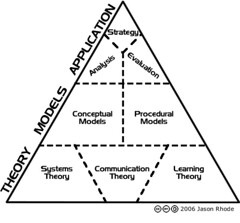
Hierarchy of Instructional Design
Hierarchy of Instructional Design (Photo: jrhode)
I gave a presentation today on discussion forums. I know that LMSs are old-fashioned now in the post web 2.0 social media world, but my goal as an instructional designer is to at least get the best use or best practices out there for whatever tools are available and being used by any particular school or institution. The presentation is in about 3 parts. The first talks about why we use discussion assignments. The second looks at the characteristics and practices that make for a successful discussion assignment, and the third talks about assessment. Oh yes, there is a fourth part: we actually went into Sakai and looked at the "Discussion Forums" tool which is the old open source forum "JForum." I prefer that tool over the generic Sakai "Forums" tool because I find "Discussion Forums" easier to grade and manage. I get where things are and why. The profile in "Discussion Forums" is easier to use than the Profile tool in Sakai which is NOT integrated with the Forums tool or any other tool for that matter. But my point is that the how and why of using a particular tool, the pedagogy implied by the assignment, and the assessment of the assignment is more important than the tool itself.

Map of income distribution in Salinas.
Map of income distribution in Salinas. (Photo credit: Wikipedia)
So in this workshop, I present a rubric for discussion posts. Most other teachers and instructional designers ask me about this. Why in a Facebook world do I need a rubric for discussion posts? Isn't this very mid 90s? Well, it is. Despite the "Millennial" thinking about students, we have a lot of students who do not know what the internet and online communication is really all about. I know this flies in the face of the "Net Generation" fallacy (where you take the recreational habits of the upper middle class/rich kids of your Ivy League school and try to extrapolate what is happening in the rest of the 99% world with technology and learning). I first developed my rubric for discussion posts around my rubric for blog posts when I was teaching English at Hartnell College in Salinas. Many of my students where first generation college students and the Spanish speaking children of migrant farm workers. Many of them did not have consistent high school experiences. A few had diplomas, some GEDs and many had incomplete educations because they moved around a lot. (According to the standard commercial English textbooks, these kids are ready for Shakespeare and Milton.) How are these students supposed to know what is expected of them in an online environment? Easy. You talk to them. You frame the question in terms that they are familiar with. You ask them about what the expectations we might have in a conversation in a classroom versus the cafeteria or at home. I told the students about the rubric and discussed what was in it and why and then we negotiated. Some were familiar with internet chats and wanted to know about "flame wars." We negotiated the points involved. We talked about what is a substantial reply versus superficial (like "great post"). So instead of imposing a list of seemingly arbitrary rules - the students made the guidelines their own. They now had a set of expectations for their interactions with one another and my grading. We referred to the rubric for about 5 weeks, and once we were sure that things were working - it slowly faded away. I think that is success.

I have a copy of my rubric here.

Here is a copy of my presentation as well:


Related articles:
Enhanced by Zemanta

Wednesday, August 22, 2012

Implementing OERs and Open Textbooks

The Engineering Building at the University of ...
The Engineering Building at the University of Leicester. Designed by James Stirling.(Wikipedia)
There is still a lot of energy out there around the creation of open content and the licensing of existing content with open licences. There are many worthwhile projects out there that are interested in creating OERs such as SCORE in the UK. But how do we use these materials effectively? How can we roll out this content in the most effective manner? Who is evaluating these materials for quality? These are common questions about OERs and they point to an evolutionary history of OERs: creation, repositories, evaluation, assessment, and implementation. There are three projects worth taking a close look at even if you are already aware of them because there are common themes arising in OER implementation. 

 The OSTRICH Project - "The OSTRICH project, funded by the Higher Education Academy and JISC, and led by the University of Leicester, will transfer and cascade the key outcomes of Leicester’s institutional open educational resources (OER) pilot project, OTTER, to the universities of Bath and Derby." Why do you need to know about this? Because their blog provides an excellent model for implementing and assessing OERs. You can follow the evolution of their implementation step-by-step through their blog.

Kaleidoscope Project - "Project Kaleidoscope is implementing a set of fully open general education courses across eight colleges serving predominantly at-risk students. The project will dramatically reduce textbook costs and allow collaborative improvement of course design to improve student success." This project built assessment and peer review into the implementation process. The genius of the project is that it brings multiple colleges together not only to review OERs and open textbooks but to find common course outcomes and develop common assessments. This is a critical stage in the history of the implementation of OERs. This project shows that inter-institutional collaboration is a key factor in OER implementation success.

SAIDE ACEMaths Project - "The aim of the SAIDE ACEMaths project was to pilot a collaborative process for the selection, adaptation and use of OER materials for teacher education programmes in South Africa. Our latest research article entitled Collaborative Design and Use of Open Educational Resources: A Case Study of a Mathematics Teacher Education Project in South Africa by Ingrid Sapire and Yvonne Reed was published in Distance Education vol. 32 no. 2 August 2011." 

OPAL: Open Education Quality Initiative - "Open educational resources, and open education more generally, are considered to have huge potential to increase participation and educational opportunities at large and to promote widening participation and lifelong learning. At the same time, the past decade has shown that openness in itself is not enough to unfold this potential. It is important to shift the focus more to the actual open practice of using, reusing, or creating open educational opportunities: open educational practice." They have published numerous case studies on the implementation of OERs. 


Each one of these projects emphasizes collaboration in one way or another. Instructors are learning how to work together to reuse, remix, and share OERs through these projects, but beyond that, they are identifying the practices that will make the implementation of OERs successful. 
Enhanced by Zemanta

Friday, August 10, 2012

Parallels in Open Software and Open Textbooks

Dr. Cable Green speaking to Creative Commons staff
Dr. Cable Green speaking to Creative Commons staff (Photo credit: tvol)
I was reading this morning about what makes a successful open source project and what makes one not so successful, and I found a number of parallels between successful open source software projects and the creation and implementation of open textbooks. For instance, Andy Brice writing on a failed software project lists "lack of support from the people who would actually have to use it" as one of the reasons for the project failing. Symbian is another example - this was meant to be an open source platform but after the announcement that it was going open source, a year went by before anyone had access to the source code. OpenMediaVault was meant to be open source. The software was freely available to users but developers had to pay a licensing fee. Back in 2005, Xara announced that its graphic package was going open source and "two years later, the project is stagnant and on the verge of irrelevance, primarily because the company couldn't figure out how to work with the open source community" (Nathan Willis). Online community is the backbone of any open source project; I even read about a company that wanted to take it's start up money and create an online community around their product. This is definitely a cart before the horse. What does all this have to do with open textbooks? If you have been around the open textbook community for any length of time, you will begin to see these same factors emerge in online textbook success stories. Story after story tells us the importance of community in an open source project. A successful open textbook is like an open source project in that it is:
  • Freely available 
    • Get money out of the way of creation & development and into support
    • Keep the licenses open
  • Accessible
    • Make the text and files available to all in a useable, editable form
    • Multiple formats will help others adapt the work for students with different needs
  • Built by the community
    • Find others who are interested in contributing to similar works. This was the important lesson from the Kaleidoscope project.
    • An open textbook created by local teachers will be more powerful and relevant than one made by a corporation with no idea of local student needs
  • Maintained by a community
    • A community can edit, share, and adapt instantly
    • A community can solve problems, translate docs into other languages, create new versions
  • Implemented by a community
    • The top down approach is doomed to failure (see your local school)
Just as the open source software community needed a license to keep open source software open, the Creative Commons organization is answering questions about licensing strategies that educators are asking as they author course materials and textbooks. The next stage in OERs (and this has started already) is building open communities around these projects. (e.g. College Open Textbooks, MERLOT and Connexions).
Here is a presentation I gave this morning making the connections between open software and open textbooks:
Enhanced by Zemanta

Wednesday, August 01, 2012

MOOC Links from NGLC Presentation

This in from Friend-of-the-Blog, Bosha Struve:


If you are interested these were pulled out of the chat window from the webinar…


Additional URL’s from Chat:

·         Edward R. O'Neill, USC: I analyzed one MOOC lecture, and then argued it wasn't supportive of learning. Here's the analysis: http://managinglearningtechnology.blogspot.com/2012/07/whats-lecture-anyway-lecture-and-mooc.html
·         Edward R. O'Neill, USC: And this is my argument about when lectures don't support learning well--strictly FYI. http://managinglearningtechnology.blogspot.com/2012/07/is-lecture-good-for-learning.htm
·         Kelvin Bentley: http://opencontent.org/blog/archives/2436
·         Francisca Yonekura: I'm currently participating in the game based learning mooc http://gamesmooc.shivtr.com/
·         Ben Harwood: E-learning and Digital Cultures - Coursera https://www.coursera.org/course/edc
Starts in Jan '13
·         Amy Collier, Stanford: Sam, take a look at George's blog: http://www.elearnspace.org/blog/2012/07/25/moocs-are-really-a-platform/
·         http://www.mooc.me/
·         Betzi - UMass Boston: @Audrey - Wiley covers it in his openness in edu course http://openeducation.us/
·         Carie Page, EDUCAUSE Help: October 8th - November 16th  http://edfuture.net
·         @injenuity: There are some names of edtech startup funders in the right column on this list http://bit.ly/H3BGpv
·         Geoff Cain: Massive list of MOOC resources: http://www.worldofwebcast.com/post/massive-list-of-mooc-resources-lit-and-literati
·         Gerry McK / Iowa State University: I curate a blog titled _Alt-Ed_ that is "devoted to documenting significant initiatives relating to Massive Open Online Courses (MOOCs), digital badges, and similar alternative educational projects." _Alt-Ed_ is located at
Enhanced by Zemanta

Tuesday, July 31, 2012

Nine Essential MOOC Links

English: George Siemens at TEDxNYED.
George Siemens at TEDxNYED. (Wikipedia)
A few of us from today's NGLC presentation "MOOCs: open online courses as levers for change in higher education" by George Siemens on MOOCs were passing around a few URLs, and I thought it would be handy to have some of them in one place. This is not meant to be exhaustive but please drop us a note in the comments if you have a link to add.
  • Massive List of MOOC Resources, Lit, and Literati
    This is a great hub of research for MOOCs. Lets get this into a wiki! If you review these links, you still get the impression that MOOCs are completely undefined because it includes discussions of Khan Academy which I would argue does not belong on a page about MOOCs. This page is useful because it speaks to the fact that MOOCs are still in a defining process. 
  • Stephen Downe's MOOC.ca page.
    This has links to relevant articles, resources and a call for curators of MOOC lore.
  • David Cormier's Description of MOOCs 
    An enthusiastic vision of MOOCs. I like this simple "Common Craft" definition of MOOCs. 
  • The MoocGuide Wiki. Stephen Downes' also has a Google Docs version of this.
    This is a useful gude on how to roll your own MOOC. There are 42 members to this wiki so it has a good chance of being a living document.
  • Join a MOOC.
    This site has a listing for MOOCs - something I think we really need. 
  • Alt-Ed
    This site is "is devoted to documenting significant initiatives relating to Massive Open Online Courses (MOOCs), digital badges, and similar alternative educational projects."
  • Howard Rheingold's Interview with George Siemen's on MOOCs
    This is a good introduction to MOOCs
  • Inge DeWardes' 3 part article on setting up a MOOC
    I am interested in MOOCs from the instructional design perspective. I think that there are ways to set MOOCs up so that even the so-called "unmotivated" student or students with little experience with online learning can be successful. That will be part of another post!
The 9th resource is the talk that George gave today. Feel free to comment and add to this - if we get more responses, we will move the conversation to the wiki.

Okay here is a bonus 10th:


Enhanced by Zemanta

Sunday, July 22, 2012

The Real Trouble With Online Education

E-learning short courses
E-learning ( London College of Fashion)
An editorial piece in the New York Times on July 19th by Mark Edmundson attempts to tell us about "The Trouble with Online Education." Despite the fact that the author does not appear to have taken or taught an online class, and despite not having any listed credentials in the field of education, online teaching and learning, or instructional design, Edmundson, and apparently the editors of the New York Times, feel he is qualified to to make the pronouncement that online courses are not "real" courses.

He asks "can online education ever be education of the very best sort?" In that loaded Gatsbyesque question, does he mean the kind of education the 1% can get at the Ivy Leagues? No, most online classes that I know of or have experienced were not small settings where we sat with a professor in big leather chairs sipping sherry. Not everyone can afford such an education and maybe that is why some folks seem to be threatened by online learning - the barbarians are at the gates! Online classes are classes of a different sort. And here is my real problem with this article: the author does not know what happens in an online class so he assumes it is not what happens in a face-to-face class and this is just wrong. 

Edmundson describes face-to-face classes as places where there is engagement, dialog and the inadvertent creation of academic community "the students will always be running into others who are also enrolled" (I am presuming in the halls or the cafeteria - do his students not work or have families?). But the fact is, I have taken face-to-face classes at colleges (U.C. Berkeley, for instance) where the professor had no time for undergrads, directed all questions to the tutors, and did nothing to foster community. Conversely, I took an online course in 2008 from the University of Manitoba (George Siemens and Stephen Downes MOOC "Connectivism and Connective Knowledge") and I am still in touch with students I met there - in fact, we are basically continuing what we learned in online communities. We are still engaged with one another. What instructor wouldn't want that? In the "very best sort" of online classes, this community and engagement is deliberately built into the courses, and the research says that student engagement is the number one factor in the success of online courses. That said, I did take an online class that was poorly run: the teacher would go days without connecting with the course, the feedback on assignments was minimal and late, and there was little direction. My point is that the teaching modality does not matter if the teacher is engaged.

There seems to be a lot of this going around, there were blog postings I read through the Chronicle of Higher Ed from Siva Vaidhaynathan and Joshua Kim's posting in Inside Higher Ed that both gave negative evaluations of MOOCs (Massively Open Online Classes) despite the authors having no experience with MOOCs or online classes. I addressed those issues in my posting "Why MOOCs Work" but I feel that there is a larger issue here. If you read the three articles together, all contra elearning, they all have this alarmist ring to them that somehow online education is a watering down of face-to-face education. You get a real sense that if the world now accepts online education as it seems that it does, and accepts badges and portfolios in place of traditional certification, that it will detract from the value of the precious face-to-face college. You know the college - the one with the tuition that has risen faster than the price of inflation, faster than the costs of healthcare, and the $250 textbooks. 

Edmundson claims that "Online education is a one-size-fits-all endeavor." There are too many kinds of online classes out there for this to be true: there are full online courses that include Skype sessions with teachers and tutors; there are hybrid courses; there are classes that are more self-directed; and there are MOOCs; I could go on. What constitutes an online class can be as individual as the instructor who teaches it. 

He claims that "It tends to be a monologue and not a real dialogue." Again, he is basing this on courses that are filmed and canned but that is NOT the most common teaching modality in online education. Most online classes include discussion forums and students now are using social media and networks such as Twitter and Facebook to engage with one another, with their instructors and experts in their field of study. A glance at the research at sites like Educause would give him an idea about what is happening. 

He says that instructors can't gauge the nuances of a class online. If  online instructors engage their online class with online discussion forums and chat, they can gauge what is happening. In fact, in some of my online English classes I got to know some of my students better than my face-to-face classes because the students will often seek out that engagement, and socialize a lot online, to make that human connection online. 

All of this points to an appalling lack of knowledge about what constitutes online learning. I can't believe that a college professor would accept similar judgements from a student with nothing to back them up but what "seems." All three authors, Edmundson, Vaidhaynathan, and Kim, evoke what "seems" as evidence. It is not like the research is hard to find. There have been hundreds of studies that show that there is no significant difference between the outcomes and success rates between online and face-to-face learning. All Edmundson would have to do is to take a look at WCET's "No Significant Difference" webpage to find a collection of the research that goes back a hundred years. Or to look at any recent study like the one reported in The American Interest called "New Study: Online Classes Just as Good."

The real trouble with online education right now is that online education is currently being defined in unfavorable ways by those who feel threatened by it. Online education is not the same as face-to-face education. Just as you should not believe the hype behind anything "new" (even if it just new to the press) - don't be dissuaded by those who are so embedded in the old paradigm and have so much to gain by its persistence that you miss out on some great teaching and learning opportunities. 

Enhanced by Zemanta

Thursday, July 12, 2012

15 Time-Saving Tips for Teaching Online

PLANTATION, FL- NOVEMBER 02:  Howie Brown adju...
Online learning saves time for students. Students in online courses have 24/7 access to their course materials, other students, and their instructor. For working students, this is an incredible benefit. But we often hear that online learning takes a lot of an instructor’s time. I have found that it can be, but when a course is set up in advance to take advantage of a learning management system’s features, a lot of time can be saved. Many of these techniques make for a more engaging experience for the students and less stress for the instructor. Note: this is an update of a post from 2009 that adds tips that teachers have sent in since then. Thanks everyone!

Here are some of my favorite time-saving tips. Please add to them!

1. Create a "Welcome Letter" that not only introduces the instructor and the course but gives detailed instructions on how to access the course and where to get help. Here is our example from DE 101.

2. Create a comprehensive syllabus.
  • Utilize a "Week Zero," a module that explains to new students how to be an online student and use the learning management system (LMS).
  • Direct students to tech support and the help desk as much as possible.
  • Create a course “scavenger hunt.”
3. Use a syllabus quiz.

4. Make your course easy to navigate.
  • Keep as much content as you can no more than two clicks away.
  • Use a consistent format week-to-week or module-to-module.
  • Remove buttons or tools you are not using.
5. Schedule your time.
  • Do not work on your online course because you can; work on it because you have scheduled the time.
  • Let the students know your schedule.
  • Access your course consistently (e.g. three times a week) and respond to email promptly (with-in 48 hours).
6. Be strict about forms of communication. E.g. ONLY take assignmnts in drop box; only accept e-mail in 1 acct. etc.

7. Automate your course as much as possible.
  • Take advantage of the time-release feature of announcements.
  • Record and reuse lectures.
  • Let the LMS handle as much of the grading as you can.
8. Distributing and exchanging documents.
  • Use the assignment feature of your LMS instead of e-mail.
  • Have the students attach documents to a forum posting.
9. Centralize question and answers.
  • Use a discussion forum for “Frequently Asked Questions.”
  • Create a FAQ page.
  • Ask students to ask questions in the forum rather than e-mail.
10. Use online groups with a deliverable
  • Let the students do the work.
  • Do not respond to every posting, respond to the group deliverable.
11. Use a "common responses" file to quickly paste in answers to common questions.

12. Allow students to facilitate online discussions.

13. Use a detailed grading rubric to help answer questions in advance.

14. Encourage student-student interaction and study groups.
  • Give them the space to solve problems.
15. Communicate to entire class in general terms using audio and/or video on a regular basis.

What about you? How do you streamline your online teaching process? Leave a comment below if you have any time saving tips.
Enhanced by Zemanta

Tuesday, July 10, 2012

Why MOOCs Work

English: Jim Groom as Edupunk
Jim Groom as Edupunk 
(Photo credit: Wikipedia)
I have been reading articles lately written by educators who have not participated in MOOCs but nonetheless seem to have some pretty strong opinions about them such as the "What's the Matter With MOOCs" by Siva Vaidhyanathan from the august (Latin for "dusty, old, and conservative") Chronicle of Higher Ed. And there is Joshua Kim's article for Inside Higher Ed, "Playing the Role of a MOOC Skeptic." I found myself getting a little testy about the issue because I am so passionate about MOOCs. I was in George Siemens' and Stephen Downes' Connectivism and Connective Knowledge class, and I skirted the fringes of Jim Groom's DS 106, his digital storytelling class. If you are not familiar with them, MOOCs are "Massively Open Online Classes" - classes with no limit to who can participate. There are no fees unless you want credit. If you read Vaidhyanathan's article, you will get a real sense about how this can really threaten the establishment. What if you hold a class and nobody pays? If we at the elite colleges give our stuff away, won't that devalue the education for the alumni and paying students? There is a lot of hand wringing like that going on. But that is not how MOOCs work. I want to look at how they do work based on my limited experience (which is better than something written by someone with NO experience).

Now I am going to warn you, I have drunk deeply from the MOOC cool-aid - my experience in Connectivism and Connective Knowledge changed how I work, and how I engage with faculty and students in some very positive, deep, and profound ways. I don't agree with everything that Siemens or Downes has written, they would be the last ones on earth to expect that, but there are no learning theories out there that can contend with, or account for, the rapid changes that are going on in education and technology than Connectivism. Interestingly enough, I think the success of MOOCs counts on an understanding of those principles. George Siemens wrote a great post on those principles in his posting "What is the Theory That Underpins Our MOOCs?"

My staff in the Distance Education department at College of the Redwoods also participated in Jim Groom's DS 106 and this experience is in turn shaping how we do our "DE 101" - our student orientation for distance learning. We are working on cracking that orientation out of the LMS box and turn it into a wider community of learning that we are hoping the students will take far beyond the confines of the orientation - through college and maybe even into their professional lives.

I love George Siemen's article on the theory of MOOCs, but as an instructional designer by trade, I would add these four points:

1. Student MotivationThis is one of the criticisms of MOOCs and the "flipped classroom model": students in those scenarios need motivation to be successful. Students are not born motivated. Lack of student motivation is not an excuse for classes not working. If you are a teacher and your students lack motivation, you need to get into another line of work. Part of what teachers do is inspire and motivate. Many teachers can't help but being motivational because they are enthusiastic about their field. Teachers can provide opportunities for the students to reflect on why they are in the class and be given opportunities to contribute to the class - in my experience, this is often enough to motivate students. I would often get students in my English classes who were used to teachers doing the work for the students. This is not a problem with MOOCs. Students can be taught motivation. As Siemens puts it, we need to foster autonomous, self-regulated learners.

2. Facilitated Connections
True learning occurs when the student chooses the modality in which the learning takes place. In traditional education, that modality is forced (typically, static classroom lecture mode). If the student accepts the choice, he or she is a "good student." What would happen if the learning materials were in different multiple formats; open, accessible and maybe sometimes asynchronous and the students got to choose which version of the material they used and how they engaged with it? Why can't "lecture" also be a video stream, podcast, or recorded event? Then the "live" bit can occur when the students decide to get together and review the materials, discuss them, and then later bring their questions to the facilitator. These reviews can happen in a Moodle discussion forum, Facebook, Twitter, or even in virtual worlds like Second Life.

3. Self-Organization
Teachers need to have faith in the students ability to self-organize - this is how revolutions, religions, and AA meetings work. Humans have evolved to do this very effectively, just ask the wooly mammoth. To this end, students need to be encouraged to use the media with which they communicate as a learning tool. If the students like discussion forums, make that available. If the students are texters or use Facebook, encourage them to take the discussion their. Even if you are not a chronic tweeter, why not have instructions available to students who are? What happened in my Connectivsm and Connective Knowledge class was that discussions took place in a wide variety of fora and then a self- or group appointed "leader" would bring our questions back to the course facilitators for clarification. Often the best thing that the facilitators did was to stand back and let us learn.

4. Content Curation
There was no text book for Connectivism and Connective Knowledge. The course consisted of many of the articles and readings that lead the facilitators to Connectivism, but also the people behind those ideas. What George Siemens and Stephen Downes are really good at is bringing the right people together to talk. They have been exploring these ideas for a while and they were good at breaking down how they arrived at some of their conclusions. Fortunately, the ideas are new enough that the people that helped them out along the way are still with us. So a "lecture" in this course consisted of some weekly readings, a video or two, and a live, weekly presentation by the facilitators or someone like Dave Cormier or another "guest lecturer." These lectures would often start out as a lecture and then evolve into a conversation with the facilitators and students. You would be really surprised at how open people are in your discipline to being a guest in your course via webinar or Skype.

So therefore, getting together with an instructional designer and creating course guides that account for the different media would be really helpful. Fortunately, George Siemens and Peter Tittenberger also thought of that with their "Handbook for Emerging Technologies" which needs to be updated and put back onto a wiki somewhere - maybe at College of the Redwoods or a college near you - so it can be added to and revised.

For Connectivism, the medium is the message - teaching Connectivism any other way than a MOOC is as ridiculous as buying a book about free, open text books from Amazon.Com. I hope that the critics of MOOCs take the time to actually take a course, even as a lurker - they will gain immensely from the experience, and who knows? They might even learn something.
Enhanced by Zemanta

Thursday, July 05, 2012

Check Please! Crowdsourcing the Menu at the NYPL

New York Public Library
NY Public Library (Photo:Austin_YeahBaby)
The New York Public Library has a fascinating menu collection of over 45,000 menus dating from the 1840s to the present. It is one of the largest collections in the world and according to their website, it is "used by historians, chefs, novelists and everyday food enthusiasts." They have scanned about a quarter of the collection and those images are available online. They can be searched by date but everyone wants to be able to search those menus by dish, ingredients, price, and presentation. It would represent an extremely useful database of information.

How are they making that happen? The NYPL is crowdsourcing the job. They have invited the public to go in online, select a menu and transcribe it. As they put it "We’ve built a simple tool that makes the transcribing pretty easy to do, but it’s a big job, so we need your help." They could scan using OCR (optical character recognition) except that many of the early menus are hand written, use old ornate fonts, or old, "idiosyncratic layouts" that make accurate reading by scanners difficult. Besides that, they still need the information to be categorized in a database and spell-checked, something that would have to be done by hand any way.

If you want to help, you can go to their website and just click on the Help Transcribe button. To follow the project or learn more, you can email them at menus@nypl.org


Note: There is a list of crowdsourcing projects that Susan Robbins posted on the LIS 653-02 Student Discussion Blog.
Enhanced by Zemanta