Wednesday, February 22, 2012

Open Education Week from March 5-10, 2012

A Wikiversity Logo for Open Educational Resour...Image via WikipediaEfforts to Expand Access to Education and Knowledge to be Featured in Global Events

CAMBRIDGE, Mass., – (February 21, 2012) –The OpenCourseWare Consortium announces today the first annual Open Education Week from March 5-10, 2012. Open Education Week is a global event that seeks to raise awareness about the benefits of free and open sharing in education, especially Open Educational Resources (OER). OER are high-quality, free and open educational materials that offer opportunities for people anywhere in the world to share, use and reuse.

“The vision of the open education movement is to create a world in which the desire to learn is fully met by the opportunity to do so, where everyone, everywhere, is able to access affordable, educationally and culturally appropriate opportunities to gain whatever knowledge or training they desire. The movement encompasses producing, sharing, using and modifying content, as well as innovative models of educational delivery,” said Mary Lou Forward, executive director of the OpenCourseWare Consortium. “Open Education Week will showcase projects, resources, people and ideas so that people around the world can see the breadth of what has been accomplished already, and participate in discussions about the future of the movement.”

Open Education Week is being coordinated by the OpenCourseWare Consortium. The event will take place online and in different locations around the world, with opportunities to participate in webinars, discussions and live events. Projects and events will be featured from institutions and organizations from around the world, including: University of Cape Town, University of Michigan, Universidad Politécnica de Madrid, University of California, Irvine, Delft University of Technology, and Creative Commons.

Participation is free and open to all. Visit www.openeducationweek.org for more information.
Enhanced by Zemanta

Friday, February 03, 2012

Beating the High Cost of Education with Open Textbooks

I wrote this as a Tech Beat article for the Times Standard:

Jonas is a 20-year-old College of the Redwoods student. He works part-time at a local auto shop and wants to one day open his own business. He needs to take classes in business and mathematics to help him be successful. Because he works, he barely qualifies for any financial aid, but he was just able to save enough money to cover the cost of school and can make it if his financial aid will pay for the required textbooks.

On the first day of class, he discovers that his financial aid check won't arrive until two weeks after classes have started. Jonas will eventually buy his textbooks and catch up. Some students wait even longer and succumb to the temptation of just “winging it.” They try to get by without buying the textbook at all.

As you can see, Jonas, like many students in California, has a problem. The cost of education is rising twice as fast as the rate of inflation; it is rising even faster than the cost of healt
Image representing Creative Commons as depicte...Image via CrunchBaseh care. The average student spends over $900 a year on textbooks. In many cases, the cost of the textbook is higher than the cost of the class (from Student PIRGs).

One innovative answer is “open textbooks.” What is an open textbook? An open textbook is one that is free, and instead of a traditional copyright which limits what a teacher can do with a text, it is either in The public domain or the author has used what is known as the Creative Commons licensing -- the author retains ownership but spells out exactly how a textbook can be used (seehttp://creativecommons.org). These textbooks are available electronically at online repositories like College Open Textbooks and CK-12 which offers “customizable, free, curriculum aligned content for k-12." Open textbooks can also be available in hard copy editions for significantly lower costs.

Using open textbooks and learning objects can be just as effective and, in many cases, more effective than a commercial textbook. Why? Commercial textbooks are a one-size-fits-all proposition. Because learning objectives and outcomes differ from institution to institution based on the needs of the local communities, main faculty already have to adapt and remix commercial texts for the needs of the student populations, often in the form of additional, costly supplements or multiple books. What I have found in my work with open textbooks is that textbooks are often supplanted (not supplemented) by openly licensed video, audio, images (and yes, open textbooks), making the course even more engaging for the students.

The real value to the authors of open texts is that they are not drawing on their own work alone, but they are getting access to a community of authors, revisers, practitioners, researchers and adapters -- a community of scholarship that will support the work of the textbook. A commercial textbook cannot take into account the social and economic conditions of the local community. A traditional commercial college textbook cannot be adapted to the deficiencies or advantages of the local high school. You can, for a price, however, buy “supplements,” which is the hole card of the commercial publisher of not-quite-entirely-unlike open textbooks. Why let book printers in another state determine the needs of your community? A community of scholars can support an online English grammar better than any book publisher trapped in the two-year publishing cycle model. These conversations and decisions should be happening in colleges and schools, not corporate boardrooms.

The math department at College of the Redwoods is already addressing this issue. They have classes that include free textbooks authored by the faculty. The textbooks are available for free online, on CD, or for a nominal cost in the college bookstore if the students prefer a hard copy. These books are written by local instructor swho are aware of the particular problems faced by the local student population. For the math department, the textbooks did not seem adequate, and they were too expensive, so instructors like Dave Arnold, Bruce Wagner and others in the department wrote or contributed to their own textbooks that include online help, examples and online quiz banks.

And fortunately for Jonas, California Senator Darrell Steinberg has proposed legislation to save California college students hundreds of millions of dollars a year in education costs. At a time when education affordability is at the forefront of national debate, this legislation would give students free access to open textbooks for 50 lower-division courses. These books would be available electronically through a “digital open source library,” with a print versions offered for around $20.
Enhanced by Zemanta

Monday, January 30, 2012

Apple Innovates Away Textbook Access and Affordabilty

I wanted to write a few notes here about many of the questions and comments I have read on Twitter and elsewhere about the iPad and textbook authoring. Two things that Apple does well is marketing and innovation. Sometimes though, the two don't speak well together. Apple is "reinventing" the textbook only for those who haven't been watching the textbook get reinvented over the last ten years. The open textbook and OER movements have been reinventing textbooks and revolutionizing education for while now. What Apple has figured out is how to monetize and brand that "revolution" into a free app on an expensive non-ADA compliant platform. English: The logo for Apple Computer, now Appl...Image via Wikipedia

I have a Mac at home and an iPod, why aren't I delirious over the "new" technology? Because for what I do, for the problems I need to solve, Apple is no solution. What Apple has done is to figure out a way for instructors to quickly author textbooks on their proprietary platform. For instance, faculty can now take an open textbook, load it on to an iPad and upload it to the app store where it is now inaccessible to those with smaller budgets, older computers or even an e-book reader. How is this an improvement? All I see is an expensive tool designed to lock out poorer students and colleges.

Where would we get the money to provide iPads for students? Do we make it a requirement that students have to have an iPad to take someone's class? The colleges that are most excited about this are those with money. I think you will find the community colleges less enthusiastic.

Why is Apple doing this? According to Publisher's Weekly: "Sales of mass market paperback plunged in September, falling 54.3% at reporting houses. Trade paperback did much better with sales flat at reporting houses, while hardcover sales fell 18.1%." PW goes on to say that "For the first nine months of 2011, e-book sales were up 137.9% at reporting publishers, to $727.7 million." The e-book market is ripe for "innovation." Apple is not interested in opening access to education; they are not interested in innovating in education for the sake of education. Their eye is on the bottom line as it has always been.

Patrick Martin really summed this up nicely: “at the bare minimum, the technology that replaces textbooks must work across multiple platforms and be capable of running on the cheapest hardware. Anything short of that will just be another thing that only more prosperous parents can purchase in hopes of giving their children a leg up. There’s nothing wrong with that, but it’s not a revolution.”

Enhanced by Zemanta

Tuesday, January 24, 2012

Daum Equation Editor

We had a faculty member who is teaching chemistry for non-majors ask us to come up with an equation editor that would not require his students to learn LaTex or ML - the subject is tough enough without having the students learn code as well. We went through a lot of candidates and we came to the conclusion that math people don't do visual stuff very well. We sent out the hounds on Twitter and Facebook to track anything down. We went to Europe (via email) and came close to buying something. Finally we found the Daum Equation Editor and what a Daum fine equation editor it is. It is a Google Chrome app so the students will have to have Google Chrome. It allows the students to click on a fraction symbol and fill it in. It saves the equation as text or as an image.

Enhanced by Zemanta

Monday, January 23, 2012

Open Education Week Coming in March

This from Cable Green at Creative Commons: "Join your colleagues around the world to increase understanding about open education! Open Education Week will take place from 5-10 March 2012 online and in locally hosted events around the world. Image representing Creative Commons as depicte...Image via CrunchBaseThe objective is to raise awareness of the open education movement and open educational resources. There are several ways you and your organization can be involved..." He then goes on to list several ways - provide a pre-recorded presentation of your work in OER, host a webinar, etc. There is a form at the bottom of the announcement.This is an important organization to support: they have literally redefined copyright in favor of both the consumers and producers in an age where the lines between the two are dissolving quickly. As they put it at Creative Commons: "The idea of universal access to research, education, and culture is made possible by the Internet, but our legal and social systems don’t always allow that idea to be realized. Copyright was created long before the emergence of the Internet, and can make it hard to legally perform actions we take for granted on the network: copy, paste, edit source, and post to the Web. The default setting of copyright law requires all of these actions to have explicit permission, granted in advance, whether you’re an artist, teacher, scientist, librarian, policymaker, or just a regular user. To achieve the vision of universal access, someone needed to provide a free, public, and standardized infrastructure that creates a balance between the reality of the Internet and the reality of copyright laws. That someone is Creative Commons."

Enhanced by Zemanta

Thursday, January 19, 2012

OERs: Why Commercial Electronic Textbooks Are No Bargain

Earlier this month, there was a posting at the California State Library blog that said that, according to a Dayton College study, the savings for students using electronic textbooks was only a dollar: "Despite the promise that digital textbooks can lead to huge cost savings for students, a new study at Daytona State College has found that many who tried e-textbooks saved only one dollar, compared with their counterparts who purchased traditional printed material." This came as no surprise to me. Electronic textbooks in themselves, especially those sold by businesses, solve the problem of distribution and printing costs to the commercial publisher, but not the problem of cost to the students and schools (or as the commercial publishers refer to them "the customers"). The study show that there are some cost saving in many circumstances but the cost of education and textbooks is currently rising faster than inflation or health care manifold over.

NEW YORK, NY - SEPTEMBER 12:  A view of the Mc...Image by Getty Images via @daylifeThe real solution to this problem is not just electronic textbooks, but textbooks that are also openly licensed. That means the textbooks are licensed in such a way that they are available to students and schools for free (such as the alternative to traditional copyright "Creative Commons"). These textbooks tend to be created by teachers for teachers and students in a particular context. They are then fully editable by other teachers to adapt to the particular needs of their students. According to the Dayton College study, nearly 1/4 of students who responded said they took fewer classes in a semester because of the cost of textbooks, and 29% of the students avoided purchasing a textbook because of its high cost at least once. Again, from the study, "During three of the project’s four semesters, students enrolled in some of the e-text pilot sections paid only $1 less for rental of their e-texts than students who bought a printed book due to publisher pricing decisions. These students were also unable to recoup a portion of expenses by selling the textbooks back to the on-campus bookstore when the course ended, which increased their disappointment."

The study, described at the CSL blog, was "conducted over four semesters, compared four different means of textbook distribution: traditional print purchase, print rental, e-textbook rental, and e-textbook rental with an e-reader device. It found that e-textbooks still face several hurdles as universities mull the switch to a digital textbook distribution model." None of this solves the problems for the students or schools. Electronic textbooks are a real temptation now for commercial enterprises because when you eliminate printing, storage and distribution, textbooks become very profitable. I am not excited when any corporation gets involved in the textbook business, even if the model is even sort of open. The whole point of business is to make a profit. I understand that, but there are appropriate and sustainable business models and old and broken ones. We do not privatize the police and generally the military (yes, there is Blackwater, but you see the problems that arise when you do it!). Our education should not be left in the hands of the profiteers. Even the somewhat more open than most publishers, like Flatworld Knowledge have a bottom line.

I can show numerous examples of outstanding open textbooks that are outstanding not just because they are "cool," have a great interface, and come with expensive supplements, but because they are incredibly effective. And no one can sell you that textbook even if they wanted to because the ones I am thinking about were created by a local community (our math department at College of the Redwoods for instance), meant to tackle problems in local schools, and address the needs of the local students. I can't sell you that book, but what I am willing to do is to talk to any educator, anywhere, who is interested in building that kind of community in your own school. This is a different philosophy than the commercial model (and no, that doesn't make me a "red") - it is a philosophy that says that learning and knowledge exist in the community and can't be commodified.
Enhanced by Zemanta

Wednesday, January 18, 2012

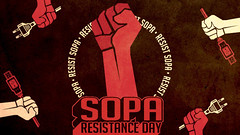
SOPA Resistance Day

On Jan 24th, Congress will vote to pass internet censorship in the Senate, even though the vast majority of Americans are opposed. We need to kill the bill - PIPA in the Senate and SOPA in the House - to protect our rights to free speech, privacy, and prosperity. See this timeline of SOPA and PIPA events and the activist backlash.

What can you do?
    SOPA Resistance Day!Image by ~C4Chaos via Flickr
  1. If you have a Twitter account, tweet about the #SOPASTRIKE and ask your followers to get ready. You can follow SopaStrike on twitter for news as the strike gets closer. Go to Blackout SOPA to add ‘STOP SOPA’ to your Twitter image.
  2. Post the SOPA Strike page to your Facebook account by clicking here.
  3. Get ready for January 18th! Email and tweet at your friends, tell them to tell everyone about the strike. When the day comes, call Congress, tweet like crazy (#SOPASTRIKE), and help the strike appear everywhere!
Enhanced by Zemanta

Friday, January 13, 2012

My Nigerian Millions

This is the Tech Beat article I wrote for the Times Standard:

By last count, I have made over $3.5 billion on the Internet since 1997. It has not come all at once; the money trickles in a few million dollars at a time. Every once in a while a whopping $100 million will just appear out of the blue. Apparently, I have a lot of friends in Nigeria: a widow of a former financial director, a rogue general or two, ex-managers of oil companies who need someone with my last name, and a couple of deposed dictators. All of them need me to contact them so I can collect untold millions.
Federal Bureau of Investigation Seal                 Image by DonkeyHotey
The Nigerian Scam letter is one of the most persistent and successful con games on the Internet. ”While such an invitation impresses most law-abiding citizens as a laughable hoax, millions of dollars in losses are caused by these schemes annually,” the FBI's Internet fraud website reads. The website refers to it as one in a class of frauds called “advance fee fraud.” It is also called the “419” scam after the Nigerian penal code enacted against it.

In my study of these letters a few years back, I chose 400 letters at random from seemingly different sources and traced the IP, or Internet protocol, addresses of about 200 of them (yes, I had more time on my hands then). Although not fool proof because Internet addresses can be spoofed, the emails seemed to come from everywhere: Nigeria, other African countries, Italy, the Netherlands, South America and all around the Pacific Rim. It is difficult to determine if an email comes from a real or fake account. The difficulties are illustrated by the one email which I traced to the Netherlands, but it claimed to be from Africa and had an email account from England. I found four major variations of the scam: the son or daughter who needs help in claiming the inheritance; an aide to an official who needs to open a foreign account for over-invoiced money; a banker who finds an abandoned account and needs a foreigner to claim the money; and the widow of an official wgi has money for a foreign investor or to “do God's work.” But common to all is the required advance fee to access the money. The letters are a request for assistance in the transfer of millions of dollars to an overseas account, for which the victim is promised a percentage.

Many recipients of these emails think that the authors are trying to get bank account numbers -- it is far more insidious than that. If a potential victim responds to the email, then the culprits start asking for more and more legal fees and bribes. They will take the money until the victim starts to complain, and then the culprits typically move on to the next victim. Like many Internet scams, their success depends on volume. For every 10,000 emails they send out, they may get only a couple of responses, but that is all they need. Often, victims are asked to come to Nigeria. If that happens, the victim runs the risk of kidnapping or murder.

Two days after the capture of Saddam Hussein in Iraq, I received an email from a man claiming to be an arms dealer who had money to buy weapons for the insurgency. Since Saddam had been captured and the war was essentially over, would I help him find an appropriate bank to deposit $22 million? The letters are often written with bad grammar, phonetic spelling and in dialect. This allows the reader to imagine a poor, naive foreigner who will surely be taken advantage of.
”Why shouldn't that person be me?” a potential victim might ask.

Some of the letters ask that the victim send assurances that they will deal with the author honestly. This is meant to give the victim a sense of shared risk. If the authors can convey the feeling that they have something to lose, then the victim is more likely to believe that he or she has something to gain.

Variations of this con have been around since at least the 1920s as a variation of the “Spanish Prisoner” scam, which involves collecting money for bribes to help release an aristocrat who is supposedly languishing in prison. If you help with the escape, you will be handsomely rewarded by the family.

Who would fall for such a blatant scam? How could anyone respond to one of these emails? The FBI warns us that we should not reply to these emails. The more economically desperate the times, the more desperate the possible measures. A small percentage of people is willing to believe anything if it will get them in the black and out of trouble, and another percentage is always willing to make that offer, solicited or not.

Geoff Cain is the director of Distance Learning at College of the Redwoods. He also serves on the board of directors for the Redwood Technology Consortium. Want to know more about technology and education? See Geoff's blog at http://www.geoffcain.com.
Enhanced by Zemanta

Wednesday, January 11, 2012

DE 101: Online Student Success

eLearning in Health conference twitter visuali...
I wanted to share a few notes here about our orientation to online learning. Here at College of the Redwoods, Barry Tucker and I have created "DE 101" - our free, not-for-credit, fully online student orientation to online learning. This is our syllabus.  NB: This posting is meant to be a chatty draft of a more formal paper that Barry Tucker and I will write on this course.

What problem does this solve?
Every semester, we have students going into to online classes with little exposure to technology or online learning. Students have spent 12 years learning to be a face-to-face student, and have had little experience with distance education. We find that students who are struggling with the technology and who do not understand what is involved in online learning (the motivation and study skills needed) will do poorly. We believe that this accounts for the disparity between the retention rates and success rates in the online and face-to-face classes.Our students typically do not have access to a lot of technology and it have only recently had access to high speed networks or even computers. This is a very rural and large area (10,000 sq miles).

How does it work?
The "course" goes for two weeks. We have two "facilitators" and three "TAs." Basically if you are in the Distance Education department, you are participating in DE 101. There are four modules in the course that open up twice a week. This mimics the flow of a typical online course. Each module covers a piece of technology and a personal skill, such as time management, that research has shown to contribute to success in online classes. The orientation is hosted in our instance of Sakai. We try to use as many of the tools in Sakai as we can and we throw in some outside tools as well. Each module has a lesson (which may include illustrations, recorded audio or video), a brief assignment, and a quiz or survey. The first module will open on Monday, the next on Thursday, etc. The tests and surveys are simple. The first one is a syllabus quiz. The whole point is to let the students play with the tools and practice using the technology with out the stress of trying to learn algebra or biology at the same time.We are using tools like Twitter to help model the possibilities of building learning networks online.

What Are the Challenges?
Time constraints. Two weeks does not seem to be enough time. It is better than trying to pack everything in a couple hours which is often the case with face-to-face orientations. ADA issues need to be solved. We have text equivalents for a lot of the media in the course - we need a quick, inexpensive (free?) way of captioning videos. We think YouTube's automatic captioning is exciting. We are also part of a grant for captioning educational video. In these days of Google Voice's speech-to-text technology, there has to be an easier way to do this. (Keep an eye on this blog for solutions to come.)

What are the results?
We have seen a significant increase in student retention and success rates in online classes since we have implemented DE 101. We went from and 11% difference between face-to-face rates to 5% which is the national average. One semester we brought it down to 4%. In our surveys, the students report that they feel more comfortable with the technology and are ready to take online classes. We hear back from faculty who say that they appreciate having DE 101 students in their classes because they can help other students out as well.

Where do we go from here?
We would like to see more of an emphasis on collaborative work. I would like to build the course into a community instead of a "class." I am in a class this semester, Jim Groom's DS 106 (Digital Storytelling). That course has a built in pedagogy of participation and collaboration. The students share assignments and create assignments. I would like to have the students decide what skills are important in online learning (and smart network creation) and then collaborate on assignments to meet those goals. I would like a system of badges ala Code Academy, where students with research and citation skills can help their peers learn how to use online tools like Zotero for their research. We want to use more assignments that use Google Docs, social media and other technologies that encourage collaborative learning.

How are you preparing your students for online learning? Please feel free to share your comments below.
Enhanced by Zemanta

Thursday, January 05, 2012

OER Books & Journals: Don't forget Europe!

English: Open Access logo and textImage via WikipediaI came across a great site in my morning reading: OAPEN (Open Access Publishing in European Networks) which "is a collaborative initiative to develop and implement a sustainable Open Access publication model for academic books in the Humanities and Social Sciences. The OAPEN Library aims to improve the visibility and usability of high quality academic research by aggregating peer reviewed Open Access publications from across Europe." I was there this morning looking at a great article on new translations Dante. That is the occupational hazard here - I find far too many interesting things to read! A lot of this material is in English. I am particularly impressed with their focus on community which I feel is the most important aspect of open education resources and open textbooks, the community behind them. Also, the quality of the work is excellent.
Enhanced by Zemanta

Saturday, December 31, 2011

New Year's Eve Technology Predictions

Every year we are treated to a wide range of predictions in the technology field. Typically Futurists write about what they think will happen. I have included in my list things that I think will not happen as well. This could be valuable advice for investors. My predictions are based on extensive research, a thorough review of data including white papers, reports and various old serials and comic books.

1. Learning Analytics
The big boom in this field will be in the consulting fees for everyone who manges to shoe-horn this buzz word into any project.

2. Learning Management Systems
Frank ShannonImage via WikipediaThe LMS field will still be dominated by programmers, database administrators, and business people. There is a remote possibility that those involved in actual online teaching and learning will have a say in how LMSs are put together.

3. The Semantic Web
The semantic web will become vaguely closer to reality. I am typing this post using with a semantic web tool, Zemanta, and it actually thinks I mean London, Midlands and Scottish railway when I type "LMS." But seriously, I love Zemanta because I have found connections in my writing that I would not have found without it.

4. Conveyor Belt Sidewalks
This year will be a year of continued disappointment to Futurists when the era of the conveyor belt sidewalk, the personal jetpack, and flying cars remain tantalizingly far on the horizon. I am kind of relieved by this because most drivers can barely handle the x and y axis with out having to figure out how not plow their cars through someone's roof.

5. Science Fiction Becomes Science Fact
I believe that this will be the year that the space program will introduce fins on space helmets. Also, the next generation of space vehicles will look more and more like the 1956 Chevy Belair.

6. Personal Robots
Again, despite the best efforts of the Honda Corporation, personal robots will not happen this year. I was about to write that I do not need a personal robot maid to wash the dishes, but then I realized that I already have one - it is called "the dishwasher." All of this personal robot research should be going in to creating artificial limbs - these robots sure as heck can't dance.


7. Social Media on the Wane
There are other sites that have predicted the rise of Google + and other sites have predicted the fall of Google +. The social media bubble will start to burst. It will be the hot topic in 2012 on Twitter, Facebook, Diigo, Google +, LinkedIn, Ning, YouTube, Friendfeed, Twine, Wordpress, LiveJournal, Myspace, WriteAPrisoner.com, and the blogosphere. New sites will spring up every where to cover this news. The death of social media will become such a hot topic that it will even revive Friendster.

Remember, you can get futurists anywhere that will tell you what might happen, I include what won't happen. And yes, I am available as a keynote speaker - I come complete with futuristic neo-retro Nehru jacket and wrap-around sun glasses.


Enhanced by Zemanta

Monday, December 19, 2011

Vaclev Havel and the 300-Baud Velvet Revolution

A DSL ModemImage via WikipediaI was familiar with Václav Havel through his writings and only later came to understand his significance as a politician (I hate to use that word to describe people I like) as communism fell. Havel had to distribute some of his writings as "samizdat" - slang for self-publishing -  because the means of communication was held by the state. Samizdat was a key form of dissident activity across the Soviet bloc where individuals reproduced censored publications by hand and passed the documents from reader to reader - it was the social media of the day but a lot more dangerous! The Soviet authorities at one time fired him from the state theater and sent him to work in a brewery. He was a signatory of Charter 77 which was distributed in the 70s this way.  The whole "Velvet Revolution" was an amazing thing to watch. There was something so inevitable about it all: the truth was going to prevail despite money, corruption and guns.

You know you are living under a repressive regime when communication tools are against the law. For instance, it is illegal, according to the State dept., to own an unregistered computer modem in Myanmar: "It is illegal to own an unregistered modem in Burma. You may bring one laptop computer into Burma, but you must declare it upon arrival. Limited email service is available at some large hotels. All emails are subject to monitoring by Burmese security services. It is very expensive to send photographs via email. One foreign visitor was presented a bill for $2,000 after transmitting one photograph via a major hotel's e-mail system. During September and October 2007, the military government disconnected all Internet access across the country for extended periods of time." This is not unusual in countries controlled by dictators.

I remember reading about people smuggling modems into Czechoslovakia back in the late 80's. Bruce Sterling later recalled the Velvet Revolution in Wired Issue 3.01, Jan 1995: "Back in '89, Czech students were trying to coordinate the uprising across the nation, and the technical students...were running the telecom angle. They used a 300-baud device with the size, shape, and heat of a kitchen toaster. The Czech secret police were far too stupid and primitive to keep up with digital telecommunications, so the student-radical modem network was relatively secure from bugging and taps. Fidonet BBSes were springing up surreptitiously on campuses whenever an activist could sneak a modem past the border guards. Modems were, of course, illegal. Most of the Czech cops, however, had no idea what modems were." The Velvet Revolution was using 300 and 900 baud modems at a time when we were bathing in the lap of luxury with our 2400 baud modems. They used the best technology and means of communication in the most effective way they knew how. Much like the Arab Spring and the Occupy Wall Street folks, no one asked if it was the most "appropriate" or the most "sustainable." A reading literate people can help foster and ensure democracy, Epictetus in his Discourses says that only the educated are free. In his day, that meant reading and writing. In our day it should include a technologically literate people, understanding how we are technologically connected and how to best leverage smart communication networks.

Enhanced by Zemanta

Friday, December 16, 2011

Help Shape Creative Commons 4.0

Creative CommonsImage by jorgeandresem via FlickrThis just in from the ubiquitous Cable Green:

Creative Commons has officially opened the public discussion process for version 4.0 of the CC license suite. Please see the announcement below, and join the discussion by subscribing to the CC license discussion list (link in blog post, below).

As we all know, the core part of any OER definition is the educational resource is either openly licensed or is in the public domain... so anyone can: reuse, revise, remix and redistribute. This is your chance to affect the licenses we all use to share OER.

One of the many reasons CC is considering versioning the licenses at this time is to address how can we improve the attribution requirements to ease citation in open educational resources (OER).
What would you like to see changed?

Starting now through February we are holding a requirements gathering period, an important (if not the most important) time to contribute ideas for improving the license suite. We hope you'll join the discussion and share your ideas for how we can improve the licenses for use with public sector information and data. And please do help us spread the word.

http://creativecommons.org/weblog/entry/30676
Enhanced by Zemanta

Monday, December 12, 2011

Open Content Licensing for Educators Workshop

Image representing Creative Commons as depicte...Image via CrunchBaseThis in from Cable Green: Creative Commons, the OER Foundation and Ako Aotearoa announce an international professional development opportunity for all educators.

What: Open content licensing for educators workshop (#OCL4Ed)
Where: Online
When: 23 -27 January 2012
Cost: Free
Registration: Open (register today)
Facilitators:
  • Cable Green, Director Global Learning, Creative Commons
  • Jane Hornibrook , Public Lead, Creative Commons Aotearoa New Zealand
  • Wayne Mackintosh, Director, OER Foundation.
Open content licensing for educators (#OCL4Ed) is a free online workshop designed for educators who want to learn more about open education resources, copyright, and creative commons licenses.
Wikieducator logo.Image via WikipediaThe course materials were developed as a collaborative project by volunteers from the OER Foundation, WikiEducator, the OpenCourseWare Consortium and Creative Commons with funding support from UNESCO. The course will provide prerequisite knowledge required by educators to legally remix open education materials and help institutions to take informed decisions about open content licenses.

Visit: http://wikieducator.org/Open_content_licensing_for_educators/About

Please spread the word through your networks. Give the gift of knowledge and invite a friend to join you.
Download and share this poster with your colleagues.

We look forward to meeting you during the workshop and extend our thanks to Ako Aotearoa, New Zealand's National Centre for Tertiary Teaching Excellence for sponsoring this professional development opportunity.
Enhanced by Zemanta

Sunday, December 11, 2011

Redwood Technology Consortium's Annual Holiday Tweet-Up

The Redwood Technology Consortium welcomes the public to join them at the 3rd annual Holiday Tweet-up, Wednesday, Dec. 14, at Greenway Partners in Arcata from 6:00-10:00 P.M.

The Tweet-up started three years ago with the intention of providing a face-to-face meeting place for community members whose main interaction was through social networking websites, like Twitter and Facebook. The event has become a fun place to gather with laptop computers, smart phones and even without technology devices to visit, play trivia games and win prizes.

English: Bronze statue of President William Mc...Image via WikipediaRTC will also provide a bar with the vodka-based Humboldt Hashtag (a clever nod to the Twitter habit of following the pound sign with a common word or phrase, which makes a topic easy to search), local wines and microbrews and non-alcoholic drinks.

Throughout the year, the RTC focuses primarily on advocacy for broadband duplication and education. This year, the Humboldt Internet Marketing Group was created, under the RTC umbrella, and community members meet at lunchtime on the second Tuesday of each month to discuss topics that focus on marketing businesses of all sizes in the internet age

This year, the RTC has seen the retirement of board members Steve Stratton and Robert Beckerdite, and welcomed new members Geoff Cain, Terry Olgin and Monica Topping. Veteran members Seth Johannesen and board president Mary Cruse, and board treasurer Sean Connors remain.

Greenway Partners is located at 1385 Eighth Street in Arcata, across the street from the Arcata Kinetic Lab.

The RTC Holiday Tweet-up is a no-cost, all-ages event.

Contact: Monica Topping (707) 498-3534
Redwood Technology Consortium
Enhanced by Zemanta

Saturday, December 03, 2011

On Learning Latin

Bust of Emperor Augustus wearing the Corona Ci...Image via WikipediaI once walked into a beginning Latin class at U.C. Berkeley. I hadn't made up my mind whether I was going to take the class or not. Right off the bat, the teacher had us reciting "amo, amas, amat..." - all 40 of us in unison - in other words, it was going to be one of those classes where rote memorization was the key learning method. I raised my hand and asked why we were chanting verbs and declensions and the instructor said that if we didn't do that we would be forever tied to a dictionary. I sat listening to the students and wondered how long students have been attempting to learn Latin this way; probably a couple of centuries, but I have some ideas from my reading over the years that that method is fairly Victorian. The tables of verbs and noun declensions fit the mechanistic age of logarithm tables, early assembly lines, and the industrial mills. I figured out that the teacher thought that we had to know grammar in order for us to read Latin. This is ridiculous, of course, because I was talking and reading simple sentences long before I knew what a coordinating conjunction or a transitive verb was. I got up from the desk, walked out of the classroom, willing to resign myself to the possible fate of being shackled to a dictionary for eternity like some lost Jacob Marley.

Why do we still do "drill and kill"? Some of it is educational hazing: I imagine the instructor thinks "I had to go through this misery and now my students have to as well."  To be fair, that is how the instructors actually learned it. In college, they are not trained in teaching, so they know no other way. Others make the argument that unless a student is thoroughly proficient in the rudiments, they can't master the subject. And that is my objection, what do we really want to teach? Do these teachers want Latin grammarians or readers of Latin literature and history? I had a teacher ask me once (in a blog posting) - "You wouldn't give students a Latin text and ask them to figure out the grammatical rules on their own?" Well, maybe I would.

Even what I consider to be the best texts make the mistake of thinking that students are going to find some kind of clarity around lists of verbs. Wheelock's Latin is a standard text and the thing that actually makes that textbook so useful is all of the examples from actual Latin texts. We used this at Sonoma State in my Latin classes, but the instructor also had us translating texts from day one. My textbook hero is Clyde Pharr - he wrote a textbook on Homeric Greek that has students reading right from Homer within a dozen chapters, and his Vergil's Aeneid has them reading from Vergil even earlier. Either of these texts could be used as primary textbooks. The sick thing is that Pharr did most of his work in the 1920s and many teachers have not figured all of this out yet. Pharr follows the assumption that children learn grammer by using language; they can learn the grammar in context just as they learn to speak grammatically in context. They are not going to use Latin if it is essentially a boring, tedious plow through inane paradigmatic sentences and tables of verbs. They are going to read if the work they are reading is interesting and engaging - Homer and Vergil are certainly that.

If rote memorization is the main teaching method, the teachers will only have students with a high tolerance for the tedious. If you teach students rote memorization, that is all they will be good at. I am sure we want more from our students than being good test-takers! Being able to jump through the hoops is not the same thing as critical thinking.

Notes 12/04/11:
Learning Latin in Context - This project shows the possibilities and importance of learning in context and in a community. (networked learning - or Connectivism).
Enhanced by Zemanta

Tuesday, November 29, 2011

Public Domain Music Keeps Getting Better

Portrait of Django Reinhardt, Aquarium, New Yo...Image via WikipediaHow does public domain music keep getting better? For one thing, the technology being used to clean up sound files has gotten significantly better. Many of the online archives of audio suffered from some pretty raw recordings from wax-cylinders and old 78s. This music is in the public domain and free but much of it was listenable only for real fans. There is some really amazing music out there too, for instance Django Reinhardt is well represented in http://archive.org. You can pull up whole collections of his music here and here for instance. You can listen to the music there, embed the playlist on your blog, or click on a link and download the whole collection. And it is worth doing now because the files have been cleaned up in one of the many programs that clean up audio files to get all the pops and hisses out of old recordings. Many use Audacity which is a free open source audio recording and editor package. There are instructions on their wiki on how to clean up audio files. Archive.org is an important site on the internet because it is a huge repository of public domain and openly-licensed texts, images, movies, music, and any kind of recording (poetry readings, famous speeches, lectures, radio programs, etc.).

This music is important in the history of music and jazz and should be available. Many of these recordings would not be available to anyone if it weren't for Archive.Org. I also want to recommend Django Reinhardt's music as a cure to seasonal affective disorder - you just can't be sad listening to his music!

Enhanced by Zemanta

Wednesday, November 16, 2011

Call for Open Education Practices

UNESCO Headquarter, ParisImage by Matthias Ripp via Flickr
This is from Abel Caine:

UNESCO is a member of the Open Educational Quality Initiative (OPAL) which aimed to create a new open educational practices (OEP) framework.

Open educational practices were defined as practices which support the production, use and reuse of open educational resources (OER) which help learners, educational professionals, organizational leaders, and policy makers to improve quality in higher education and adult education and training.

UNESCO's responsibility within the OPAL Initiative was to:
1.   Build a Clearinghouse of at least 100 of the best open educational practices; and
2.   Assist at least 50 organizations to apply an OEP Maturity self-assessment

We are close to achieving our goal and with the Initiative ending on 31st December 2012, we are making a final big Call to all members of the global OER community.

If you are currently working with OER or open educational practices, we would like to invite you to submit your practice to the OPAL Clearinghouse.

This is a very quick fill-in-form (approximately 5 minutes) which allows you to share your best practices.

If you feel your organization already practices open education or is ready to move into open educational practices, then please take the time to complete the OPAL Maturity Assessment:

This is a comprehensive mapping exercise based on the OPAL Guidelines (approximately 25 minutes).

Please excuse any cross-posting and don’t hesitate to contact both myself or Ms. Molly Malone (m.malone@unesco.org) for any help to complete the uploading of a practice or the self-assessment. We'd appreciate it if you could please also forward this message to your OER colleagues and look forward to your submissions.
Enhanced by Zemanta

Thursday, November 10, 2011

Why #Occupy will succeed

George Siemens wrote an interesting post on the Occupy Movement earlier this month. I think he gets that leaderless, connected groups can succeed but he also writes "I saw a few #occupy members on Colbert Report yesterday. They may not be representative, but I was left with a sense of  'wow, I don’t speak their language…I have ZERO interest in being a part of what they are talking about.'" I think that is a win for the media!

Essa-queta, Kiowa Apache chief. http://lewisan...Image via WikipediaThere is a real problem with understanding what the Occupy Movement is all about. It is not the so-called incoherence of the message, its that the power structures that are being protested against include the very media that is reporting on the movement. Even the Economist gets it - when discussing the media's take on the movement they report that "They also give the lie to the idea, spread about when the protests first began, that the people behind the protests don't know what they want. What they want is pretty clear: jobs, cheaper health care, cheaper education, and relief from suffocating debt." If all you knew about the Occupy Movement was what you saw on CNN or Jon Stewart, then you will not get it. CNN, Brian Williams, or Stewart are not in the business to give you the big picture. Television is entertainment. It is the circus in "bread and circuses." If they don't have a goof-ball with aluminium foil on his head, it is not good television. They have to trivialize this to assuage the frayed nerves of their corporate sponsors. In this time of financial corruption and economic recession and depression, how comfortable are those sponsors with a protest movement that is centered on accountability, bank and financial reform, and general expressions of public frustration? The critics of the movement want a bullet-pointed executive summary. In an interview with Amy Goodman of Democracy Now, Cornell West said "It’s impossible to translate the issue of the greed of Wall Street into one demand, or two demands. We’re talking about a democratic awakening."

This is an international movement. This movement has been compared to the protests in the 60s and I remember that those protests also suffered from a so-called lack of a coherent message. Ending the Vietnam War sounded to many as strange and abstract as Bank Reform. It sounded clear later as more people were seeing the impact of the war. The real story of those protests in the 60s and early 70s did not come from CBS News (although images in the media from Vietnam were instrumental in turning public opinion), the message and organization of those protesters came through underground newspapers, pamphlets, and books. There were radio stations too.

And now this is why I am writing about this. The Occupy Movement has all it needs to succeed: it has a message, boots on the ground, and its own media. A useful model for understanding this movement comes from the book "The Starfish and the Spider." The idea behind "The Starfish and the Spider" is that centralized organizations are like spiders and can be destroyed with an attack to the head. Decentralized organizations rely on catalyst-leaders in the field to make decisions. These organizations are like starfish: no single blow will kill them, and parts that are destroyed will grow back. Some points from the "The Starfish":
  • When attacked, a decentralized organization tends to become even more open and decentralized;
      We have seen this over and over throughout the Middle East in the Arab Spring. Nothing strengthens or legitimizes a movement more than over-reaction by the governing authorities.
  • An open system doesn’t have central intelligence; the intelligence is spread throughout the system;
      This is why interviewing individuals for "the message" can be pretty pointless. The real message is found in the network of the participants.
  • Open systems can easily mutate;
  • The decentralized organization sneaks up on you;
     
    Who saw this coming?
  • Put people into an open system and they’ll automatically want to contribute;
  • When attacked, centralized organizations tend to become even more centralized.
The examples from the book include a look at how the Apache indians dealt with the Spanish invasion of the Americas - their organization was loose knit and flexible enough to allow them to go from living in villages to being a nomadic people. Other examples of decentralized organizations include AA or Al-Qaeda.

Twitter, Facebook, and Tumblr are all important tools for organizing this movement. The Economist says of the Occupy Movement "what's going on in America right now may be the world's first genuine social-media uprising." I think the Arab Spring might hold that title, but the media's lack of understanding how social networks are shaping politics in the U.S. and the world is quickly making the mainstream media's lack of relevance even more apparent.

George Siemens wrote "#Occupy can be leaderless and diverse and still succeed. It can be distributed and networked and still succeed. However, if its message doesn’t resonate with a significant portion of society, due to lack of coherence or limited capability of individuals to form personal coherence around numerous voices, it will fail." But the interesting part of this is that in his work, knowledge comes from the connections; meaning can emerge out of chaos.

Don't wait for CNN to figure this out for you - go out and talk to those people who are standing in front of your city hall. Think about how you feel about these issues, talk to others, and don't accept every thing the banks tell us as inevitable in "this economy." Check out your local credit union. When you do that - the movement succeeds. 

Enhanced by Zemanta

Thursday, November 03, 2011

Job Announcement: Open Education Director

OpenImage by wiccked via FlickrTacoma Community College, an innovative college in an innovative state, is advertising for an "Open Education Program Program Director." I can tell you by direct experience that this is a good college to work for. I think the fact that there is an American community college advertising for such a position is incredibly significant. I am hoping as progress is made in open textbooks and the open education resources, that more colleges will need staff positions dedicated to supporting instructors and students. Washington state has already released 42 courses in its open course library project.

Enhanced by Zemanta