Tuesday, June 19, 2012

DE 101: Preparing Students for Online Learning

On June 15th, 2012, my associate Barry Tucker and I presented at the Online Teaching Conference 2012 in San Jose, CA. We presented on DE 101, our live, free, fully online, two-week orientation for students here at College of the Redwoods.


There is an archive of our session in CCC Confer

College of the Redwoods offers its students "DE 101" a free, two-week, fully online seminar on how to take an online class and be a successful online student. In this seminar, students learn about Sakai and how to use other online tools such as their student email and TurnItIn.com. The course covers the tools in Sakai as well as the skills required to be a successful online student. Topics covered include an over-view of the typical tools used in an online Sakai course but also cover, time management, online collaboration skills, solving technology problems, identity theft prevention and other topics of concern to online learners. The Distance Education department has completed 9 sections of this course. We have found that having this kind of training available before the student takes an online course (or concurrently) helps student completion and retention in online learning.

As we continue the research into how our course works, we will be putting our findings in a paper and sending it out to a journal. The seeds of that paper are in an earlier posting about DE 101.
Enhanced by Zemanta

Friday, June 08, 2012

Plagiarism, TurnItIn, and Instructional Design

English: A photo I took in front of the Colleg...
Jeffery Maiten: A photo I took in front of the College of the Redwoods library after the rain (Source:  Wikipedia)
Here at College of the Redwoods, we use TurnItIn. TurnItIn is plagiarism detection software. We have it integrated with our learning management system's assignment tool so all papers that get uploaded to the assignment, get checked by TurnItIn. TurnItIn will connect to Blackboard, Moodle, WebCT, Angel, and Sakai (we use the latter). TurnItIn is basically the best software of its kind out there. I have used other software packages at other schools and none of them do as complete of a search as TurnItIn. It is not enough to just use Google. There are other efforts from the usual suspects, but none as complete or efficient as TurnItIn. Budgets being what they are, I recently checked out some free software. Interestingly enough, I selected a paragraph from one of my old blog postings as a test. The free software did not catch it as plagiarized. As a former English teacher, I have mixed feelings about plagiarism detection software. I would like to think that if you teach and model academic honesty that such measures are not necessary. That said, I know that classes other than composition don't always hove time to teach academic honesty, research and documentation. And there are other pressures on students that make the thought of saving time and effort by using the work of others more attractive. Some of what is called "plagiarism" comes from students not knowing how to properly cite their sources. I like to use reports from TurnItIn as teaching moments.

As an instructional designer, I have even more mixed feelings about using software to detect plagiarism. There are things that teachers can do to help prevent plagiarism:
  1. Teach writing as a process. If you require students to turn in the various stages of their paper - outline, discovery draft, bibliography, etc. then there is no room for the student to plagiarize. And when students try to circumvent the process, you know you are probably dealing with an academic honesty issue. 
  2. Dedicate a class session to academic honesty. This lets the students know that you value academic honesty and that you know how students can cheat. Make sure they get a copy of the school's academic honesty policy. Some even go so far as having the students sign a statement that says that they read and understand the policy. 
  3. Ask deeper questions. If the answers the students are giving you are coming from Wikipedia, then you are asking the wrong questions.Take a look at Bloom's Taxonomy and think about what kind of writing you are asking your students to do.
  4. Know your students. Get to know your students by asking them to keep a journal. Or begin the day with a short in-class writing assignment.If you know how they express themselves and at what level their writing is at, any changes would be a red flag for issues in the students' work.
  5. Bring in the students' experience. Ask the students to bring their experiences into the assignment. In part of your question, ask them to provide an example of a similar problem they have encountered in their previous work. Or have them interview a relative or employer.The learning theory Constructivism tells us that students learn best when they are able to apply what they are learning to past experience. 
  6. Let your students connect. Have the students work together on their revisions. Have them discuss their research in groups. This encourages students to bring their research to their audience. They can't discuss thoughts that are not their own. Also, this allows students to see how other students tackle assignments and research problems. 
  7. Make it relevant. Don't just ask students to take a position on a topic and argue for it. Require that they use a few news sources in their paper. I love teachers who complain about reading the same death penalty papers year after year. Change the assignment! Ask them to bring in a topic from the headlines. Have them find out what journalists or writers are covering their topic.
  8. Model academic honesty. Some of the same teachers who get worked up about plagiarism will sometimes be the same teachers who do not cite sources in their own class materials. Show students how it is done and why early and often. Start with that favorite quote or picture you put in your syllabus.
If you have other tips for preventing plagiarism or teaching academic honesty, I would love to hear from you in the comments!
Enhanced by Zemanta

Sunday, June 03, 2012

France: Minitel and the Internet

Minitel 1 (France, 1982)
Minitel, France, 1982. Wikipedia
I was just in Paris this month. How did I get to Paris? Fortunately for me, my car got stolen in October, and I decided to go to Paris instead of replacing it. We were a two car family but there are now only two of us. Two cars makes sense when we are both adjunct teachers teaching at three different colleges, but now that I am an administrator, it makes no sense to have two cars. I miss my non-descript Mazda Protege. So what did I do in Europe? I went on a long over-due vacation: I spent 8 days in Amsterdam researching Dutch art for a novel I am writing and spent 9 days in Paris just because I love Paris.

Paris, of course, was amazing. I was there 13 years ago and I never imagined it would take so long to get back. I love art, music, French literature, history, urban walks, and food, and Paris has all of that in spades. It is the most gorgeous, romantic city on earth and only San Francisco comes close. I have heard SF referred to as "Paris West" but interestingly enough, no one calls Paris "San Francisco East."

I inadvertently got unplugged in Europe. I had all of these great apps on my phone that were going to help me translate, navigate, mediate, and explicate my experiences in Europe, but Verizon charges Louis the XVIth era prices for international data and over-seas connections. The phone stayed home. I have a camera with the latest card format allowing me to take thousands of pictures and movies on my camera but my Ubuntu Linux netbook would not read the card. Neither would any internet cafe in Europe using Windows XP, which is most of them. On top of that, the budget hotels we were staying in were not exactly up to snuff with wireless. Wifi worked in the lobby and the first four floors, but after that, we were out of luck. Which is fine, we tend to stay in the kind of hotels that brag about "potable water." So I spent most of my vacation disconnected - I did not feel smarter; on the contrary, I would have loved to be able to talk to my people while traveling.

One of the headlines in Paris while I was there was "The second life of Minitel." Minitel was the bulletin board of the nation in the pre-internet age. It was their AOL. It has been around for 30 years and they are finally pulling the plug. They were going to stop the service last year but they gave in to pressure to wait for the 30th anniversary. But what exactly was Minitel? Minitel was a terminal-based service that used existing phone lines to let users access bulletin boards, make travel reservations, order from retail outlets, access databases, and telephone directories. The terminals were given away for free to 9 million people and the service is used by 25 million people because there is also a computer interface to the service. This was a lot like the bulletin board services in the United States.

According to Wikipedia, "Minitel was often considered as an impediment for a fast deployment of the Internet in France, since it already provided safe and easy online access for many useful services without requiring a personal computer. Indeed, it still has advantages over the Internet: it does not require subscribing to a service (except the phone service), buying and maintaining a personal computer..."

However the Minitel system got French people used to making purchases online and using online services for connecting to one another and communicating online. So it made the Internet possible in France. The people of France were familiar with all of the issues that we were only to meet up with later: the government did not intervene in pornographic bulletin boards, they said it was the parents responsibility.

In 1986, French students used the Minitel system to coordinate a national strike, demonstrating an early use of digital communication devices for "participatory technopolitical ends." This was a prelude to the Velvet Revolution in Eastern Europe, Twitter, and the Arab Spring.
Enhanced by Zemanta

Friday, June 01, 2012

Is the Internet making us stupid?

Marshall McLuhan caused wide irritation with h...
Marshall McLuhan caused wide irritation with his statement that the traditional, book-oriented intellectuals had become irrelevant for the formulation of cultural rules in the electronic age. (Photo credit: Wikipedia)
This is an article I wrote for the Times-Standard "Tech Beat" column:

Is the Internet making us stupid? Variations on this argument have been floating around since Nicolas Carr first wrote “Is Google Making Us Stupid?” in the Atlantic Monthly back in 2008. His idea is that the more we rely on computers to do our “thinking” for us, the weaker our brains become.

These arguments rely on a shallow definition of thinking. If I believe that the only way to express intelligence is through writing 20-page papers or consuming information in the same way that my grandparents did, then I am not that smart. Carr and others believe that if someone grows impatient with books, that person is experiencing some kind of cognitive deficit.

One problem with this argument comes from the fact that we really know little about cognition in the first place. Cognitive science is still in its relative infancy. This field is rapidly changing as technology advances, so making some kind of declaration on how we think and learn based on this new science is a bit premature.

And what if technology does change the way that we think? Is this necessarily a bad thing? Maybe that is how we evolve. We develop technologies to deal with problems in our environment, and as Marshall McLuhan says, “we shape tools and then our tools shape us.” He says that technology is just an extension of our natural faculties and abilities. We have the intelligence to invent fire and bicycles. Does this make us slower and weaker? Or did we invent stuff to make up for our weaknesses?


The Hansen Writing Ball, the first typewriter ...
The Hansen Writing Ball, the first typewriter sold commercially, invented by Rasmus Malling-Hansen around 1865, first manufactured in 1870. This was a model from 1878. (Photo credit: Wikipedia)
Carr recounts the story of the philosopher Nietzsche's introduction to the typewriter, and he says that “under the machines' sway” Nietzsche's writing became more terse and “telegraphic.” I think this is a good thing. It is refreshing when a philosopher can get to the point. My uncle Ed, also a writer, once said to me that “the word processor is to words what the chainsaw is to wood.” I knew exactly what he meant because I wrote a book in 1990-91 using a typewriter. It was the last major project I did using a typewriter. The typewriter had me on the floor literally cutting and pasting pages and paragraphs together. I may have enjoyed the process at the time, but I would never go back.

Carr discusses McLuhan in his article: “Media are not just passive channels of information. They supply the stuff of thought, but they also shape the process of thought.” I agree with this. At various times in human history, our media, from the cave paintings of Chauvet-Pont-d'Arc to the Internet, has gone from being an oral and visual culture to a written culture and now back into a visual medium of connections. We are connected to the information, connected to one another, and connected to the means of producing information.

We have to let go of the idea that there is some kind of privileged media. Socrates distrusted writing because it removes people from how he thought we really learn, by having conversations. Carr talks about “deep reading” and that somehow, with all of this access to information, our reading will become shallow and sporadic. He seems to forget the mountains of trash that have made it into print (novelizations of television shows, for instance). Someone can read books their entire life and not make it out of the shallows.

Thomas Claburn wrote an article in the Oct. 15 edition of Information Week called “Is Google Making Us Smarter?” where he cites a study showing that there may be some benefits to computer use, especially with older adults. The study involved 24 volunteers between the ages of 55 and 76, half of whom had prior Internet search experience. According to the article, “Participants' brains were scanned using functional magnetic resonance imaging (fMRI) scans while they conducted Internet searches and read books. The study participants showed similar brain activity when reading, but when searching online, those with prior Internet experience also showed activity in the frontal, the temporal, and the cingulate areas of the brain, areas associated with complex reasoning.”

We are in a new era. But despite the fear we may have of new media, according to publisher Timothy McSweeny, “... there isn't as much bad news as popularly assumed. ... Book sales are up, way up, from twenty years ago. Young adult readership is far wider and deeper than ever before. Library membership and circulation is at all-time high.”

The latest technologies include new definitions of what a book might be. They might not be in traditional print. They might come on Kindles, Nooks, iPhones and iPads, and the Internet itself. But people are reading. Between Harry Potter and all of the vampire novels, the future of literacy is assured.

Geoff Cain is a member of the Redwood Technology Consortium and director of distance education at College of the Redwoods. Contact him at geoff-cain@redwoods.edu.
Enhanced by Zemanta

Open Content Licensing for Educators Workshop

Image representing Creative Commons as depicte...
Image via CrunchBase
This is from Cable Green: 

2012 is a significant year for open education and OER. We are celebrating 10 years since UNESCO coined the term "Open Educational Resources".

In joining the global celebrations, the OER Foundation will host a free online training workshop on OERs, Copyright and Creative Commons licensing.

When: 20 June -  3 July 2012 (to coincide with the UNESCO World OER Congress in Paris).
Where: Online
Cost: Free. Registrations for this celebratory online workshop are now open:  Register today to reserve your seat.

We are aiming to break our previous #OCL4Ed record of 1067 registrations, so please share the gift of knowledge and invite colleagues and friends to join us.

We welcome graduates of former OCL4Ed workshops to join our lead facilitators and assist with peer-learning support for educators around the world who want to learn more about OER and open licensing.  More info on how you can assist coming soon. 

We look forward to welcoming you to OCL4Ed 2012.06.

With kind regards

The OER Foundation team
COL Chair in OER at Otago Polytechnic
UNESCO-COL Chair in OER at Athabasca University
Enhanced by Zemanta

Saturday, May 19, 2012

Facebook and My 1000 Closest Friends

This is an article I wrote for the Times Standard "Tech Beat' column for May 11, 2012:

I have read a few claims recently about the detrimental effects of the Internet. The most recent one came from the New York Times in the article “The Flight from Conversation” by Sherry Turkle, a professor from MIT, who says that the Internet is making our relationships with one another superficial. Her idea is that we are mistaking our “likes” on Facebook as real conversation and our “friends” online as real friends. I think this argument comes from a fundamental misunderstanding of the nature of online communication.

Turkle says that for the past 15 years she has studied connective technologies and talked to “hundreds of people of all ages and circumstances about their plugged in lives.” She relies primarily on anecdotes, and one of my favorite quotes from economist Roger Brinner says that “the plural of anecdote is not data.” A collection of subjective experiences does not make them objective. Anecdotal evidence is of limited usefulness; it can provide case studies and be the starting point for research, but it is generally considered as weak evidence.

Turkle says that the little devices we carry around with us are so powerful “they change not only what we do but who we are.” I basically agree with this. I don't particularly think this is negative. People write less. Last year the post office closed 3,700 locations. Some of this was due to expanded retail marketing, but much of it is because email and texting make most letter writing superfluous. Does this mean that somehow our correspondence is less meaningful?

I have hundreds of anecdotes of my own. Let's take my community college cafeteria in 1984. There were no cell phones. There was no email. The college library had a non-networked computer lab with TRS 80s. Our only hope was to actually talk to somebody face to face. I would go into the cafeteria, buy a cup of coffee, sit down at the table, and ask the nearest girl “What classes are you taking?” or “What's your major?” with what I hoped would pass for something not quite entirely unlike sincerity. One might suspect that, even though I was trying to start up a conversation, I may not have been really all that interested in what classes they were taking or what their major might have been. Needless to say, my intent was to have a conversation. More often than not, the “conversation” stopped there. But once in a great while it led to more coffee elsewhere.

Today, I have 879 friends on Facebook, but let's take a closer look. I do not expect birthday cards from 875 of them. I originally started using Facebook because many educators and instructional designers I met at education conferences (both face-to-face and online) were using it to share materials, links, and contact information. This accounts for at least 300 of my “friends.” About 200 of my “friends” are literary journals, editors, and literary agents. They never call or come over for dinner, yet I follow them on Facebook because I write and want to keep up with what is going on in the literary world.

A little over a hundred friends on Facebook are family. Some I see often, and many of them I have never met. Some of these distant cousins live in Ireland. We will be using Facebook to plan a birthday/family reunion this December when my father turns 80 and my little brother turns 50. There is nothing superficial about that.

You might have friends at your local service organization, temple, or church. But what happens when you go to that weekly meeting? Do you have a deep conversation? Maybe not, but you probably know that if you need help, you have a community to fall back on when things are tough. Or you might be willing to lend a hand to someone who is in need. It might be something simple like a lift to the hospital on a Monday morning or a chore that an older person might find difficult to do. When you meet those people, you might just smile and nod. The “like” in Facebook is that smile and nod.

Social networks can be superficial, and yet over and over again, we see that when there is trouble, those friends in social networks can have a major impact. I am thinking here of the Arab Spring and the communications networks that sprang up out of Twitter to change the face of the Arab world forever. Maybe the technology has allowed us to see the superficial surface of human communication frozen in time in the social network, but that is not how we should be judging technology because most people seem to be using to enhance their connections with one another rather than trivialize them.

Geoff Cain is a member of the Redwood Technology Consortium and director of distance education at College of the Redwoods. Contact him at geoff-cain@redwoods.edu<
Enhanced by Zemanta

Wednesday, May 16, 2012

Art and Technology in Amsterdam

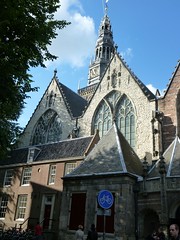
Oud Kirk (old church)
Oud Kirk (Photo credit: bolinhanyc)
I am in Amsterdam this week. I am here mostly for the art but also to see the places where the art was created. One of the reasons why I am here is that I read a book a while back called "The Art of Describing" by Svetlana Alpers. She writes about Italian painting being from a "textual" culture and Dutch painting coming from a visual culture. Italian painting is emblematic and can be read - knowledge in Dutch painting is visually recorded. It makes sense that the rise of the science of optics in the Northern Renaissance also parallels this new way of expressing their experience of the world. She also writes about the influence of maps on painting. The optics allows artists to see the world with a new, "scientific" accuracy. It allows us to measure the world in new ways. Some of these new technologies include lenses, telescopes, microscopes, and the camera obscura.

In contrast to this culture, I keep reading on writer's blogs (ironically enough) that in order to be an artist or writer in our culture we have to avoid distractions and stay off the internet. I am glad that the Dutch artists didn't think that they had to "unplug" in order to create art. Vermeer and Rembrandt were just as much businessmen in the hubbub of everyday life as they were artists. They worked and played with the technology of the day and were not afraid to let it inform their work.

I am a little unplugged this trip, not by choice but because the international data charges for Verizon are insanely expensive, and I am a fourth-floor walk-up, shared bath kind of traveler. Also, Google thought that I was Dutch for the last four days and translated my accounts into Dutch. I had to use Google Translate to use my email. Sometimes our technology is just too smart for its own good. Things are back to "normal."
Enhanced by Zemanta

Tuesday, May 15, 2012

OER: Indigenous People's Reader

Jacqui Cain has edited a reader for developmental English classes that includes indigenous people's stories from around the world: stories translated from oral traditions. She did this presentation for the 2012 Online Teaching Conference which starts in June as part of their virtual presentations track.


The reader will be available at the end of the summer.

Tuesday, April 10, 2012

Worldreader and biNu

WorldreaderWorldreader is a US and European non-profit whose mission is to make digital books available to children in the developing world, so millions of people can improve their lives. As of March 2012, they have "put over 75,000 e-books - and the life-changing, power-creating ideas contained within them – into the hands of 1,000 children in Sub Saharan Africa. Those children now read more, read better, and are improving their communities." In many African countries, 80 percent of the population owns a cell phone. Up to now, Worldreader has focused on distributing Kindles to classrooms (the organization’s founder is former Amazon exec , but by making e-books available via cell phones the organization can reach a much wider group of readers.

Worldreader's app was developed by Sydney-based startup biNu. It is currently in beta. The app uses cloud-based data compression technology to enable any Java-enabled phone (non-smartphone) to download e-books and access news websites and Facebook over an ordinary mobile signal. This is a huge step in cost reduction.

biNu is a fascinating project in itself: "With over half the world’s population owning a mobile phone today, but less than half that number having regular access to a computer, we are driven by a passion to help bring the reality of the Internet, along with its economic, educational and social benefits, to everyone." They are basically bringing the internet to regular phones.

"biNu approached this challenge by devising a patented software platform that delivers Internet applications to “low-end” mobiles with almost instant response times and efficient use of network bandwidth."

Although reaching 75,000 students in Africa is just a drop in the bucket, this project is very important because it is significantly lowering the cost of books and most importantly, access to information.
Enhanced by Zemanta

Saturday, April 07, 2012

Mobile Learning: Education is Everywhere

IPad Mini
This is an article I wrote for the "Tech Beat" column for the Times-Standard:

Darrell is a part-time student who does not own a car. Every Tuesday and Thursday, he takes the hour-long bus ride to school. Like many students at his community college, he works nearly 30 hours a week while taking three classes. Between work, commuting, and attending classes, he is hard-pressed to find time for studying.

Fortunately for him, though, while taking the bus one morning, he found himself sitting next to one of his fellow classmates, Julie. He told her about his frustrations with his schedule and the homework and how he didn't feel like he had time to see a tutor. She told him about the many educational sites that can be accessed on the phone. Sites like the Mobile ESL page from Athabasca University (http://eslau.ca) that has online grammar lessons and short self-tests that will help you check your work. She also pointed out that parts of the college's own learning management system were accessible by phone. She even had one instructor who was using an electronic textbook that was accessible by smart phones.

Darrel quickly took to the world of mobile learning. His phone was no longer just for texting and music.

What exactly is mobile learning? Mobile learning (often called “mlearning”) is any learning or instruction that takes place at a specific location but relies on a mobile device to access the information or event.

Mlearning often depends on “smart phones.” Smart phones, such as the iPhone or Android, are basically minicomputers that can connect to the Internet via wifi or through the phone network. Any phone that can connect to the Internet can participate in mlearning. Mlearning is also taking place on tablet computers such as the iPad and the highly portable netbooks. Not all phones are smart phones, but they are becoming more and more widespread and common. Soon, there will be no other phone but a smart phone.

What are some ways that instructors can use phones for learning? They can host content that is easily accessible to phones on the Internet. Many software packages make mobile-friendly websites out of the box, and many phones have simplified web browsers that help make accessing the information easier.

Many resources and institutions, such as the New York Public Library, have mobile-friendly sites. And speaking of libraries, a number of libraries, such as Oregon State and Yale, are taking advantage of mobile phones with a “Text-a-Librarian” service.

Mobile phones often have applications on them that will allow them to read electronic books. Tens of thousands of books are available for free on the Internet through sites such as gutenberg.org. Amazon's Kindle software is available for phones, but there are many free non-corporate readers out there as well.

Instructors can ask students to gather data with their phones. Often, smart phones include cameras. That, combined with the Internet connection, allows students to post photographs online. Students can also post data to websites, blogs, or wikis. This can allow students to gather information in the field.

Mobile phones can also read barcodes and special versions of barcodes called QR codes that will allow users to interact with objects. QR codes are used in science and art museums on the description cards for exhibits or works of art. When they are scanned, they might give more information via text, audio, or video, or it might take the visitor to a webpage.

Mobile phones are natural portals to sites like Facebook and Twitter. Some instructors will use services like Twitter to send announcements, as a “back channel” discussion site for lectures, and as a way to continue the community of the classroom beyond the walls of the college.

Sample of a QR code. 
Mobile phones are also used as “student response systems.” Any mobile phone can be used this way. Using websites like Poll Everywhere (www.polleverywhere.com), instructors can set up polls that the students can respond to in class. Give three choices for an answer, for instance, the students can text a number to respond to their choice. Instructors can get instant feedback no matter how large their class is.

Smart phones like the iPhone or the Android have an “app store” associated with them. There are numerous free applications that can be used on a phone that allow students to learn anything from languages to the Periodic Table.

There are many ways that both students and teachers can take advantage of phones for teaching and learning. It is important for educators to understand that students often will be catching what they can of their learning experience when they can catch it. Everyone benefits when we use tools that, by default, make the learning materials as accessible to as many as possible when they need it.

Geoff Cain is a member of the Redwood Technology Consortium and director of distance education at College of the Redwoods. Contact him at geoff-cain@redwoods.edu.

NOTE: Drake Teller posted a comment at the Times Standard: "Also check out Celly, a free service with group texting and instant polling. However, with Celly you can send and receive polls from the web or from any sms capable phone. Thus, it does not necessarily require a smart phone to have class discussions, send alerts, or gather student response (like a software clicker w/o the software). For more info: http://cel.ly/schools
Enhanced by Zemanta

Sunday, April 01, 2012

Innovation: Of Tide Mills and TED Talks

Tide mills, along with riverine ship mills, we...Tide mills, along with riverine ship mills, were a major early medieval technological advance, allowing to tap the tidal power along the Atlantic Coast for milling. (Photo credit: Wikipedia)Watching TED Talks this morning made me think about how different the cultures of innovation are now and a thousand years ago. The TED Talks tend to promote the myth of the lone, gifted super genius entrepreneur. Nothing particularly wrong about that but it is a cultural construct and myth that rarely acknowledges the past work of others, graduate students, adjuncts, the labor or the laborers, the dead ends that others went down so you didn't have to, and positions of privilege.  I would like to see a "TED Talk" of a 6th Century Irish monk from the west coast of Ireland to talk about alternative sustainable energy and if they did that, we would notice a lot of really familiar ideas and "innovations" such as tide mills.

Tidal mills were used since Roman times for grinding mills for cereals (wheat flour) and salt. They have existed for centuries (possibly millennia in some places) along the European Atlantic coast (Ireland, Holland, Britain, Belgium, France, Portugal and Spain), located mainly in pipes, canals and rivers, where the potential energy of the tides was maximal, which allowed them to run for about six hours by flood-tide cycle. They basically existed where ever the Romans built roads. And they were also picked up later by the  monasteries who were often headed up by missionaries from Rome.

I don't know if our star monk could bring in a Powerpoint presentation - maybe he could tell the highlights of the story in stained glass or in an illustrated parchment. But notice that we don't have a record of that particular monk. We don't because they tended not to see themselves as tenure track wunderkind but as a part of a community and, for good or ill, part of the "Great Chain of Being." I think if your innovations survive a thousand years, you should at least get rewarded with a sabbatical or something. We know of very few Roman or monastic innovators by their names. There was learning, apprenticeship, and mastery but it was for a community and tended to not be for any one person's particular gain. No one copyrighted or patented the aqueduct. These were truly, in the best sense of the word, civic works.

The TED Talk I listened to this morning was with David Sadoway who is developing liquid metal batteries. I loved that he gave a shout out to Volta, and his graduate students and assistants - that happens rarely in these talks, mostly because they are so pressed for time and they have to get the ideas out there in that small amount of time.

Which brings me to my next point about cultures of innovation: I love hearing that the Chinese can't innovate: they invented the compass, gunpowder, paper, and the printing press to go with it. What they don't have is a culture of mentorship, entrepreneurship, and creativity that David Sadoway talks about. When they get that, Silicon Valley will seem like a pretty quaint little place.


Enhanced by Zemanta

Friday, March 30, 2012

Mobile Learning by Default

Motorola MILESTONE smartphone displaying Wikip...Motorola MILESTONE smartphone displaying Wikipedia home page (Photo credit: Wikipedia)When I first started reading about mobile learning platforms, there was a lot of talk about special content management systems or learning management systems that would enable mobile learning (or "mlearning"). A few years ago, there were a lot of mobile learning platform start-ups, but it looks like that is not really where mlearning is going to go. Many applications support mlearning right out of the box. For instance, my wife, Jacqui, teaches reading and she uses Softchalk to create her course "textbook." She then uploads it to Sakai (the college's learning management system). Students will often read in the classroom on the computers. One day she came in when the students were supposed to be reading and a few of them had their phones out. She asked them to put them away. They quickly turned the phones around to face her and she was really surprised at what she saw: they were reading her textbook on their phones. Not only could they read it, but all of the images, roll-over definitions, embedded videos and annotations worked perfectly. She didn't have to do a thing. And it really tells us how students engage with content and the digital world. The students who need or prefer the mobile content just naturally navigated to the content with their phones.

Style sheets can detect when a web page is being accessed by a mobile phone and then redirect the user to the mobile version of that page - Facebook does that and so does this blog. Blogger.com uses a mobile style sheet and I didn't have to do a thing. In fact, some visitors of this blog have told me that they prefer the mobile version to the pretty web version because it loads faster and they can access the information they are looking for quickly.

One of the things that impressed me about the Angel learning management system before they were subsumed by Balkbored was that every part of the LMS was accessible by phone even before the wide-spread use of smart phones.

What is my standard for mobile sites? One of my favorite mobile sites (I used to teach English in a happier time long, long ago...) is the mobile ESL site at Athabasca University put together by Rory McGreal et alia.  This is a very useful site that is openly licensed. We are working on a version of this for College of the Redwoods so stay tuned. This is the model of how mobile sites should work: simple, self-contained, easy-to-read, and it includes self-assessment! This is the how and why of mobile learning. This is what the students will be using on the long bus ride to school. This is genius. If all of that wasn't enough, you can download the files and adapt them to your particular circumstances and upload them to your own server because it is openly licensed under a Creative Commons Attribution-Noncommercial-Share Alike 3.0 license.

Students have reported that they are able to access Sakai (the learning management system used at College of the Redwoods where I work) on their mobile phones without too much trouble. Here is a screen shot of the mobile interface from Ithaca College in NY:


It is important for us to understand as educators that students often will be catching what they can of their learning experience when they can catch it. It behooves us to use tools that by default makes the learning materials as accessible to as many as possible.
Enhanced by Zemanta

Monday, March 26, 2012

OER Policy Registry: Request for Help

Image representing Creative Commons as depicte...Image via CrunchBaseCable Green just lit the Bat Signal!

Greetings Open Colleagues,

The open community shares a need for more information to help us with our work. We know, for example, that there are many policies supporting open education at institutions and governments throughout the world. Many of us know of some of these policies, but it would be extremely helpful if we had a single database of open education policies that the entire community could access and update.

To meet this goal, Creative Commons has received a small grant to create an “OER Policy Registry.” The Open Educational Resources (OER) Policy Registry will be a place for policymakers and open advocates to easily share and update OER legislation, OER institutional policies and supporting OER policy resources. We have begun to enter OER policies into the registry, but we need your help to make it a truly useful global resource.

The open movement is reaching a stage where we’ve had some real, concrete OER policy victories and there is the potential to achieve many more. Sharing our collective knowledge of existing OER policies, in the same way we believe in sharing educational resources, will help advocates and policymakers worldwide be more successful.

Please join the effort:
(1) Contribute any OER policies you know about via this Google form.
  • We are collecting both legislative AND institutional (non-legislative) OER policies from around the world. Your form submissions will be added to the draft list of OER policies.
(2) Review the draft list of OER policies. (Google doc)
(3) Forward this message to your colleagues, lists, blogs, and other channels, to ensure that we get as much input as possible. As the OER movement is global, it is critical that we capture OER policies from around the world.

Anyone can add OER policies to the Google form through the next month. Beginning May 1, the OER Policy Registry will move to the Creative Commons wiki. At that point, anyone will be able to edit and update the OER Policy Registry on the wiki, and all contributions will be licensed under CC BY.

We’re starting with a Google form because (a) it’s easy and (b) wikis require you to create an account before editing, and that may be a barrier to participation.

CC is in contact with other projects that collect similar information, including UNESCO, CoL, the Florida Distance Learning Consortium, EU OCW and a project in New Zealand. We will add OER policy data they gather as it becomes available. If anyone knows of other efforts to gather OER policies, please send them to Anna Daniel (anna@creativecommons.org) and we will reach out to them too.

If you have any suggestions or feedback on the content and/or framework, please let us know.

Warmest regards and thank you!

Cable
Enhanced by Zemanta

Friday, March 23, 2012

Wired Love: From Telegraph to Twitter

An illustration of Phelps' Electro-motor Print...An illustration of Phelps' Electro-motor Printing Telegraph, the last and most advanced telegraphy mechanism designed by George May Phelps. (Photo credit: Wikipedia)This is an article I wrote for the "Tech Beat" column for the Times-Standard:

As one who works in online learning, I often get forwarded emails from colleagues alerting me to the dangers that might arise from using Facebook, Twitter, or other social networks. For instance, a few years back, after sending out a notice for a workshop on social networks and education, I received several emails warning me with a link to David Gardener's article called “The Marriage Killer: One in five American divorces now involve Facebook” from the Daily Mail. This lurid article begins with, “It used to be the tell-tale lipstick on the collar. Then there were the give-away texts that spelled the death knell for many marriages. But now, one in five divorces involve the social networking site Facebook....” The implication being that I may want to be careful in promoting the use of social networks like Facebook in education because there are perils that lurk beneath the surface of the Internet that may lead to unintended and tragic consequences.

This is not surprising. I have given workshops on how to use virtual worlds in education, often using educational sites designed in the virtual world “Second Life.” Invariably, after sending out the announcement for the workshop, I will get a cautionary email such as the one informing me of the 40-year-old British couple who had famously married in Second Life in a huge wedding, but then divorced later after one of them had an alleged “affair” in the online world. The wife said that she caught her husband's avatar having sex with another animated woman: the couple are now divorced (in the real world).

What are these stories really telling us? Is there anything really inherently dangerous in online communication? This is not a question of 'should we' or 'should we not' have relationships online. The fact is that the online world is just another medium of communication, and that is what humans do: communicate in a wide variety of ways. We are every bit as complicated in our courtship rituals and communications as the rarest of birds-of-paradise in New Guinea.

The only difference between the modern online courtship rituals and those of the past is the new medium of the Internet. There are a lot of things we are doing online that we never could have imagined doing just 10 years ago. Who would have thought that making purchases online would become so commonplace? Or online banking? Or wedding invitations?

But yet, there was something about the more recent warnings I received that seemed very familiar. And the reason is that every time we, as a culture, develop a new technology, there are always those who see it as the first step down a slippery slope that will ultimately mean the end of the world as we know it.

For example, people had been batting around the idea of the telegraph in various forms since the 1740s. Eventually, Samuel Morse developed a system that could transmit signals over long distances and by the 1860s there was a trans-Atlantic cable, a well-established telegraph network in the Northeastern United States and a network in California and other parts of the West linked by a trans-continental cable. In less than a generation, this new technology transformed how people handled money, got the news, ran elections and even fell in love!

Doesn't this sound familiar? Sense trouble?

The stage was set for wire fraud, romances and the usual chicanery that happens when people figure out new ways to communicate with one another. There was even a novel written in 1880 by telegraph operator Ella Cheever Thayer who published the world's first “cyber-romance.” “Wired Love: a romance of dots and dashes,” was a novel about two telegraphers who fall in love over the telegraph wires without ever meeting face-to-face. It was the mother to the film “Shop Around the Corner” (about a relationship via letters), and the grandmother to the modern email version of the love story “You've Got Mail.” “Wired Love” was a bestseller for 10 years, and according to Tom Standage in his book “The Victorian Internet,” relationships like this were not at all that uncommon.

For every failed relationship in cyberspace, there is an example of success. The most famous modern example is the couple in the “twitterverse,” Greg Rewis and Stephanie Sullivan (now Mr. and Mrs. Rewis). Greg Rewis proposed to his girlfriend on Twitter and sent an instant message on his phone asking her to check her Twitter account just for good measure. Later, their children sat in the church and tweeted the ceremony to those attending virtually.

Despite the “dangers,” the real lesson is that people communicate and connect with one another. This is what we do. We are very good at it. We will use all forms of communication for education, banking or socializing. Despite the warnings and cautionary tales, people will not resist using any means possible to connect with one another.

Geoff Cain is a member of the Redwood Technology Consortium and director of distance education at College of the Redwoods. Contact him at geoff-cain@redwoods.edu.
Enhanced by Zemanta

Twitter and the Greater Community

Tweeting bird, derived from the initial 't' of...Tweeting bird, derived from the initial 't' of Twitter Deutsch: Twitschervogel, entwickelt aus dem Anfangs-'t' von Twitter (Photo credit: Wikipedia)Over the last week, I went to a bookstore where an internationally known author was reading from her latest book. As people were sitting down, we all started talking with one another. We were gathering together to share an experience, to connect with one another over our shared love for this author and books in general. I looked over the crowd and there were a handful of people with their heads down tapping quickly into their phones. I followed suit. The woman behind me said to her friend, "I wish I could Tweet."  Now I thought this was very funny on many levels - she was not saying she didn't have the ability or the means although both of those could be true. She may not even own a mobile phone. What she was expressing was that she was really excited to be where she was and she wanted to be able to share that with a broader community - with as many people as possible. The popularity of Twitter, microblogging, and texting isn't in the inanity of knowing who is eating pizza where, but in our connection to that greater community. This is not to say that knowing when someone is eating pizza is really inane. I have found by reading tweets from people I know and work with, I begin to get an unconscious sense of their life's patterns. I will sometimes catch myself knowing I had better call an associate at 3:30 because they always head out to the gym at 4:00. The company celebrated their sixth birthday on March 21st. Like most 6 year olds, it is still finding its legs and learning how to read. Twitter has certainly become part of the digital public square when to "Tweet" can also mean "I wish I could tell the whole world I am here."

Related articles
Enhanced by Zemanta

Friday, March 09, 2012

Tapping the Power of Analytics

The Learning Analytics CycleThe Learning Analytics Cycle (Photo credit: dougclow)This is an article I wrote for the Tech Beat column for Times-Standard:

Professor Dunn is a chemistry teacher with 120 students in three sections of her class. Her students are all reading the same materials, working on the same projects, and yet, after the midterm, she sees that the results across the courses are different. Why is one section having a problem when the other two are not?

Then she receives several emails from her college's learning analytics software concerning several students in the underperforming class. The emails were generated by a computer program that looks at what is happening in the school's online interface with student data from other parts of the campus such as Admissions and Records, EOPS or the athletics department and uses that to recommend specific action or interventions to help the students. For example, one email recommends a time-management learning unit and tutorials, while for another student, the program recommends tutoring and that the students contact their academic advisor. Why the different strategies?

Professor Dunn's classes are part of a learning analytics project that can help her students. What the learning analytics program “knew” that Professor Dunn did not know was that one student is fresh out of high school with little direction but is on the basketball team, while the other student is returning to college after being in the workplace for a few years and is a single parent of two young children.

The learning analytics program keeps track of what her students are doing and why. It is a computer program that analyses data for correlations that most instructors don't have the time or access to the necessary information to perform for each student. The software tracks who her students are, how they did in the past, where they are now, how much time they spend with the materials she posts online and how they do on her tests. The program will help her predict what kind of help her students will need to succeed.

Again, the concept of analytics is nothing new; researchers and academics have been writing about analytics since the 1970s and learning analytics as we now think of it since at least 2004. This is a concept not just for businesses but for many traditional colleges as well. For instance, Purdue University uses a system called “Course Signals” which can be seen at www.itap.purdue.edu/learning/tools/signals/. Rio Salado College in Arizona is using learning analytics as well with its “PACE” program.

Are there problems with learning analytics? Why do some consider it controversial? Some consider any kind of analytics to be an invasion of privacy. Others think that because businesses use analytics to sell T-shirts on Facebook that the only application for analytics is business. A few have written that the teachers should be making the decisions and not a computer.

A lot of care is taken with learning analytics software to encrypt student identities. The information that the program accesses is already being gathered by the schools and other agencies; learning analytics just uses that information to help faculty make decisions about how to help their students. And no computer program is perfect; no computer program will remove the need for critical thinking skills on the part of the administrators, teachers, or students.

The business sector has been using analytics for many years to make decisions. They have been very successful at it. If Amazon, Facebook and other online services can provide a custom commercial environment, why can't education create a customized learning environment for the students? This is not a trivialization or even a commercialization of education. Business is not the only field that uses analytics. The field of epidemiology, the study of how disease spreads, has been on the forefront of analytics for years. They specifically track the relationship between human behavior and disease.

Analytics is basically making decisions using data. We do that now. The real question is, how do we get out of the way of our data and let it tell its story? William James said that “the art of being wise is the art of knowing what to overlook.” Human beings get hung up on details; computers do not. Humans also have the unfortunate habit of combining perfectly usable data with our opinions, misconceptions and prejudices, everything that is otherwise known as “common sense.” Machines are not making decisions for us. We are using them to gather relevant data and to show how the data interrelates for the benefit of our students.

The goal of learning analytics is to enable teachers and schools to identify educational opportunities for each student's level of need and ability. More than just a buzz word, learning analytics promises to harness the power of advances in data mining, interpretation and modeling to tailor education to individual students more effectively.
Enhanced by Zemanta

Wednesday, March 07, 2012

My Mediæval Family

It occurred to me the other night that there are plenty in my family that would have done alright in the Middle Ages. I have a nephew who is a bookmaker - no, his uncles were pretty disappointed when it turned out to be actual books and had nothing to do with horses. He designs actual books: not ebooks, not pdf files, but actual books. My sister is a Catholic chaplain. My brother Crispin, as good  a medieval name as you would want to hear, is a distiller. And my father makes stained glass windows. My wife makes her own bread. There are a few leeches in the family - I mean the ones who practice the medical arts. We have a fair amount of builders and designers in the family too along with poets and bards. All of those occupations or professions take a measure of patience and curiosity; a penchant for philosophy and craft (and the ability to see why philosophy and craft go together). Anyhow, I am grateful for being in a big family where everyone is doing good work.

A window Jim Cain (my dear father) created for an Episcopal Church in Coalinga, CA.


Enhanced by Zemanta

Wednesday, February 29, 2012

OERs and Biology at Collge of the Redwoods

On Tuesday, March 6, 2012 at 4:00 PM PST Geoff Cain & Wendy Riggs present on switch from a commercial textbook to open education resources for a Biology course for non-Biology majors at College of the Redwoods, a two-year community college. They will talk about how they found and evaluated and adapted materials, and the triumphs and challenges they met along the way. College of the Redwoods is a partner with the Kaleidoscope grant, an NGLC grant supporting the implementation of open textbooks.

This event is one of many in celebration of Open Education Week.  There are many events going on around the web - be sure to check out the calendar of webinars that will be happening around the clock from around the world!.

Participant Details
  • Dial your telephone conference line: (888) 886-3951
  • Enter your passcode: 274076
  • Go to www.cccconfer.org
  • Click the "Participant Log In" button under the "Webinars" logo
  • Locate your meeting and click GoFill out the form and click connect
Time: Tuesday, March 6, 2012 at 4:00 PM PST UTC-8 hours (other time zones)
Enhanced by Zemanta