Wednesday, April 27, 2011

CR receives $100,000 grant from Next Generation Learning Challenges

Earth Day at Armstrong Redwoods HealdsburgImage by Al_HikesAZ via Flickr
We are pretty excited about this grant. This is the press release from Paul DeMark's office here at College of the Redwoods:

College of the Redwoods announced that it has been awarded part of a $750,000 grant from Next Generation Learning Challenges (NGLC) as a member of the Kaleidoscope Project.

Designed and funded by the Bill & Melinda Gates and William & Flora Hewlett Foundations, NGLC is focused on identifying and scaling technology-enabled approaches to dramatically improve college readiness and completion, especially for low-income young adults, in the United States. CR's portion of the grant is approximately $100,000.

The Kaleidoscope Project will implement a fully open general education curriculum across eight colleges that serve predominantly at-risk students. M.L. Bettino, dean of academic affairs for Cerritos College explained the benefits of the project: ''The Kaleidoscope Project’s use of open educational resources will virtually eliminate textbooks costs as an obstacle to success for low-income students. It will also allow institutions to collaborate to refine and improve course content, closing the loop between course design and student learning outcomes.''
''I am very pleased that CR has received this grant,'' said CR Interim President Utpal Goswami. ''It will enable us to continue to develop innovative instructional projects to serve student needs. The ultimate beneficiaries will be students.''

''This grant will help us to support the academic achievement of our students, many of whom are low-income, first-generation college students who live in rural areas a long distance from any of our campus sites,'' explained Maggie Lynch, Chief Technology Officer and Dean of Distance Education. ''Our participation in the Kaleidoscope Project allows us to bring the resources of the Gates and Hewlett Foundations, MIT, Carnegie Mellon University and our innovative Kaleidoscope college partners. We look forward to creating improved opportunities for access and success for our students through this important work.''

Led by Cerritos College, the Kaleidoscope Project includes partners, in addition to CR, include Chadron State College, Mercy College, Palo Verde College, Rancho Santiago Community College District and Tompkins Cortland Community College. The eight colleges collectively serve more than 100,000 students annually; 69 percent of these students are at risk of dropping out.

A team of respected, global open education experts will support the college partners including Norman Bier from Carnegie Mellon’s Open Learning Initiative, Chris Coppola from rSmart, Cable Green from the Washington State Board for Community and Technical Colleges, Vijay Kumar of MIT, Kim Thanos of Thanos Partners and David Wiley from Brigham Young University.
The project will also benefit from use of the Sakai collaboration platform for course delivery, and the use of both Sakai analytics and the Association of American Colleges and Universities VALUE rubrics to assess student learning.

About Next Generation Learning Challenges:

NGLC focuses on identifying and scaling technology-enabled approaches to dramatically improve college readiness and completion by addressing a continuum of interrelated issues spanning secondary and postsecondary education from grades 6 through college. NGLC is led by EDUCAUSE in partnership with The League for Innovation in the Community College, the International Association of K-12 Online Learning, and the Council of Chief State School Officers. In addition to funding, NGLC is gathering evidence about effective practices, and working to develop a community dedicated to these persistent challenges. The Bill & Melinda Gates Foundation and the William and Flora Hewlett Foundation helped design the Next Generation Learning Challenges, and fund the initiative.

Enhanced by Zemanta

Wednesday, April 20, 2011

OERs and Money: The revolution will happen without you.

Stewart Brand in Sausalito, California, USA Im...Image via Wikipedia"On the one hand, information wants to be expensive because it's so valuable. The right information in the right place just changes your life. On the other hand, information wants to be free because the cost of getting it out is getting lower and lower all of the time. So you have these two fighting against each other." -- Stewart Brand.

I ran across this quote while perusing some funny videos of Daedalus Howell from a while back who was eulogizing the "Ten Things Killed by the Internet." The video is from 2009 and I hope the updated version will one day include "over-priced college textbooks." This was one of those moments of serendipity because I have been reading the debate between David Wiley and Stephen Downes about whether OER should favor commercial use. OERs are "open eduction resources" such as Stephen Downes' book on critical thinking and logical fallacies. My first reaction to the debated question is "no." Why should an open license "favor" the very mechanism that it is trying to subvert? And my second reaction is "So what?" The kind of education that "favors" commercial licenses is going the way of the video store.

I do not envy David Wiley. Going up against Stephen Downes in a debate is no mean feat. Wiley has the credibility gap to over-come with his connection to commercial publishing, and Downes has been a long time OER advocate and contributer who has been writing on this from the beginning.

I personally feel strongly that learning materials should be created by the community that uses them. The publishers just get in the way. We have a number of examples right here at College of the Redwoods of a community of educators getting together to create a textbook and online testing system that works better than anything that a publisher could offer us. Why? Because it is customized and built from the ground up with the needs of the local community in mind. With commercial textbooks, one has to amend, adapt, and supplement. There is nothing wrong with that; it is just not better than community authored. No body ever said "Hey, lets go with the Pearson textbook; they have our students' best interest at heart."

There are good commercial text books, but there are some atrocious ones that cost just as much! And meanwhile, more and more textbooks and learning objects are being created and openly licensed to world. There are companies positioning themselves to facilitate open textbooks and they will be profitable for a while. They are poised to become the Netflix of education. How long will that paradigm last? Who knows. I find it hysterical that with the economy in the shape that it is, with education costs rising faster than inflation and healthcare that commercial publishers feel they have to protect and defend corporate profits in a debate. And it is all available to you for free.
Enhanced by Zemanta

Thursday, April 14, 2011

Why the Library is No Substitute for the Internet

My apologies to many of the fine librarians I know who have really kept up on the changing world of networked knowledge and the internet. The image at the left was posted by Xeni Jardin from Joe Sabia at BoingBoing. It is a sign on a shelf in his public library in Milford, Connecticut. (Click on the image to see the whole arguments.) It is a shame that the gate-keepers of knowledge are so little informed about what is happening with the internet. My responses are below.

1. Not Everything is on the Internet. Not everything is in the library either. I do not know any library that could currently afford to contain all of the books that are on the internet.
2. The Needle (your search) in the Haystack (the web). It is not very hard to find things on the internet. If you are having trouble, go to a library where the librarians believe in the web. That would be a good reason to consult a librarian. Why aren't the Milford librarians taking the time to teach then online critical thinking skills required to find academically viable materials?
3. Quality Control Doesn't Exist. The internet contains numerous repositories of vetted information (open access journals, MERLOT, etc.) Librarians have the opportunity to catalog these repositories and again, teach the critical thinking skills required to find good information. What the sign really means is that there is no one controlling the information. This has its pros and cons but why can't a librarian help me through this?
4. What You Don't Know Really Does Hurt You. Exactly my point. What these librarians don't know about the internet is hurting our children.
5. States Can Now Buy One Book and Distribute It to Every Library on the Internet. They do not understand electronic books, digital rights, or open education resources. How sad. See #4.
6. Hey, Bud, What About E-Books? Reading on a machine is different than reading a book.
7. Aren't There Paperless Universities Now? There should be but there aren't. But, university libraries are getting smaller and smaller. They are becoming service centers rather than book storage facilities.
8. But a Virtual State Library Would Work Right? Yes, in fact it will, especially with open source textbooks. This is a ridiculous statement. Using the old paradigms and business models, it would cost a thousand times that estimate. The sign, I am hoping, was put up before Google, Amazon, and the Kindle and iPad were invented.
9. The Internet: A Mile Wide, an Inch (or Less) Deep. This only partially true, it is mostly hundreds of miles wide and very shallow but it also has a couple of deep canyons of information and networks of experts in there. It contains the warp and woof of human expression. Where are the librarians and information managers to help make sense of it all? Not in Milford's library!
10. The Internet is Ubiquitous but Books Are Portable. And orange trees make terrible espresso. Hey Milford! 1997 is calling and it wants its MLS back!

Disclaimer: I have a nice little library at home but not because the internet is shallow!

Enhanced by Zemanta

Friday, April 08, 2011

New Education Technology Changes Everything


I am reading a book on a "new" educational technology. Everything in the book is hauntingly familiar. We have heard these warnings about technology and education before. Its "...importance as an instrument of instruction in the common school, has been insisted on in every periodical on education which I have seen, either of this country or Europe; as well as in almost every recent treatise on the same subject. It has also been introduced into most of our improved schools, of every grade, especially in New England and New York. In many of our common schools, however, it has been but barely introduced; the teacher knows almost as little how to use it as his pupils. It is vain or nearly in vain that our more intelligent Committees and even the Secretaries of our Boards of Education urge the importance of its use, from year to year, so long as no instruction is given concerning its use."

We hear this all the time: why are we providing technology but not providing instruction in its proper use?

"It is in this view that I have prepared the following manual. It is, of course, not designed for pupils, but solely for teachers. Nor is it intended to be used blindly, even by teachers themselves. Let such only of its methods be tried as seem adapted to the circumstances of the teachert and let even those be modified to meet the peculiarities of his own school room. Hardly any mistake could be greater than for the teacher, who should take up a book like this, to adopt its various methods without reference to existing circumstances."

So in other words, there is no one implementation of technology, but possible technological solutions to particular problems.

If you haven't guessed, the technology is the slate black board. The book is The Slate Blackboard &; Exercises by William A. Alcott from 1843.
Enhanced by Zemanta

Wednesday, April 06, 2011

Spotlight on Innovation: Attacking High Text Costs While Improving Outcomes

Spotlight On Innovation:
Attacking High Text Costs While Improving Outcomes
Date: Monday, April 11th, 2011
Time: 3:30 pm ET / 12:30 pm PT
Duration: 50 minutes followed by a live Q&A session
As the high cost of college texts negatively impacts student retention and outcomes, what actions can faculty and institutions take to reverse this trend?

Register now for this webinar to learn about three of the most exciting initiatives aimed at driving costs down while enhancing innovation and outcomes.
Moderated by Eric Frank, President and Co-Founder of Flat World Knowledge, this panel will begin with an overview of what open texts are and how they've emerged as a force in past years, and then spotlight the innovative work of the University System of Ohio, Washington Open Course Library Project, and Virginia State University.
Join us on April 11th. Click below to register.
Featured Speakers:
THE UNIVERSITY SYSTEM OF OHIO
Darlene McCoy
Associate Vice Chancellor, Affordability and Efficiency
Dr. Steve Acker
Research Director, EText Ohio Project; Emeritus Professor, The Ohio State University
WASHINGTON STATE OPEN COURSE LIBRARY PROJECT
Dr. Cable Green
Project Director of eLearning and Open Education, WA State Board for Comm. and Tech. Colleges
VIRGINIA STATE UNIVERSITY
Dr. Mirta Martin
Dean, Reginald F. Lewis School of Business
Dr. Andrew Feldstein
Assistant Professor


Can't Make It?
Feel free to check out our pre-recorded webinar library which contains many 30-60 minute webcasts. Visit our webinar library.
Enhanced by Zemanta

Tuesday, April 05, 2011

Diversity Matters: Read the Koran

An Ilkhanid Koran with Persian translation bet...Image via WikipediaI have been home sick lately with a ferocious cold. Unfortunately, this has lead to watching CNN and MSNBC far too much and one of the really frightening things to watch is news being interpreted by some of the people least likely to understand what they are reporting on. I am frightened by the lack of liberal arts education in the public sphere and the media. Okay, so you get the picture: sick, education guy descends into the depths of curmudgeonry as his fever goes up. I am stopping short of saying that education was better in my day because it wasn't. Knowledge of the Middle East in the 70's was a few notches above "Road to Morroco." It is obvious to me that by the surprise and befuddlement in the voices of the reporters and the inane questions they ask that they do not have even a basic grasp of Middle Eastern history or any acquaintance with Islam.

If you are in school, don't wait for the teachers. You owe it to yourself to get the education you need to make sense of the world. If you have graduated or never went to school, it is never too late. As unfashionable as this idea is, there are key books in western civilization and we are doing a great disservice to history and culture by not teaching them. For instance, reading the Bible and Ovid's Metamorphoses are essential to understanding art history. Without them, half of what a student is looking at is meaningless. Much of western art was created with shared texts, common cultural baggage. Although many in the Islamic world say that the Koran can only be read in Arabic, reading a translation in English is better than being completely blind to the fastest growing faith in the world.

So this is an education blog, why am I writing about the Koran? Because, like the world that inspires terrorism, the news is ruled by ignorance and fear. One of the goals of education is not just to provide information but understanding. Education should be about something. In order to think critically about what is happening in the world, we need the whole picture. A couple years ago, I read the Koran with a reading group at the Saltwater Unitarian church. We did this as part of a world religion study but also, I think, as a response to the fear and prejudice that has been growing about Islam in this country. The seventh principle of Unitarianism says that "we respect the interdependent web of all existence of which we are a part." This is often interpreted as environmentalism, but I see this as cultural as well. Reading the Koran felt like a pretty subversive act given the reactionary mood of some in this country. We read from Approaching the Quran: The Early Revelations by Michael Sells which came highly recommended. It is a very clear and poetic translation that also comes with a CD of readings in Arabic with calls to prayer. These selections led many of us to keep on reading. There are a number of online editions as well:

  • The Online Quran Project. Readers can select multiple translations
  • The Qur'an. The The Center for Jewish-Muslim Engagement. This is a three translation parallel text.
  • ReadTheQuran.Org. This English translation also includes audio files of the original Arabic so you can actually hear the text as millions of people do around the world everyday.
  • The Holy Qur'an. A wiki version translated by Abdullah Yusif Ali, a popular Islamic scholar from the 30s.

Again, all of this needs to be put into context too, so I think it is important to read a history of the Middle East. And I mean, really, virtually any history at this point. You will be one up on almost all the the "experts" being interviewed on CNN. It is very important that we understand why people in the Middle East and especially North Africa are hesitant to accept our "help" with their political affairs. Peter Mansfield's History of the Middle East is a fairly detailed overview with useful chapters on North Africa. Again, no matter how you feel about what is happening in the Middle East, I don't know how not understanding their culture and history is going to help you.

If you have better suggestions or other favorites, please feel free to link them in the comments below.
Enhanced by Zemanta

Tuesday, March 22, 2011

Open Textbooks:
The College Student Speaks Out

Tuesday, April 5, 2011
2:00-3:00 PM EST / 11:00AM-Noon PST

Moderator: Nicole Allen
Textbook Advocate for the Student PIRGs and Director of the Make Textbooks Affordable campaign.

In the national debate surrounding textbook affordability and adoption, the student voice often goes unheard. Join Nicole Allen, the national Textbook Advocate for the Student Public Interest Research Groups (Student PIRGs), and college students from around the nation as they discuss their initiatives to make textbooks affordable through the use of high-quality open textbooks and other cost-saving solutions. Learn what motivates students to become and stay involved, and how they impact teaching and learning along the way. Don't miss this lively discussion!

TextbookImage via Wikipedia


Information and Free Registration

Enhanced by Zemanta

Saturday, March 19, 2011

OER: The Myth of Commercial Textbook Reliability

Japanese high school textbooksImage via WikipediaAn "OER" is an open education resource and the most common example is an open textbook. An open textbook is a book, most often electronic, that is licensed in a way that allows re-use, repurposing, editing, and republishing. One of the main advantages in an open textbook, apart from the fact that they are free, is that open textbooks can be edited by the instructor. Some "open" textbooks managed by commercial publishers may not be editable at the sentence level. One of the criticisms leveled at open textbooks is that the quality somehow suffers because they do not have the "imprimatur" of the commercial publishers. Even some advocates of open textbooks believe this myth.

According to the Educause article "7 Things You Should Know About Open Textbooks," "The traditional publishing model features robust editorial..mechanisms designed to ensure the quality...of printed textbooks." In my experience as a former manager for a commercial textbook publisher, their motivation was to bring a textbook to the market as quickly as possible, not ensure the quality. The authors go on to say "an open textbook may seem to be missing an essential credential that speaks to its validity." This is a more accurate statement because this is about perception, not reality. There is a presumption that a textbook that was not vetted by a project manager at a business conglomerate must have quality and reliability issues. Those who are arguing this do not understand the commercial textbook industry. Textbook publishers don't always get it right, and often, textbooks are bought by school districts and colleges departments without being reviewed carefully because buyers assume that commercial publishers are careful. Why else would they be so expensive? Here are a few glaring examples (of many) where they were not careful:
I will let these examples suffice for now. You can go to Google yourself and search for "textbook errors" and find many more examples. In that search, I also found articles about how to turn textbook errors into "teachable moments." How sad is that? Why would we accept these textbooks? How helpless are we that we are content with these errors? The traditional publishing cycle of commercial textbooks means that it can take two years before a corrected commercial textbook makes it back to the "customer" (that is our students). Texas has talked about fining publishers for each error - now there is a teachable moment!

How did we get here? Getting back to the Educause article which says that reliability issues in open texts "places an extra burden on the instructor to ensure an open text is complete, accurate, and appropriate for the student needs." This should be the work of all instructors and administrators no matter what the licensing looks like.

But the solution can only come from open texts: an instructor or department cannot correct a commercial text, cannot add to it, or adapt the materials to the specific needs of the local student population. That can only be done with texts that are open licensed. With an open textbook, any errors can be corrected as they are found.

Lets do our job as educators and not rely on commercial businesses to teach our students. We should be engaged in the curriculum at all stages and not hold open texts to a higher standard than commercial textbooks. Instructors and academic departments should partner to author, revise, adapt, and vet course materials. We should be partnering with other institutions to support these efforts - a textbook should include a network of subject matter experts, expert practitioners in the field, and advanced students.

Besides all of that, a textbook is not a course. It is a single tool, a reference point. A textbook is not teaching. If the answers to your questions can be found in a textbook, you are not asking the right questions.

Enhanced by Zemanta

Friday, March 18, 2011

8 Open Source Project Management Tools

Project development stagesImage via WikipediaOne of the consequences of a depressed economy in a college work environment is the pursuit of and reliance on more grants. And multiple grants means that project management is all the more important. I will be looking at open source project management tools over this weekend and I am specifically looking for scalable software that can be used by a worker in a one-person department or a small group, and eventually be able to grow with the department or the college. The criteria that I am using right now for reviewing project management software is that it has to be open source, user friendly, and scalable. We are not interested in anything that is supposedly "free" but handled by a commercial company. Our experience is that when we use free tools, they go away when the company is sold or folds. That is the inherent instability and unreliability of commercial software in this economy. Who thought we would be looking to open source for stability? Project management will help us keep track of projects, assist in reporting out to grants, and help manage multiple due dates and time lines.

Collabtive
Collabtive is web-based project management software. The project was started in November 2007. It is Open Source software and provides an alternative to proprietary tools like Basecamp. Collabtive is written in PHP and JavaScript. Collabtive is intended for small to medium-sized businesses and freelancers. We offer commercial services for installation and customization of Collabtive. It can also be installed on an internal server as well as in the cloud. All major browsers like Internet Explorer (7/8), Firefox, Opera, Safari, and Chrome are supported. Collabtive is developed by a team of professional volunteers. Everyone involved is a pro in their respective areas, providing high quality contributions to the project.

dotproject
"dotProject is a volunteer supported Project Management application. There is no "company" behind this project, it is managed, maintained, developed and supported by a volunteer group and by the users themselves."

Project Management LifecycleImage by Ivan Walsh via FlickrGanntProject
"GanttProject is a cross-platform desktop tool for project scheduling and management. It runs on Windows, Linux and MacOSX, it is free and its code is open source."

Project HQ
"
Project HQ is a collaborative open source project management tool, similar to Basecamp and activeCollab. Project HQ is built on open source technologies like Python, Pylons and SQLAlchemy and is fully database independent. Project HQ uses a structured workflow to assist you in managing your projects."

Projectivity
"Projectivity is an Open Source Enterprise Management Platform combining unique tools for:

  • Portfolio Management
  • Project Management
  • Knowledge Management
  • Collaboration   
The Projectivity Platform makes the implementation and running of an Enterprise Management Application an easy task. Projectivity is what you decide it to be and can fulfil your specific needs."
Projectory
"
Projectory is an open source, platform-independent, web-enabled project management tool designed to track software projects through all phases of development. Where traditional project management software is primarily useful only for planning and reporting purposes, Projectory lets you track actual development effort expended by teams or individuals across multiple projects and activities. It's easy to configure for small or large software development groups, and its streamlined user interface."


ProjectPier
"ProjectPier is a Free, Open-Source, PHP application for managing tasks, projects and teams through an intuitive web interface. It must be downloaded and installed on your own web server. ProjectPier will help your organization communicate, collaborate and get things done Its function is similar to commercial groupware/project management products, but allows the freedom and scalability of self-hosting. Even better, it will always be free."

 TaskJuggler
"TaskJuggler is a modern and powerful, Free and Open Source Software project management tool. Its new approach to project planing and tracking is more flexible and superior to the commonly used Gantt chart editing tools. It has already been successfully used in many projects and scales easily to projects with hundreds of resources and thousands of tasks."

If you are using project management as a consultant (single user) or as a small dept., we would love to hear back from you with your suggestions. Thanks!
Enhanced by Zemanta

Sunday, March 13, 2011

The Japanese Earthquake: New Roles for Social Media

Tsunami warning sign on seawall in Kamakura, J...Image via WikipediaI think we should all be getting now how important social media has become in politics (Iran, Egypt, Tunisia, Wisconsin, etc.) and in natural disasters such as Haiti and now with Japan. The earthquake and tsunami are terrible disasters and my focus on social media is in no way meant to trivialize them, on the contrary, social media will be an important component in the international response. Social media and networks after the tsunami were the only way millions of people in Japan were getting information about the scope of the disaster. So many people photographed, filmed and tweeted the tsunami that not only do researchers now have a historically unprecedented amount of data available, but lives were saved. Trapped people were able to tweet or text their location and get help. Families were able to communicate for hours after the event to let one another know where they were and what was happening.
Tsunami Evacuation Platform in Yaizu, Shizuoka...Image via WikipediaSocial media is also part of the solution afterwards. With services like HelpAttack!, people are able to easily pledge money to the Red Cross and spread the word to others on how to help. It is very easy: you just log-in with your Twitter account, pledge an amount for every update (up to a limit you set), and after 30 days, you pay your donation. 
The Red Cross also has a mobile giving program: you can text "REDCROSS" to 90999 to donate $10.
Groupon has an online offer inviting customers to donate $5, $10, or $25 to support International Medical Corps' emergency efforts in Japan. They have raised $16,000 in donations so far.


Related articles
Enhanced by Zemanta

Thursday, March 10, 2011

Catching Up or Leading the Way

Yong ZhaoImage by David Warlick via FlickrYong Zhao presented on education today in CCC Confer (Elluminate! Live) on Catching Up or Leading the Way: American Education in the Age of Globalization. Yong Zhao is currently Presidential Chair and Associate Dean for Global Education, College of Education at the University of Oregon, where he also serves as the director of the Center for Advanced Technology in Education (CATE). He is a fellow of the International Academy for Education. Zhao has published over 20 books and 100 articles. His most recent book is Catching Up or Leading the Way: American Education in the Age of Globalization and the Handbook of Asian Education. He has also developed computer software, including the award-winning New Chengo/ZON (http://enterzon.com), the world’s first massively multi-player online role-playing game for studying Chinese.

These are my notes from his talk:
Zhao compares Asian and U.S. education. He looks at the phenomena of each culture feeling like they have to catch up with the other. The challenges he says lie in globalization and technology. He said that in the village he grew up in in China, they did not value his ability to ready and write - the village only needed a few people to do that. They really needed someone who was good at "driving water buffaloes."  Globalization in his mind is merely the shortening of distance. He compared Columbus' voyage with current travel; a telegram across the seas used to take 17 hours - "The Death of Distance." What are the implications of the death of distance? The fist challenge is the development of global supply chains. The cost of production becomes cheaper. He used the global supply chain of Dell Computers as an example. Everything now is made in multiple locations. Why are we preparing our students for work that is already being out-sourced? We are producing qualified workers but they cost too much.

All "local" problems are now global - unrest, poverty, climate change, etc. What kinds of skills do we teach that will allow the workers not be obsolete in a few years? Or to address the real problems?

Technology isssues: over 10 million jobs lost due to automation in the last 10 years.

Volcanology Building, part of the science comp...Image via WikipediaWe should not try to be like others. We can't rely on "common standards" - creativity, passion, diversity of talents have always been America's strengths. Since the 60s the U.S. has always been at the bottom of  standardized testings. Yet, we have the most innovative economy in the world. We rely on new talent and new industries. We need more people to come up with new ideas. Have of the jobs in the U.S. will be coming in the creative industries. Move away from standardized testing and curriculum - we need to encourage creativity. We value individual talents in America. We should not be creating workers but entrepreneurs. New jobs in the U.S. came from new industries, not the old ones. We need to teach students to take initiative. Zhao talked about the "bohemian index." We have multiple criteria to judge talent and we celebrate the differences.

1. We need to create an education system that plays to our strengths.
2. We need education to cultivate the entrepreneur spirit which is to:
  • Take risks
  • Emotional intelligence
  • Creativity
3. View others as partners not competition

Student learning outcomes may not be very helpful because they are chasing after certain kinds of knowledge; knowledge should be acquired when someone needs to use the knowledge. We need to promote individual curiosity. He says that he has been reading reports about the death of American education since the 80s and has an interesting and funny blogpost on that topic. He uses words like "inspiration." He talked about the "creativity crisis" as well: we should reward creative thinking, give students opportunities to create, and provide opportunities for creative people to gather.

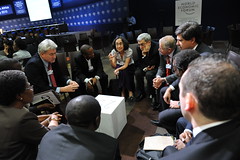
This talk was a refreshing antidote the standardized testing and STEM-at-all-costs thinking.
Enhanced by Zemanta

Wednesday, March 09, 2011

Net Generation Myth

TRS-80 Model IIIImage by John Biehler via FlickrThe ETC blog has an  interesting post by Jan Schwartz on the net gen myth. The article talks about Prensky and Tapscott's research which Marc Bullen, in a presentation to the British Columbia Institute of Technology found to be mighty thin - small samples and biased. What is the Net Generation myth? By accident of birth, all those born after a certain year, somehow have these wicked mad technology skills because, regardless of economic class or geographic location, the kids are surrounded by technology and just intuitively get it. This may be pretty much true for a certain strata of middle class kids and possibly for those in urban areas but the rest of the world, which represents a huge population, just does not experience the world that way. I live in Humboldt Co. California. We are five hours plus away from San Francisco. We are pretty isolated and since the
British Columbia Institute of TechnologyImage via Wikipediacollapse of fishing and lumber, economically depressed. Currently, the students here do not have the kind of infrastructure to support smart phones and internet access is expensive and patchy (better than when I arrived a couple of years ago but not by much). But I will not take the students' situation today, look at how they communicate with what little infrastructure we have and then extrapolate a generalization about how ALL learn or relate to technology - it just isn't warranted. I recognize that internet access and web-enabled phones are rapidly spreading. But critical expertise in the use of these tools is not going to happen just because someone is currently a teen. We cannot afford to make assumptions because the digital divide still exists for many. We need a curriculum strategy that integrates the tools students will need to be successful in the growing world of networked knowledge based on actual assessment, research, and experience, not accidents of birth.

While teaching health information management and English, I found that there were Baby Boomers like myself who were more comfortable with technology than any of the students. A few of the students knew how to chat online, download music and play some games but they had no idea what academically reliable information looked like, how to contact experts in the field, how to collaborate online, or anything else that was not related to entertainment, and no, for those few, not many of those skills were transferable. In the high schools, IF a student went to a high school that used technology it was something to be heavily filtered, managed and feared. They were not comfortable with the technology at all. We changed that by creating lessons that used the tools in a scaffolded way (something like the 23 things), not by making assumptions based on their age. I feel the same way about digital native/digital immigrant stuff although just to be on the safe side I got my digital immigrant green card:


Enhanced by Zemanta

Friday, March 04, 2011

Smarthistory: a Kickstarter success story

Beham, (Hans) Sebald (1500-1550): Dialectica (...Image via WikipediaI was really glad to see that people have stepped up and supported Smarthistory - this is a really amazing site that needs and deserves our support. Their Kickstarter page is here, but PLEASE contribute; this is an incredible project that can really promote art history and online education, and despite reaching their financial goals, we have to think about on-going support. These are just the kinds of courses that are on the chopping block right now in these hard economic times and we need to step up.

We don't know what is going to happen as we lose liberal arts education. This used to be one of the most important parts of learning: participating in a shared culture. When we lose the liberal arts, we lose our sense of history. Being able to access arts on the web means that students in schools across the world get to benefit from the curation of professional art historians. Yes, looking at pictures on the web is not the same as being there. But this is the next best thing. It is also something completely different. It is a guided view of art and art history scholarship that you could not get in a static textbook. Also, I have seen paintings here for the first time that I could not get to experience any other way. Please support this site!


Enhanced by Zemanta

Wednesday, March 02, 2011

OER Africa: Course Development Handbook

The OAR model is an Instructional Design model...Image via WikipediaI am currently reading Santosh Panda's textbook Handbook on In-House Style for Course Development.  This would be recommended reading for new course developers or distance education admins who are new to the field or need to develop a systematic course development program
 with new staff. I am always on the look-out for possible training materials for new instructional designers or ways to enhance or streamline the course development process. This handbook contains a lot of useful materials and seems to be written with an awareness of what actually happens in online classes. It is light on theory and heavy on the practical. I have been in presentations on instructional design where the why was the focus instead of the what and the how. This inevitably leads to having a teacher stand up and say "Great. How does this actually supposed to work?" This not to say that Panda's book is theory-free somehow - the book models a lot of good theory through its use of concept maps and emphasis on course structure, and his discussion of constructivism. I would like to see more examples of student interaction in the example assignments but again, this is a practical handbook for getting things off the ground.

To think I had to travel all the way to Africa to find a book that was written in our own backyard :-) I am always looking for good instructional design materials. If you have a favorite online, please post a link to it in the comments.

Enhanced by Zemanta

Friday, February 25, 2011

Brainstorming: order from chaos

BrainstormingImage by MikeOliveri via FlickrBrainstorming is a method for rapidly gathering ideas from a group. These ideas can help individuals in the group solve problems and discover solutions. Brainstorming sessions allow members to express their ideas and creativity, and to discover connections between ideas and participants. There are marginalized voices in your class or organization that have something unique to contribute. Brainstorming can help bring forth these voices from the back of the room. By their nature, brainstorming sessions allow everyone to have an equal voice.

Ordo ab Chaos: Six Rules for Brainstorming Sessions:
  1. Suspend criticism and judgment.
    Everyone must agree to accept all answers; there is no good or bad idea. For five minutes, everyone is brilliant. Reviewing and sorting of the ideas will come later.
  2. Wild is permitted.
    Wild is good. Wild ideas give birth to great ideas.
  3. Quantity not quality.
    The more ideas you can work from the better.
  4. Everyone participates.
    All and any ideas will contribute to the whole. There are no bosses or teachers in a brainstorm.
  5. Invent and recycle.
    Utilize ideas already stated and combine them with others. Do not fear your creative voice.
  6. Record everything.
    Let people call out their ideas, but if the ideas are not written down, people will forget what was said. Use a white board or a computer projector. Misspelling, shorthand, and doodling are acceptable. Suspend criticism of the recording process as well; this is a creative process.

Guidelines for facilitating a brainstorming session:
  1. Schedule a brainstorming session during a regularly scheduled meeting or class time. The participants will appreciate the added interaction.
  2. Have the group or class help define the brainstorming topic. A facilitator may want to discuss general problems, but allow the group to decide on the question together.
  3. Assign a facilitator for the session. This person will keep everyone involved and will encouraging everyone to give ideas and keep the session moving. The facilitator can keep the session moving by repeating what was said and keeping others focused.
  4. Assign a recorder. This person will write down everyone’s ideas. The recorder’s goal will be to get everything down quick and dirty.
  5. Review the rules before starting. Everyone must agree to commit to the process. The facilitator should encourage wild ideas, and if participants laugh, they should be reminded that no criticisms or judgments are to be made.
  6. Set a time limit (for five minutes or so), but if ideas are flowing, let the process keep going.
  7. After the brainstorming is complete, read through the list of ideas and discuss, sort, and analyze them.
  8. Afterwards, have the recorder send out the results to participants as a document or webpage. Ideally, there will be some tangible record to promote further discussion. 
Africa Brainstorming Turning Vision into Reali...  Image by World Economic Forum via FlickrThis is where mind maps or concept maps come in handy. You can use an online concept map to record ideas and then send that map out to your students or co-workers. We typically use Gliffy or the web version of Inspiration. Gliffy, like Google Docs, allows the user to invite participants to the document via email. The email contains a link to the document and then it can be edited by that user as well. We will be using CMaps for this purpose in the future as part of an on-going experiment. We will report back here on the results of our investigations. We would love to know if you are using a combination of brainstorming and concept maps. Feel free to email me or to make a comment below.
 
    Enhanced by Zemanta

    Thursday, February 24, 2011

    Jing: ADA Compliance and New Media

    Jing logoImage via WikipediaJing's pro version now includes the ability to add captions. I want to congratulate them on that. No, I want to send them an award or something. I owe them all a College of the Redwoods keyring at the next conference I go to. We use Jing a lot in my department. Jing is a great screen capture tool that captures images and videos of what you are doing on the screen and allows you to voice over at the same time. This is incredibly useful in training materials. The screen capture function lets you insert comments and highlights. If that wasn't enough, it includes a free "Screen Cast" account to store all your images and Flash videos that provides a link and an embed code for all your files. All this for $15 bucks a year. The missing piece was captions. It is against the law to use these videos for student instruction of any kind without captions. There are too many web 2.0 widgets out there that are not compliant. Every day, my Google Reader and email is filled with the latest tool that is supposed to solve all my problems and they are built by programmers who have no understanding of ADA 508 or the legal issues involved around accessibility. I go on Twitter and instructional designers are touting some wonder widget that has no place in education because it is not accessible. Are we still fighting this fight? You can't buy non-compliant software with federal funds and yes, check your state guidelines too. Often, greed is the only thing standing in the way. If a company uses a picture of a table (with no alt tags) instead of a table of data, screen readers cannot see it and the software should not be purchased. Those of you who read this blog know that I choose software carefully and lean heavily towards open source but this is a very useful tool that has now increased its accessibility and they are rewarded with my business. Bravo!

    I talked to a salesman recently who said that his company was going to sell non-compliant software because it was not financially viable for them to make it so. We can make it so by knowing the law. How financially viable is it to lose a sale because you don't care about accessibility? The more I learn about accessibility, the more I am discovering that it is laziness and greed keep some companies back.  There is 2 billion dollars of DOL money out there for education and your going to NOT make you work accessible??
    Enhanced by Zemanta