Showing posts with label Stephen Downes. Show all posts

Friday, April 11, 2014

Connectivism, Neuroscience, and Education

English: Human brain.
I have never been comfortable with proclamations by educators or scientists (and yes, there is a difference) about how the brain works. The logical fallacy goes something like this: "we have isolated a mechanism in the brain, learning takes place in the brain; therefore, we now know how learning works." Whenever a psychologist says something smug like "the brain doesn't work that way" (around 1:21), I want to pull my hair out. The latest theories about how the brain supposedly works also include huge gaps in our understanding of how the brain supposedly works and plenty of lines of research that may one day soon give us a more complete picture of how the brain supposedly works. The idea is that if we know how the brain is supposed to work, then we will somehow know how we learn. There are so many layers here though that it seems to be an impossible task. First, it assumes a purely mechanistic view of the mind and learning. Not that we have to get metaphysical, but this could be something that is so complicated that thinking of the mind as a flow chart or a network may not even scratch the surface of what is really happening. When educators talk about what neuroscience has to say about learning, we have to remember that neuroscientists aren't even sure what neuroscience has to say about neuroscience. It is a difficult field because each year brings in a new raft of technologies that reveals more and more about the physical properties, chemical reactions, and neural connections in the brain. But I think there is some promising work in neuroscience that we should be keeping an eye on as educators. One of the more interesting lines of research includes the mathematical models around "deep learning." I think this is finally getting at the complexity necessary to account for the complexity of thinking, language, and learning.

Deutsch: Phrenologie
I think there are some promising avenues of discovery in the work of Gary Marcus that could one day help address how we learn. Gary Marcus describes deep learning this way: "Instead of linear logic, deep learning is based on theories of how the human brain works. The program is made of tangled layers of interconnected nodes. It learns by rearranging connections between nodes after each new experience." In other words, the brain is not seen as a series of connected flowcharts but as intersecting nets of connections that create patterns.

Additionally, Geoffrey Hinton describes the brain as a holograph. Daniela Hernandez writes about Hinton in Wired saying that "Hinton was fascinated by the idea that the brain stores memories in much the same way. Rather than keeping them in a single location, it spreads them across its enormous network of neurons."What I like about Hinton is that he says that his work involves creating computer models of intelligence and he seems to avoid the heavy handed proclamations of discovering how learning works. His work discusses "machine learning" which is an entirely different concept. I think it is very important to remember that we are talking about models and not "how the brain works." The networks involved in learning are even more complex than his model because our layers include language, behavior, culture, society, etc. Never mind the chemical and quantum connections in the brain. It is just possible that one day Hinton's work can speak to the complexity of the interplay of all of those networks and their seemingly infinite interrelations.

How does this shape my practice as an educator? I teach workshops on concept mapping and have used concept mapping in my classes, not because I feel that they somehow mimic the way the brain learns but because it is an engaging learning and teaching method that provides opportunities to utilize visual and kinesthetic learning modalities as well as using critical analysis. In other words, it is a method of teaching and learning that engages multiple ways of knowing. And it may also be a good metaphor for how learning may occour in networks, including neural networks. I have seen this discussion around the learning theory, Connectivism. I think we could go into any learning theory and use it, somewhat clumsily, as a way to discuss how learning arises out of the formation and interplay of network, but fortunately George Seimens and Stephen Downes have done a better job with their work around Connectivism.
Enhanced by Zemanta

Sunday, November 24, 2013

Some Notes on Connectivism and Peer Review

A social network diagram
A social network diagram (Wikipedia)
I have been looking at social constructivism and the social generation of knowledge over the last week. I am interested in this line of thought because I feel that for us to really get a handle on what connectivism is, we have to be able to talk about it in the context of previous theories that talk about how we communicate and learn. Connectivism has to account for social constructivism because that is one of the prevailing theories about learning in the universities. According to Stephen Downes, "connectivism is the thesis that knowledge is distributed across a network of connections, and therefore that learning consists of the ability to construct and traverse those networks." Connectivism, if you are not yet familiar with it, is a learning theory proposed by Stephen Downes and George Siemens. It is important to note that even though this is a new theory, it is not particularly dependent on any technology: connectivism was not invented by the internet. The internet was invented because we are very interested in communicating and being connected, and connectivism is a useful theory that can describe how this happens. When I say that connectvism is nothing new, I am not saying that in a derogatory way, I mean that it is the natural evolution of our understanding of how we learn. In various postings in this blog, I have pointed out how throughout history spontaneous learning networks have arisen between groups and individuals. I am interested in in the development of communication and knowledge networks from the earliest mail routes to the "Republic of Letters," from the telegraph to the early dial-up networks, from the Minitel to the modern internet. There is a lot of concern out there about whether or not connectivism is a learning theory or not. I find this issue ironic and kind of amusing. Well, it is about learning, so that is settled. How can it not be a theory? According to Merriam-Webster, a theory is "an idea or set of ideas meant to explain facts or events" and "an idea that is suggested or presented as possibly true that is not known or proven to be true" and finally, the third definition "the general principles or ideas that relate to a subject." So yes, it is a theory, the real question is whether or not it is a strong or weak theory, or does it account for the facts? Can we make predictions with this theory? Does it explain what happened before? The irony is that the same mechanisms that educators are going to use test whether or not it is a useful theory are the same mechanisms connectivism describes, for instance, peer review.

Brent Renalli has in interesting paper called "A Pre-history of Peer Review: Religious Blueprints from the Hartlib Cycle." In it, I ran into my old friend John Cominus (1592-1670), the author of one of the first illustrated textbooks for children. He was also an early proponent of universal education, visual learning, and going beyond rote memorization in schools. All of these ideas, like connectivism, are still considered "new" and controversial in many universities - any instructional designer can tell you stories about that! I didn't go looking for Cominus, but in my research into education, I keep running into him. In a typical paper on peer review, authors tend to credit the Royal Society with its invention, but it was already a well-established system in Europe and elsewhere to ensure religious orthodoxy as a mechanism of censure. "Peer review" is generally not a good way to get new ideas out.

Connectivism has gone through its modern "Republic of Letters" stage via the blogs. Downes and Siemens both have used the blogs to write books, essays, and propose ideas. Educators in turn have responded for and against on their respective blogs - and continue to do so. And now, Siemens has published in a more formal and traditional manner with peer reviewed journals such as MERLOT's Journal of Online Learning and Teaching. Other education researchers are publishing articles about connectivism such as Dorothy Kropf in the European Journal of Open, Distance, and Elearning. Thus far, the ideas around connectivism have had more exposure and peer review than Einstein's theory of relativity had in 1905 (the "Annus Mirabilis" papers) when only Max Plank and Wilhelm Wien had read them before publication in Annalen der Physik. I wonder if the theory of connectivism could have come out of the traditional institutions. I think these ideas had to have been born in the very media the theory analyzes. In many ways, the theory flies in the face of all the accepted theories in education (behavioralism, cognitivism, and the many shades of constructivism) and probably would not have gained traction. I have seen papers get rejected from journals because there are not enough researchers publishing about idea X in refereed journals. We have to expect that. Universities rarely innovate - that is left to the lonely patent clerks of the world. Universities are where ideas go to fossilize and become the established order. Connectivism needed the internet, blogs, and Twitter to take shape.
Enhanced by Zemanta

Friday, September 13, 2013

MOOCs and Student Support

English: Internet Penetration (% Population). ...
Internet Penetration (% Population). Red
indicates no statistics available. (Wikipedia)
I read an article this week that I found via Stephen Downe's blog that is from the eLearning Africa News Portal called "The Underlying Inequality of MOOCs" by Alicia Mitchell. The main issue that Mitchell has with MOOCs is an old argument against all online education: the "digital divide." Unlike the education writers of the 1990s, she looks at the issues of poverty and connectivity and says that we have to be mindful that not everyone has access or the same means and skills that those of us in more privileged parts of the world may have. I do not argue that there is not a digital divide, I just don't think stopping online learning is a great solution to that problem. She does not make the leap that many have in the past with a "therefore," online learning is not viable or should be curtailed etc. I actually agree with her and my "therefore" is that, broadly, we need to continue to work for economic justice and universal education.  Africa is a hot bed of online learning, open education resources, and innovation specifically because of the problems discussed in her article. And my more focused "therefore" is say this is exactly why we need a MOOC to help students "learn how to learn." That is what we were getting at when we created "DE 101" - an free, two-week, fully online orientation to online learning. That was in a "traditional" online course format. The one I am working on here at Humboldt State University will be a MOOC called "eLearning 101."

In another look back to the 90s, I am really concerned about so-called "MOOCs" that are massive, not particularly open, online courses that are based on a one-way distribution of information and then tests. This is a huge step backwards. Especially when there are such better models out there such as Stephen Downe's and George Siemens' Connnectivism and Connective Knowledge MOOC or Jim Groom's project-based DS 106. There are all of these great models out there (often called "cMOOCs") but the ones that get all the attention are the ones supported by the Ivy Leagues and a lot of grant money. The entire MOOC phenomena is being judged by players like Sebastian Thrun who just figured out that online students need student advisors, mentoring, and tutors. These are things that many people have been writing about and more importantly doing for years now. In the article "Udacity CEO Says 'Magic Formula' is Emerging," David Carr reports:

Thrun's magic formula is not a fully automated online class featuring prerecorded videos and Web-based assessments. In other words, it's not a MOOC at all. To get better results, he said, "We changed the equation and put people on the ground." By adding mentors and a help line, and making phone calls to remind students to do their work, Udacity found it could get more students to do the work, finish the course and pass. Longer term, he has some ideas about using adaptive learning software to eliminate some of this labor, but for now it takes manpower.

The press, publications like the Chronicle of Higher Ed and Information Week are now defining MOOCs by such phrases as "a fully automated online class featuring prerecorded videos and Web-based assessments." This is not innovation, at least, not innovation in education. It may be an innovation in platform building, fund raising, or grant writing, but it is not an innovation in education. Real online courses and truly massive, open, online courses are engaging, interactive, and focus on building learning communities and networks. There is a rich body of literature and research that discusses the importance of student advising and support. If it has taken this long for Udacity to figure out what we all learned about online education in the 90s, I don't think I will live long enough to see them figure out the importance of learning communities and PLNs.

But it is not enough just to be against something. I am going to keep using the term MOOC even though the term is missapplied by the press and highly funded institutions and businesses. We need to keep building instances of MOOCs that counter the prevailing notions. I will be posting updates here as I continue to work on the eLearning 101 MOOC.
Enhanced by Zemanta

Friday, June 14, 2013

MOOCs: Disruption is the Mother of Invention

Stephen Downes speaking at D2L09.
Stephen Downes
There is an article in the Boston Review by Thomas Leddy called "Are MOOCs Good for Students?" In this article Leddy claims that
"MOOCs pose a great threat to the most important value of higher education: 'literacy.' By 'literacy' I mean, very broadly, the ability to read, think about, and intelligently respond (both orally and in writing) to the literature of any field of study. Thus, implementation of MOOCs for university credit is bad because it is bad for our students."
Leddy says this because he seems to be familiar with only one kind of MOOC - those of the MIT and Stanford model. Not all MOOCs are alike, yet despite the fact that he has had the traditional education that would allow him to read, think about, and intelligently respond to any field of study, that does not seem to extend to education itself. I am not sure what publications like the Boston Review or the Chronicle of Higher Ed is up to, but the majority of articles about MOOCs in such publications are typically written by those who have never taught online, taught a MOOC, or even taken a MOOC. They are written by people who have not even reviewed the history or literature (however scant) on MOOCs.

I hate to tell Leddy this, but literacies are changing. I do a lot of writing, but my work depends more on my ability to collaborate with others and the creation of intelligent networks than my ability to write a ten page paper.

Leddy is very concerned with the massive (not "massively" by the way) courses that use multiple choice tests and paints all MOOCs with the same brush. I have taken three MOOCs and in not one did I take a multiple choice test. The MOOCs were assessed with what I would consider portfolio assessment. I could not have finished any of the MOOCs without reading, thinking, and intelligently responding to my peers.

English: George Siemens at TEDxNYED.
George Siemens
MOOCs didn;t just come out of nowhere to just to knock traditional teachers out of their chairs; they came from very thoughtful teachers who said "what if we did for teaching what open education resources was doing for content?" There were problems that needed to be addressed in education that traditional educators have no interest or stake in solving. MOOCs (massive open online courses) are not the disruption. The disruption came when the traditional schools decided that money was more important than access. The disruption happened when educators decided that they were fine with keeping education as an exclusive privilege of the few. The real disruption was the fact that the cost of education rose faster than the cost of living and the cost of healthcare combined.

We need to keep making the distinction between cMOOCs and xMOOCs - cMOOCs "Connectivist MOOCs" are actually community-driven models where the students create knowledge and learning together. This knowledge creation can be facilitated but it is not dependent on a "teacher." The teacher becomes the facilitator and curator of the learning experience. In a cMOOC the connections students make with one another are just as important, if not more important, than any other kind of interaction in the course.

xMOOCs are getting all of the press because their model more closely fits, for good or ill, the model of education most familiar for traditional academics: sage on the stage, education as information transmission, knowledge as consumable, students as commodity, etc. xMOOCs are not true MOOCs: they often massive online but they are seldom "open" and depending on what you call a "course" they may not be that either. A true MOOC should be free. There is still a lot of hand wringing about money and tuition in some of these models that falls under the "sustainability" issue. I would even question if some of these are actually "courses" in the sense that we mean them in the world of online education. As a Director of Academic Technology, I would not sign off on a course that had no student-student or teacher-student engagement. I would call it a correspondence course, a learning experience, but not a true online learning experience. In contrast, cMOOCs depend on the interaction of the students for their success.

MOOCs are going through the difficult stages of innovation that open education resources and open textbooks have and are still going through. Free, openly licensed (non commercial) textbooks are a great idea - monetizing that is a horrible, counter-intuitive, counter-productive idea. "Lower cost" is not the same as free. Open for business is not what the "open" in OER, open textbooks, of MOOC is supposed to mean.

MOOCs can work. There are ways to design MOOCs to maximize student interactivity and engagement. In the related articles below, I have included some postings I wrote on MOOCs and instructional design and give some of my history with successful MOOCs.  MOOCs are not going away and just like any other learning platform (including face-to-face) there are good and bad ways to use it. We need to research MOOCs thoroughly with an open mind to discover why the successful ones are successful and address potential problems.

I would encourage Leddy and anyone else who is interested in MOOCs to explore the work of David Wiley, George Siemens, Stephen Downes, David Cormier, and Jim Groom before coming to any conclusions. You might just learn something. 
Enhanced by Zemanta

Wednesday, April 17, 2013

MOOCs, Group Work, and Instructional Design

English: Debate Chamber of the Oxford Union So...
Debate Chamber of the Oxford Union Society (Wikipedia)
Everything Old is New Again
In my last post I pointed out that all the arguments about MOOCs sound so much like the old arguments against online education in the 90s. One of the main arguments for authentic online learning in the 90s was the possibility of making online classes social environments. This fit well with the pedagogy of Constructivism. Constructivism says that knowledge is constructed when new information comes into contact with previous knowledge and evaluated against experience. Social Constructivism is an outgrowth of Constructivism that "extends constructivism into social settings, wherein groups construct knowledge for one another, collaboratively creating a small culture of shared artifacts with shared meanings" (Moodle). The instructors goal then was to facilitate these connections. In the 90s, this learning theory seemed to fit what was happening with effective teaching online. The goal of online assignments was to give students the opportunity to receive new information, hold it up to previous knowledge and experience, share that with a group, and then together, coming to new conclusions or new knowledge. Educators and researchers like Palloff and Pratt with their emphasis on learning communities, promoted group work and discussion forums as the solution to the badly performing classes that were basically online repositories of documents and maybe multimedia files. Over and over again, from the early days of online learning, the research shows that the greater the engagement in an online class, the higher the success and retention rates. Engagement does not mean clicking a link, widget or consuming media - it means actual interaction with students and instructors as well as content.

English: George Siemens at TEDxNYED.
George Siemens
Everything New is Old Again
Today, we have learning theories that are evolving towards a more complete accounting of how we learn online. I am thinking here of George Siemens and Stephen Downes' theory of Connectivism. I am not ready to throw out the Constructivist baby with the pedagogical bath because Connectivism is still in the Copernicus vs. Relativity explanation for gravity stage - I believe logically and experientially that the theory is right, but I am not ready to use it to put a satellite in orbit. This doesn't make the theory wrong. We need to be doing more research; it is just a matter of time. For myself, I am satisfied that this new theory accounts for much of what is going on with Constructivism. I am going to let the Phd's battle out the details: instructional designers have courses to create, assignments to design, and faculty to work with. A good working theory is a good working theory. A lot of what we are doing with online classes and MOOCs is testing the viability of Connectivism.

What Then Should We Do?
So this preamble is really a way to point out that everything that makes authentic learning work in a brick-and-mortar classroom are the same things that make online learning work. And as a teacher and instructional designer, I have a really practical end in mind. To my way of thinking, there is no difference between an online discussion forum and the Debate Chamber of the Oxford Union Society except one is more expensive and acoustically louder than the other. They are just different platforms. A MOOC is just another platform. George Siemens wrote back in March that MOOC providers were going to have to rely more on group work to be successful. I find this sentence especially funny and pertinent here: "The 'new pedagogical models' (A Silicon Valley term meaning: we didn’t read the literature and still don’t realize that these findings are two, three, or more decades old)...." But what kind of group work should we use and how can we ensure that it is successful? Siemens points out that there is a high dropout rate in MOOCs that could make group work a problem, but I believe that group work is one of the engagement pieces that is missing from many of these MOOCs (especially those using content delivery model rather than the content creation model).

Ensuring the Success of Group Work
Faculty and students have often told me about problems with group work. What do you do about the alpha student who needs to be the leader and do all the work? How should instructors handle the student who has little motivation? I have a blog post coming about this but essentially there are eight things needed for a successful group work project:
  1. Clear objectives
    Students need to know the exact purpose of the assignment. Let the students know where they are going.
  2. Detailed instructions
    This is particularly important in a MOOC because students tend to have less contact with the instructor. A detailed instruction document accompanied with a video and some examples are very useful here.
  3. Give each student a specific role
    This prevents one person from taking over the process and helps with assessment too.
  4. Communicate expectations in advance
  5. Use collaborative tools
    Model the means for useful collaboration. Give students instructions for setting up a wiki or a Google site for collaborating
  6. Facilitate and model leadershipSometimes good leadership is not getting in the way of good work. Leadership in MOOCs means that you live the model: you are connected and engaged in your course. You cannot disappear for two weeks and expect this to work. 
  7. Encourage networks
    Having the students using social media tools allows them to bring other subject matter experts into the project.
  8. Provide assessment and closure
    You would not want to participate in a MOOC with an endless series of unconnected assignments with no sense of closure. Assessment in group work gets interesting. I liked to use a blank form for the students to divide up participation points.
I will be posting a short article on how these components work here on this blog.

Kinds of Assignments:
The ubiquity of internet access and the proliferation of collaborative tools and platforms makes collaborative learning more available than it has ever been. This allows us to design a wide variety of assignments that are ideal for MOOCs or standard online classes. These are just a few ideas here:
  1. Group Research Project
    Group research projects are opportunities for students to get together and literally construct knowledge. Having students work on a research project and publish their results together on a wiki or a group blog benefits the students and the class. 
  2. Group PresentationsStudents can work on presentations with one another remotely and create slide presentations with audio or even a film and work on the 
  3. Media Projects
    Students learn a lot from content creation. Jim Groom's DS 106, a class that some would call a "task based MOOC" is an excellent example of students working together to create media. Students can create videos or podcasts. When they graduate from college, no one is going to ask them to write a 20 page paper; they will be asked to work in groups, use technology, and create media.
  4. Debates
    One of our instructional designers here at Humboldt State University is using online debates in discussion forums.The debates are carefully structured and each participant has a role. This kind of prior attention to details is essential to online group work.
  5. Role Playing and Simulations Role playing and simulations have never been easier because there is so much data online now that can be used to build simulations (I am thinking here of epidemiological data, for instance). 
  6. Concept MapsTypically these are solitary projects but having a group negotiate what should be in a concept map and how concepts relate to one another are a good way to allow the students to clarify those concepts with and for one another rather than having the instructor spoon-feed "meaning" to them.
  7. Infographics This is a good project for groups because the roles can cover a wide-variety of learning modalities and abilities: some students can gather data, others develop art work, and others can write interpretive materials.
Any of these assignments can be created in advance and given to small groups. The students benefit not just from following the steps of the projects, but through sharing the end results with other groups. 

Enhanced by Zemanta

Friday, April 12, 2013

MOOCs: Lets Do The Timewarp Again!

The Rocky Horror Picture Show's Lets Do The Timewarp Again
I love all the arguments from the 1990s that were leveled at online teaching and learning that are now being leveled at MOOCs. I re-read all of my favorite straw-man hits from the 90s including the digital divide, lack of credibility, perception by the establishment, lack of interaction, etc. all remixed for the MOOC era.

Currently, educators and journalists struggle to write about MOOCs because the term MOOCs covers a broad category of online courses. When they are writing about MOOCs, they tend to only be thinking of the latest wave of entrepreneurial colleges like Corsera - they do not understand that MOOCs have been successfully working in places like the University of Manitoba and Canada's open university, Athabasca. Those are referred to as the "Connectivist MOOCs" or cMOOCs originally founded by Stephen Downes and George Siemens. And that folks like Jim Groom have been successfully running task-based MOOCs like DS 106 for years before MOOC became the latest scary innovation.

The current jeremiads are being written by journalists and educators who can't distinguish a collection of videos (such as Khan Academy) in YouTube from an online course, have little experience with online learning and no experience with MOOCs (or a single experience with a particular kind of MOOC with which they try to define the whole phenomena).

I am amazed at how few educators get the money issue. There is a lot of hand-wringing out there around questions like "why would the students pay for my class when they can go to MIT or Stanford for free?" The answer is usually something as smug as John Marks' conclusion "they are for self-improvement, we are for self-formation." There are students out there who need the information that MOOCs are providing because they may not live near a college or have the time and money for the "self-formation" experience that Marks is promising.

The criticisms against MOOCs generally fall along the same lines as the arguments they were using against online education - MOOCs are bad because students won't be able to socialize, make connections, join clubs and fraternal organizations, participate in sports, see the instructor talk, and they will be reading on computers instead of sipping sherry in a big leather chair reading a first edition of Keats. How could a MOOC replicate that? Never mind the fact that many students do not have the opportunity of socializing and making connections in college. Some students 20 hours a week and commuted to college.

This points to some fundamental misconceptions about online learning and why students take online classes. Typically, they are not taking them to replicate the "college experience" - they are taking them because they cannot get to the college experience. I have been excited about MOOCs as I have been about online eduction, open education resources, and open textbooks because they are opportunities open up education to more people who would otherwise not get it.
Enhanced by Zemanta

Friday, February 08, 2013

MOOCs and Other Four-Legged Chickens

I have just moved to Humboldt State University. The college is fairly rural but we get a lot of folks from urban areas. I over heard a very interesting conversation between some students in the cafeteria.  One of them was freaking out because there was a rat in the garden outside that they could see outside through the window.
She yelled "what is that hopping around?"
One of her friends said "that has to be a bird."
She said "but it has four legs and a tail."
"But chickens have four legs," said the other, "at least, that's what you get in the bucket." They went back and forth. The wood rat hopped away and her three friends went on debating the nature of birds and mammals.
You might wonder how someone could make such a mistake. But imagine if the only time you have ever really thought about chicken was when it was in a soup,  a sandwich or already in a bucket. If you order fried chicken, you can get a whole assortment of parts but it would be difficult to piece back together a whole bird.

MOOCs are going through what I am thinking of here as a "four-legged chicken" stage. There are a lot of educational experiences and platforms that are being described as MOOCs: there is the original "Connectivist" or networked based MOOCs, task-based MOOCs, and content-based MOOCs. Some even describe collections of videos as MOOCs. There are many variations. Because the MOOC acronym has the word "class" in it, many educators are expecting to see their own definition of a class which is often a face-to-face class or a "traditional" online class where they have the most control. When the description of the MOOC does not meet the definition of a class, the conclusion is that it will fail as an educational experience. Many of the arguments I have read against MOOCs will latch on to one aspect of the course or only look at one kind of MOOC and then condemn the whole idea. Many of the arguments are re-hashes of arguments against online learning that were already fought and won 15 years ago (i.e. "No Significant Difference," student identity issues, etc.). Online learning was the four-legged chicken of the 90s.

My take on MOOCs is that there needs to be more focus on how they work - this is the instructional design component. On one hand, we are early in the research, but MOOCs have been around since 2008. Most educators are just now hearing about them because, as Stephen Downes has also pointed out, they were only recently picked up by the big name universities which then attracts the attention of the Chronicle of Higher Ed, the Horizon Report, etc.

Recently an instructor created a MOOC that, for a number of reasons, failed. Of course that happened - this is a new teaching and learning environment. We are still learning how all the pieces fit together. Face-to-face and online classes have also failed. There are face-to-face colleges with worse retention and student success rates than some online colleges. This is not the "I told you so moment" that some think it is. I feel very strongly that we can't dismiss MOOCs because, in my experience, some of them work very well (George Siemens, Stephen Downes, and Jim Groom). The current state of the research is thin, we need more data, we need to work out the best practices. And in the end, you cannot assemble a chicken from a bucket of KFC.

Enhanced by Zemanta

Saturday, November 17, 2012

What Part of MOOC Don't You Understand?

Stephen Downes
Stephen Downes (Photo credit: WordShore)
Educators who have not taken a MOOC (Massive Open Online Course) and do not understand their history, are currently writing about these courses which is causing them to be inaccurately represented in the press. The main problem is there is all the publicity around Coursera and Edx that ignores other kinds of MOOCs.

I also think part of the problem comes from the age-old issue of looking at new technologies through the lens of the old - the "horseless carriage" problem (a car is not "horseless" because it never needed one). I think an example of this is found in the essay "A New Era of Unfounded Hyperbole" by Siva Vaidhayanathan, which gives us an example of a typical misunderstanding MOOCs:
"MOOCs, on the other hand, are more like fancy textbooks. They are all about the mass market and not the rich connectivity that established online courses offer their limited collection of students."
This is a gross generalization of MOOCs. I would go so far as to call the statement above "unfounded hyperbole." The first MOOC I participated in "Connectivism and Connective Knowledge 2008" was one of the most interactive and engaging experiences in my education. There were a couple thousand participants who all self-organized into study groups and communities. This happened not on accident, but through the example and facilitation of the MOOCs teachers, George Siemens and Stephen Downes. They would not like the work "teacher" I think because it represents the traditional, hierarchical structure of traditional classes. I have never taken a class that was "all about the mass market." The reason why we wanted a class with a lot of people is because we learn in those networks - we get to take advantage of the the collective knowledge and talents of thousands of people. If your MOOC doesn't do that, you might not be in a "class."

When Vaidhayanathan is writing about MOOCs, I assume he is not writing about the MOOCs that came from David Wiley, George Siemens, Stephen Downes, Cormier, or Jim Groom. I am sure he is writing about Coursera and Edx. I would not make any generalizations about those because I have never taken a class in Coursera or Edx. What I will say is that their pedagogy and methods are different from what are sometimes called "cMOOCs" or "Connectivist MOOCs."

Another of Vaidhayanathan's generalizations says that
"The classroom has rich value in itself. It’s a safe, almost sacred space where students can try on ideas for size in real time, gently criticize others, challenge authority, and drive conversations in new directions."
They can also be stultifying places where new ideas are not encouraged, where there is no real criticism, challenges to authority are not rewarded, and discussion discouraged (often because the lecturer won't/can't allow for the time). There are good face-to-face classes and bad. There are good online classes and bad. The same goes with MOOCs: my experience in CCK08 rivals my best classes at Berkeley or Sonoma State (both of which had some amazing classes).

Vaidhayanathan is not alone. I keep reading about the possibility of MOOCs going international when Canada has been in for four or five years ahead of the Ivy Leaguers. There are also a number of stories about how we might be able to take MOOCs for credit when this has been the case at University of Manitoba and Athabasca for years.

I do appreciate the last part of his article where he lists some possible upsides to MOOCs and asks that we "...focus on what we can learn and accomplish from the MOOC experiment and leave behind the unfounded hyperbole."

I would like to see less hyperbole and generalizations on both sides and more research.
Enhanced by Zemanta

Saturday, October 27, 2012

MOOCs and Connectivist Instructional Design

george seimens
George Siemens (Photo credit: heloukee)
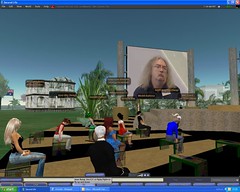
I am very interested in the instructional design of MOOCs. While I was working at Tacoma Community College, I co-taught a course called "Health Information Management 101." The purpose of the course was to introduce health information management students to all of the technology that they would encounter in the course of getting a certificate or degree in health information management, as well as collaborative technologies that would help them successfully work online (this is where modern HIM is going). The idea was that we would use all of the tools to teach the class that were also part of the curriculum. We taught the course using a "multimodal delivery" method: it was a hybrid online but students could choose at anytime to take the course online or show up for the lab. The whole point of the curriculum was to help students get the idea that they did not have to learn how to use any software program, but that they could gain transportable skills that would enable them to use any technology to meet the needs of any situation. When students are taking HIM classes, they can't be taught the technology of the work place because that technology in HIM changes too quickly. One year, hospitals and insurance companies are using one program, the next they are upgraded to a new system or have moved on to something else. They are as bad as schools and their learning management systems. What we had to teach was the core skills that allowed anyone to adapt to any technology they might find themselves in. We got the students up to speed on texting, messaging, sharing and collaborating using wikis, blogs, Google docs, and even toyed with Second Life. The idea was that if we could create a community online of HIM students, then they could help one another manage the pace of technological change in their field. We wound up succeeding far beyond our expectations. Within a couple of semesters, the network we facilitated, had first semester students, second semester, and students who were working in the profession all talking to one another in twitter. We even had students who were in other fields also talking to our HIM students. Our "classroom" was streamed live from a lab where we assisted students with the different projects. We wanted a space where local students could drop in physically if they wanted to or participate remotely. What we noticed was that students started helping one another as much as we were helping students. One of the reasons for this was that each assignment was basically a detailed guide on how to use a particular tool, and each assignment asked the students to share their work with one another. They wouldn't just sign up for Twitter; they would add the entire class to their account. They wouldn't just sign up for a social bookmarking site; they would share their bookmarks with the class. Creating the community was built into the lessons. This class was not  MOOC but it gave us the experience of letting the community, even the community outside of the classroom, drive the learning.

Around the same time, we ran into George Siemen's essay, "Connectivism: a learning theory for the digital age"as well as the work by Stephen Downes on the same topic. We were then so far beyond the ADDIE model of instructional design. There was no model of typical instructional design that could account for what was happening here. Stephen Downes wrote in the Huffington Post "At its heart, connectivism is the thesis that knowledge is distributed across a network of connections, and therefore that learning consists of the ability to construct and traverse those networks. Knowledge, therefore, is not acquired, as though it were a thing. It is not transmitted, as though it were some type of communication." We were really excited by many of the ideas around connectivism because it is the only learning theory that does not have the justification of the old model of education at its heart (i.e. hierarchical, top down, sage on the stage, medieval lecture halls, exclusivity, etc.). Connectivism accounted for how our students were working, interacting, and collaborating. We could piece together bits of social constructivism and other theories to account for some of it, but none of the other models we looked at were as complete. This isn't to say that we agreed with everything about connectivism. Instructional designers are a very practical bunch. We tend to evaluate a theory based on its usefulness, not its pedigree. And a theory is just that - a theory. Theories do not spring forth whole like Athena from Zeus's forehead - they are postulated, tested, experimented with, and revised. Connectivism isn't wrong just because it does not validate every theory that went before it. The questions that instructional designers ask are like Wittgenstien's answer to the afterlife: "The real question of life after death isn't whether or not it exists, but even if it does, what problem this really solves?" A theory, for instructional design, should be a tool that answers questions that are actually being asked. It should lead to real solutions to instructional problems.

I participated in George Siemen's and Stephen Downe's MOOC, "Connectivism and Connective Knowledge 2008" (CCK08).  And unlike other education classes I had taken at the graduate level, this one was taught using the method it was teaching. Each week, there were blogging assignments, discussions in Twitter, Facebook, the discussion forum in Moodle, and even in Second Life. There were weekly guest lecturers as well as presentations by the course facilitators. The real heart of the course was the groups of students who would meet virtually, using the collaborative tools of their own choosing, who would discuss the presentations and readings. These groups were self-organized, leaderless, and informal. Yet, there always seemed to be someone in the group who would carry the discussion back into the course to have questions answered by the facilitators. And the facilitators would sometimes participate in the discussions. This experience was highly interactive. There was interaction with the facilitators, the content and between the students. Interestingly enough, the research shows that interaction is one of the primary measures of success and retention in online classes: the higher the degree and opportunity for interaction, the more successful a course will be. This course completely changed how I think of course design. Giving students the opportunity to apply what they are learning to their learning experience, workplace, and previous knowledge is a powerful experience. This should be at the center of our learning design and course outcomes.

Another experience that I think ties the two course models together was my experience in Jim Groom's DS 106 - a digital storytelling MOOC from Mary Washington University. In this course, there are detailed instructions on how to do each assignment, and more importantly, how to create your own assignments. There is also a degree of networking and collaboration that I don't think has ever been attempted before. Students don't just participate in the network - they literally become the network. Each student is asked to create their own domain on the web. Each one becomes acutely aware of their status as a node in the web. This is the way it should be. Students of digital storytelling should know their media as well as any painter who creates their own materials. Again, the network created in DS106 goes far beyond the idea of a classroom. The twitter hashtag #DS106 basically has a life of its own with past and present students, artists, media professionals, and followers from around the world all participating, collaborating and sharing art, video, and projects.

So given these experiences, what should connectivist instructional design look like? Based on the principles of connectivism, learning should:
  • Provide for a diversity of opinions
  • Allow students to create connections between specialized nodes and learning sources
  • Foster their capacity to learn (teach metacognitive learning skills)
  • Increase their ability see connections between fields, concepts, and ideas
  • Teach students to build networks that will allow students to keep current in their field
  • Allow students to choose what to learn and how
Aditionally, in a presentation that George Siemens gave on instructional design for the MOOC "Connectivism and Connective Knowlege 2008" he said that learning should be designed for adaptability, for "patterning, wayfinding, and sensemaking" and focus on "content, context, and connections." He says that it is difficult to take all of this and try to build some mechanistic formula for creating learning experiences. I agree with that - but this is also a teaching philosophy. The best way to help students get this is to model it in our teaching. This is exactly what MOOCs can do that traditional classes can't. In this blog, I will be collecting assignments and activities that model these principles, that have the connectivist principles built into them.

If you have some that you would like to share, as a student or as a teacher, feel free to add to the comments below. 

Enhanced by Zemanta

Wednesday, September 26, 2012

Keeping Open Education Resources Open

A Wikiversity Logo for Open Educational Resour...
 (Photo credit: Wikipedia)
What does the "open" in "open education resources" mean? What it should mean is free to reuse, remix and share. If your open education resources are locked up with a proprietary platform, they are no longer open. If they are converted into "supplements" for a "free" text, they are no longer open. This is the fear behind those who choose a license that says "not for commercial use." That does not make it less open because you are not free to lock down someone else's work and make a profit off of it.

The reason I release materials to the wild with an open license is so that other educators can use them and benefit from them; maybe even modify them (and hey, feel free send me a copy back). I want to contribute to the education community. My intention is not to enrich some business who will repackage and "improve" on my work by locking it down into a closed system and then charging for access. The claim that I am making my work less open because it is not free for commercial use is ridiculous! That is like saying animals are only free if they are also free to be in a zoo. And the only ones who really benefit from the corporate lock-down of OERs and open textbooks are the corporations.

The Creative Commons license warning that an OER is not part of a "free culture" is an unnecessary distraction. FreedomDefined. org is not helping:
"Licenses which only allow non-commercial use are not considered Free Culture licenses. This is because in practice there are many ways that Cultural works can be used and reused which would be considered commercial. Another problem is that there is no generally agreed definition of where the border line is between Commercial and Non Commercial uses with very many cases falling in the undefined area in between. In practice Share Alike or Copyleft clauses provide a restriction on commercial profits since any reuse making excessive profits will soon stimulate a bunch of copycats which will bring prices down while encouraging even wider distribution of the works - which is the objective of the free culture licenses." 
That phrase "which will bring down prices" is the funny bit here. My goal is not to keep down the prices of my work but to remove the cost barrier altogether from my work! I want it free as in free of cost to any student, now and in the future.

The claim that OERs will not benefit from corporate modification and promotion is really missing the point. That is not the only way that OERs are adapted, developed, and distributed. OERs belong to the community of teachers and learners. They should remain there. The real work being done in the OER community is by communities of educators

So why do school districts go after corporate materials that are almost, but not quite entirely, unlike open? Because they are still clinging to the old paradigm that says that if it didn't get "vetted" by a corporate press, it lacks quality, legitimacy, the imprimatur and nihil obstat of a "reputable" press. We need to redefine this legitimacy. The corporate presses have not done education any favors: the price of education is outstripping the cost of inflation and healthcare. Each semester, publishers come up with new and interesting ways to justify their $280 dollar textbooks. And the sad truth is that the instructors know these subjects better than the project managers at corporate education publishing houses. The books are not more accurate because they went through their vetting process (see OER: The Myth of Textbook Reliability). Every open textbook that I have encountered that was created in-house or by a community of scholars has been hands down superior in every way to a corporate textbook because it addresses the needs of the teachers who created it and the students who are using it, it is lower in price and more accessible.

There are new models emerging for the development and implementation of OERs and open textbooks.   There are a number of models suggested by Stephen Downes in his article "Models for Sustainable Open Education Resources" that I feel have yet to be fully explored. There is also the implementation model suggested by the Kaleidoscope Project that begins with a community of scholars working on shared student learning outcomes and assessments and only then do they adopt OERs or open textbooks. In other words, open textbooks are an opportunity to have education content driven by the SLOs of the local schools, not by commercial interests.

Fretting over whether or not an OER is free to be exploited by a corporation is a huge step backward and a great disservice to the students.
Enhanced by Zemanta

Tuesday, July 31, 2012

Nine Essential MOOC Links

English: George Siemens at TEDxNYED.
George Siemens at TEDxNYED. (Wikipedia)
A few of us from today's NGLC presentation "MOOCs: open online courses as levers for change in higher education" by George Siemens on MOOCs were passing around a few URLs, and I thought it would be handy to have some of them in one place. This is not meant to be exhaustive but please drop us a note in the comments if you have a link to add.
  • Massive List of MOOC Resources, Lit, and Literati
    This is a great hub of research for MOOCs. Lets get this into a wiki! If you review these links, you still get the impression that MOOCs are completely undefined because it includes discussions of Khan Academy which I would argue does not belong on a page about MOOCs. This page is useful because it speaks to the fact that MOOCs are still in a defining process. 
  • Stephen Downe's MOOC.ca page.
    This has links to relevant articles, resources and a call for curators of MOOC lore.
  • David Cormier's Description of MOOCs 
    An enthusiastic vision of MOOCs. I like this simple "Common Craft" definition of MOOCs. 
  • The MoocGuide Wiki. Stephen Downes' also has a Google Docs version of this.
    This is a useful gude on how to roll your own MOOC. There are 42 members to this wiki so it has a good chance of being a living document.
  • Join a MOOC.
    This site has a listing for MOOCs - something I think we really need. 
  • Alt-Ed
    This site is "is devoted to documenting significant initiatives relating to Massive Open Online Courses (MOOCs), digital badges, and similar alternative educational projects."
  • Howard Rheingold's Interview with George Siemen's on MOOCs
    This is a good introduction to MOOCs
  • Inge DeWardes' 3 part article on setting up a MOOC
    I am interested in MOOCs from the instructional design perspective. I think that there are ways to set MOOCs up so that even the so-called "unmotivated" student or students with little experience with online learning can be successful. That will be part of another post!
The 9th resource is the talk that George gave today. Feel free to comment and add to this - if we get more responses, we will move the conversation to the wiki.

Okay here is a bonus 10th:


Enhanced by Zemanta

Sunday, July 22, 2012

The Real Trouble With Online Education

E-learning short courses
E-learning ( London College of Fashion)
An editorial piece in the New York Times on July 19th by Mark Edmundson attempts to tell us about "The Trouble with Online Education." Despite the fact that the author does not appear to have taken or taught an online class, and despite not having any listed credentials in the field of education, online teaching and learning, or instructional design, Edmundson, and apparently the editors of the New York Times, feel he is qualified to to make the pronouncement that online courses are not "real" courses.

He asks "can online education ever be education of the very best sort?" In that loaded Gatsbyesque question, does he mean the kind of education the 1% can get at the Ivy Leagues? No, most online classes that I know of or have experienced were not small settings where we sat with a professor in big leather chairs sipping sherry. Not everyone can afford such an education and maybe that is why some folks seem to be threatened by online learning - the barbarians are at the gates! Online classes are classes of a different sort. And here is my real problem with this article: the author does not know what happens in an online class so he assumes it is not what happens in a face-to-face class and this is just wrong. 

Edmundson describes face-to-face classes as places where there is engagement, dialog and the inadvertent creation of academic community "the students will always be running into others who are also enrolled" (I am presuming in the halls or the cafeteria - do his students not work or have families?). But the fact is, I have taken face-to-face classes at colleges (U.C. Berkeley, for instance) where the professor had no time for undergrads, directed all questions to the tutors, and did nothing to foster community. Conversely, I took an online course in 2008 from the University of Manitoba (George Siemens and Stephen Downes MOOC "Connectivism and Connective Knowledge") and I am still in touch with students I met there - in fact, we are basically continuing what we learned in online communities. We are still engaged with one another. What instructor wouldn't want that? In the "very best sort" of online classes, this community and engagement is deliberately built into the courses, and the research says that student engagement is the number one factor in the success of online courses. That said, I did take an online class that was poorly run: the teacher would go days without connecting with the course, the feedback on assignments was minimal and late, and there was little direction. My point is that the teaching modality does not matter if the teacher is engaged.

There seems to be a lot of this going around, there were blog postings I read through the Chronicle of Higher Ed from Siva Vaidhaynathan and Joshua Kim's posting in Inside Higher Ed that both gave negative evaluations of MOOCs (Massively Open Online Classes) despite the authors having no experience with MOOCs or online classes. I addressed those issues in my posting "Why MOOCs Work" but I feel that there is a larger issue here. If you read the three articles together, all contra elearning, they all have this alarmist ring to them that somehow online education is a watering down of face-to-face education. You get a real sense that if the world now accepts online education as it seems that it does, and accepts badges and portfolios in place of traditional certification, that it will detract from the value of the precious face-to-face college. You know the college - the one with the tuition that has risen faster than the price of inflation, faster than the costs of healthcare, and the $250 textbooks. 

Edmundson claims that "Online education is a one-size-fits-all endeavor." There are too many kinds of online classes out there for this to be true: there are full online courses that include Skype sessions with teachers and tutors; there are hybrid courses; there are classes that are more self-directed; and there are MOOCs; I could go on. What constitutes an online class can be as individual as the instructor who teaches it. 

He claims that "It tends to be a monologue and not a real dialogue." Again, he is basing this on courses that are filmed and canned but that is NOT the most common teaching modality in online education. Most online classes include discussion forums and students now are using social media and networks such as Twitter and Facebook to engage with one another, with their instructors and experts in their field of study. A glance at the research at sites like Educause would give him an idea about what is happening. 

He says that instructors can't gauge the nuances of a class online. If  online instructors engage their online class with online discussion forums and chat, they can gauge what is happening. In fact, in some of my online English classes I got to know some of my students better than my face-to-face classes because the students will often seek out that engagement, and socialize a lot online, to make that human connection online. 

All of this points to an appalling lack of knowledge about what constitutes online learning. I can't believe that a college professor would accept similar judgements from a student with nothing to back them up but what "seems." All three authors, Edmundson, Vaidhaynathan, and Kim, evoke what "seems" as evidence. It is not like the research is hard to find. There have been hundreds of studies that show that there is no significant difference between the outcomes and success rates between online and face-to-face learning. All Edmundson would have to do is to take a look at WCET's "No Significant Difference" webpage to find a collection of the research that goes back a hundred years. Or to look at any recent study like the one reported in The American Interest called "New Study: Online Classes Just as Good."

The real trouble with online education right now is that online education is currently being defined in unfavorable ways by those who feel threatened by it. Online education is not the same as face-to-face education. Just as you should not believe the hype behind anything "new" (even if it just new to the press) - don't be dissuaded by those who are so embedded in the old paradigm and have so much to gain by its persistence that you miss out on some great teaching and learning opportunities. 

Enhanced by Zemanta