Showing posts with label birkerts. Show all posts

Thursday, July 17, 2014

Death of the Book Redux

Ludwig Wittgenstein
Wittgenstein (from Wikipedia) 
I don't know if this is related to climate change or the polar vortex, but the yearly declaration that the book is dead or dying is early this year. Naomi S. Baron, in her article "How E-Reading Threatens the Humanities" is the latest. Never mind the fact that with every new change in technology, there is resistance to the change. Socrates was suspicious of writing itself because it took away from relying on memory. Writers like Sven Birkerts have been writing wistful epitaphs on books and culture for years, if you are not familiar with him, his book "The Gutenberg Elegies: The Fate of Reading in the Electronic Age" might be hard to find now in paperback but it is available in a Kindle edition.  The article is filled with anecdotal evidence from experiences with her students and she asks:

Are students even reading Milton or Thucydides or Wittgenstein these days? More fundamentally, are they studying the humanities, which are based on long-form reading?

As a former English teacher, I would say that is not their job but ours as teachers. It is our job to show them why Milton, Thucydides or Wittgenstein are relevant. The humanities have always been in crisis because most students expect to get training in college that will allow them to get work afterwords. It is our job as instructors to show them that despite that goal, everything they learn in humanities courses will only help them later.

When I first entered college in the 80s, I read about the death of the book, the death of the humanities, and read articles about the importance of a liberal arts education. This is probably just the nature of journals like the Chronicle of Higher Ed, but you rarely see articles like this from state or community colleges. They always seem to come from the hallowed halls of the Ivy League where instructors can afford the luxury of sitting in big libraries reading old leather bound books. What these instructors are really afraid of is the change in the technology. The technology makes paying hundreds of dollars for a text irrelevant and wasteful. There are too many new ways to deeply engage in an online text. I would recommend that anyone who is interested in this read Innovating Pedagogy 2012, the first article is called "New pedagogy for e-books." There are a number of tools that allow for commenting, highlighting, and discussing texts. I would especially include here:

  • NB from the Haystack Group at MIT's CSAIL. This site allows instructors to upload PDFs and then students can bookmark, highlight, add comments, and discuss the text with the class.
  • Diigo allows students to bookmark, highlight and comment on online texts and then share those bookmarks.
  • Bounce - Students or teachers can select regions of a webpage, annotate, and share the URL of the annotated page with others, who may also comment.
  • Google Docs - Any text can be uploaded to Google Docs and shared with a class that can highlight and comment on that text.
  • And just about any wiki like wikispaces.com are good collaborative spaces to share and comment on texts. 
There is something exciting about holding a device in my hands that is connected to the largest library in the world. I can thoughtfully read on an iPad because I can annotate a text, bookmark, connect with others who are reading the text and if the author is alive, I can even send an email.

I see both sides of the argument - we do lose something whenever new technology is introduced. But sometimes we gain things as well. Every shift in communication technology has led to some kind of disruption, but also a benefit. We should learn from that history: moveable type got rid of scribes but eventually lowered the cost of books. One of the many ironies about all of this is that I know more people reading the classics right now because they are free downloads via Kindle, Google Books, Gutenberg, and the University of Pennsylvania's Online Books page.

We have a Biology teacher here who used an online, open textbook (openly licensed via Creative Commons) for his online and face-to-face Biology courses. Our survey tells us that these students felt that there was no difference between their experiences with the etext than with a commercial hardcopy except commercial text was too expensive!

It is up to instructors to work out how best to use this technology. There is a right way and a wrong way. Instructors should be asking questions about how best to leverage the technology into new opportunities for teaching and learning. There are a lot of tools here to harness towards the end of making the humanities engaging. Where Baron sees distractions, I see opportunities for engagement and deep learning. What Baron is really saying is that the old methods of teaching do not work in the connected age; I am not sure why that is news.

Monday, April 19, 2010

Sven Birkerts in the Digital Age

Honoré de BalzacImage via Wikipedia

Sven Birkerts wrote an article in the American Scholar called "Reading in a Digital Age" where the tagline claims that his essay discusses "why the novel and the Internet are opposites and why the latter undermines the former and makes it more necessary." My meditation here begs to differ. The novel and the internet are not opposites; one informs the other and makes both necessary. There are things I like about Birkerts; he is a careful and thoughtful reader of books. I appreciate what he reads. I appreciate his reveries about books, binding, and paper. I like his reading lists. He reads authors that matter. That said, I would not turn to him to understand the internet, hypertext, or what is happening in social media and its connection to writing.

His arguments tend to be false dichotomies. It is not either/or. The internet is used for one thing and novels are used for another. How is one the opposite? Is a sailboat the opposite of a car? Information on the internet tends not to invite sustained meditation and reading on a linear level. It is organized as a series of connections, and this is how most people read. The mind links information, previous readings and experiences into a reading of the text. A lovely old leather bound book is still, in the end, a hypertext in the mind of the reader - even if that process is slow, thoughtful, and meditative. With that said, I can find the complete works of Dickens on the internet, download them and read them in a slow and thoughtful way.

Birkerts also indulges in the "digital natives" argument about technology - that young people get it (and are therefore cyber-addled cretins) and older people don't (and are therefore thoughtful and meditative). The problem with this argument is obvious to anyone not working in the Ivy Leagues - it is a class issue. I have many students in the community colleges who have had a limited exposure to technology. Their lack of critical thinking skills comes an education system that has seriously failed them and from the teachers who have forgot to keep up in their field who are supposed to teach them those skills. Students are stuck with teachers who think the only way to transmit information is through a two year old, $140 textbook. If a student can get though a class while surfing the internet, that curriculum needs to be revised.

I am currently using the internet to write a novel. It is not a book of postmodern fractured narrative (although I appreciate that approach) but a thoughtful examination of identity, projection and art. I am using Wikimedia to research examples of art that I am exploring, Google Docs as my word processor, and an online concept map program to outline the work. I don't do this because I am trying to use the latest technology (cool factor) but because I have a full-time job and have to be able to write and work anywhere on a moments notice; time spent at home, a break at work, a fleeting moment in a cafe, or an hour in the public library. Technology allows me to merge those moments fairly seamlessly. Yes, I would like a room of my own or an office somewhere, but that will have to wait for another lifetime. My room of my own exists virtually and asynchronously.

I know plenty of people who are proficient in the world of novels and the world of technology and the internet. I can show you hundreds of examples in Facebook - a community where hundreds of authors share information, announce readings, and despair of their vocation. A friend of mine who I consider highly proficient in technology (one of the first people in our little state college to work with researchers abroad via modem) is also a man who is in the middle of reading all of Balzac's novels. This represents nearly a hundred and twenty volumes of text.

What I find interesting about Birkerts' writing style is that all of the novels, magazine articles and movies that that he names feel like mere name dropping: they do not move his argument forward, support his argument, or at least, they do not tell us exactly why novels are the opposite of the internet. The article that he mentions on neuroscience is a single article and not a sustained argument based on even a casual review of the literature. I want to read those books and articles, but for now, they seem to be a distraction, like so many blips and beeps on the screen. In the end, he admits that he reads for entertainment - he doesn't say it that way - he uses words like "resonance."

So why is the novel the opposite of the internet? Is it because one is easier to read lying down?

The same human mind that came up with La Comédie humaine also came up with the internet. The connections between the novels and the internet are more important than the differences. Humans are connective thinkers. A direct example of this kind of thinking is in Robert Burton's Anatomy of Melancholy. Each sentence requires a knowledge of Medieval and Renaissance medical history, religious lore, literary history, and Latin - all in the same sentence! How can you read one paragraph of that book and not know that Wikipedia was inevitable?
Reblog this post [with Zemanta]

Wednesday, February 24, 2010

On the Greatly Exaggerated Death of Culture

I really thought Culture (I mean the exclusive education of privilege maintained by privilege) would have died years ago. Sven Birkerts and others have been predicting the death of The Book, Google is supposed be making us stupid, and instant messaging is supposed to turn us into twittering idiots, yet somehow things are not quite working out that way. Instead, books are more available than ever, social networking makes the authors and experts more accessible, and those same networks allow us to connect with others who are working along the same lines (or cause us to think differently). The same impenetrable silos of knowledge (The Ivy League) are now adopting an open courseware model because they are beginning to understand that information is not knowledge until someone applies, discusses, uses, and shares it. They really want an underprivileged high school student to be curious about New Media classes at MIT and to read their stuff.

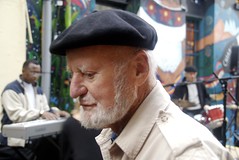
Lawrence Ferlinghetti at the San Francisco Int...Image of Ferlinghetti by Steve Rhodes via Flickr


Imagine my surprise when I open up the Chronicle of Higher Ed and read in an article called "The New Math of Poetry" by David Alpaugh that there is too much poetry in the world. That's right: because of technology, there is too much poetry in the world:

"Len Fulton, editor of Dustbooks, which publishes the International Directory of Little Magazines and Small Presses, estimates the total number of literary journals publishing poetry 50 years ago as 300 to 400. Today the online writers' resource Duotrope's Digest lists more than 2,000 'current markets that accept poetry,' with the number growing at a rate of more than one new journal per day in the past six months."

His complaint is that with all that poetry, we may miss the new Blake or Dickinson because the traditional filters of Culture (and please, do not reach for that revolver) are no longer in place. He says that no one can possibly read that much poetry and that

"professionals can ignore independent poets and reserve the goodies—premiere readings, publications, honors, financial support—for those fortunate enough to be housed inside the professional poetry bubble."

That is already the case. That has been the case for far too long. How many Blakes or Dickensons have we lost because they could not get into Yale or any college for that matter? Or didn't have the proper letters of recommendation to get through the doors of a publishing house? He does admit that Thoreau and Whitman were self-published. Yet he doesn't tell us how a volunteer army nurse and bum (Whitman) would get published in the academic poetry world before print-on-demand, lets say in the 1950s. Whitman would have died in obscurity if he waited to communicate. He continued to publish, not because he had the imprimatur and nihil obstat of Harvard, but because people read his poetry and bought his books. Emerson praised his work but the universities thought his work obscene and he had only one poem anthologized (a mummification process for poets) in his lifetime.

I also know some really great poets who only recently have made it into the anthologies because their poetry did not come out of the conservative academic tradition: they sinned by becoming popular before they were critically acclaimed. The first time I saw Ferlinghetti in a college anthology was in the early 90s for a single poem. There are a couple sides to poetry and one of them is the academic scene where the Status Quo gets to decide who is and who is not a poet. There is the MFA side where those who join the lodge publish fellow lodge members (secret handshake revealed upon final tuition payment). And then there is everyone else, who, despite themselves, can't help writing poetry, making videos, recording podcasts and producing art because that is what humans do and have been doing for 10,000 years. That is the frightening news flash: we are all poets. Ferlinghetti used to call for poetry to be recognized as a universal language, he opened his "Populist Manifesto" with

Poets, come out of your closets,
Open your windows, open your doors,
You have been holed up to long
in your closed worlds.

Technology is an opening of that window. More people can communicate and in a wider array of media than ever before. We should not be sitting on the ground telling sad tales of reading and the death of reading: people are reading and writing more than ever. They are just not reading and writing along the old model. People are creating videos, journals and blogs and listening to poetry in new ways that allow everyone to participate. And no, the professors will not have time to tell us who to include and who to exclude. It is up to us now.
Reblog this post [with Zemanta]