Showing posts with label Professional development. Show all posts

Tuesday, October 25, 2011

The Open Course Library: Bridging the gap between the LMS and OCW

Speakers: Tom Caswell & Connie Broughton

We will share the Open Course Library project, including technical & professional development challenges faced as we developed phase 1.

The goal of the Open Course Library is for faculty to design digital, openly licensed materials for 81 high enrolling courses in Washington State community and technical colleges. During the development of the first 42 Open Course Library courses, faculty designed, piloted, and then revised their courses using the our system wide ANGEL LMS. We chose to use ANGEL as our primary development platform for because most of our faculty course designers were already familiar with that LMS. Using ANGEL also made sense because all faculty were required to pilot their OCL course, so initial development, piloting, and revisions could all be made with the same system.

In this presentation we will explain the workflow and roles of the Open Course Library staff. We will share some of the challenges we faced developing OER in an LMS. While new systems such as Canvas are removing many of the technical barriers to open sharing from an LMS, other challenges remain. Considerations for open content sharing include professional development for copyright and Creative Commons licensing, instructional design, and web accessibility.

Notes: 
They had to make the case for open education.
Why is "open" important in education?

  • Efficiency: You can build on content that is already created
  • Affordability
  • Quality: We tend to do our best work when we know our peers can see it.
  • Self-Interest: Increased faculty exposure, reputations, and opportunities
They built 80 top courses and created an open course library all built on open education resources and open textbooks. The state of WA has 75% adjunct teachers in the community and technical college system. This is a quick way for faculty to get course materials together quickly. They didn't slam the door on commercial publishers but limited the textbook costs to $30. This approach is different from an "open courseware site." The open course library workflow is more of a straightline workflow - teachers who built the courses are also the ones who have taught them. 

The courses will be available on Connexioins.

Master & open course materials are linked 
  • Faculty update both together
  • Older versions still available
  • Proprietary content is flagged and hidden from open course
They have a new RFP for an LMS that is requiring an open publishing feature. 

Goals:
  • Design and share 81 high enrollment gatekeeper courses
  • Improve course completion rates
  • Lower textbook costs
  • Provide new resources
  • Fully engage our colleges in the global open educational resources discussion
Phase 1: 42 courses released this Monday
Phase 2: 39 courses available in Spring 2013

"Every faculty member works with an instructional designer and a librarian."

Q1= design, Q2= more design, Q3 Teach pilot course, Q4 review

Process: 81 courses built by our own faculty:
  1. Define learning objectives
  2. Go to OER library for materials
  3. Fill in missing content with created content
How does OER help teach more students and teach them better?
  • No-rivalrous, scalable, searchable
  • Allow for preview
Results?
  • 81 courses with 411,133 enrollments
  • Textbook savings of 41 million a year
  • Completion rates may also increase if students can afford to actually buy the text
Phase 1 Faculty Concerns
  • Many were unfamiliar with the particular LMS
  • No way to compare work between course teams
  • Too many websites to keep in track of
Phase 2
  • Using Google Docs to collaborate and share as we go
  • All project management information in one Google Site
They are also using Tegrity.

More information on http://opencourselibrary.org

Enhanced by Zemanta

Tuesday, June 14, 2011

Faculty Development: It is more than technology training!

Johns Hopkins Monument, Johns Hopkins Universi...Image via WikipediaI am interested in this because we have a lot of issues around professional development at College of the Redwoods.

At Hopkins, Denille works in a graduate engineering program. The teachers are adjunct. She has 9 on staff. Previously, they had outsourced instructional design, used WebCT, and had no pedagogy instruction. No targeted faculty development. They created 30-35 courses in five years. Online instructors had different needs: tech, distant, pedagogical, changing roles, and misconceptions. The changing roles were "sage on the stage" to online facilitator. There was no consistent quality online. Faculty and students were very frustrated.

They needed ongoing development - they hired additional staff, designed a course dev process, offered more training to faculty.

They adopted the quality matters rubric.

They used a cohort-based course development process. They put up tutorials but still not thinking about a formal faculty development program.

After five years there was increased quality and consistency, knowledge of tech increased.

A survey after five years of faculty said that they felt their needs were not being met, 100% thought that targeted prof dev would be useful. They wanted opportunities to learn teaching skills and best practices.

How to meet the demands? Improve the course dev process. They put together a course that taught online course development. Focused on best practices, not technology. Subliminal goals - teach them the tools by using them.

The course consisted of 6 modules
Intro to online teaching
online course component
writing learning objectives
preparing content
learning activities
assessments

They found that 2 weeks was not enough time, enjoyed interacting with their peers, caught on quickly, prepared for course development, more open to new ideas.

Room for improvement: More examples, less eduspeak, extended duration. Increasing dev opportunities, we shouldn't stop here; consider the muddiest points.

Redesign Intro to Online Development (FA 11)
Revised learning topics, learning activities, added periodic and final deliverables.

Next steps: evolve standards, increase faculty dev, increase fac dev for retention, need more just-in-time opportunities, and create blended and peer-led opportunities.

Later will create courses such as Engaging Online Learners, Learning activities, Creating better Assessments.

The cohorts are 12 faculty. They are paid - part of the development stipend is that they have to take this course. The faculty receive a generous stipend.

Why is faculty development important?
Most faculty were not trained to teach.
Faculty are important to student retention and recruitment.

In the conversation, we talked about sharing professional development resources: denille@jhu.edu

Presenter:
Denille Williams (Johns Hopkins University)

Description:
Faculty development is critical to the quality and success of online programs. The quality of development and delivery of online courses can be greatly enhanced by providing opportunities for faculty to learn best practices and increase faculty knowledge of online teaching and learning. During this session you will learn about the evolution of faculty development for online instructors at Johns Hopkins Engineering for Professionals as we present the past, present, and future of the JHU-EP online faculty development efforts. JHU-EP will also share our findings and experiences as we work to transition our faculty development program online using Sakai to deliver a course on best practices for online course development and plan future courses to enhance online teaching skills. After learning about online faculty development at JHU-EP, share in an open discussion about the faculty development efforts at your institution and ideas for the future of faculty development.

bios: Denille Williams: Denille Williams is an instructional designer at Johns Hopkins University, Engineering for Professionals. Denille has over seven years of experience in working with faculty and students in online education, specializing in the development of online science and engineering courses. Denille is a Certified Faculty Developer and has an M.S. in Higher Education (Academic Development, Instruction, and Technology) and a B.S. in Legal Studies. Her research interests include adjunct faculty development and promoting active learning in the online environment.s)
Enhanced by Zemanta

Tuesday, February 15, 2011

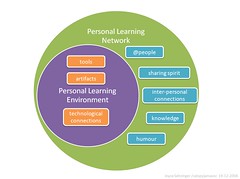
PLNs: The Power of Personal Learning Networks

PLE as subset of PLNImage by catspyjamasnz via FlickrWhat is a PLN? I am not talking about the Polish Zloty but "personal learning networks" - the collection of links, tools, and people on the internet we use to support our teaching and learning. I have been reading some critical literature on "personal learning networks." We are seeing now the formalized study and analysis of informal learning networks (see some of the articles at the bottom of this posting). Why the interest? First of all, there is the growth of social networks like Twitter and Facebook. Students (and instructors) and connected in ways that were not possible even five years ago. Second, there is a power relationship inherent in traditional teaching that does not always make the classroom (online or off) the ideal place for learning, creativity, or innovation. The problem often comes from the idea that somehow the student is broken and needs to be fixed or contains a void that needs to be filled with a one-way dump of information. This is the "sage on the stage" model of teaching and learning. What often really happens is students attend a lecture and then talk to their friends, wikipedia, and Google to figure out what the teacher was talking about. This is a primitive personal learning network.

Interestingly enough, there is still a lot of language around PLNs that harken back to the one-way dump. This comes from instructors seeing new technology in terms of the old technology (e.g. the internet is a library). A PLN should not just be a place where one goes just to consult "experts." A true PLN requires participation and engagement. A PLN is a practice and a discipline just like traditional scholarship: it requires you to read, think, and create. In order for your PLN to be effective, you need to do four things:
  1. Link to others: Find the other participants in your field. Some will be "experts" and some will be participants just like yourself. If you are in education, for instance, there are many lists of educators in twitter. Link to people with opinions and ideas different from your own.
  2. Ask questions: Post questions. The wider your network, the wider variety of answers you will find.
  3. Share: Share ideas that you have found in your network with others. Share your bookmarks in Delicious and what you are reading on your blog. Share other people; let others know about your network and and recommend people and sources of information.
  4. Answer questions: Offer solutions or help others find the means to answer questions.
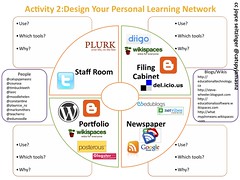
4 Faces of Personal Learning Network (Activity)Image by catspyjamasnz via FlickrYou can see from the list above, that as simple as it is, there is a lot going on. It would be just as big a mistake to abandon a traditional learning management system and just adopt PLNs as an answer as it would be to adopt an LMS and not sufficiently train students in its use. All of the skills around critical thinking and evaluating sources come into play here.We need a curriculum that teaches students how to make choices about who they are connecting to and why. Critical thinking skills around networks needs to be explored. Teaching and modeling technologies for sharing are also a part of this.These are critical skills in the community college, and we are still using early computer curriculum to show students how to use software that won't exist in two years.

In the right-hand side-bar of this blog is are some links to the HIM 101 class that I co-taught with Charlene Gore at Tacoma Community College. It includes a map of how we used Twitter in the class that I think represents an interesting use of Twitter as a PLN.
    Enhanced by Zemanta

    Saturday, January 08, 2011

    Guido Europeaantje on Twitter and professional development.

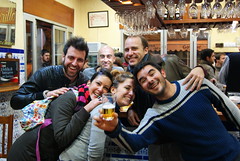
    Guido's students3 @europeaantjeImage by eltpics via Flickr
    Guido is an EFL teacher in Seville, Spain. He coordinates the teens’ department of the school where he works and conducts teacher-training workshops. After more than 10 years of experience his professional development has started taking giant steps forward again thanks to the power of Twitter.
    He gave an over-view of Twitter in his workshop called "Twitter: Turn 140 Characters into a Virtual Staffroom." He compares Twitter (for teachers) as a virtual staffroom where teachers can get together, share resources and ideas. 
    I love that he gets that Twitter is about networks. There are too many users out there who think that it is a "microblog" or a one-way push of information. He emphasized, as we do here, the importance of following and following someone back - i.e network building. 
    Guido writes that "Many educators worldwide connect on Twitter. This workshop is meant for teachers who are unfamiliar with Twitter or who aren´t very active on it (yet). The short messaging system Twitter can be turned into a huge virtual staffroom where teachers from around the world meet, communicate, support each other and share teaching tips, resources, weblinks and opinions. Come and discover some tools and tricks to help you keep up with “what´s happening” on Twitter."
    Guido promotes Twitter as a personal learning network. "It is a communication tool. You have to interact with people." It is a medium for sharing. 

    Enhanced by Zemanta