Showing posts with label moocs. Show all posts

Tuesday, February 11, 2014

When is a MOOC not a MOOC?

Statue of John Harvard, founder of Harvard Uni...
Statue of John Harvard Wikipedia
The Comical of Higher Ed has a headline that says "Harvard U. Will Offer Exclusive MOOCs to Alumni." After reading the article, the reader learns that what they are doing is giving alumni access to segments of courses and course content. The alumni are not taking a class. If it is not "massive," if it is not "open," and it is not a "class," it is not a MOOC! It is just the "online" part - it is an "O" not a MOOC.

I need to put together a collection of articles that maps out how the CHE has gotten MOOCs completely wrong, and thereby polluting the discourse around MOOCs with misinformation, exaggerations and over-simplifications. It is a huge disservice to the academic community. They seem to have attempted to help by writing up an article about George Siemens.

There are a number of great discussions going on around universities, journals, and the web about what MOOCs are and their possibilities (especially cMOOCs). It is a shame that the CHE misses the boat so often. 
Enhanced by Zemanta

Tuesday, July 23, 2013

Four Steps to Getting MOOCs Right

Betonwerksteinskulptur "Lehrer-Student&qu...
"Lehrer-Student" von Reinhard Schmidt
in Rostock (Photo credit: Wikipedia)
I love alarming education headlines - five MOOC classes are put on hold and the San Francisco Chronicle says "San Jose suspends online courses." Which it didn't - it suspended five MOOC courses because of a high student failure rate. San Jose's online college is still going forward. And they are right to suspend the classes. I just wish more work went into how those courses were put together (if only for the sake of the students). These classes are not so far out on the cutting edge that one couldn't predict that there would be problems. The MOOCs at San Jose are nothing new - even the failure rate is nothing new. All of the research into how to make online classes successful, including MOOCs is already in place. Educators have been researching successful online programs since the 90s. There are very clear reasons why the best online programs succeed. My own work in community colleges in closing the student success and retention rates between online and face-to-face classes dealt with similar issues. What we learned about online classes, big and small, was that they will not succeed for any population, at-risk or otherwise without these four things in place:

  1. Interactivity and Engagement - There is a direct correlation in the research between online interactivity and student success rates. Interactivity means "meaningful, purposeful, engagement" not just clicking on the play button. Interactivity means teacher-student, student-student, and student-content. And yes, there are ways to do this successfully in a MOOC (step 1, hire an instructional designer!). There needs to be more emphasis in MOOCs on collaborative projects and less"watch a video, take a test." This distinction is easily made when you look at connectivist cMOOCs versus xMOOCs. 
  2. Student Support - If your face-to-face students can't be successful without tutors, academic advisors, a help desk, and librarians, why would you expect your online students to be successful without them? There are tutoring services on your campus and great peer-to-peer tutoring resources online such as OpenStudy. 
  3. Student Orientation - Students have spent 12 years learning how to be a face-to-face student and 0 years learning how to be an online student. This is an easy fix. We did it in the community colleges with courses like "DE 101." Things that make students successful in online classes include time management, study skills, motivation, and other metacognitive skills that can be taught. Online learning is not just about technology.
  4. Faculty Training - The same magic that makes someone a teacher instantly when they get their master's degree does not work online. Just as students need to learn the skills to be an online student, teachers need to learn the skills to facilitate online teaching. Recording your lecture and posting it online will not work. There are a lot of resources, classes, and research online on this subject. 
So interestingly enough, there are no real differences in how classes online or off are successful! I have been in online classes, including MOOCs that had all of this in place: the assignments were designed to be collaborative and engaging, there were links to student support, there was sufficient information to tell students how to take the class, and the instructors were skilled online facilitators, curators, and guides. A college does not have to ignore 20 years of research into online learning to be innovative.
Enhanced by Zemanta

Friday, April 26, 2013

Open Textbooks and the Student Debt Crisis

Loans
Loans (Photo credit: zingbot)
Daniel De Vise at The Washington Post reported that student loan debt is now at "$870 billion nationally, surpassing the nation’s outstanding balance on auto loans ($730 billion) and credit cards ($693 billion)." This is according to the report "Grading Student Loans," a source  that De Vise refers to as "a scholarly blog post published by the economists at the New York Fed." The cost of education has far outstripped the rise in the cost of living and the rising cost of healthcare. And yet, despite the fact that there are free solutions to the textbook part of the equation, educators are slow to adopt them. Open textbooks are free, openly licensed textbooks that are electronically available to students at no cost, and available to students in hard-copy for the cost of printing. They are also editable by the instructors.

There are major implementations of open education resources and textbooks, organizations dedicated to their creation, grants and initiatives for hosting and support, but there are still many educators out there who do not know about open textbooks. Many of the common questions about open education resources and open textbooks have been answered, but apparently not widely publicized. Some of the perceptions of OERs - that they are hard to find, of low quality, not peer-reviewed, etc. are out-dated views. Lets take a quick look at some of these questions

Where do I find them?
There are many sources of open textbooks. I really like the high quality collection of open textbooks that are being hosted by the Saylor Foundation.  One can also go to College Open Textbooks which is a good portal to other sites. There are many other sites that are hubs to open textbook sites.

What kind of quality?
Before we discuss quality, I would urge you to read my posting on "The Myth of Commercial Textbook Reliability." I don't think that open textbooks should be held the same scrutiny as commercial textbooks - it needs to be more. We can do better as an academic community than the commercial businesses are doing now. We do not have to wait through a two year publication cycle to make corrections or amendments to open textbooks. We don't have to produce or have the students buy "supplemental materials" because we can customize open textbooks for the needs of our particular students in our community.There are some very high quality open textbooks out there including the ones mentioned above from the Saylor Foundation.

But are they peer-reviewed?
There is a peer review process for open textbooks and it is evolving all the time. OpenStax is one provider of free, open source, peer reviewed text books, and there are organizations like College Open Textbooks are sponsoring peer review processes as well. And why can't we develop a process for this on our campuses?

The rising cost of education is fueling innovation in education such as open eduction resources, open textbooks, and to some extent, MOOCs (massive online open courses). As educators, we have a moral obligation to remove barriers to education and to open up the opportunities that education can provide to everyone. Now is not the time to balk at change; change is coming whether we want it to or not. Innovation does not have to be in the hands of the corporations. MOOCs were not invented by corporations but by innovative educators. We can decide if we want that change to come from forward thinking educators who can shape innovation, or we can wait for crushing debts to make the changes for us.

Note: I have more links to OER and open textbook resources on my OER page. 
Enhanced by Zemanta

Wednesday, April 17, 2013

MOOCs, Group Work, and Instructional Design

English: Debate Chamber of the Oxford Union So...
Debate Chamber of the Oxford Union Society (Wikipedia)
Everything Old is New Again
In my last post I pointed out that all the arguments about MOOCs sound so much like the old arguments against online education in the 90s. One of the main arguments for authentic online learning in the 90s was the possibility of making online classes social environments. This fit well with the pedagogy of Constructivism. Constructivism says that knowledge is constructed when new information comes into contact with previous knowledge and evaluated against experience. Social Constructivism is an outgrowth of Constructivism that "extends constructivism into social settings, wherein groups construct knowledge for one another, collaboratively creating a small culture of shared artifacts with shared meanings" (Moodle). The instructors goal then was to facilitate these connections. In the 90s, this learning theory seemed to fit what was happening with effective teaching online. The goal of online assignments was to give students the opportunity to receive new information, hold it up to previous knowledge and experience, share that with a group, and then together, coming to new conclusions or new knowledge. Educators and researchers like Palloff and Pratt with their emphasis on learning communities, promoted group work and discussion forums as the solution to the badly performing classes that were basically online repositories of documents and maybe multimedia files. Over and over again, from the early days of online learning, the research shows that the greater the engagement in an online class, the higher the success and retention rates. Engagement does not mean clicking a link, widget or consuming media - it means actual interaction with students and instructors as well as content.

English: George Siemens at TEDxNYED.
George Siemens
Everything New is Old Again
Today, we have learning theories that are evolving towards a more complete accounting of how we learn online. I am thinking here of George Siemens and Stephen Downes' theory of Connectivism. I am not ready to throw out the Constructivist baby with the pedagogical bath because Connectivism is still in the Copernicus vs. Relativity explanation for gravity stage - I believe logically and experientially that the theory is right, but I am not ready to use it to put a satellite in orbit. This doesn't make the theory wrong. We need to be doing more research; it is just a matter of time. For myself, I am satisfied that this new theory accounts for much of what is going on with Constructivism. I am going to let the Phd's battle out the details: instructional designers have courses to create, assignments to design, and faculty to work with. A good working theory is a good working theory. A lot of what we are doing with online classes and MOOCs is testing the viability of Connectivism.

What Then Should We Do?
So this preamble is really a way to point out that everything that makes authentic learning work in a brick-and-mortar classroom are the same things that make online learning work. And as a teacher and instructional designer, I have a really practical end in mind. To my way of thinking, there is no difference between an online discussion forum and the Debate Chamber of the Oxford Union Society except one is more expensive and acoustically louder than the other. They are just different platforms. A MOOC is just another platform. George Siemens wrote back in March that MOOC providers were going to have to rely more on group work to be successful. I find this sentence especially funny and pertinent here: "The 'new pedagogical models' (A Silicon Valley term meaning: we didn’t read the literature and still don’t realize that these findings are two, three, or more decades old)...." But what kind of group work should we use and how can we ensure that it is successful? Siemens points out that there is a high dropout rate in MOOCs that could make group work a problem, but I believe that group work is one of the engagement pieces that is missing from many of these MOOCs (especially those using content delivery model rather than the content creation model).

Ensuring the Success of Group Work
Faculty and students have often told me about problems with group work. What do you do about the alpha student who needs to be the leader and do all the work? How should instructors handle the student who has little motivation? I have a blog post coming about this but essentially there are eight things needed for a successful group work project:
  1. Clear objectives
    Students need to know the exact purpose of the assignment. Let the students know where they are going.
  2. Detailed instructions
    This is particularly important in a MOOC because students tend to have less contact with the instructor. A detailed instruction document accompanied with a video and some examples are very useful here.
  3. Give each student a specific role
    This prevents one person from taking over the process and helps with assessment too.
  4. Communicate expectations in advance
  5. Use collaborative tools
    Model the means for useful collaboration. Give students instructions for setting up a wiki or a Google site for collaborating
  6. Facilitate and model leadershipSometimes good leadership is not getting in the way of good work. Leadership in MOOCs means that you live the model: you are connected and engaged in your course. You cannot disappear for two weeks and expect this to work. 
  7. Encourage networks
    Having the students using social media tools allows them to bring other subject matter experts into the project.
  8. Provide assessment and closure
    You would not want to participate in a MOOC with an endless series of unconnected assignments with no sense of closure. Assessment in group work gets interesting. I liked to use a blank form for the students to divide up participation points.
I will be posting a short article on how these components work here on this blog.

Kinds of Assignments:
The ubiquity of internet access and the proliferation of collaborative tools and platforms makes collaborative learning more available than it has ever been. This allows us to design a wide variety of assignments that are ideal for MOOCs or standard online classes. These are just a few ideas here:
  1. Group Research Project
    Group research projects are opportunities for students to get together and literally construct knowledge. Having students work on a research project and publish their results together on a wiki or a group blog benefits the students and the class. 
  2. Group PresentationsStudents can work on presentations with one another remotely and create slide presentations with audio or even a film and work on the 
  3. Media Projects
    Students learn a lot from content creation. Jim Groom's DS 106, a class that some would call a "task based MOOC" is an excellent example of students working together to create media. Students can create videos or podcasts. When they graduate from college, no one is going to ask them to write a 20 page paper; they will be asked to work in groups, use technology, and create media.
  4. Debates
    One of our instructional designers here at Humboldt State University is using online debates in discussion forums.The debates are carefully structured and each participant has a role. This kind of prior attention to details is essential to online group work.
  5. Role Playing and Simulations Role playing and simulations have never been easier because there is so much data online now that can be used to build simulations (I am thinking here of epidemiological data, for instance). 
  6. Concept MapsTypically these are solitary projects but having a group negotiate what should be in a concept map and how concepts relate to one another are a good way to allow the students to clarify those concepts with and for one another rather than having the instructor spoon-feed "meaning" to them.
  7. Infographics This is a good project for groups because the roles can cover a wide-variety of learning modalities and abilities: some students can gather data, others develop art work, and others can write interpretive materials.
Any of these assignments can be created in advance and given to small groups. The students benefit not just from following the steps of the projects, but through sharing the end results with other groups. 

Enhanced by Zemanta

Friday, February 08, 2013

MOOCs and Other Four-Legged Chickens

I have just moved to Humboldt State University. The college is fairly rural but we get a lot of folks from urban areas. I over heard a very interesting conversation between some students in the cafeteria.  One of them was freaking out because there was a rat in the garden outside that they could see outside through the window.
She yelled "what is that hopping around?"
One of her friends said "that has to be a bird."
She said "but it has four legs and a tail."
"But chickens have four legs," said the other, "at least, that's what you get in the bucket." They went back and forth. The wood rat hopped away and her three friends went on debating the nature of birds and mammals.
You might wonder how someone could make such a mistake. But imagine if the only time you have ever really thought about chicken was when it was in a soup,  a sandwich or already in a bucket. If you order fried chicken, you can get a whole assortment of parts but it would be difficult to piece back together a whole bird.

MOOCs are going through what I am thinking of here as a "four-legged chicken" stage. There are a lot of educational experiences and platforms that are being described as MOOCs: there is the original "Connectivist" or networked based MOOCs, task-based MOOCs, and content-based MOOCs. Some even describe collections of videos as MOOCs. There are many variations. Because the MOOC acronym has the word "class" in it, many educators are expecting to see their own definition of a class which is often a face-to-face class or a "traditional" online class where they have the most control. When the description of the MOOC does not meet the definition of a class, the conclusion is that it will fail as an educational experience. Many of the arguments I have read against MOOCs will latch on to one aspect of the course or only look at one kind of MOOC and then condemn the whole idea. Many of the arguments are re-hashes of arguments against online learning that were already fought and won 15 years ago (i.e. "No Significant Difference," student identity issues, etc.). Online learning was the four-legged chicken of the 90s.

My take on MOOCs is that there needs to be more focus on how they work - this is the instructional design component. On one hand, we are early in the research, but MOOCs have been around since 2008. Most educators are just now hearing about them because, as Stephen Downes has also pointed out, they were only recently picked up by the big name universities which then attracts the attention of the Chronicle of Higher Ed, the Horizon Report, etc.

Recently an instructor created a MOOC that, for a number of reasons, failed. Of course that happened - this is a new teaching and learning environment. We are still learning how all the pieces fit together. Face-to-face and online classes have also failed. There are face-to-face colleges with worse retention and student success rates than some online colleges. This is not the "I told you so moment" that some think it is. I feel very strongly that we can't dismiss MOOCs because, in my experience, some of them work very well (George Siemens, Stephen Downes, and Jim Groom). The current state of the research is thin, we need more data, we need to work out the best practices. And in the end, you cannot assemble a chicken from a bucket of KFC.

Enhanced by Zemanta

Wednesday, January 16, 2013

MOOCs: Why Do We Need Instructional Design?

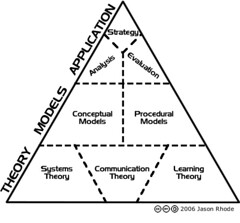
Hierarchy of Instructional Design
Note: The following is an extended abstract for a paper. I was in the process of sending this out to journals when I realized that this needs to be an open document. I have always found the publishing process in education to be somewhat ironic: scholars publish papers on open education in journals that colleges can no longer afford to buy. What is wrong with this picture? If you are interested in MOOCs and Instructional Design, please email me or leave a comment if you would like to collaborate. I will be submitting it to open journals or we may turn it in to an openly licensed book or modular OER.  This feels like it belongs on a wiki. Maybe we should create a MOOC to develop these ideas?

Just as we need a new learning theory to account for new modalities in learning, we also need a new framework for instructional design, a rubric for MOOC development. New modalities of learning, content delivery, and engagement in online, hybrid courses and Massive Open Online Courses (MOOCs) have required new learning theory: Connectivism. Given this new theory, this paper suggests that a new instructional design model is needed as well. According to my reading of Connnectivism, instructional design for MOOCs should:
● Provide for a diversity of opinions
● Allow students to create connections between specialized nodes and learning sources
● Foster their capacity to learn (teach metacognitive learning skills)
● Increase their ability see connections between fields, concepts, and ideas
● Teach students to build networks that will allow students to keep current in their field
● Allow students to choose what to learn and how
Additionally, in a presentation that George Siemens gave on instructional design for the MOOC "Connectivism and Connective Knowledge 2008" he said that learning should be designed for adaptability, for "patterning, wayfinding, and sensemaking" and focus on "content, context, and connections." Siemens says that it is difficult to take all of this and try to build some mechanistic formula for creating learning experiences. This paper will introduce a new rubric of connectivist learning theory as applied to instructional design in order to examine and explain how successful learning takes place in MOOCs.

There are many definitions for “instructional design.” Some definitions are particularly narrow and limit the role as relating learning to technology. For the purposes of this paper, I will use Sheninger’s (2010) which is fairly broad: 
“Instructional Design (ID) is part creative arts and part science which utilizes theoretical as well as practical research in the areas of cognition, educational psychology, information technology, graphic and Web design, and problem solving. ID aims to create the best instructional environment and learning materials to bring a learner from the state of not knowing, not feeling or not being able to accomplish certain tasks to the state of knowing, feeling and being able to accomplish those tasks in a given subject area through carefully organized interactions with information, activities and assessments.” 
MOOCs are a relatively new modality of online learning and the basic research is still in its infancy, but this paper will develop its thesis and argument from research into Connectivist pedagogy, an analysis of the author’s experiences in MOOCs, and interviews with instructors and participants.

The kinds of problems that we can solve with instructional design include student success and retention. Just as some students need help in understanding how online education works (motivation, time management, study skills, etc.), students will also need help in understanding how to successfully take a MOOC. The skills students need to be successful can be built into curriculum. Many of the more successful MOOCs are based in colleges where the students are already successful learners, but this doesn't mean that MOOCs are only appropriate for those colleges.

Another problem is teacher preparation. Just as teachers need to learn how to be successful online teachers, the facilitation skills needed in a MOOC are different. It is a very different, certainly non-hierarchical model. There are ways to structure assignments and activities in a MOOC that will model the skills needed to be successful in a MOOC.

I would like to include a review of the literature of connectivism that compares Connectivism with previous models shows that as the teaching and learning modalities change, so do the theories. Theories such as Constructivism do not fully account for full online courses, hybrid online courses, personal learning networks, or MOOCs. Applying Connectivism to instructional design requires a redefinition of instructional design along the same lines as the changing role of the teacher (Siemens, 2010). The principles of instructional design, which includes a systematic approach to designing course content and learning events, will inform the creation of MOOC development rubric that will be included with this paper.

This project will include definitions of the skills, student success, and include a guide to the connectivist pedagogy for successful online learning and successful participation in a MOOC.

Consider this posting as a preamble. I am especially interested in hearing back from teachers with experience in online education and MOOCs, instructional designers, and other practitioners. 
Enhanced by Zemanta

Saturday, November 17, 2012

What Part of MOOC Don't You Understand?

Stephen Downes
Stephen Downes (Photo credit: WordShore)
Educators who have not taken a MOOC (Massive Open Online Course) and do not understand their history, are currently writing about these courses which is causing them to be inaccurately represented in the press. The main problem is there is all the publicity around Coursera and Edx that ignores other kinds of MOOCs.

I also think part of the problem comes from the age-old issue of looking at new technologies through the lens of the old - the "horseless carriage" problem (a car is not "horseless" because it never needed one). I think an example of this is found in the essay "A New Era of Unfounded Hyperbole" by Siva Vaidhayanathan, which gives us an example of a typical misunderstanding MOOCs:
"MOOCs, on the other hand, are more like fancy textbooks. They are all about the mass market and not the rich connectivity that established online courses offer their limited collection of students."
This is a gross generalization of MOOCs. I would go so far as to call the statement above "unfounded hyperbole." The first MOOC I participated in "Connectivism and Connective Knowledge 2008" was one of the most interactive and engaging experiences in my education. There were a couple thousand participants who all self-organized into study groups and communities. This happened not on accident, but through the example and facilitation of the MOOCs teachers, George Siemens and Stephen Downes. They would not like the work "teacher" I think because it represents the traditional, hierarchical structure of traditional classes. I have never taken a class that was "all about the mass market." The reason why we wanted a class with a lot of people is because we learn in those networks - we get to take advantage of the the collective knowledge and talents of thousands of people. If your MOOC doesn't do that, you might not be in a "class."

When Vaidhayanathan is writing about MOOCs, I assume he is not writing about the MOOCs that came from David Wiley, George Siemens, Stephen Downes, Cormier, or Jim Groom. I am sure he is writing about Coursera and Edx. I would not make any generalizations about those because I have never taken a class in Coursera or Edx. What I will say is that their pedagogy and methods are different from what are sometimes called "cMOOCs" or "Connectivist MOOCs."

Another of Vaidhayanathan's generalizations says that
"The classroom has rich value in itself. It’s a safe, almost sacred space where students can try on ideas for size in real time, gently criticize others, challenge authority, and drive conversations in new directions."
They can also be stultifying places where new ideas are not encouraged, where there is no real criticism, challenges to authority are not rewarded, and discussion discouraged (often because the lecturer won't/can't allow for the time). There are good face-to-face classes and bad. There are good online classes and bad. The same goes with MOOCs: my experience in CCK08 rivals my best classes at Berkeley or Sonoma State (both of which had some amazing classes).

Vaidhayanathan is not alone. I keep reading about the possibility of MOOCs going international when Canada has been in for four or five years ahead of the Ivy Leaguers. There are also a number of stories about how we might be able to take MOOCs for credit when this has been the case at University of Manitoba and Athabasca for years.

I do appreciate the last part of his article where he lists some possible upsides to MOOCs and asks that we "...focus on what we can learn and accomplish from the MOOC experiment and leave behind the unfounded hyperbole."

I would like to see less hyperbole and generalizations on both sides and more research.
Enhanced by Zemanta

Friday, October 12, 2012

Beyond MOOC Hyperbole with Siva Vaidhyanathan

These are my notes on "Beyond MOOC Hyperbole: Why We Should Support MOOC Experimentation...Critically and Carefully." This was a presentation hosted by Dave Cormier and presented by Siva Vaidhyanathan for our MOOC "The Current and Future State of Higher Education 2012." According to the article on Siva Vaidhyanathan in Wikipedia, he "is a cultural historian and media scholar and is currently a professor of Media Studies and Law at the University of Virginia. Vaidhyanathan is a frequent contributor on media and cultural issues in various periodicals including The Chronicle of Higher Education, New York Times Magazine, The Nation, MSNBC.com, and Salon.com. He is a fellow of the New York Institute for the Humanities and the Institute for the Future of the Book. From 2004 through 2008 he maintained a blog, Sivacracy.net on which he frequently commented on media and technology issues, as well as his love of sports." This was the second CFHE12 discussion. He talked about the place of MOOCs on higher ed. He comes at this as a professor of media studies.

American Palladianism: The Rotunda at the Univ...
(Photo credit: Wikipedia)
He began by saying that "Discussing higher ed as if it were a single entity really clouds the issues" because it covers a wide variety of schools and the role and scope of community colleges or big name Ivy League schools. MOOCs will have different effects and benefits to different kinds of teachers. The real question is "what tools are best for a particular context." He does not think that discussions about "revolutions" and "disruptions" are not very useful (they are ahistorical). There is a lot of talk about MOOCs being the end of the university or the rebirth. We should be suspicious about these claims. He said that there are no simple conclusions that can be made on new tools and pedagogy. He thinks the college is "a temple of empirical reason." Hmmm... The heirs of the monasteries. He has to convince students that he is the "source of wisdom."

The discussion of MOOC mania is in a "faith" realm, not an empirical reasoning realm. He discussed the attempted firing of the president of his college, University of Virginia. Their was talk of MOOCs being one of the issues. They are now working with Coursera to offer courses. There was an email that discussed faculty teaching in MOOCs. There is a lot of panic, therefore, around MOOCs.

He is excited about MOOCs because:
  1. They are pushing interesting ideas and work to "all corners of the world"
  2. Could inspire people to pursue knowledge
  3. We can learn a lot about learning
  4. We could do great marketing for UVA (inspire people to enroll)
We need to encourage people to collaborate around the world - this is how real creativity will happen.  MOOCs could help us break out new technologies and pedagogies. We need to understand that we are doing this as a "public service."

He has serious concerns about MOOCs:
  1. Revenue/Cost savings trump education/academic values
  2. Commercialization of the missions
  3. Reduction of the missions of higher education into a transaction
  4. Student ("user") privacy concerns
  5. Taking the worst aspects of college learning as the favored methods of college learning
  6. Assuming teaching and learning resemble the "hypodermic needle" model
  7. Technofundamentalism
  8. Market fundamentalism
Homer statue at the University of Virginia
Homer statue at UV (Photo credit: Wikipedia)
He is worried about money and commercialization trumping education (Isn't this already happening?) He is concerned about FERPA issues. He says that the current MOOCs are "television shows" - they are a one-way delivery of content. Ironically, this is how this presentation if being delivered. Siva does not seem to be familiar with the connectivist MOOCs where interaction with students was, in my experience, the primary mode of learning.

He is complaining about the lack of public funding for education. I think that the cost should be lowered!

The work that instructors do cannot be reduced to a commercial transaction. I agree with him about concerns about thinking about colleges as a "business model." MOOCs, OERs, and open textbooks are, among other things, a response to the financial issues around education. He spent a lot of time discussing, at the end, the wonders of a brick & mortar education. I think that there are ways to develop high quality education through MOOCs, OER, and open textbooks.
Enhanced by Zemanta

Wednesday, August 01, 2012

MOOC Links from NGLC Presentation

This in from Friend-of-the-Blog, Bosha Struve:


If you are interested these were pulled out of the chat window from the webinar…


Additional URL’s from Chat:

·         Edward R. O'Neill, USC: I analyzed one MOOC lecture, and then argued it wasn't supportive of learning. Here's the analysis: http://managinglearningtechnology.blogspot.com/2012/07/whats-lecture-anyway-lecture-and-mooc.html
·         Edward R. O'Neill, USC: And this is my argument about when lectures don't support learning well--strictly FYI. http://managinglearningtechnology.blogspot.com/2012/07/is-lecture-good-for-learning.htm
·         Kelvin Bentley: http://opencontent.org/blog/archives/2436
·         Francisca Yonekura: I'm currently participating in the game based learning mooc http://gamesmooc.shivtr.com/
·         Ben Harwood: E-learning and Digital Cultures - Coursera https://www.coursera.org/course/edc
Starts in Jan '13
·         Amy Collier, Stanford: Sam, take a look at George's blog: http://www.elearnspace.org/blog/2012/07/25/moocs-are-really-a-platform/
·         http://www.mooc.me/
·         Betzi - UMass Boston: @Audrey - Wiley covers it in his openness in edu course http://openeducation.us/
·         Carie Page, EDUCAUSE Help: October 8th - November 16th  http://edfuture.net
·         @injenuity: There are some names of edtech startup funders in the right column on this list http://bit.ly/H3BGpv
·         Geoff Cain: Massive list of MOOC resources: http://www.worldofwebcast.com/post/massive-list-of-mooc-resources-lit-and-literati
·         Gerry McK / Iowa State University: I curate a blog titled _Alt-Ed_ that is "devoted to documenting significant initiatives relating to Massive Open Online Courses (MOOCs), digital badges, and similar alternative educational projects." _Alt-Ed_ is located at
Enhanced by Zemanta

Tuesday, July 31, 2012

Nine Essential MOOC Links

English: George Siemens at TEDxNYED.
George Siemens at TEDxNYED. (Wikipedia)
A few of us from today's NGLC presentation "MOOCs: open online courses as levers for change in higher education" by George Siemens on MOOCs were passing around a few URLs, and I thought it would be handy to have some of them in one place. This is not meant to be exhaustive but please drop us a note in the comments if you have a link to add.
  • Massive List of MOOC Resources, Lit, and Literati
    This is a great hub of research for MOOCs. Lets get this into a wiki! If you review these links, you still get the impression that MOOCs are completely undefined because it includes discussions of Khan Academy which I would argue does not belong on a page about MOOCs. This page is useful because it speaks to the fact that MOOCs are still in a defining process. 
  • Stephen Downe's MOOC.ca page.
    This has links to relevant articles, resources and a call for curators of MOOC lore.
  • David Cormier's Description of MOOCs 
    An enthusiastic vision of MOOCs. I like this simple "Common Craft" definition of MOOCs. 
  • The MoocGuide Wiki. Stephen Downes' also has a Google Docs version of this.
    This is a useful gude on how to roll your own MOOC. There are 42 members to this wiki so it has a good chance of being a living document.
  • Join a MOOC.
    This site has a listing for MOOCs - something I think we really need. 
  • Alt-Ed
    This site is "is devoted to documenting significant initiatives relating to Massive Open Online Courses (MOOCs), digital badges, and similar alternative educational projects."
  • Howard Rheingold's Interview with George Siemen's on MOOCs
    This is a good introduction to MOOCs
  • Inge DeWardes' 3 part article on setting up a MOOC
    I am interested in MOOCs from the instructional design perspective. I think that there are ways to set MOOCs up so that even the so-called "unmotivated" student or students with little experience with online learning can be successful. That will be part of another post!
The 9th resource is the talk that George gave today. Feel free to comment and add to this - if we get more responses, we will move the conversation to the wiki.

Okay here is a bonus 10th:


Enhanced by Zemanta

Sunday, July 22, 2012

The Real Trouble With Online Education

E-learning short courses
E-learning ( London College of Fashion)
An editorial piece in the New York Times on July 19th by Mark Edmundson attempts to tell us about "The Trouble with Online Education." Despite the fact that the author does not appear to have taken or taught an online class, and despite not having any listed credentials in the field of education, online teaching and learning, or instructional design, Edmundson, and apparently the editors of the New York Times, feel he is qualified to to make the pronouncement that online courses are not "real" courses.

He asks "can online education ever be education of the very best sort?" In that loaded Gatsbyesque question, does he mean the kind of education the 1% can get at the Ivy Leagues? No, most online classes that I know of or have experienced were not small settings where we sat with a professor in big leather chairs sipping sherry. Not everyone can afford such an education and maybe that is why some folks seem to be threatened by online learning - the barbarians are at the gates! Online classes are classes of a different sort. And here is my real problem with this article: the author does not know what happens in an online class so he assumes it is not what happens in a face-to-face class and this is just wrong. 

Edmundson describes face-to-face classes as places where there is engagement, dialog and the inadvertent creation of academic community "the students will always be running into others who are also enrolled" (I am presuming in the halls or the cafeteria - do his students not work or have families?). But the fact is, I have taken face-to-face classes at colleges (U.C. Berkeley, for instance) where the professor had no time for undergrads, directed all questions to the tutors, and did nothing to foster community. Conversely, I took an online course in 2008 from the University of Manitoba (George Siemens and Stephen Downes MOOC "Connectivism and Connective Knowledge") and I am still in touch with students I met there - in fact, we are basically continuing what we learned in online communities. We are still engaged with one another. What instructor wouldn't want that? In the "very best sort" of online classes, this community and engagement is deliberately built into the courses, and the research says that student engagement is the number one factor in the success of online courses. That said, I did take an online class that was poorly run: the teacher would go days without connecting with the course, the feedback on assignments was minimal and late, and there was little direction. My point is that the teaching modality does not matter if the teacher is engaged.

There seems to be a lot of this going around, there were blog postings I read through the Chronicle of Higher Ed from Siva Vaidhaynathan and Joshua Kim's posting in Inside Higher Ed that both gave negative evaluations of MOOCs (Massively Open Online Classes) despite the authors having no experience with MOOCs or online classes. I addressed those issues in my posting "Why MOOCs Work" but I feel that there is a larger issue here. If you read the three articles together, all contra elearning, they all have this alarmist ring to them that somehow online education is a watering down of face-to-face education. You get a real sense that if the world now accepts online education as it seems that it does, and accepts badges and portfolios in place of traditional certification, that it will detract from the value of the precious face-to-face college. You know the college - the one with the tuition that has risen faster than the price of inflation, faster than the costs of healthcare, and the $250 textbooks. 

Edmundson claims that "Online education is a one-size-fits-all endeavor." There are too many kinds of online classes out there for this to be true: there are full online courses that include Skype sessions with teachers and tutors; there are hybrid courses; there are classes that are more self-directed; and there are MOOCs; I could go on. What constitutes an online class can be as individual as the instructor who teaches it. 

He claims that "It tends to be a monologue and not a real dialogue." Again, he is basing this on courses that are filmed and canned but that is NOT the most common teaching modality in online education. Most online classes include discussion forums and students now are using social media and networks such as Twitter and Facebook to engage with one another, with their instructors and experts in their field of study. A glance at the research at sites like Educause would give him an idea about what is happening. 

He says that instructors can't gauge the nuances of a class online. If  online instructors engage their online class with online discussion forums and chat, they can gauge what is happening. In fact, in some of my online English classes I got to know some of my students better than my face-to-face classes because the students will often seek out that engagement, and socialize a lot online, to make that human connection online. 

All of this points to an appalling lack of knowledge about what constitutes online learning. I can't believe that a college professor would accept similar judgements from a student with nothing to back them up but what "seems." All three authors, Edmundson, Vaidhaynathan, and Kim, evoke what "seems" as evidence. It is not like the research is hard to find. There have been hundreds of studies that show that there is no significant difference between the outcomes and success rates between online and face-to-face learning. All Edmundson would have to do is to take a look at WCET's "No Significant Difference" webpage to find a collection of the research that goes back a hundred years. Or to look at any recent study like the one reported in The American Interest called "New Study: Online Classes Just as Good."

The real trouble with online education right now is that online education is currently being defined in unfavorable ways by those who feel threatened by it. Online education is not the same as face-to-face education. Just as you should not believe the hype behind anything "new" (even if it just new to the press) - don't be dissuaded by those who are so embedded in the old paradigm and have so much to gain by its persistence that you miss out on some great teaching and learning opportunities. 

Enhanced by Zemanta

Tuesday, July 10, 2012

Why MOOCs Work

English: Jim Groom as Edupunk
Jim Groom as Edupunk 
(Photo credit: Wikipedia)
I have been reading articles lately written by educators who have not participated in MOOCs but nonetheless seem to have some pretty strong opinions about them such as the "What's the Matter With MOOCs" by Siva Vaidhyanathan from the august (Latin for "dusty, old, and conservative") Chronicle of Higher Ed. And there is Joshua Kim's article for Inside Higher Ed, "Playing the Role of a MOOC Skeptic." I found myself getting a little testy about the issue because I am so passionate about MOOCs. I was in George Siemens' and Stephen Downes' Connectivism and Connective Knowledge class, and I skirted the fringes of Jim Groom's DS 106, his digital storytelling class. If you are not familiar with them, MOOCs are "Massively Open Online Classes" - classes with no limit to who can participate. There are no fees unless you want credit. If you read Vaidhyanathan's article, you will get a real sense about how this can really threaten the establishment. What if you hold a class and nobody pays? If we at the elite colleges give our stuff away, won't that devalue the education for the alumni and paying students? There is a lot of hand wringing like that going on. But that is not how MOOCs work. I want to look at how they do work based on my limited experience (which is better than something written by someone with NO experience).

Now I am going to warn you, I have drunk deeply from the MOOC cool-aid - my experience in Connectivism and Connective Knowledge changed how I work, and how I engage with faculty and students in some very positive, deep, and profound ways. I don't agree with everything that Siemens or Downes has written, they would be the last ones on earth to expect that, but there are no learning theories out there that can contend with, or account for, the rapid changes that are going on in education and technology than Connectivism. Interestingly enough, I think the success of MOOCs counts on an understanding of those principles. George Siemens wrote a great post on those principles in his posting "What is the Theory That Underpins Our MOOCs?"

My staff in the Distance Education department at College of the Redwoods also participated in Jim Groom's DS 106 and this experience is in turn shaping how we do our "DE 101" - our student orientation for distance learning. We are working on cracking that orientation out of the LMS box and turn it into a wider community of learning that we are hoping the students will take far beyond the confines of the orientation - through college and maybe even into their professional lives.

I love George Siemen's article on the theory of MOOCs, but as an instructional designer by trade, I would add these four points:

1. Student MotivationThis is one of the criticisms of MOOCs and the "flipped classroom model": students in those scenarios need motivation to be successful. Students are not born motivated. Lack of student motivation is not an excuse for classes not working. If you are a teacher and your students lack motivation, you need to get into another line of work. Part of what teachers do is inspire and motivate. Many teachers can't help but being motivational because they are enthusiastic about their field. Teachers can provide opportunities for the students to reflect on why they are in the class and be given opportunities to contribute to the class - in my experience, this is often enough to motivate students. I would often get students in my English classes who were used to teachers doing the work for the students. This is not a problem with MOOCs. Students can be taught motivation. As Siemens puts it, we need to foster autonomous, self-regulated learners.

2. Facilitated Connections
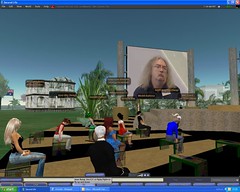
True learning occurs when the student chooses the modality in which the learning takes place. In traditional education, that modality is forced (typically, static classroom lecture mode). If the student accepts the choice, he or she is a "good student." What would happen if the learning materials were in different multiple formats; open, accessible and maybe sometimes asynchronous and the students got to choose which version of the material they used and how they engaged with it? Why can't "lecture" also be a video stream, podcast, or recorded event? Then the "live" bit can occur when the students decide to get together and review the materials, discuss them, and then later bring their questions to the facilitator. These reviews can happen in a Moodle discussion forum, Facebook, Twitter, or even in virtual worlds like Second Life.

3. Self-Organization
Teachers need to have faith in the students ability to self-organize - this is how revolutions, religions, and AA meetings work. Humans have evolved to do this very effectively, just ask the wooly mammoth. To this end, students need to be encouraged to use the media with which they communicate as a learning tool. If the students like discussion forums, make that available. If the students are texters or use Facebook, encourage them to take the discussion their. Even if you are not a chronic tweeter, why not have instructions available to students who are? What happened in my Connectivsm and Connective Knowledge class was that discussions took place in a wide variety of fora and then a self- or group appointed "leader" would bring our questions back to the course facilitators for clarification. Often the best thing that the facilitators did was to stand back and let us learn.

4. Content Curation
There was no text book for Connectivism and Connective Knowledge. The course consisted of many of the articles and readings that lead the facilitators to Connectivism, but also the people behind those ideas. What George Siemens and Stephen Downes are really good at is bringing the right people together to talk. They have been exploring these ideas for a while and they were good at breaking down how they arrived at some of their conclusions. Fortunately, the ideas are new enough that the people that helped them out along the way are still with us. So a "lecture" in this course consisted of some weekly readings, a video or two, and a live, weekly presentation by the facilitators or someone like Dave Cormier or another "guest lecturer." These lectures would often start out as a lecture and then evolve into a conversation with the facilitators and students. You would be really surprised at how open people are in your discipline to being a guest in your course via webinar or Skype.

So therefore, getting together with an instructional designer and creating course guides that account for the different media would be really helpful. Fortunately, George Siemens and Peter Tittenberger also thought of that with their "Handbook for Emerging Technologies" which needs to be updated and put back onto a wiki somewhere - maybe at College of the Redwoods or a college near you - so it can be added to and revised.

For Connectivism, the medium is the message - teaching Connectivism any other way than a MOOC is as ridiculous as buying a book about free, open text books from Amazon.Com. I hope that the critics of MOOCs take the time to actually take a course, even as a lurker - they will gain immensely from the experience, and who knows? They might even learn something.
Enhanced by Zemanta