Showing posts with label elearning101. Show all posts

Tuesday, November 26, 2013

eLearning 101: An Open Class for New Online Learners

Humboldt State University
Humboldt State University (Wikipedia)
Our new class is slowly taking shape. The course will be based on our old DE 101 (Distance Ed 101) which in turn was based on HIM 100 (a Health Information Management class where we introduced students to networked learning). It is also based on my experiences with CCK08 (the Connectivism and Connective Knowledge course facilitated by George Siemens and Stephen Downes) and DS 106 (Jim Groom's project-based digital storytelling class), both of which I think represent the best of the MOOC idea. I was calling our course a MOOC but I am absolutely disgusted with some of the online classes that are going under that name right now - I would not want to give my faculty the idea that we were following a model that didn't build in student support, or value engagement and interaction, and valued venture capital over learning. I believe that we can create an open course that uses the best of these classes, uses actual research into the needs of our students, and then help students learn to be independent, life-long learners, with a dynamic learning community that they can take with them through college and into their professional lives.

The structure of our course owes a lot to the excellent work of Humboldt State Universities instructional designers, like Riley Quarles who has developed the structure of the blogs for our Child Development program. Dan Fiore, another instructional designer I am working with, is putting together Wordpress and an open badge system.

The students for this course are new to online learning, but of the 1600 students who responded to our survey, 95% use Facebook. At the typical university that hosts MOOCs, there is a higher level of motivation and skill sets (Stanford for instance). What we know about this population is that we need to have modules on things like time management, online communication skills, motivation, study skills, and how to create a personal learning network. One of the key purposes of the course is to help the students figure out how to form online learning communities for academic and professional support. We do have a module called "LMS" (learning management system) and that is specific to our campus' installation of Moodle - other campuses could insert their LMS of choice there.

The MOOCs that I have participated in were made up mostly of grad students and education professionals. My work has mostly been in community colleges and state colleges, so the tools and skills we are teaching are different.

Where we are now:

1. We are using Wordpress. There will be a main course blog that will link all the topics of the course (which may be on pages or separate blogs). The facilitators will have blogs as will the students. The students will choose or create an assignment on the topic and post to their blog. This feed will be aggregated on the topic blogs.

2. We are using open badges. I know that motivation is an issue in online classes in our university system, and all the research I have read says that badges are one of the ways to address that issue. Plus, I want the students to have a

3. We are gathering data. We have sent out a survey to our students to see how they are accessing the web, where they are accessing it, and what tools they are already using. The course is based on previous courses and orientations I have created but each is different according to the needs of the student population. For instance, at Tacoma Community College, we had more students involved in virtual worlds like Ever Quest and Second Life. Humboldt State only had 6% of the respondents in online games.

4. Updating course materials. The course materials are from previous courses and orientations. All of the modules will be openly licensed with a CC-NC-SA license.

5. Getting out to the learning communities and asking people to help get out and push. I went to the Open Ed 13 conference to learn more about open badges and to meet more people who are teaching in MOOCs. I will be presenting on this at the DET/CHE conference in San Jose next week.

The illustration below is s rough sketch that is evolving - this is not meant to be a traditional hierarchical course but student driven: the student chooses which modules are important, the student chooses the assignments from the module (or creates one) and gets together online with students to complete the work.


I would love to talk to anyone who is working on a similar project. Feel free to email me or leave a comment. I will also post updates and my presentation here as things take shape. 
Enhanced by Zemanta

Friday, June 14, 2013

Essential Skills for Online Students

E-learning short courses
(Photo credit: London College of Fashion short courses)
I am writing up a page for our students here at Humboldt State University on the study skills needed to be a successful online student. The same skills needed for success in face-to-face courses are needed in online courses, but my research shows that the following are particularly important for online learners:
  • Motivation and Self-Discipline - There is often no set schedule - you must make real commitment to your assignments and deadlines. Remind yourself often why you are in school and what you want to accomplish.
  • Time Management - Use the calendar in gmail or any task list that will notify you like "Remember the Milk." Print out the course schedule and enter the dates into an online calendar.
  • Effective and Appropriate Communication - Even though you are online, your classes are an academic environment; communicate accordingly.
  • Engagement - Be an active learner. You have to take responsibility for your education.  Ask questions. Ask questions in the forums where other students will benefit from the answers, and don't be afraid to answer questions either.
  • Collaboration - Forming online study groups and participating in discussions online can make all the difference in an online course. The connections you make are as important as what you learn. 
I am basing a lot of this on my previous research working in community colleges with our DE 101 class - an introduction to online learning. I am also very interested in the Connectivist perspective here: we need to include more in our student prep courses on networking which is important for students to connect to content, their peers and instructors. Being able to build smart networks is at least as important as the subject matter because the networks will allow students to continue their learning long after the class is over.

I am unsatisfied with our "tech skills" list too. Lots of emphasis on software and not enough on what you would use it for. We need to teach students how to be effective in MOOCs, mlearning and other platforms and educational environments - not just the online learning model of the 90s.

What would you add to this list? What habits make your students successful? Add them to the comments or email me and I will include them in the list. 

Enhanced by Zemanta

Wednesday, April 17, 2013

MOOCs, Group Work, and Instructional Design

English: Debate Chamber of the Oxford Union So...
Debate Chamber of the Oxford Union Society (Wikipedia)
Everything Old is New Again
In my last post I pointed out that all the arguments about MOOCs sound so much like the old arguments against online education in the 90s. One of the main arguments for authentic online learning in the 90s was the possibility of making online classes social environments. This fit well with the pedagogy of Constructivism. Constructivism says that knowledge is constructed when new information comes into contact with previous knowledge and evaluated against experience. Social Constructivism is an outgrowth of Constructivism that "extends constructivism into social settings, wherein groups construct knowledge for one another, collaboratively creating a small culture of shared artifacts with shared meanings" (Moodle). The instructors goal then was to facilitate these connections. In the 90s, this learning theory seemed to fit what was happening with effective teaching online. The goal of online assignments was to give students the opportunity to receive new information, hold it up to previous knowledge and experience, share that with a group, and then together, coming to new conclusions or new knowledge. Educators and researchers like Palloff and Pratt with their emphasis on learning communities, promoted group work and discussion forums as the solution to the badly performing classes that were basically online repositories of documents and maybe multimedia files. Over and over again, from the early days of online learning, the research shows that the greater the engagement in an online class, the higher the success and retention rates. Engagement does not mean clicking a link, widget or consuming media - it means actual interaction with students and instructors as well as content.

English: George Siemens at TEDxNYED.
George Siemens
Everything New is Old Again
Today, we have learning theories that are evolving towards a more complete accounting of how we learn online. I am thinking here of George Siemens and Stephen Downes' theory of Connectivism. I am not ready to throw out the Constructivist baby with the pedagogical bath because Connectivism is still in the Copernicus vs. Relativity explanation for gravity stage - I believe logically and experientially that the theory is right, but I am not ready to use it to put a satellite in orbit. This doesn't make the theory wrong. We need to be doing more research; it is just a matter of time. For myself, I am satisfied that this new theory accounts for much of what is going on with Constructivism. I am going to let the Phd's battle out the details: instructional designers have courses to create, assignments to design, and faculty to work with. A good working theory is a good working theory. A lot of what we are doing with online classes and MOOCs is testing the viability of Connectivism.

What Then Should We Do?
So this preamble is really a way to point out that everything that makes authentic learning work in a brick-and-mortar classroom are the same things that make online learning work. And as a teacher and instructional designer, I have a really practical end in mind. To my way of thinking, there is no difference between an online discussion forum and the Debate Chamber of the Oxford Union Society except one is more expensive and acoustically louder than the other. They are just different platforms. A MOOC is just another platform. George Siemens wrote back in March that MOOC providers were going to have to rely more on group work to be successful. I find this sentence especially funny and pertinent here: "The 'new pedagogical models' (A Silicon Valley term meaning: we didn’t read the literature and still don’t realize that these findings are two, three, or more decades old)...." But what kind of group work should we use and how can we ensure that it is successful? Siemens points out that there is a high dropout rate in MOOCs that could make group work a problem, but I believe that group work is one of the engagement pieces that is missing from many of these MOOCs (especially those using content delivery model rather than the content creation model).

Ensuring the Success of Group Work
Faculty and students have often told me about problems with group work. What do you do about the alpha student who needs to be the leader and do all the work? How should instructors handle the student who has little motivation? I have a blog post coming about this but essentially there are eight things needed for a successful group work project:
  1. Clear objectives
    Students need to know the exact purpose of the assignment. Let the students know where they are going.
  2. Detailed instructions
    This is particularly important in a MOOC because students tend to have less contact with the instructor. A detailed instruction document accompanied with a video and some examples are very useful here.
  3. Give each student a specific role
    This prevents one person from taking over the process and helps with assessment too.
  4. Communicate expectations in advance
  5. Use collaborative tools
    Model the means for useful collaboration. Give students instructions for setting up a wiki or a Google site for collaborating
  6. Facilitate and model leadershipSometimes good leadership is not getting in the way of good work. Leadership in MOOCs means that you live the model: you are connected and engaged in your course. You cannot disappear for two weeks and expect this to work. 
  7. Encourage networks
    Having the students using social media tools allows them to bring other subject matter experts into the project.
  8. Provide assessment and closure
    You would not want to participate in a MOOC with an endless series of unconnected assignments with no sense of closure. Assessment in group work gets interesting. I liked to use a blank form for the students to divide up participation points.
I will be posting a short article on how these components work here on this blog.

Kinds of Assignments:
The ubiquity of internet access and the proliferation of collaborative tools and platforms makes collaborative learning more available than it has ever been. This allows us to design a wide variety of assignments that are ideal for MOOCs or standard online classes. These are just a few ideas here:
  1. Group Research Project
    Group research projects are opportunities for students to get together and literally construct knowledge. Having students work on a research project and publish their results together on a wiki or a group blog benefits the students and the class. 
  2. Group PresentationsStudents can work on presentations with one another remotely and create slide presentations with audio or even a film and work on the 
  3. Media Projects
    Students learn a lot from content creation. Jim Groom's DS 106, a class that some would call a "task based MOOC" is an excellent example of students working together to create media. Students can create videos or podcasts. When they graduate from college, no one is going to ask them to write a 20 page paper; they will be asked to work in groups, use technology, and create media.
  4. Debates
    One of our instructional designers here at Humboldt State University is using online debates in discussion forums.The debates are carefully structured and each participant has a role. This kind of prior attention to details is essential to online group work.
  5. Role Playing and Simulations Role playing and simulations have never been easier because there is so much data online now that can be used to build simulations (I am thinking here of epidemiological data, for instance). 
  6. Concept MapsTypically these are solitary projects but having a group negotiate what should be in a concept map and how concepts relate to one another are a good way to allow the students to clarify those concepts with and for one another rather than having the instructor spoon-feed "meaning" to them.
  7. Infographics This is a good project for groups because the roles can cover a wide-variety of learning modalities and abilities: some students can gather data, others develop art work, and others can write interpretive materials.
Any of these assignments can be created in advance and given to small groups. The students benefit not just from following the steps of the projects, but through sharing the end results with other groups. 

Enhanced by Zemanta

Wednesday, January 16, 2013

MOOCs: Why Do We Need Instructional Design?

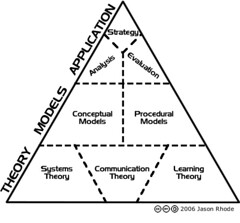
Hierarchy of Instructional Design
Note: The following is an extended abstract for a paper. I was in the process of sending this out to journals when I realized that this needs to be an open document. I have always found the publishing process in education to be somewhat ironic: scholars publish papers on open education in journals that colleges can no longer afford to buy. What is wrong with this picture? If you are interested in MOOCs and Instructional Design, please email me or leave a comment if you would like to collaborate. I will be submitting it to open journals or we may turn it in to an openly licensed book or modular OER.  This feels like it belongs on a wiki. Maybe we should create a MOOC to develop these ideas?

Just as we need a new learning theory to account for new modalities in learning, we also need a new framework for instructional design, a rubric for MOOC development. New modalities of learning, content delivery, and engagement in online, hybrid courses and Massive Open Online Courses (MOOCs) have required new learning theory: Connectivism. Given this new theory, this paper suggests that a new instructional design model is needed as well. According to my reading of Connnectivism, instructional design for MOOCs should:
● Provide for a diversity of opinions
● Allow students to create connections between specialized nodes and learning sources
● Foster their capacity to learn (teach metacognitive learning skills)
● Increase their ability see connections between fields, concepts, and ideas
● Teach students to build networks that will allow students to keep current in their field
● Allow students to choose what to learn and how
Additionally, in a presentation that George Siemens gave on instructional design for the MOOC "Connectivism and Connective Knowledge 2008" he said that learning should be designed for adaptability, for "patterning, wayfinding, and sensemaking" and focus on "content, context, and connections." Siemens says that it is difficult to take all of this and try to build some mechanistic formula for creating learning experiences. This paper will introduce a new rubric of connectivist learning theory as applied to instructional design in order to examine and explain how successful learning takes place in MOOCs.

There are many definitions for “instructional design.” Some definitions are particularly narrow and limit the role as relating learning to technology. For the purposes of this paper, I will use Sheninger’s (2010) which is fairly broad: 
“Instructional Design (ID) is part creative arts and part science which utilizes theoretical as well as practical research in the areas of cognition, educational psychology, information technology, graphic and Web design, and problem solving. ID aims to create the best instructional environment and learning materials to bring a learner from the state of not knowing, not feeling or not being able to accomplish certain tasks to the state of knowing, feeling and being able to accomplish those tasks in a given subject area through carefully organized interactions with information, activities and assessments.” 
MOOCs are a relatively new modality of online learning and the basic research is still in its infancy, but this paper will develop its thesis and argument from research into Connectivist pedagogy, an analysis of the author’s experiences in MOOCs, and interviews with instructors and participants.

The kinds of problems that we can solve with instructional design include student success and retention. Just as some students need help in understanding how online education works (motivation, time management, study skills, etc.), students will also need help in understanding how to successfully take a MOOC. The skills students need to be successful can be built into curriculum. Many of the more successful MOOCs are based in colleges where the students are already successful learners, but this doesn't mean that MOOCs are only appropriate for those colleges.

Another problem is teacher preparation. Just as teachers need to learn how to be successful online teachers, the facilitation skills needed in a MOOC are different. It is a very different, certainly non-hierarchical model. There are ways to structure assignments and activities in a MOOC that will model the skills needed to be successful in a MOOC.

I would like to include a review of the literature of connectivism that compares Connectivism with previous models shows that as the teaching and learning modalities change, so do the theories. Theories such as Constructivism do not fully account for full online courses, hybrid online courses, personal learning networks, or MOOCs. Applying Connectivism to instructional design requires a redefinition of instructional design along the same lines as the changing role of the teacher (Siemens, 2010). The principles of instructional design, which includes a systematic approach to designing course content and learning events, will inform the creation of MOOC development rubric that will be included with this paper.

This project will include definitions of the skills, student success, and include a guide to the connectivist pedagogy for successful online learning and successful participation in a MOOC.

Consider this posting as a preamble. I am especially interested in hearing back from teachers with experience in online education and MOOCs, instructional designers, and other practitioners. 
Enhanced by Zemanta