Showing posts with label semantic. Show all posts

Thursday, February 17, 2011

Watson for $200: What is a semantic wunderkind?

YORKTOWN HEIGHTS, NY - JANUARY 13:  (L-R) Exec...    Getty Images via @daylife
I am only somewhat impressed by Watson but to be fair, Watson is only seven years old.The most interesting thing about it is that it represents some real milestones for the semantic web.I also like that they are running the machine on Linux. Like most young people, Watson only understood questions once they were texted to "him." The newspapers fatuously report that Watson has beat us at our own game and yet humans are the kind of animals that invent games, trivia, and computers - none of which any so-called "artificial intelligence" has even come close to doing. I am not going to knock this achievement. This will be remembered as a historic moment because this is really an advance in our understanding of how to get machines to use "natural language" input and this is really going to help out the semantic web. The processing speed and sorting of data was remarkable.
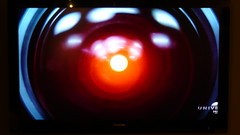
HAL 2001  Game Hint: Let the computer win!According to the article in Wikipedia, Watson is made up of a cluster of ninety IBM Power 750 servers (plus additional I/O, network and cluster controller nodes in 10 racks) with a total of 2880 POWER7 processor cores and 16 Terabytes of RAM. Each Power 750 server uses a 3.5 GHz POWER7 eight core processor, with four threads per core, and yet he still thinks that Toronto is in the United States. I think he is ready for his high school diploma now. As a child of the 60s, Stanley Kubrick has made me suspicious of anything that I think might even be remotely capable of sealing all the doors and sucking all the oxygen out of the room.

According to IBM, "Watson is an application of advanced natural language processing, information retrieval, knowledge representation and reasoning, and machine learning technologies to the field of open domain question answering."

I like the qualification "knowledge representation." I make it a point not to ascribe anthropomorphic qualities to inanimate objects - especially if those qualities include things like "knowledge" when its definition is still being debated and explored by neuroscientists, psychologists, philosophers, and yes, even educators. We certainly do not know enough about intelligence to make any proclamations that Watson is doing anything close to "reasoning" since we are not really sure about what goes into that process (calling it a process is even suspect). But according to David Ferrucci, IBM's lead researcher on Watson "Humans are learning machines that live and experience the world and take in an enormous amount of information — what they see, what they taste, what they feel, and they're taking that in from the day they're born until the day they die," he said. "And they're learning from all the input all the time. We've never even created something that attempts to do that." So you see, according to Ferrucci, that is all there is to it - you take in information (input) and you spit out intelligence (output). I am not going to even address arguments about human psychology, intuition, creativity, inspiration, and emotions. Just looking at this from the "how-does-a-neuron" work kind of level, we are still in our infancy - okay, maybe seven years old. Would you ask a seven year old directions to the airport?

Enhanced by Zemanta

Sunday, January 30, 2011

The Semantic Web and Universal Design

W3c semantic web stackImage via WikipediaI have been looking at PopcornJS this morning. PopcornJS allows programmers to build in triggerable events in the code delivering a video in a webpage. What problems does that solve? One of the things we are wrestling with at the college is accessibility. According to ADA 508, all videos have to be captioned. We have grants for captioning videos. I have always thought that we should be doing more. If we follow the principles of Universal Design, we are not only making media accessible, but we are crafting learning modules and objects for their maximum interactivity and, what I feel is the next step, connectivity. Videos and other learning content represent another opportunity to link students to subject matter experts and other students. We can integrate learning modules with knowledge networks. One avenue of exploration is HTML5 and the semantic web. We can do more than just caption videos - we can take the metadata, the code in that accompanies the video and package it with a transcript of the video to trigger events and things like live links to Twitter, Flickr, Google Maps & Translate, Wikipedia, etc. PopcornJS is the code that will allow us to do this. There is an interesting page and demo on PopcornJS.

This is what the internet should be doing. There are too many tools like this available for us to accept content from publishers that is not accessible. Publishers will often supply textbooks and supplementary content that does not meet ADA guidelines. Educators and instructional designers should be taking the lead in the colleges using techniques like PopcornJS and not waiting for the commercial publishers to catch up. They have no interest in meeting ADA guidelines because they are not the ones that have to deal with the consequences. In my quest to make the internet a happier, shinier place, I am not calling for a boycott of those companies but suggesting a solution. Colleges could pool their resources (programmers, beta-testers, and content creators) to help move this project along much in the same way the Sakai project is supported. The commercial uses for something like PopcornJS are obvious - someone looks up and watches a surfing video in YouTube. The video opens in a page with a map of the area where the video was filmed, a link to the TripAdvisor page on the area, the Twitter feed about the surf from the locals, and of course, more targeted marketing. But imagine taking that page as a teacher or instructional designer and building in other learning modules, maps, translations and connections.

Colleges should be setting the standards for media and the semantic web to, at minimum, ensure accessibility. We should go farther and develop guidelines for content around interactivity and connectivity. The semantic web and projects like PopcornJS represent another opportunity to open up education. What do we call these? Semantic knowledge guidelines?
Enhanced by Zemanta