From the program:
"Milton Chen, Senior Fellow and Executive Director, emeritus at The
George Lucas Educational Foundation. San Francisco Bay Area.
milton.chen@edutopia.org
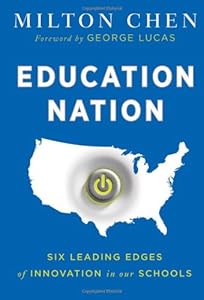
Education Nation: Six Leading Edges of Innovation in Our Schools
School systems are reinventing themselves, focusing on their growing
edges of innovation in districts, states, and nations. These Edges are
redefining the nature of “school” as it was known in the 20th Century
and include
- the Thinking Edge,
- the Curriculum Edge,
- the Technology Edge,
- the Time/Place Edge,
- the Co-Teaching Edge, and
- the Youth Edge.
The Six Edges form the framework of Dr. Chen’s 2010 book, selected as
one of the 10 best books of 2010 by the American School Board Journal.
The Edges address fundamental shifts to our thinking about schooling;
ways in which technology is transforming when, where, and how students
learn; and roles of teachers and students as teachers form teaching
teams with other experts. Students are assuming more responsibility
for their own learning and assembling their learning pathways from an
increasing variety of educational courses and experiences. Dr. Chen
will show examples of these innovative practices from Edutopia.org,
the Lucas Foundation’s multimedia Web site and its archive of
documentaries, available for free download and embedding, with foreign
language captions from Google Translate.
High Tech and High Touch can come together in powerful learning to
'strengthen human connections' and indeed, communities."
Milton Chen was a researcher at the Sesame Workshop [Why are we calling it that instead of the Children's Television Workshop?], an assistant prof
at Stanford school of education, and executive director of Edutopia.
He is interested in project based learning.
He encourages us to write the gov about the 10 billion dollar surplus
to send it to edu.
He recounts his journey to the US from China.
Kids can learn a lot more than we think they can if we give them the
right media. They were told that they could not use television in the
70s for teaching. This is much like what we are going through with
online learning.
He talked about George Lucas' involvement with education. Lucas not a
successful student. He showed the "Academy of Achievement" website.
the site tells the stories of how famous people came to do their work.
Lucas went to community college and got into USC.
*NB - If he is so smart, why does he feel like he has to keep changing
his damn films?!
Chen notes that there were these "lucky accidents" that got Lucas
where he is today.
Chen moved on to the Edutopia and Lucas filming cases of project-based
learning and multimodal teaching and learning. They made the film
"Learn & Live" about children doing research with a "very expensive"
connection to a remote high magnification microscope with video
conferencing. They made a VHS tape and a book. Today we just publish
to the web. A few years later, the NSF funded an online scanning
electron microscope where students can schedule time and view insects
that they have collected and sent in.
He talked about how much money we spend on education and yet we are
static with our education levels.
He asks us to think about using the non-cognitive side of learning
(like meditation) and the emotional side of learning - the 8
intelligences:
verbal, logical, visual, musical, kinesthetic, intrapersonal,
interpersonal, naturalist. We are more than the sum of our SAT scores.
He is excited about the school gardens movement. Alice Waters started
this in Berkeley.
He then discussed his book "Education Nation" which was the best of
the Edutopia website. He wants us to be an "education nation" where
edu is the highest priority. "Education today is the economy
tomorrow."
US educational stats are grim. Other countries have a higher regard
for education. Some have images of people learning.
We have a strong informal education system though. Blending formal
and informal schools through universities, media, museums, companies,
churches, and youth groups.
Most countries have another month of learning - 200 days vs our 180.
The leading edges of innovation: thinking, curriculum, technology,
time/place, co-teaching, and youth.
Innovation is a "must do" not a "nice to have."
Google is 15 yrs old, Youtube is 8 and every minute 100hrs of new
videos are uploaded.
He discussed Clay Shirky's "How social media can make history." We
are in a time where we can not only learn any time and place, but any
path at any pace.
Thinking edge: Growth vs. a fixed mind set. Students and teachers have
to change their beliefs about students being good or bad at subjects.
"You get better at something by doing it." We have new roles for
teachers - this is the end of the solo practitioner and the rise of
the team collaborator. Teachers = mentors, team leaders and students,
team members, scholars. Change the vocabulary.
We then watch "Digital Youth Portrait: Luis." - a high school senior
is involved in media and online culture. He makes films and is
actively engaged in his education via technology. He believes that
this is the modern student. We need more flexibility in learning -
students need choices.
He sees badging systems, alternative, flexible ways of showing what
you know.
Make learning more visible and shareable. Peer-learning is
very important - a powerful teaching tool - collaborative learning.
The Institute of the Future website.
Every technology has a light and dark side. We need digital literacy
and digital citizenship. Tech can be distracting, a medium for
bullying.
He is not concerned with corporate influence in education technology.
But interestingly enough is that exactly what happened in a previous
meeting - we let the corporations drive the discussion on plagiarism
and "cheating."