Showing posts with label American Education. Show all posts

Saturday, December 03, 2011

On Learning Latin

Bust of Emperor Augustus wearing the Corona Ci...Image via WikipediaI once walked into a beginning Latin class at U.C. Berkeley. I hadn't made up my mind whether I was going to take the class or not. Right off the bat, the teacher had us reciting "amo, amas, amat..." - all 40 of us in unison - in other words, it was going to be one of those classes where rote memorization was the key learning method. I raised my hand and asked why we were chanting verbs and declensions and the instructor said that if we didn't do that we would be forever tied to a dictionary. I sat listening to the students and wondered how long students have been attempting to learn Latin this way; probably a couple of centuries, but I have some ideas from my reading over the years that that method is fairly Victorian. The tables of verbs and noun declensions fit the mechanistic age of logarithm tables, early assembly lines, and the industrial mills. I figured out that the teacher thought that we had to know grammar in order for us to read Latin. This is ridiculous, of course, because I was talking and reading simple sentences long before I knew what a coordinating conjunction or a transitive verb was. I got up from the desk, walked out of the classroom, willing to resign myself to the possible fate of being shackled to a dictionary for eternity like some lost Jacob Marley.

Why do we still do "drill and kill"? Some of it is educational hazing: I imagine the instructor thinks "I had to go through this misery and now my students have to as well."  To be fair, that is how the instructors actually learned it. In college, they are not trained in teaching, so they know no other way. Others make the argument that unless a student is thoroughly proficient in the rudiments, they can't master the subject. And that is my objection, what do we really want to teach? Do these teachers want Latin grammarians or readers of Latin literature and history? I had a teacher ask me once (in a blog posting) - "You wouldn't give students a Latin text and ask them to figure out the grammatical rules on their own?" Well, maybe I would.

Even what I consider to be the best texts make the mistake of thinking that students are going to find some kind of clarity around lists of verbs. Wheelock's Latin is a standard text and the thing that actually makes that textbook so useful is all of the examples from actual Latin texts. We used this at Sonoma State in my Latin classes, but the instructor also had us translating texts from day one. My textbook hero is Clyde Pharr - he wrote a textbook on Homeric Greek that has students reading right from Homer within a dozen chapters, and his Vergil's Aeneid has them reading from Vergil even earlier. Either of these texts could be used as primary textbooks. The sick thing is that Pharr did most of his work in the 1920s and many teachers have not figured all of this out yet. Pharr follows the assumption that children learn grammer by using language; they can learn the grammar in context just as they learn to speak grammatically in context. They are not going to use Latin if it is essentially a boring, tedious plow through inane paradigmatic sentences and tables of verbs. They are going to read if the work they are reading is interesting and engaging - Homer and Vergil are certainly that.

If rote memorization is the main teaching method, the teachers will only have students with a high tolerance for the tedious. If you teach students rote memorization, that is all they will be good at. I am sure we want more from our students than being good test-takers! Being able to jump through the hoops is not the same thing as critical thinking.

Notes 12/04/11:
Learning Latin in Context - This project shows the possibilities and importance of learning in context and in a community. (networked learning - or Connectivism).
Enhanced by Zemanta

Thursday, March 10, 2011

Catching Up or Leading the Way

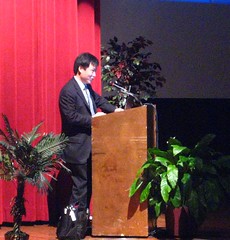
Yong ZhaoImage by David Warlick via FlickrYong Zhao presented on education today in CCC Confer (Elluminate! Live) on Catching Up or Leading the Way: American Education in the Age of Globalization. Yong Zhao is currently Presidential Chair and Associate Dean for Global Education, College of Education at the University of Oregon, where he also serves as the director of the Center for Advanced Technology in Education (CATE). He is a fellow of the International Academy for Education. Zhao has published over 20 books and 100 articles. His most recent book is Catching Up or Leading the Way: American Education in the Age of Globalization and the Handbook of Asian Education. He has also developed computer software, including the award-winning New Chengo/ZON (http://enterzon.com), the world’s first massively multi-player online role-playing game for studying Chinese.

These are my notes from his talk:
Zhao compares Asian and U.S. education. He looks at the phenomena of each culture feeling like they have to catch up with the other. The challenges he says lie in globalization and technology. He said that in the village he grew up in in China, they did not value his ability to ready and write - the village only needed a few people to do that. They really needed someone who was good at "driving water buffaloes."  Globalization in his mind is merely the shortening of distance. He compared Columbus' voyage with current travel; a telegram across the seas used to take 17 hours - "The Death of Distance." What are the implications of the death of distance? The fist challenge is the development of global supply chains. The cost of production becomes cheaper. He used the global supply chain of Dell Computers as an example. Everything now is made in multiple locations. Why are we preparing our students for work that is already being out-sourced? We are producing qualified workers but they cost too much.

All "local" problems are now global - unrest, poverty, climate change, etc. What kinds of skills do we teach that will allow the workers not be obsolete in a few years? Or to address the real problems?

Technology isssues: over 10 million jobs lost due to automation in the last 10 years.

Volcanology Building, part of the science comp...Image via WikipediaWe should not try to be like others. We can't rely on "common standards" - creativity, passion, diversity of talents have always been America's strengths. Since the 60s the U.S. has always been at the bottom of  standardized testings. Yet, we have the most innovative economy in the world. We rely on new talent and new industries. We need more people to come up with new ideas. Have of the jobs in the U.S. will be coming in the creative industries. Move away from standardized testing and curriculum - we need to encourage creativity. We value individual talents in America. We should not be creating workers but entrepreneurs. New jobs in the U.S. came from new industries, not the old ones. We need to teach students to take initiative. Zhao talked about the "bohemian index." We have multiple criteria to judge talent and we celebrate the differences.

1. We need to create an education system that plays to our strengths.
2. We need education to cultivate the entrepreneur spirit which is to:
  • Take risks
  • Emotional intelligence
  • Creativity
3. View others as partners not competition

Student learning outcomes may not be very helpful because they are chasing after certain kinds of knowledge; knowledge should be acquired when someone needs to use the knowledge. We need to promote individual curiosity. He says that he has been reading reports about the death of American education since the 80s and has an interesting and funny blogpost on that topic. He uses words like "inspiration." He talked about the "creativity crisis" as well: we should reward creative thinking, give students opportunities to create, and provide opportunities for creative people to gather.

This talk was a refreshing antidote the standardized testing and STEM-at-all-costs thinking.
Enhanced by Zemanta