How this vision informs instructional design is that we recognize the social dimension of learning and how learning experiences happen in networks. Instructional design and teaching is the facilitation of these networks. The one-way delivery of information is a one sided "conversation" that has some use. I can gather information through reading a book or hearing a lecture, but I learn when I discuss it, through writing, talking, meeting others (in whatever medium) and make connections.
THIS BLOG IS HERE FOR HISTORICAL PURPOSES ONLY - IT IS CONTINUED AT WWW.GEOFFCAIN.COM
Showing posts with label Instructional Design. Show all posts
Wednesday, April 23, 2014
Connectivism - The First 2000 Years
How this vision informs instructional design is that we recognize the social dimension of learning and how learning experiences happen in networks. Instructional design and teaching is the facilitation of these networks. The one-way delivery of information is a one sided "conversation" that has some use. I can gather information through reading a book or hearing a lecture, but I learn when I discuss it, through writing, talking, meeting others (in whatever medium) and make connections.
Wednesday, December 04, 2013
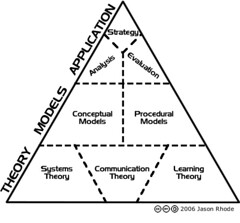
DET/CHE: Cognition, Learning Theory, Backward Design: The importance of instructional design.
![]() |
| Hierarchy of Instructional Design (Photo credit: jrhode) |
Instructional designers take on many roles at campuses. The perspectives of the designers combined with the organizational structure of the campus can greatly impact the results of the instructional design process. This presentation examines the importance of instructional design to the construction of high quality learning environments. Topics to be covered include fundamental principles in cognitive science, learning theories and backward design. Implications for the design of courses which range from technology-enhanced to technology-centric (e.g. fully online courses and MOOC’s) will be presented. Applications of instructional design in strategic planning for learning environments as well as practical considerations for implementation of strategies will be discussed. Advantages and disadvantages of a variety of organizational reporting structures will be explored. Specific ideas participants will take away from the session
• Importance of instructional designers to the development of high quality courses that use educational
technology
• Importance of organizational structure in facilitating instructional design for learning
• Overview of cognitive science that applies to the instructional design process
MOOCs, the model from Thrun,
Its about design, not technology
Design Considerations
Why would online video work?
What do we lose when we record a lecture?
How do we allow for substantive interactions?
He refers to the WASC handbook for interactions online.
What can tech allow us to do that we couldn't do otherwise?
Backward Design
Start with the end in mind - quote from Stephen Covey
Could also be from McTighe
Key elements of ID
What do you want your students to know'
How will you know that students have met the objectives
Interaction
Other considerations
A review of learning theories.
Behaviorism, Constructivism, Constructionism
He claims that drill and practice has its place. [I disagree with
this, I think you can learn the same with contextual learning.]
Social constructivism, situated cognition
Refers to a 1999 paper that applies cognitive science to designing
learning spaces. "Designing Learning: Cognitive science principles for
the innovative organization" Penuel & Roschelle.
What is the role of instructional designers?
CSUSB Online Learning Modules Template
1. Reading
2. Short lecture
3. Discussion
4. Student research
5. Assessment
Where are instructional designers housed in your organization?
Why does it matter?
Access to infrastructure
Access to decision makers
Responsiveness
Agility
Strategic or operational focus
Related articles
- Connectivism Reflection (michjo4.wordpress.com)
- Reflections on Instructional Design and Technology (libraryidt.wordpress.com)
- The ADDIE model of Instructional Design (easygyan.wordpress.com)
- Constructivism and Social Learning Theory (amywilliams5.wordpress.com)
Tuesday, December 03, 2013
DET/CHE: The Art & Science of Education
| Town plan of Imola (Wikipedia) |
I am at the Directors of Education Technology and California Higher Education conference in San Jose this week (DET/CHE). This is my first time here and I am presenting on MOOCs, eLearning, and Instructional Design. I am excited about the location. We are in downtown San Jose which has the Tech Museum right across from the San Jose Museum of Art. Interestingly enough, the Tech Museum is looking more like an art museum (Fritjof Capra spoke there recently on Leonardo Da Vinci) and the art museum is running an exhibit called "The Genius of Everyday Things." And this is how it should be. There is a long history of art and science working and playing together. It is only in the last few centuries when specializations and their theoretical baggage seem to have separated the two in academia. I like the Merriam-Webster definition of Art: "something that is created with imagination and skill and that is beautiful or that expresses important ideas or feelings." That should at least also be the definition of instructional design if not education itself. I have a number of postings to this blog on art because art talks about how we see and experience the world and is about expressing our connection to it. Education is an opportunity to erase those artificial boundaries and to acknowledge that we experience the world with all of our senses and not just the ones for writing papers. Like Art (with a capital "a") education is also an opportunity think about how we see and experience the world and navigating our connections to the people and ideas around us. It is not an accident that George Siemens sees the role of the teacher to be a curator and "sense-maker" rather than a subject matter expert or funnel. (See p.15 of Siemens' "Learning and Knowing in Networks.")
| The Tech Museum of Innovation in downtown San Jose; the white line in the sky is an airliner on approach to San Jose International Airport during the exposure time (Photo credit: Wikipedia) |
Lets tear down those walls. If you are here at this conference, I think it would be worthwhile to take the time to visit the art museum. I would love to see the three organizations (DET/CHE, Tech Museum, and the Art Museum) coordinate a presentation someday!
Related articles
- San Jose Museum of Art (purplehouseblog.wordpress.com)
- Behind the Headline: Art Makes You Smart (educationnext.org)
Friday, July 12, 2013
Mobytes Instructional Design App
| Juniper Hall at Humboldt State University. (Photo credit: Wikipedia) |
- Instructional Design (ID) basics
- Evolution and application
- Learning theory and styles
- Instructional theory
- Getting started with ID
If you are not an Android phone person, much of the information here is available on Madhuri Dubey's blog.
Related articles
- ID Blogs: Find the Best, Ignore the Rest (betterblendedinstruction.wordpress.com)
- Processes, models and learning theories (jcronk11.wordpress.com)
- More articles from this blog on instructional design.
Friday, February 08, 2013
MOOCs and Other Four-Legged Chickens
I have just moved to Humboldt State University. The college is fairly rural but we get a lot of folks from urban areas. I over heard a very interesting conversation between some students in the cafeteria. One of them was freaking out because there was a rat in the garden outside that they could see outside through the window.
She yelled "what is that hopping around?"
One of her friends said "that has to be a bird."
She said "but it has four legs and a tail."
"But chickens have four legs," said the other, "at least, that's what you get in the bucket." They went back and forth. The wood rat hopped away and her three friends went on debating the nature of birds and mammals.
You might wonder how someone could make such a mistake. But imagine if the only time you have ever really thought about chicken was when it was in a soup, a sandwich or already in a bucket. If you order fried chicken, you can get a whole assortment of parts but it would be difficult to piece back together a whole bird.
MOOCs are going through what I am thinking of here as a "four-legged chicken" stage. There are a lot of educational experiences and platforms that are being described as MOOCs: there is the original "Connectivist" or networked based MOOCs, task-based MOOCs, and content-based MOOCs. Some even describe collections of videos as MOOCs. There are many variations. Because the MOOC acronym has the word "class" in it, many educators are expecting to see their own definition of a class which is often a face-to-face class or a "traditional" online class where they have the most control. When the description of the MOOC does not meet the definition of a class, the conclusion is that it will fail as an educational experience. Many of the arguments I have read against MOOCs will latch on to one aspect of the course or only look at one kind of MOOC and then condemn the whole idea. Many of the arguments are re-hashes of arguments against online learning that were already fought and won 15 years ago (i.e. "No Significant Difference," student identity issues, etc.). Online learning was the four-legged chicken of the 90s.
My take on MOOCs is that there needs to be more focus on how they work - this is the instructional design component. On one hand, we are early in the research, but MOOCs have been around since 2008. Most educators are just now hearing about them because, as Stephen Downes has also pointed out, they were only recently picked up by the big name universities which then attracts the attention of the Chronicle of Higher Ed, the Horizon Report, etc.
Recently an instructor created a MOOC that, for a number of reasons, failed. Of course that happened - this is a new teaching and learning environment. We are still learning how all the pieces fit together. Face-to-face and online classes have also failed. There are face-to-face colleges with worse retention and student success rates than some online colleges. This is not the "I told you so moment" that some think it is. I feel very strongly that we can't dismiss MOOCs because, in my experience, some of them work very well (George Siemens, Stephen Downes, and Jim Groom). The current state of the research is thin, we need more data, we need to work out the best practices. And in the end, you cannot assemble a chicken from a bucket of KFC.
Related articles
- MOOCs: Why Do We Need Instructional Design? (cain.blogspot.com)
- Instructional Design and the #MOOC: the danger of not knowing what we don't know (akedtech.com)
- Three Kinds of MOOCs (Lisa's Online Teaching Blog)
- The Mechanical MOOC (Hack Education)
Wednesday, January 16, 2013
MOOCs: Why Do We Need Instructional Design?
Note: The following is an extended abstract for a paper. I was in the process of sending this out to journals when I realized that this needs to be an open document. I have always found the publishing process in education to be somewhat ironic: scholars publish papers on open education in journals that colleges can no longer afford to buy. What is wrong with this picture? If you are interested in MOOCs and Instructional Design, please email me or leave a comment if you would like to collaborate. I will be submitting it to open journals or we may turn it in to an openly licensed book or modular OER. This feels like it belongs on a wiki. Maybe we should create a MOOC to develop these ideas?
Just as we need a new learning theory to account for new modalities in learning, we also need a new framework for instructional design, a rubric for MOOC development. New modalities of learning, content delivery, and engagement in online, hybrid courses and Massive Open Online Courses (MOOCs) have required new learning theory: Connectivism. Given this new theory, this paper suggests that a new instructional design model is needed as well. According to my reading of Connnectivism, instructional design for MOOCs should:
There are many definitions for “instructional design.” Some definitions are particularly narrow and limit the role as relating learning to technology. For the purposes of this paper, I will use Sheninger’s (2010) which is fairly broad:
The kinds of problems that we can solve with instructional design include student success and retention. Just as some students need help in understanding how online education works (motivation, time management, study skills, etc.), students will also need help in understanding how to successfully take a MOOC. The skills students need to be successful can be built into curriculum. Many of the more successful MOOCs are based in colleges where the students are already successful learners, but this doesn't mean that MOOCs are only appropriate for those colleges.
Another problem is teacher preparation. Just as teachers need to learn how to be successful online teachers, the facilitation skills needed in a MOOC are different. It is a very different, certainly non-hierarchical model. There are ways to structure assignments and activities in a MOOC that will model the skills needed to be successful in a MOOC.
I would like to include a review of the literature of connectivism that compares Connectivism with previous models shows that as the teaching and learning modalities change, so do the theories. Theories such as Constructivism do not fully account for full online courses, hybrid online courses, personal learning networks, or MOOCs. Applying Connectivism to instructional design requires a redefinition of instructional design along the same lines as the changing role of the teacher (Siemens, 2010). The principles of instructional design, which includes a systematic approach to designing course content and learning events, will inform the creation of MOOC development rubric that will be included with this paper.
This project will include definitions of the skills, student success, and include a guide to the connectivist pedagogy for successful online learning and successful participation in a MOOC.
Consider this posting as a preamble. I am especially interested in hearing back from teachers with experience in online education and MOOCs, instructional designers, and other practitioners.
Just as we need a new learning theory to account for new modalities in learning, we also need a new framework for instructional design, a rubric for MOOC development. New modalities of learning, content delivery, and engagement in online, hybrid courses and Massive Open Online Courses (MOOCs) have required new learning theory: Connectivism. Given this new theory, this paper suggests that a new instructional design model is needed as well. According to my reading of Connnectivism, instructional design for MOOCs should:
● Provide for a diversity of opinionsAdditionally, in a presentation that George Siemens gave on instructional design for the MOOC "Connectivism and Connective Knowledge 2008" he said that learning should be designed for adaptability, for "patterning, wayfinding, and sensemaking" and focus on "content, context, and connections." Siemens says that it is difficult to take all of this and try to build some mechanistic formula for creating learning experiences. This paper will introduce a new rubric of connectivist learning theory as applied to instructional design in order to examine and explain how successful learning takes place in MOOCs.
● Allow students to create connections between specialized nodes and learning sources
● Foster their capacity to learn (teach metacognitive learning skills)
● Increase their ability see connections between fields, concepts, and ideas
● Teach students to build networks that will allow students to keep current in their field
● Allow students to choose what to learn and how
There are many definitions for “instructional design.” Some definitions are particularly narrow and limit the role as relating learning to technology. For the purposes of this paper, I will use Sheninger’s (2010) which is fairly broad:
“Instructional Design (ID) is part creative arts and part science which utilizes theoretical as well as practical research in the areas of cognition, educational psychology, information technology, graphic and Web design, and problem solving. ID aims to create the best instructional environment and learning materials to bring a learner from the state of not knowing, not feeling or not being able to accomplish certain tasks to the state of knowing, feeling and being able to accomplish those tasks in a given subject area through carefully organized interactions with information, activities and assessments.”MOOCs are a relatively new modality of online learning and the basic research is still in its infancy, but this paper will develop its thesis and argument from research into Connectivist pedagogy, an analysis of the author’s experiences in MOOCs, and interviews with instructors and participants.
The kinds of problems that we can solve with instructional design include student success and retention. Just as some students need help in understanding how online education works (motivation, time management, study skills, etc.), students will also need help in understanding how to successfully take a MOOC. The skills students need to be successful can be built into curriculum. Many of the more successful MOOCs are based in colleges where the students are already successful learners, but this doesn't mean that MOOCs are only appropriate for those colleges.
Another problem is teacher preparation. Just as teachers need to learn how to be successful online teachers, the facilitation skills needed in a MOOC are different. It is a very different, certainly non-hierarchical model. There are ways to structure assignments and activities in a MOOC that will model the skills needed to be successful in a MOOC.
I would like to include a review of the literature of connectivism that compares Connectivism with previous models shows that as the teaching and learning modalities change, so do the theories. Theories such as Constructivism do not fully account for full online courses, hybrid online courses, personal learning networks, or MOOCs. Applying Connectivism to instructional design requires a redefinition of instructional design along the same lines as the changing role of the teacher (Siemens, 2010). The principles of instructional design, which includes a systematic approach to designing course content and learning events, will inform the creation of MOOC development rubric that will be included with this paper.
This project will include definitions of the skills, student success, and include a guide to the connectivist pedagogy for successful online learning and successful participation in a MOOC.
Consider this posting as a preamble. I am especially interested in hearing back from teachers with experience in online education and MOOCs, instructional designers, and other practitioners.
Related articles
- MOOCs and Connectivist Instructional Design (Brainstorm in Progress)
- MOOCs and Pedagogy: Teacher-Centered, Student-Centered, and Hybrids (larrycuban.wordpress.com)
- "MOOCs" for Credit Come to California (hackeducation.com)
- The LMS and the PLE (downes.ca)
Thursday, November 29, 2012
Inclusive Learning Design Handbook
I am reviewing the "Floe" website today. I am particularly interested in their "Inclusive Learning Handbook." What is Floe? According to their website:
Ironically, I find the default font in the handbook almost impossible to read - but fortunately their platform includes an easy preferences button that will allow me to adjust the font, color, and contrast of the text AND it is openly licensed and not behind a pay-wall so I can use what ever font I want to read it.
This is a very important project: it includes content, instructions, and tools for making sustainable, accessible content that will render all of the questions about $ustainability in OERs irrelevant.
"Learners learn best when the experience is personalized to individual needs. OER is an ideal learning environment to meet the diverse needs of learners, including learners with disabilities. The Floe (Flexible Learning for Open Education) Project supports the OER community in providing a sustainable, integrated approach to accessible learning, addressing the needs of learners who currently face barriers."I like this approach because it includes a lot of principles of Universal Design but also addresses other access issues - including cost. Their handbook creates a very innovative context for the creation of OER. It includes not just the content itself but tagging that content with metadata, a profile for learners that the students create for themselves, and the use of open formats. Here are the suggestions for the "Technique" section of the handbook:
- Label resources to indicate what learning needs the resource addresses
- Allow the creation of variations and enhancements
- Support learning profiles
- Support flexible styling
- Support keyboard control of functions and navigation
- Provide audio or text descriptions of non-text information presented in videos, graphics or images
- Provide text captions of information presented in audio format
- Separate text that can be read in the interface from underlying code
- Use open formats wherever possible
"Open formats are typically published freely and don't require software developers or users to pay licensing royalties to use them in a variety of applications. As a result, open formats make it easier for content to be used and exchanged freely within different operating systems, applications, and software tools."This is one of the few platforms that pays attention to the learner - there are tools to help learners assess how they prefer to learn.
Ironically, I find the default font in the handbook almost impossible to read - but fortunately their platform includes an easy preferences button that will allow me to adjust the font, color, and contrast of the text AND it is openly licensed and not behind a pay-wall so I can use what ever font I want to read it.
This is a very important project: it includes content, instructions, and tools for making sustainable, accessible content that will render all of the questions about $ustainability in OERs irrelevant.
Related articles
- Babson Report on OER in US Higher Education (mfeldstein.com)
- OER Minicourse (slideshare.net)
- Fluid Project Wiki - Open Source Design Pattern Library and UI Design Handbook (talentopoly.com)
- WritingCommons.Org and Community-Based OER Models (cain.blogspot.com)
Saturday, October 27, 2012
MOOCs and Connectivist Instructional Design
| George Siemens (Photo credit: heloukee) |
I participated in George Siemen's and Stephen Downe's MOOC, "Connectivism and Connective Knowledge 2008" (CCK08). And unlike other education classes I had taken at the graduate level, this one was taught using the method it was teaching. Each week, there were blogging assignments, discussions in Twitter, Facebook, the discussion forum in Moodle, and even in Second Life. There were weekly guest lecturers as well as presentations by the course facilitators. The real heart of the course was the groups of students who would meet virtually, using the collaborative tools of their own choosing, who would discuss the presentations and readings. These groups were self-organized, leaderless, and informal. Yet, there always seemed to be someone in the group who would carry the discussion back into the course to have questions answered by the facilitators. And the facilitators would sometimes participate in the discussions. This experience was highly interactive. There was interaction with the facilitators, the content and between the students. Interestingly enough, the research shows that interaction is one of the primary measures of success and retention in online classes: the higher the degree and opportunity for interaction, the more successful a course will be. This course completely changed how I think of course design. Giving students the opportunity to apply what they are learning to their learning experience, workplace, and previous knowledge is a powerful experience. This should be at the center of our learning design and course outcomes.
Another experience that I think ties the two course models together was my experience in Jim Groom's DS 106 - a digital storytelling MOOC from Mary Washington University. In this course, there are detailed instructions on how to do each assignment, and more importantly, how to create your own assignments. There is also a degree of networking and collaboration that I don't think has ever been attempted before. Students don't just participate in the network - they literally become the network. Each student is asked to create their own domain on the web. Each one becomes acutely aware of their status as a node in the web. This is the way it should be. Students of digital storytelling should know their media as well as any painter who creates their own materials. Again, the network created in DS106 goes far beyond the idea of a classroom. The twitter hashtag #DS106 basically has a life of its own with past and present students, artists, media professionals, and followers from around the world all participating, collaborating and sharing art, video, and projects.
So given these experiences, what should connectivist instructional design look like? Based on the principles of connectivism, learning should:
- Provide for a diversity of opinions
- Allow students to create connections between specialized nodes and learning sources
- Foster their capacity to learn (teach metacognitive learning skills)
- Increase their ability see connections between fields, concepts, and ideas
- Teach students to build networks that will allow students to keep current in their field
- Allow students to choose what to learn and how
Aditionally, in a presentation that George Siemens gave on instructional design for the MOOC "Connectivism and Connective Knowlege 2008" he said that learning should be designed for adaptability, for "patterning, wayfinding, and sensemaking" and focus on "content, context, and connections." He says that it is difficult to take all of this and try to build some mechanistic formula for creating learning experiences. I agree with that - but this is also a teaching philosophy. The best way to help students get this is to model it in our teaching. This is exactly what MOOCs can do that traditional classes can't. In this blog, I will be collecting assignments and activities that model these principles, that have the connectivist principles built into them.
If you have some that you would like to share, as a student or as a teacher, feel free to add to the comments below.
Related articles
- Why MOOCs Work (cain.blogspot.com)
- Instructional Design in a Connected World (cain.blogspot.com)
- Lessons Learned from a MOOC (etcjournal.com)
- Designing a Learning Design MOOC (downes.ca)
Labels:
#ds106,
CFHE12,
connectivism,
ds106,
education,
George Siemens,
Instructional Design,
Jim Groom,
Massive open online course,
MOOC,
Second Life,
Stephen Downes,
Tacoma Community College,
twitter
Tuesday, July 10, 2012
Why MOOCs Work
| Jim Groom as Edupunk (Photo credit: Wikipedia) |
Now I am going to warn you, I have drunk deeply from the MOOC cool-aid - my experience in Connectivism and Connective Knowledge changed how I work, and how I engage with faculty and students in some very positive, deep, and profound ways. I don't agree with everything that Siemens or Downes has written, they would be the last ones on earth to expect that, but there are no learning theories out there that can contend with, or account for, the rapid changes that are going on in education and technology than Connectivism. Interestingly enough, I think the success of MOOCs counts on an understanding of those principles. George Siemens wrote a great post on those principles in his posting "What is the Theory That Underpins Our MOOCs?"
My staff in the Distance Education department at College of the Redwoods also participated in Jim Groom's DS 106 and this experience is in turn shaping how we do our "DE 101" - our student orientation for distance learning. We are working on cracking that orientation out of the LMS box and turn it into a wider community of learning that we are hoping the students will take far beyond the confines of the orientation - through college and maybe even into their professional lives.
I love George Siemen's article on the theory of MOOCs, but as an instructional designer by trade, I would add these four points:
1. Student MotivationThis is one of the criticisms of MOOCs and the "flipped classroom model": students in those scenarios need motivation to be successful. Students are not born motivated. Lack of student motivation is not an excuse for classes not working. If you are a teacher and your students lack motivation, you need to get into another line of work. Part of what teachers do is inspire and motivate. Many teachers can't help but being motivational because they are enthusiastic about their field. Teachers can provide opportunities for the students to reflect on why they are in the class and be given opportunities to contribute to the class - in my experience, this is often enough to motivate students. I would often get students in my English classes who were used to teachers doing the work for the students. This is not a problem with MOOCs. Students can be taught motivation. As Siemens puts it, we need to foster autonomous, self-regulated learners.
2. Facilitated Connections
True learning occurs when the student chooses the modality in which the learning takes place. In traditional education, that modality is forced (typically, static classroom lecture mode). If the student accepts the choice, he or she is a "good student." What would happen if the learning materials were in different multiple formats; open, accessible and maybe sometimes asynchronous and the students got to choose which version of the material they used and how they engaged with it? Why can't "lecture" also be a video stream, podcast, or recorded event? Then the "live" bit can occur when the students decide to get together and review the materials, discuss them, and then later bring their questions to the facilitator. These reviews can happen in a Moodle discussion forum, Facebook, Twitter, or even in virtual worlds like Second Life.
3. Self-Organization
Teachers need to have faith in the students ability to self-organize - this is how revolutions, religions, and AA meetings work. Humans have evolved to do this very effectively, just ask the wooly mammoth. To this end, students need to be encouraged to use the media with which they communicate as a learning tool. If the students like discussion forums, make that available. If the students are texters or use Facebook, encourage them to take the discussion their. Even if you are not a chronic tweeter, why not have instructions available to students who are? What happened in my Connectivsm and Connective Knowledge class was that discussions took place in a wide variety of fora and then a self- or group appointed "leader" would bring our questions back to the course facilitators for clarification. Often the best thing that the facilitators did was to stand back and let us learn.
4. Content Curation
There was no text book for Connectivism and Connective Knowledge. The course consisted of many of the articles and readings that lead the facilitators to Connectivism, but also the people behind those ideas. What George Siemens and Stephen Downes are really good at is bringing the right people together to talk. They have been exploring these ideas for a while and they were good at breaking down how they arrived at some of their conclusions. Fortunately, the ideas are new enough that the people that helped them out along the way are still with us. So a "lecture" in this course consisted of some weekly readings, a video or two, and a live, weekly presentation by the facilitators or someone like Dave Cormier or another "guest lecturer." These lectures would often start out as a lecture and then evolve into a conversation with the facilitators and students. You would be really surprised at how open people are in your discipline to being a guest in your course via webinar or Skype.
So therefore, getting together with an instructional designer and creating course guides that account for the different media would be really helpful. Fortunately, George Siemens and Peter Tittenberger also thought of that with their "Handbook for Emerging Technologies" which needs to be updated and put back onto a wiki somewhere - maybe at College of the Redwoods or a college near you - so it can be added to and revised.
For Connectivism, the medium is the message - teaching Connectivism any other way than a MOOC is as ridiculous as buying a book about free, open text books from Amazon.Com. I hope that the critics of MOOCs take the time to actually take a course, even as a lurker - they will gain immensely from the experience, and who knows? They might even learn something.
Related articles
Labels:
#ds106,
CCK08,
connectivism,
Dave Cormier,
ds106,
George Siemens,
Instructional Design,
Jim Groom,
Massive open online course,
MOOC,
moocs,
pedagogy,
Siva Vaidhyanathan,
Stephen Downes
Friday, July 29, 2011
OERs: Creating Assignments with Public Domain Documents
Image via WikipediaWhile working on the Kaleidoscope Project (assisting faculty at eight colleges develop courses that implement open education resources or open textbooks), I have run into interesting instructional design challenges with creating assignments using materials that were written a hundred years ago. Typically, instructors will take assignments out of a teacher's edition of a textbook or from supplemental material. When they do that, they often trust that the publisher is aware of the learning outcomes of the course or subject. This is not always a safe assumption to make. We are not limited to using older public domain texts, but there are instructors using them. If one wanted to create an course using openly licensed materials, there are modern textbooks, essays and openly licensed journals that can all serve those purposes. If one wanted to use nothing except materials written in the past four or five years, it could easily be done. Such projects are becoming more and more common. Ironically, there are English textbooks out there that are still using excerpts from Toffler's Future Shock (1972) when discussing technology, so the openly licensed textbooks have opportunities to make vast improvements.But there are cases where instructors want to take advantage of the vast wealth of public domain texts. This seems like a non-issue in most areas of the humanities where we still traffic in Plato, but the question comes up; how do we make it relevant? How do we make it new? The funny thing about that is that students have to do that all the time. They do this whether we want them to or not! One of the ways that we understand a piece of writing or new knowledge, is by applying our previous personal experience, what is happening in the world around us at the time, and combine it with what we have learned before. From this constructivist approach, the teacher's assignment is to give the student
opportunities to apply personal experience and previous knowledge to new information. We can add to that by facilitating the connections the students can make to one another and subject matter experts via twitter and other social networks. But given a public domain text, let's say an essay by psychologist Otto Rank, a teacher could ask the students, based on their personal experience, if Rank's description of interpersonal relationships is valid. What recent news stories seem to support or refute his theory? If the students are reading works by other writers, they can be asked how the theory differs from that author. If they are using a discussion forum (and they should be) then the students have the opportunity to share their experiences and benefit from the experiences and readings of others. They should also be encouraged to follow experts in the field on blogs and twitter and to participate in broader discussions outside of class. In other words, we make sense out of the world through our interactions, and these may be interior or exterior. We are connection-making animals. Learning does not come from a text by itself no more than a textbook is a class.What techniques do you use in your classes to help your students connect to the broader issues? Feel free to email me or use the comment link below.
Related articles
- A Basic Guide to Open Educational Resources (OER) (downes.ca)
- Sir John Daniel of the Commonwealth of Learning: Open Education and Policy (creativecommons.org)
- Open Educational Resources: Share, Remix, Learn #iste11 (speedofcreativity.org)
- 10 Open Education Resources You May Not Know About (But Should) (mindshift.kqed.org)
- Fwd: Academic Developers Sharing Open Resources: CPD4HE Workshop (academic-practice.blogspot.com)
Friday, July 08, 2011
OERs and the Next Stage of Open Textbooks
By rubyblossom. via FlickrThere are some exciting things happening in the world of open education resources and open textbooks. I have worked in the recent past on projects that create or find open education resources, participated in presentations on open textbooks, and this latest project feels like the next step in all of this. I am working as a consultant (instructional design) on the Kaleidoscope Project. The purpose of the project is to create collaborative efforts between colleges to create courses using existing OERs with each course being developed by at least two partner institutions. A number of our College of the Redwoods faculty are participating in this grant. The focus on the grant is not the production of open textbooks or course materials (although that is happening anyway) but on design and results:"Project Kaleidoscope will close the loop on improved course design and student learning. Using OER and a common assessment process will allow faculty teams to improve the course design and learning results based on analysis of embedded assessments and deeper learning results. Actually, the project requires this on-going, iterative review and improvement."
The learning outcomes piece of this is what is going to allow us to track the effectiveness of the materials used. Folks in the OER world have an idea of where this might go, that using open textbooks and learning objects can be just as effective and in many cases, more effective than a commercial textbook. Why? Because learning objectives and outcomes differ from institution to institution based on the needs of the local communities. This is especially true for the community colleges who often have to work on getting students up to speed academically. Faculty already have to adapt and remix commercial texts for the needs of the student populations often in the form of additional, costly supplements or multiple books. What I have been finding in my work with open textbooks is that textbooks are often supplanted (not supplemented) by openly licensed video, audio, images (and yes, open textbooks) making the course even more engaging for the students. When colleges work from the learning objectives and then find openly licensed materials that meet those learning objectives, everyone wins. But we have gone through that phase; it is now time to apply learning analytics to OERs and really show what works, what yet needs to be done, and what is possible.
Partners with the grant include Cerritos College, Chadron State College, College of the Redwoods, Mercy College, Palo Verde College, Santa Ana College, Santiago Canyon College, and Tompkins Cortland College. Advisers to the grant include Norman Bier, the ubiquitous Cable Green, M.S. Vijay Kumar, Terrel Rhodes, and David Wiley. rSmart is supporting the project by hosting the Sakai sites where the courses will live. And Kim Thanos, CCH*, is managing the whole thing on amazingly tight deadlines!
If you are involved in similar research into OERs and learning analytics, I would love to hear about it via email or leave a comment.
Related articles
- 10 Open Education Resources You May Not Know About (But Should) (mindshift.kqed.org)
- Brazil introduces OER into federal legislation and adopts local government policy (creativecommons.org)
- Creative Commons & the Association of Educational Publishers to establish a common learning resources framework (creativecommons.org)
- Should OER favour commercial use? (downes.ca)
*Chief Cat Herder
Wednesday, March 02, 2011
OER Africa: Course Development Handbook
with new staff. I am always on the look-out for possible training materials for new instructional designers or ways to enhance or streamline the course development process. This handbook contains a lot of useful materials and seems to be written with an awareness of what actually happens in online classes. It is light on theory and heavy on the practical. I have been in presentations on instructional design where the why was the focus instead of the what and the how. This inevitably leads to having a teacher stand up and say "Great. How does this actually supposed to work?" This not to say that Panda's book is theory-free somehow - the book models a lot of good theory through its use of concept maps and emphasis on course structure, and his discussion of constructivism. I would like to see more examples of student interaction in the example assignments but again, this is a practical handbook for getting things off the ground.
To think I had to travel all the way to Africa to find a book that was written in our own backyard :-) I am always looking for good instructional design materials. If you have a favorite online, please post a link to it in the comments.
Related articles
- Allison's Space 02/27/2011 (allisonkipta.wordpress.com)
- OER, Toothbrushes, and Value (downes.ca)
- OER for credit for students (mousework.wordpress.com)
- Why instructional designers need to know Adult Development Theories (lynnmunoz.wordpress.com)
Tuesday, February 22, 2011
The Instructional Designer's Toolkit
- facilitate courses through your local community colleges,
- volunteer (or get paid) as a tutor,
- join a literacy project and teach people how to read,
- work as a teaching assistant in your dept.,
- substitute teach,
- facilitate online trainings in a professional organization.
Image by jrhode via FlickrThere are many more such opportunities. The way to make the most of those opportunities is to ask questions, observe, keep a journal on what happens, read the professional literature in tutoring, education, and teaching for your discipline.It is a lot to ask, especially for new graduates. Have of what is worth knowing about teaching and learning comes from program specific classes and the other half through a broad self-education. We need more people from the humanities in instructional design. There are problems that come up in ID that are seemingly insoluble to some yet are obvious to someone reads history or art. There are ideas floating around instructional design that would have little credence with an even casual acquaintance with philosophy or psychology would clear up. One has to ask why ID degrees have so little psychology in them when how we learn seems to be the central issue of the discipline!
What tools do you consider essential for instructional designers? Feel free to add a comment below. I also have a collection of tools that we are playing with here at College of the Redwoods.
Related articles
- Online Learning: Designing for All Users (tc.eserver.org)
- Getting a Masters in Instructional Design (brighthub.com)
- Assistive technology (floreepes.wordpress.com)
- WSU researcher designs multilingual instruction materials for world's largest mall (scienceblog.com)
Monday, December 20, 2010
Instructional Design: Beyond the Formulas
We have an opportunity in course design, to bring all of the stake-holders to the table. Course design should not just be up to a dept. or a single teacher. Course development can be an opportunity to bring in a librarian, someone from student advising, disabled student services and programs, and developmental education. A course design process can show an instructor how to connect their classroom with other students, instructors, and experts in the field. It can be an opportunity to connect students with professional networks as well as other colleges and schools. What I have been finding is that when you bring everyone to the table to talk about a course, you can discover many different ways to connect your course to the community than you would have ever thought of yourself.
I would like to write (or facilitate) a course development guide that will incorporate open education resources and social networks and connectivism. This project will be hosted in Google Docs or on a wiki. If you are interested in participating, leave a comment below and I will include you on the list.
Related articles
- Online Learning: Designing for All Users (tc.eserver.org)
- Curriculum Roles and Responsibilities of Library Media ... (libraryinstruction.com)
- Online Communities for Learning Professionals (c4lpt.co.uk)
- Instructional Design vs. Learning Design and the Future of Educational Technology Tools (greenbananablog.org)
Wednesday, November 03, 2010
An Open Textbook as an Open Community
"Open educational resources (OER) means teaching, learning, and research resources that reside in the public domain or have been released under an intellectual property license that permits their free use or repurposing by others."
and from the original, 2002 UNESCO definition:
"The open provision of educational resources, enabled by information and communication technologies, for consultation, use and adaptation by a community of users for noncommercial purposes."
That is my dream for instructional design - that we are light and adaptable - we can repurpose information according to the diverse needs of students and teachers; that we can adapt to our networks quickly and efficiently because we are not stuck with merely. And from the UNESCO definition that we become a community of users, enabled by information and communication technologies for consultation.
This sounds like a community of users built around a wiki to me. Stay tuned for a different kind of request for articles/chapter/proposal.
Related articles
- Student PIRGs' Nicole Allen: Open Education and Policy (creativecommons.org)
- Summary of OER-related comments on U.S. Department of Education Notice of Proposed Priorities (creativecommons.org)
- Do Open Educational Resources Increase Efficiency? (creativecommons.org)
- Sarah Sather: In The Public Interest : Open Textbooks and the Tech-Friendly Generation (huffingtonpost.com)
Subscribe to:
Posts (Atom)