Showing posts with label Open-Educational-Resource. Show all posts

Thursday, October 27, 2011

Open Ed Conf. Keynotes: Cable Green & Philipp Schmidt

Image representing Creative Commons as depicte...Image via CrunchBaseThe Obviousness of Open Policy


Speakers: Cable Green
The Internet, increasingly affordable computing, open licensing, open access journals and open educational resources provide the foundation for a world in which a quality education can be a basic human right. Yet before we break the "iron triangle" of access, cost and quality with new models, we need to educate policy makers about the obviousness of open policy: public access to publicly funded resources.

Speaker/Artist(s) Info
Director of Global Learning, Creative Commons

Notes:
"If we had a food machine that could feed everyone in the world and the marginal cost is zero, and it won't hurt farmers, should we turn it on?"

His dream - everyone in the world can get the education they desire. If there are is a need to educate 263 million students - we could never build enough traditional schools to educate those who need it.

If we are not sharing, we are not teaching. David Wiley

There is a huge community of open source organizations.

Problem: Most of the policy makers do not understand 20th cent. technology and tools (open licensing, mobile tech, the affordances of the internet). They do not understand the tools collectively - they are able to collectively create OERs.

Rivalrous vs. Non- Rivalalrous resources - NR is digital and open licenses.

Publicly funded resources should be available to the public who paid for them.

If the world spent 5% of the GDP on edu that would equal 3 billion dollars.

How do you sustain OERs? If OER is the default of our normal work, then we do not need to invest new money. The policy is simple to explain: if work is in public domain it goes to the public; if it is licensed, the license should be open.

"We should get what we pay for."
Cooperate & share = we all win
Affordability
Self Interest

If we had open policies what could we do? Billions is given out to ed institutes for research but there are few requirements to share that research with an open license.

English Comp - 55k enrollments x $100 text = 5.5 million dollars a year to the state of Washington. Does this make sense? The open text saves millions. The money comes from fed and state financial aide.
WA will pay 2 mil for an open textbook, spend 100,000 to update it every year and still come out ahead. And then they will openly license it and still offer it for free.

Brazilians have to search for open texts before investing in commercial texts.

Efficient use of public funds to increase student success and access to quality educational materials
Everything else including all existing business models are not sacred.

If we had a food machine, we have a moral obligation to turn them off.

"The opposite of open is not closed; the opposite of open is broken."

The Impossible Open Education Future

Speaker: Philipp Schmidt  (bokap.net)
Executive Director and Co-Founder, Peer 2 Peer University

He is a Shuttleworth Fellow

"The Capetown Declaration twist"

Started Peer-to-Peer University in 2008 - Vijay Kumar said "You are starting from the wrong point - imagine that there was no university - what would it look like?"

They launched the first courses in 2009.

Anyone can join, OER, light interface, badge system. Their site is a light weight connector rather than an LMS. "School of Open" is being cooked up right now.

His frustration: Asking too much and expecting too little at the same time.

  • OER cost savings are a big deal.
  • Open is not a quick fix for all challenges in broken system. 
  • Brihanna needs an affordable student loan (in most places in the world, she would not have to work so hard)
  • Disruption comes from the fringes - make open research institutes 
  • Open education is global - we are not paying attention to what is happening in dev world
  • Open needs to keep the spirit of a lab
  • Open - participation, making, tinkering, experimenting, social, serendipity
Brothers Wright: If we had studied flight we would have never done it because we would have learned that it was impossible. 

Imagine the Impossible Open Education School of the Future
 In P2PU - they tend to use cohorts rather than MOOCs
A strong social bond of cohorts
Great facilitators are hard to scale

Alternatives? A learning expedition - following the markers of others up the side of the mountain. You can hire a guide. There model is "challenges." There is a badge system and a "Request a Mentor" button. There is also a "Become a Mentor" button. 

Learning = making things with others

What makes a good challenge? These can make good portfolio pieces
Goal: enable community to contribute "challenges"
How to: What makes a good challenge?
Testing challenges in other domains

Assessment: Every time you do an assessment apart from the activity you introduce inaccuracies.
Why not use gaming as assessment - assessment needs a "Press R to Try Again."
You fail a test - when you lose a game, you try again.

1st Step - Collect Data
2nd Step -  Showcase and share portfolios
3rd Step -  Listen to the community

"Framework and Design of Social Learning"
Enhanced by Zemanta

Wednesday, October 26, 2011

Open Ed Conference - Keynote speakers Josh Jarrett & Jim Groom

Josh Jarrett at discussing "Access is Not Enough."
Challenges from here to 2020

Warning: raw notes ahead!

Three challenges for the OER community

Four Challenges for the Next decade

  1. Completion 
  2. Quality
  3. Funding
  4. Demographics 

Higher ed tuition has gone up over 400%. There is over a trillion dollars in student loan debt. The "new normal" is students who work and go to school. "Education drives social mobility in the U.S."

Gate's Foundation rewards institutions for success, not just access, accelerate early momentum through restructured dev ed and smoother transitions between HS nad college; unlocks the power of technology for education.

First three accolades,
1. Developing frameworks, rules, and regimes to support OER.
2. Establishing a community of sharing
3. Creating access to rapidly expanding stores of OER

The three OER bugaboos: quality/impact, usage/dist., sustainability

Three Challenges:

1. Evidence: translate OER cost savings into student impact on

  • course completion
  • retention
  • enrollment intensity
  • credential completion rates

2. Content development: design for reuse

  • How much of this content is reuseable?
  • Content has to be modular for reuse.
3. Integration, instrumentation, and distribution
  • How do we create common distribution?
  • We need a comparable OER distribution channel like a publisher.
What would it mean to solve these issues?

"You can't fail placement but placement can fail you!"


Analytics tools improved success in a course by 50%.

Jim Groom - Climbed out of a tent. "We are here today to occupy Open Ed."
Are we talking about open ed resources as a store? or as an on going experience. Ten years ago there was more of a community, outside of sustainability.

Why aren't the open repositories open and accessible?

Michael Branson Smith - his course DS 106. DS106 Radio.

Gardner Campbell wrote a book called "Love Analytics" that informs his presentaion. "The bags of gold" talk.

He doesn't care about the institutions or grants - this should be a grass roots movement.

He ran his DS 106 course as a open course. He ran three sections for credit and then opened it up and had 400 sign up online. DS 106 is not an open education resource, it is an open education experience. He started with 8 assignments but then let the students create assignments. There are 200 assignments now that a student can take.

The course has a student created tutorials, examples, and assignments.

http://bit.ly/radio4life

Twitter was an important component of the course - students hash tag their messages with #ds106

"A community that transcends any technology."

The Summer of Oblivion: a pedagogy of uncertainty
He taught the course as if he had not talked to someone for 20 years. He called himself "Dr. Oblivion."

Why would we waste out time lecturing when there are new media?

"Looking for Whitman" Michael Branson Smith has a class of 80 students are working on DS 106.

"Education is an experience, not a resource."

Enhanced by Zemanta

Tuesday, October 25, 2011

Open Ed Conference: From Shared to Open: The evolution of open education in Washington State

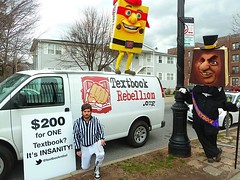
P1030513Image by textbookrebellion Speakers: Tom Caswell  & Connie Broughton

Learn how Washington's colleges went from a few system shared courses in 1997 to developing 81 courses as part of the Open Course Library.

Washington's State Board for Community and Technical Colleges (SBCTC) is currently developing the Open Course Library, an ambitious 2-year project to design open educational resources for 81 high enrolling courses. In 1997 SBCTC began developing a way to share courses with a "pooled enrollments" model. For over a decade, SBCTC's system shared courses have allowed smaller colleges to provide a variety of "long tail" course offerings through a well-organized system of online course sharing. In this presentation we will explain how our system shared courses paved the way to the Open Course Library, providing a culture of sharing as well as the technical framework to allow Washington State's colleges to engage more fully in the Open Education movement.

Notes:
Their strategic plan included shared tools, ANGEL, Tegrity, Collaborate, NW eTutoring Consortium, Professional development, and the open course library.

More information at http://techplan.sbctc.edu

"We will cultivate the culture and practice of using and contributing to open education resources."

Internet + digital content + open license = lower cost, greater access, and greater quality.

Students were averaging $1000 for textbook costs.

WA legislation in SSHB1025 asks that faculty consider the lowest cost options (all things equal) that faculty will adopt open content where possible.

Saylor Foundation adopted their courses that did not use commercial textbooks. They also fixed the broken links and put much of the material into a consistent form.
Enhanced by Zemanta

The Open Course Library: Bridging the gap between the LMS and OCW

Speakers: Tom Caswell & Connie Broughton

We will share the Open Course Library project, including technical & professional development challenges faced as we developed phase 1.

The goal of the Open Course Library is for faculty to design digital, openly licensed materials for 81 high enrolling courses in Washington State community and technical colleges. During the development of the first 42 Open Course Library courses, faculty designed, piloted, and then revised their courses using the our system wide ANGEL LMS. We chose to use ANGEL as our primary development platform for because most of our faculty course designers were already familiar with that LMS. Using ANGEL also made sense because all faculty were required to pilot their OCL course, so initial development, piloting, and revisions could all be made with the same system.

In this presentation we will explain the workflow and roles of the Open Course Library staff. We will share some of the challenges we faced developing OER in an LMS. While new systems such as Canvas are removing many of the technical barriers to open sharing from an LMS, other challenges remain. Considerations for open content sharing include professional development for copyright and Creative Commons licensing, instructional design, and web accessibility.

Notes: 
They had to make the case for open education.
Why is "open" important in education?

  • Efficiency: You can build on content that is already created
  • Affordability
  • Quality: We tend to do our best work when we know our peers can see it.
  • Self-Interest: Increased faculty exposure, reputations, and opportunities
They built 80 top courses and created an open course library all built on open education resources and open textbooks. The state of WA has 75% adjunct teachers in the community and technical college system. This is a quick way for faculty to get course materials together quickly. They didn't slam the door on commercial publishers but limited the textbook costs to $30. This approach is different from an "open courseware site." The open course library workflow is more of a straightline workflow - teachers who built the courses are also the ones who have taught them. 

The courses will be available on Connexioins.

Master & open course materials are linked 
  • Faculty update both together
  • Older versions still available
  • Proprietary content is flagged and hidden from open course
They have a new RFP for an LMS that is requiring an open publishing feature. 

Goals:
  • Design and share 81 high enrollment gatekeeper courses
  • Improve course completion rates
  • Lower textbook costs
  • Provide new resources
  • Fully engage our colleges in the global open educational resources discussion
Phase 1: 42 courses released this Monday
Phase 2: 39 courses available in Spring 2013

"Every faculty member works with an instructional designer and a librarian."

Q1= design, Q2= more design, Q3 Teach pilot course, Q4 review

Process: 81 courses built by our own faculty:
  1. Define learning objectives
  2. Go to OER library for materials
  3. Fill in missing content with created content
How does OER help teach more students and teach them better?
  • No-rivalrous, scalable, searchable
  • Allow for preview
Results?
  • 81 courses with 411,133 enrollments
  • Textbook savings of 41 million a year
  • Completion rates may also increase if students can afford to actually buy the text
Phase 1 Faculty Concerns
  • Many were unfamiliar with the particular LMS
  • No way to compare work between course teams
  • Too many websites to keep in track of
Phase 2
  • Using Google Docs to collaborate and share as we go
  • All project management information in one Google Site
They are also using Tegrity.

More information on http://opencourselibrary.org

Enhanced by Zemanta

Open Ed Conference: Are commercial publishers friend or foe of open education?

OPENImage by matthileo via FlickrSpeakers: Eric Frank and Nicole Allen

Are commercial publishers friend or foe of open education? This session will challenge five common assumptions about the role of commercial publishers in the open education movement. The presenter will share lessons learned from the frontlines of the $8 billion college textbook industry, and demonstrate why profit motives and financial incentives can be critical elements in fostering a healthy open education ecosystem that helps increase the mainstream popularity, usage and long-term financial sustainability of OER.

This session will begin with a brief overview of the disruptive business model of Flat World Knowledge, a commercial publisher of free and open textbooks. The presenter will then challenge five common assumptions about the private sector and open textbooks.

Specifically:

1. Commercial activity is counter to the goals of the open education movement. Widespread use of high-quality OER is a shared goal within the open community. The presenter will discuss how a commercial publisher can play a central role in the creation, distribution and usage of OER that helps move it from the fringes to the center of the national conversation on higher education.

2. If you build open content they will come. While a few open content sites attract thousands of users, most do not. For many faculty, open educational content is regarded as ancillary to their primary textbook. The presenter will walk through the adoption process to illustrate why it takes a publisher with a demonstrated track record in developing and marketing textbooks, along with a significant investment, to compete with the vast commercial catalogs and sales and marketing operations of large academic publishers,

3. The non-commercial clause is not in the spirit of true openness.Copyright holders have different objectives for their creations. While the non-commercial clause isn't suitable for all, for a professional publisher to reach scale and build a sustainable model around open, the non-commercial clause may be not only appropriate, but necessary for long-term survival.

4. There's already more than enough open content out there. Supply, not demand, remains a hurdle for the mainstream adoption of OER. There is a distinction between open content and adoptable open content. The presenter will provide examples of the kind of support and supplemental teaching materials faculty expect from a textbook publisher, and the resources required to change the perception, among many faculty, that free comes at the expense of quality.

5. Authors shouldn't profit from writing openly-licensed textbooks. There are many motivations for writing open textbooks. For academic authors seeking to do the right thing for students and be fairly compensated for their work, the commercial open textbook model makes sense. The presenter will share examples of both first-time and market-leading authors who have embraced the commercial open textbook model as a way to improve textbook affordability and enjoy a more sustainable income stream for years to come.

Notes:
Eric Frank is a founder of Flat World Knowledge and begins with a discussion of what FWK is all about - commercial publication of open texts. They want to create great textbooks, give faculty and students control, give students choices, and ultimately to dramatically lower the cost. They choose authors, the books are professionally developed, and developed a platform for distributing texts. They give electronic access to students for free and charge for POD versions of the book and for learning supplements. He is solving the issues around maintaining the "original" in a sea of derivatives and formats. 44% of the students take advantage of the free versions. The students, according to Frank, are saving about $80 using FWK. Large media companies like Random House are investing in FWK. He is saying that users of Flatworld textbooks are showing increases in course completion and grades. He says that they are not just a repository but that they do a lot of marketing around their books including conferences, direct mail, and review copies. They also provide support for students and teachers. They are 3% of the market share. He talked about the "stages of grief" that publishers and some institutions go through with open software or textbooks.

It is 2:30, where is Nicole Allen!?

Okay, Nicole Allen did not speak here today, quel dommage. I would have liked to see this as a debate.


Enhanced by Zemanta

Open Ed Conference: Towards an aggregated profile of the Global OER and OCW audience

Speakers Mary Lou Forward, Meena Hwang and Una Daly

Developing a profile of our global audience through aggregated surveys of OER and OCW users worldwide.

What are the demographics of those looking of open education resources and open courses? based on their surveys, most of the people visiting http://www.educationportal.com are mostly over 40. They are getting mostly life-long learners. Only a third of the visitors are there to support their studies. The most popular answer to their survey was "to update my job skills."

People were visiting from 57 different countries.

All of this points out the importance of translations.,

Survey data is up at http://www.ocwconsortium.org

There was then examples of a wide variety of users who provided comments about how folks are using OCW.  There are huge communities being built around open content around the world. One site in China that hosts ed videos and a microblogging has 1.4 million followers. One study group has 3000 members.

Una Daly got up to talk about who is using the open repositories.  She discussed the OER advocate training programs, online communities of practice, and adopter communities. She mentioned the grant around adoption of OERs and the Hoopa Tribe Reader.
Enhanced by Zemanta

Open Ed Conference: A Case Study of OER from within the LMS

Steam locomotive 6233 Duchess of Sutherland tenderImage via WikipediaSpeakers: John Rinderle, Bill Jerome
Can we increase OER uptake with seamless LMS integration?: Realizing opportunities for OER discoverability and data exchange in the LMS.

A key factor in OER uptake is the ability of resources to be easily accessed, combined with other course materials, and presented in an appropriate context for learning. For many instructors, the learning management system (LMS) is the information hub of their course. To extend the reach of OER we feel it is critical for resources to be made easily accessible from within the LMS. This need is greater than providing a simple link. From the LMS, OERs should be discoverable to students and instructors who want to use, support a single sign on interface, provide coherent navigation between LMS and OER, and seamlessly exchange key data (e.g. roster, grades, learning analytics).
In this presentation, we will share the Open Learning Initiative's approach to learning management system integration. We will survey current open standards for learning tools with the LMS and discuss our decision to implement Basic LTI (Learning Tools Interoperability). We will share our usability research on the user interface affordances required to drive a productive experience. We will also discuss the technical, user support, process and policy challenges we encountered while bringing OLI to the LMS.

Looking beyond OLI, we will make the case for improved methods and standards for integrating OER with LMS. While today's standards allow learning environment to report simple score outcomes to the LMS, the more robust measures of learning required to drive learning analytics remain locked up in individual tools. The result is that it is difficult to mix resources and achieve a unified view of how learning is progressing and the overall effectiveness of the learning design. We feel this is a missed opportunity. The next generation of standards and LMS systems will need to simplify the discovery and adoption of OER and facilitate finer grained data exchange.

Notes:
They are part of the Open Learning Initiative. They feel that the LMS is all about ease of access. Increasing access to education is part of their core mission. The LMS can make things easier to find. Without standards there are too many platforms to target otherwise. They did a survey and found that the LMS use is more complicated than they thought.  Basic LTI is available in all LMSs. They have a two-click to course content design. They are using Blackboard.

Challenges:
Technology issues
  • Some LMSs need extensions
  • Some implementations are buggy
  • Basic LTI has few required fields
Processes a Policy
  • Security 
  • Audit and control - knowing what tools faculty are using
  • Support - helping instructors
User Experience
  • Using complex systems is difficult for faculty and students
  • Bad experience = unhappy students
  • Roster management - there are two grade books
  • Single sign-on
  • Bookmarking  - basic LTI does not allow it
  • Desktop support
  • Where do users have accounts in OLI or in Blackboard?
Opportunities

Feedback Loops for Learning
Student learning data is at the heart of their solutions - an outcomes centered approach to teaching. They are creating tools for learning analytics. LMS interoperability and learning analytics should be automatic, not an afterthought.

How do we build a better user expereince?
An OER app store?

Pearson is moving in this direction using commercial and open content. 

The use experience needs to be focused on the educators and learners consuming OER.

Questions:
How does OER make greater in-roads to the LMS?
Do you agree with the app store approach?
What should an OER app store offer?
Does the app model extend or replace the content package?
Open and "closed," free and commercial. side by side?

The speaker is wondering why OERs are not moving like Web 2.0 projects - skunk works a project, release the API, then everyone uses it.

Enhanced by Zemanta

Open Ed Conference: "Which License for OER?"

OpenImage by kool_skatkat via FlickrSpeakers: Ahrash Bissell, Gary Lopez, Philipp Schmidt

Tired of the never-ending debate about "Which license for OER?" We agree! Perhaps we should talk about "Which assets" instead.

For too many projects, and for too long, the OER community has grappled with the proper interpretation of open-content licenses, their use, and possible sustainability strategies built around them. The Creative Commons licensing suite has emerged as the global standard for OER licensing, yet it has not lessened, let alone solved, this debate. The problem can be distilled to three key issues: 1) there is more than one CC license, 2) interpretation of some licensing terms (such as the non-commercial term) is subjective, and 3) the license chosen is widely perceived to be a key factor in determining workable sustainability models for OER use and production.

In this session, we will examine each of these issues, paying particular attention to their effects on people's perceptions of OER, the different ways in which licenses are justified and used, and the overall impact on the progress (or lack thereof) of the field.

We will also discuss whether it could be helpful to shift the frame of the debate, from "Which license?" to "Which assets?" In brief, the contention here is that the persistent focus on licensing has stifled the emergence of creative new production, use, and delivery models and reduced the impact of OER accordingly. One option is to embrace hybrid production models, where all "OER" are released with as few restrictions possible (e.g., under CC BY), but not all resources (from a given producer) need be released as OER. We are hoping that the discussion will reveal other options as well.

We are anticipating that we will be able to integrate the insights gained from this discussion into helpful resources for both existing practitioners and newcomers to the OER field.

Notes: There was no presentation here but this was a question and answer session. How do we produce OERs in a way that schools can use them. The speaker claims that copyright issues are not really an issue in the classroom. He is a proponent of the "CC by" license. He discussed the OER decision tree for organizations seeking to be involved in OER production. He thinks that a dual publication model might be a good idea. If you have some materials that are aligned by standards or that they were put together with scaffolded learning in mind. Can we publish a restricted version for the purposes of standards AND then break that up into open modules.

What do you do with faculty who want to release their materials for free but then they get picked up by someone who wants to put a license on it that will allow them to make money?

Two reasons licenses are important is that they can protect the author and to foster more reuse. There is now no "blessed sources" for texts in the open environment. We do not know enough about the sustainability issues around the licenses to know what the effects will be - we need more research.

Jaroslav made the point that BSD used to be an open source operating system that was made commercial. We e need more consensus on licenses.
Enhanced by Zemanta

Open Education Conf. Keynote Speakers Martha Kanter & Jim Shelton

Seal of the United States Department of EducationImage via WikipediaMartha Kanter, Under Secretary of Education, U.S. Dept. of Ed, started off the conference with a keynote address. She is the former chancellor of the De Anza Community College where she was a strong advocate for open education. Kanter and Jim Shelton drafted the educational technology plan. She was appointed by Obama to the dept  of education. She says that we are getting out competed by other countries (we are 16th in the world). She sees open education as a way to make us more competitive. The goal is to get knowledge in the hands of everyone. She discussed some of the research around OERs in k-12. She described some projects in k-12 where the students had access to the learning content 24/7 and not just 40 minutes per class. She hopes that we can become champions for the dept. of ed's research into what is working and why. We will have 10 million students graduating from high school in 2020. We lose a kid every 22 seconds though. If they have open textbooks, we have an opportunity to change the culture of education. China and India are also embracing open universities. She emphasized that there is a role here for businesses as well. She discussed the 440 requirements for someone to become a teacher and she asked us to let her know what kinds of things we can get rid of: regulations and other things that get in the way.  She talked about ENTER, a free online platform for online teaching and learning. She quoted Obama who said he wants to build more online open resources instead of brick & mortar classrooms.

Jim Shelton is the Deputy Secretary for Innovation and Improvement at the U.S. Dept. of Education. He spoke on "Enabling Better 'Teaching and Learning': A Status Check." He says that he role is to create an ecosystem that will let talented people make the changes that need to happen. We are also interested in growing opportunities internationally. He said that this is about teaching and learning, not just "free" - if we do the same thing that we have been doing but just cheaper - then sham on use.

Step 1: Shift the dialog
Make the OER value proposition "better" not just "free."

Step 2: More and Better OER about Creating Effective ER
How people learn
How to
  • Identify and describe what is to be learned
  • Demonstrate what is to be learned
  • Design and implement experiences
  • Optimize and select deliver methods 
  • Maximize motivation and engagement
Best -in-Class Examples

Step 3: Provide better Tools to Reduce Barriers to Quaility

Step 4: Create a Better Context / Align Incentives
Reduce regulatory barriers
make performance matter
Until then make "the science" matter
Ease and inform access

Moving Forward
  • What's missing?
  • What's in the way?
  • Who's steping up?
What is inhibiting the progress?

NB: These are merely my raw notes and impressions for the benefit of our team at College of the Redwoods. Your results may vary and contents may have settled during shipping. 
Enhanced by Zemanta