Showing posts with label Innovation. Show all posts

Tuesday, July 31, 2012

Nine Essential MOOC Links

English: George Siemens at TEDxNYED.
George Siemens at TEDxNYED. (Wikipedia)
A few of us from today's NGLC presentation "MOOCs: open online courses as levers for change in higher education" by George Siemens on MOOCs were passing around a few URLs, and I thought it would be handy to have some of them in one place. This is not meant to be exhaustive but please drop us a note in the comments if you have a link to add.
  • Massive List of MOOC Resources, Lit, and Literati
    This is a great hub of research for MOOCs. Lets get this into a wiki! If you review these links, you still get the impression that MOOCs are completely undefined because it includes discussions of Khan Academy which I would argue does not belong on a page about MOOCs. This page is useful because it speaks to the fact that MOOCs are still in a defining process. 
  • Stephen Downe's MOOC.ca page.
    This has links to relevant articles, resources and a call for curators of MOOC lore.
  • David Cormier's Description of MOOCs 
    An enthusiastic vision of MOOCs. I like this simple "Common Craft" definition of MOOCs. 
  • The MoocGuide Wiki. Stephen Downes' also has a Google Docs version of this.
    This is a useful gude on how to roll your own MOOC. There are 42 members to this wiki so it has a good chance of being a living document.
  • Join a MOOC.
    This site has a listing for MOOCs - something I think we really need. 
  • Alt-Ed
    This site is "is devoted to documenting significant initiatives relating to Massive Open Online Courses (MOOCs), digital badges, and similar alternative educational projects."
  • Howard Rheingold's Interview with George Siemen's on MOOCs
    This is a good introduction to MOOCs
  • Inge DeWardes' 3 part article on setting up a MOOC
    I am interested in MOOCs from the instructional design perspective. I think that there are ways to set MOOCs up so that even the so-called "unmotivated" student or students with little experience with online learning can be successful. That will be part of another post!
The 9th resource is the talk that George gave today. Feel free to comment and add to this - if we get more responses, we will move the conversation to the wiki.

Okay here is a bonus 10th:


Enhanced by Zemanta

Sunday, April 01, 2012

Innovation: Of Tide Mills and TED Talks

Tide mills, along with riverine ship mills, we...Tide mills, along with riverine ship mills, were a major early medieval technological advance, allowing to tap the tidal power along the Atlantic Coast for milling. (Photo credit: Wikipedia)Watching TED Talks this morning made me think about how different the cultures of innovation are now and a thousand years ago. The TED Talks tend to promote the myth of the lone, gifted super genius entrepreneur. Nothing particularly wrong about that but it is a cultural construct and myth that rarely acknowledges the past work of others, graduate students, adjuncts, the labor or the laborers, the dead ends that others went down so you didn't have to, and positions of privilege.  I would like to see a "TED Talk" of a 6th Century Irish monk from the west coast of Ireland to talk about alternative sustainable energy and if they did that, we would notice a lot of really familiar ideas and "innovations" such as tide mills.

Tidal mills were used since Roman times for grinding mills for cereals (wheat flour) and salt. They have existed for centuries (possibly millennia in some places) along the European Atlantic coast (Ireland, Holland, Britain, Belgium, France, Portugal and Spain), located mainly in pipes, canals and rivers, where the potential energy of the tides was maximal, which allowed them to run for about six hours by flood-tide cycle. They basically existed where ever the Romans built roads. And they were also picked up later by the  monasteries who were often headed up by missionaries from Rome.

I don't know if our star monk could bring in a Powerpoint presentation - maybe he could tell the highlights of the story in stained glass or in an illustrated parchment. But notice that we don't have a record of that particular monk. We don't because they tended not to see themselves as tenure track wunderkind but as a part of a community and, for good or ill, part of the "Great Chain of Being." I think if your innovations survive a thousand years, you should at least get rewarded with a sabbatical or something. We know of very few Roman or monastic innovators by their names. There was learning, apprenticeship, and mastery but it was for a community and tended to not be for any one person's particular gain. No one copyrighted or patented the aqueduct. These were truly, in the best sense of the word, civic works.

The TED Talk I listened to this morning was with David Sadoway who is developing liquid metal batteries. I loved that he gave a shout out to Volta, and his graduate students and assistants - that happens rarely in these talks, mostly because they are so pressed for time and they have to get the ideas out there in that small amount of time.

Which brings me to my next point about cultures of innovation: I love hearing that the Chinese can't innovate: they invented the compass, gunpowder, paper, and the printing press to go with it. What they don't have is a culture of mentorship, entrepreneurship, and creativity that David Sadoway talks about. When they get that, Silicon Valley will seem like a pretty quaint little place.


Enhanced by Zemanta

Saturday, January 22, 2011

OER, Open Textbooks, and Innovation

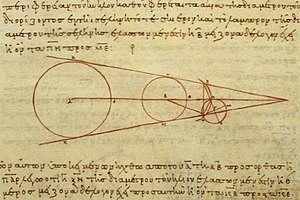
Aristarchus's 3rd century BC calculations on t...Image via WikipediaIn a recent blog posting from Cable Green, he posted a note on the new grant from the Dept. of Labor which is requiring an open license on all materials built for the grant, which means that the author is attributed but the work is open for others to copy, adapt and distribute. This is "in order to further the goal of career training and education and to encourage innovation..."

 "Innovation" is a fairly recent word. The Oxford has it back to only 1553 in English; "the alteration of what is established by the introduction of new elements or forms." It is from the Latin "innovare" meaning "to change" or "renew." It doesn't, interestingly enough, imply inventing things out of thin air. It was not always the compliment that it is today. Overly ambitious people, it was thought, were the kind who introduced novelties. As the progression of change in world culture heats up exponentially, we recognize the differences between useful innovation and the mere novelties even if it takes a generation or two.

How does innovation happen? There are a number of theories out there - one that has been popular for a few millenium is the idea of the "Lone Genius." Before the 1780s or so it was based on the idea that an authority, that is "The Authority," often divinely inspired, would spontaneously have a really great idea (consider here of Aristarchus or Leonardo). In the Romantic Era, the "lone genius" was inspired and often slightly insane. He had to be a tortured outsider, (e.g. Coleridge or Frankenstein). But there are a lot of ideas that unfold out of a community. I tend to think that a culture of innovation arises out of necessity (the village needs more food) and then someone looks at other problems the village has (seasonal flooding) and then has an intuitive leap that brings the two problems together into a solution (irrigation). What is the difference between that village and the village that failed? Maybe it is because there are also cultures of dormancy - where folks try to innovate using the same paradigms and tools as they have always used but try to apply them to a radically new problem. Sometimes that is okay for quite a long while. We are basically sending satellites into orbit with 18th century physics. It is working so why not? It will continue to work until we are faced with a larger problem that requires a very accurate definition of gravity.

So what does this have to do with Open Education Resources and open textbooks? One way of looking at the problem of open textbooks is to look at technologies, formats (open and proprietary), and distribution systems.  This is the old way. This is textbook authoring as a product. Products require support from corporations, distributors, editors, vettors, etc. In other words it is centered on the object rather than the act. Where is the innovation? The innovation in all of this is quietly going on around us in colleges like College of the Redwoods where the Math dept. saw the problem of Math textbooks and brought existing technologies together into their community (their department). The innovation is coming from places like Wikieducator where the tools are being created not just to create textbooks, but to facilitate the community needed for the real innovations to come.

At College of the Redwoods, the instructors knew that there was no textbook currently out there that would serve the specific needs of their students: those needs are not just financial although Humboldt County is in pretty dire straights much like the rest of California. Those needs are also the preparedness of the students based on what is happening in the local high schools, and the needs of local business and industry. There is no one but the department that could ultimately vet a textbook to meet those problems other than the community that is experiencing them.

It is my sincere hope that the direction that the OER community is going is not to figure out how to continue to traditionally silo knowledge and information but to inspire the creativity and facilitate the community-building necessary to solve one of the most important problems of our time: access to education. We need more research on how to facilitate open textbook creation on college campuses. There are successful models out there. Lets find out how they work.

I am interested in your feedback on what you think helps create a culture of innovation on campuses today or give us some of your favorite examples of grassroots learning and home-rolled open education resources.


Related articles
Enhanced by Zemanta