Showing posts with label Massive open online course. Show all posts

Monday, April 28, 2014

Why Connectivism is a Learning Theory

Domains of major fields of physics
Domains of major fields of physics (Photo credit: Wikipedia)
David Wiley recently made a comment on his blog, in response to a very succinct posting by Stephen Downes, that the learning theory Connectivism, though he is sympathetic to it, was incomplete. I am not sure what to make of that. I understand David's point that terms need to be carefully defined. A solid theory needs operationally defined key terms. But I am not sure that Connectivism is really incomplete. There are a lot of great theories out there that work well and are very useful but are not "complete" in every sense. Einstein thought that his theories of relativity would lead to a Universal Field theory and because his work does not account sufficiently for quantum mechanics, in that sense his theory is incomplete. But it is still quite useful and irreplaceable in many fields of study and in practical application.

When Einstein first published his theory it had to go through years of refinement and testing. That is the process. There are still things being worked out with Darwin's Theory of Evolution but the days of wondering if it is valid are long behind us. It has been proven, observed, and tested. There are still evolutionary mechanisms to be worked out and the history of evolution will take more field work.

Looking at the history of theories, I am beginning to think that the discipline a given theory arises from is often the one least capable of evaluating it. But that is where all of the experimental and observational evidence is going to come from. Most of the criticisms I have read of Connectivism boil down to the new theory is not like the old theories. A theory is meant to provide a conceptual framework for viewing and understanding phenomena. As an instructional designer, I have a purely practical approach. I am only interested in a theory's usefulness, but for me, a theory must
  • account for current theories (either through refutation or inclusion)? A theory shouldn't just account for a given phenomena, it should do so in some measurably better way (more complete, elegant, etc.).
  • sufficiently explain where we are now.
  • make predictions. Any theory that can't predict anything is basically a conjecture at best.
  • be subject to testing. Here I would emphasize that the theory should change what we do based on experiment and empirical data.  
In my experience, Connectivism has met those four conditions. Those shouldn't be the only ones but as an instructional designer, the theory accounts for current issues in my work in ways that other theories do not. 
Stephen Downes speaking at D2L09.One of the problems of learning theory is that it is usually an interpretation of learning based on a psychological school of thought, sociology, or philosophy. It would be difficult for learning theory not to come from those disciplines, but learning theory seems to get stuck because while the derivative disciplines may have moved on, the learning theory often does not because educators are not participating or doing research in the parent disciplines.

New theories come about when the current theories no longer account for new information or phenomena. This is what made Connectivism particularly important to my work. The theory was created by Stephen Downed and George Siemens (Connectivism: a learning theory for the digital age) at the same time that networks and social media were impacting education in some profound ways. Some of the phenomena that Connectivism accounts for are phenomena that many educators fight against: online classes, social media,  MOOCs, student-driven learning, etc. Connectivism for these instructors will never be a valid theory because they will never be comfortable with some of the implications of the theory: it would represent a profound change in their world view that they are not ready to accept. Connectivism is a learning theory because it accounts for the changes we are seeing in our society and in education in ways that the older theories cannot. Even social constructivists have a hard time wrapping their minds around social networks.

With that said, I am no ideologue either. I have my own bones to pick with Connectivism. It is still unclear to me how learning "may reside in a non-human appliance." It should either be the case or not. My definition of learning requires someone to actually do the learning. I see non-human appliances storing information, processing information, even mimicking pattern-making (chess computers). I don't understand how learning resides there. That is my "why a duck?" moment with the theory. It also feels like a left over principle from another theory that is not necessary for Connectivism to be a strong theory on its own.

But Connectivism is not just an explanatory or descriptive theory. As an instructional designer, I can use it to help analyze the success and failure of a particular course. So how would I test it? There are a number of ways. First, we build a course design rubric based on the tenets of Connectivism, and compare the success and retention rates, and course satisfaction (for students and teachers). Second, we repeat the experiment, and share the finding so others can reproduce the results.

The jury is still out for Connectivism. This is as it should be! The jury should always be out for all theories if we are going to engage in the scientific method and reason together. 
Enhanced by Zemanta

Tuesday, February 11, 2014

When is a MOOC not a MOOC?

Statue of John Harvard, founder of Harvard Uni...
Statue of John Harvard Wikipedia
The Comical of Higher Ed has a headline that says "Harvard U. Will Offer Exclusive MOOCs to Alumni." After reading the article, the reader learns that what they are doing is giving alumni access to segments of courses and course content. The alumni are not taking a class. If it is not "massive," if it is not "open," and it is not a "class," it is not a MOOC! It is just the "online" part - it is an "O" not a MOOC.

I need to put together a collection of articles that maps out how the CHE has gotten MOOCs completely wrong, and thereby polluting the discourse around MOOCs with misinformation, exaggerations and over-simplifications. It is a huge disservice to the academic community. They seem to have attempted to help by writing up an article about George Siemens.

There are a number of great discussions going on around universities, journals, and the web about what MOOCs are and their possibilities (especially cMOOCs). It is a shame that the CHE misses the boat so often. 
Enhanced by Zemanta

Tuesday, January 14, 2014

#Rhizome14: Community as Curriculum

English: Bamboo with rhizome Français : Pousse...
This is my introductory post. I am participating in a MOOC facilitated by Dave Cormier called "Rhizomatic Learning - The Community is the Curriculum." Dave's 2008 article "Rhizomatic Education: Community as Curriculum" has informed many of my education projects since including courses, student orientations, professional development, as well as my own teaching which has included English and Health Information Management. Back in 2008, I participated in an early MOOC, Connectivism and Connective Knowlege '08, and Dave's article was an essential node. You will notice that on the side-bar of this blog (if you scroll down) you will find the resources for my presentations on the "Connectivist Classroom" and that article is always there. It is also on my reading lists for new instructional designers. I am participating in this MOOC for a number of reasons but one of them is that I am in the middle of developing an online orientation to online learning called "eLearning 101" that I want to run as a MOOC.

I think it is important to practice what you preach and to give back to your community. I have been to too many workshops on "active learning" that were one-way dumps of information. We need to model and practice. I feel as an educator, I want to help shape this new knowledge landscape. That is the difficulty of this kind of education. I can't get a certification and then shift into neutral! Degrees or past accomplishments don't mean anything in this environment - you have to participate.

Another reason to participate is that the tools, methods, and people in online collaborative education are always changing. It is important to stay connected!

Related articles:
Enhanced by Zemanta

Thursday, January 02, 2014

eLearning 101: Presentation from DET/CHE

I went to the DET/CHE conference in November and I had a presentation that I was going to give. What happened at the conference was interesting. After listening to other presentations and listening to the concerns, fears, and needs of other presenters, I wrote a brief "prelude" as a response. I also added more notes in the notes field. I am glad I had the opportunity to do this. Presentation from DET/CHE conference:


I was really impressed that the educators I met at the DET/CHE conference. I have received a lot of offers for help, advice, and some constructive criticism around our ideas about an orientation MOOC. I will definitely put the next DET/CHE on my calendar!

Enhanced by Zemanta

Wednesday, December 04, 2013

DET/CHE: Cognition, Learning Theory, Backward Design: The importance of instructional design.

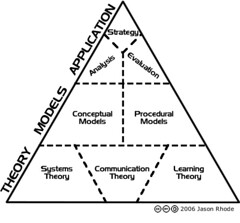
Hierarchy of Instructional Design
Hierarchy of Instructional Design (Photo credit: jrhode)
Jim Monaghan, AVP Academic Technologies/Associate Professor, Educational Technology, CSUSB

Instructional designers take on many roles at campuses. The perspectives of the designers combined with the organizational structure of the campus can greatly impact the results of the instructional design process. This presentation examines the importance of instructional design to the construction of high quality learning environments. Topics to be covered include fundamental principles in cognitive science, learning theories and backward design. Implications for the design of courses which range from technology-enhanced to technology-centric (e.g. fully online courses and MOOC’s) will be presented. Applications of instructional design in strategic planning for learning environments as well as practical considerations for implementation of strategies will be discussed. Advantages and disadvantages of a variety of organizational reporting structures will be explored. Specific ideas participants will take away from the session

• Importance of instructional designers to the development of high quality courses that use educational
technology
• Importance of organizational structure in facilitating instructional design for learning
• Overview of cognitive science that applies to the instructional design process

MOOCs, the model from Thrun,

Its about design, not technology

Design Considerations
Why would online video work?
What do we lose when we record a lecture?
How do we allow for substantive interactions?

He refers to the WASC handbook for interactions online.

What can tech allow us to do that we couldn't do otherwise?

Backward Design
Start with the end in mind - quote from Stephen Covey
Could also be from McTighe

Key elements of ID

What do you want your students to know'
How will you know that students have met the objectives
Interaction
Other considerations

A review of learning theories.
Behaviorism, Constructivism, Constructionism

He claims that drill and practice has its place. [I disagree with
this, I think you can learn the same with contextual learning.]

Social constructivism, situated cognition

Refers to a 1999 paper that applies cognitive science to designing
learning spaces. "Designing Learning: Cognitive science principles for
the innovative organization" Penuel & Roschelle.

What is the role of instructional designers?

CSUSB Online Learning Modules Template

1. Reading
2. Short lecture
3. Discussion
4. Student research
5. Assessment

Where are instructional designers housed in your organization?
Why does it matter?

Access to infrastructure
Access to decision makers
Responsiveness
Agility
Strategic or operational focus
Enhanced by Zemanta

DET/CHE: Teaching in the Digital Age

Azusa Pacific University
Azusa Pacific University (Photo credit: Wikipedia)
Mike Truong, Founding Executive Director, Office of Innovative Teaching and Technology, Azusa Pacific University
 
The demands faculty teaching in the digital age face are immense rom keeping distracted students engaged (high touch) to keeping current on the latest technologies (high tech).
This presentation will provide some proven strategies on helping faculty meet these challenges.
Specific ideas participants will take away from the session
...
•  Articulate the challenges of teaching in the digital age.
•  Explain how technology can meet some of these challenges.
•  Emplo best- practices for teaching with technology.

Where as other voices are overly critical of MOOCs or on the other extreme overly Utopian, Mike says he is in the middle, looking at technology pedagogically.

He gave an extensive quote from Hamlet's Blackberry.
We need space between our tasks to reflect.

He then talked about the "really cool" Domino's pizza app. "It is
amazing what you can do with ordering pizza now a days."

He is excited about the apps that allow you to buy glasses and take a
picture of a paycheck and electronically deposit it.

You can buy a house online - you can buy a house without even looking  at it.

"We are immensely better because of technology."

We can learn any time, place, and device.

Students are demanding that faculty use more and more tech in the classroom.

Pedagogy - gains, losses, and implications

The essay is a good model for learning critical thinking  - but it is too alphabetic-centric. Word processing helps us but it promotes linear thinking.

Technology - Jose Bowen - technology maximizes teachers face-to-face contact with students. Henry Jenkins says that technology encourages participation. Sugata Mitra - technology self-educates.

He makes the claim that "the internet harms our ability to engage with difficult text and complex ideas" a quote from Nicholas Carr. Clifford Nass says that "Media multitasking impairs our focus, productivity, and creativity." We are losing the ability to focus on one task at a time. He gives the argument of Sherry Turkle's Connected Alone.

He comes back to Wiliam Powers Hamlet's Blackberry.

He then talked about the story in Wired "Minimally invasive learning." - the issue that has "The Next Steve Jobs" on the cover.

Technology's proper role is to supplement the learning.
Enhanced by Zemanta

Tuesday, November 26, 2013

eLearning 101: An Open Class for New Online Learners

Humboldt State University
Humboldt State University (Wikipedia)
Our new class is slowly taking shape. The course will be based on our old DE 101 (Distance Ed 101) which in turn was based on HIM 100 (a Health Information Management class where we introduced students to networked learning). It is also based on my experiences with CCK08 (the Connectivism and Connective Knowledge course facilitated by George Siemens and Stephen Downes) and DS 106 (Jim Groom's project-based digital storytelling class), both of which I think represent the best of the MOOC idea. I was calling our course a MOOC but I am absolutely disgusted with some of the online classes that are going under that name right now - I would not want to give my faculty the idea that we were following a model that didn't build in student support, or value engagement and interaction, and valued venture capital over learning. I believe that we can create an open course that uses the best of these classes, uses actual research into the needs of our students, and then help students learn to be independent, life-long learners, with a dynamic learning community that they can take with them through college and into their professional lives.

The structure of our course owes a lot to the excellent work of Humboldt State Universities instructional designers, like Riley Quarles who has developed the structure of the blogs for our Child Development program. Dan Fiore, another instructional designer I am working with, is putting together Wordpress and an open badge system.

The students for this course are new to online learning, but of the 1600 students who responded to our survey, 95% use Facebook. At the typical university that hosts MOOCs, there is a higher level of motivation and skill sets (Stanford for instance). What we know about this population is that we need to have modules on things like time management, online communication skills, motivation, study skills, and how to create a personal learning network. One of the key purposes of the course is to help the students figure out how to form online learning communities for academic and professional support. We do have a module called "LMS" (learning management system) and that is specific to our campus' installation of Moodle - other campuses could insert their LMS of choice there.

The MOOCs that I have participated in were made up mostly of grad students and education professionals. My work has mostly been in community colleges and state colleges, so the tools and skills we are teaching are different.

Where we are now:

1. We are using Wordpress. There will be a main course blog that will link all the topics of the course (which may be on pages or separate blogs). The facilitators will have blogs as will the students. The students will choose or create an assignment on the topic and post to their blog. This feed will be aggregated on the topic blogs.

2. We are using open badges. I know that motivation is an issue in online classes in our university system, and all the research I have read says that badges are one of the ways to address that issue. Plus, I want the students to have a

3. We are gathering data. We have sent out a survey to our students to see how they are accessing the web, where they are accessing it, and what tools they are already using. The course is based on previous courses and orientations I have created but each is different according to the needs of the student population. For instance, at Tacoma Community College, we had more students involved in virtual worlds like Ever Quest and Second Life. Humboldt State only had 6% of the respondents in online games.

4. Updating course materials. The course materials are from previous courses and orientations. All of the modules will be openly licensed with a CC-NC-SA license.

5. Getting out to the learning communities and asking people to help get out and push. I went to the Open Ed 13 conference to learn more about open badges and to meet more people who are teaching in MOOCs. I will be presenting on this at the DET/CHE conference in San Jose next week.

The illustration below is s rough sketch that is evolving - this is not meant to be a traditional hierarchical course but student driven: the student chooses which modules are important, the student chooses the assignments from the module (or creates one) and gets together online with students to complete the work.


I would love to talk to anyone who is working on a similar project. Feel free to email me or leave a comment. I will also post updates and my presentation here as things take shape. 
Enhanced by Zemanta

Thursday, November 07, 2013

Assessment and Accreditation of Learners using OER

Photo of Athabasca University
Photo of Athabasca University (Photo credit: Wikipedia)
Rory McGreal of Athabasca University presents on assessment of OER and OER University.

"This paper examines existing and potential scalable approaches to formal assessment and accreditation to digital learning, comparing and contrasting such uses with more traditional approaches. Unbundling of services, so that assessment & accreditation are separate from teaching and support, makes OER much easier to implement and build upon. There is little requirement for physical space, so it can grow in a similar fashion as that of many Internet platforms. This of course makes OER much more scalable than physical institutions can compete with. While international or even national accreditation & assessment services are not currently widespread or easily accessible, developing a robust system that can service thousands or even hundreds of thousands of students could change the dynamic of access to post-secondary education. All of the technology is already available, such as payment systems, content management systems, and exam taking.

Lessons learned so far from key initiatives in this area are discussed, proposing tentative guidance for policy makers and various stakeholder groups in this area.
Currently, the greatest potential and demand for OER:
  • is in non-OECD countries;
  • at non-traditional institutions;
  • at institutions with PLAR models in place.
Breaking down institutional silos is still a major issue before a large-scale OER/PLAR/RPL system is in place. In terms of cost-effective and sustainable approaches to student support, peer-to-peer learning support models were considered to be the most effective, followed by support from retired academics or other volunteers, and the design of system to enable senior students or graduates to provide support for junior students.

As for the types of assessment methods that would most likely be used in the future recognition of prior learning via portfolio assessment and course-based portfolios were both considered appropriate, as well as automated online assessments.

The greatest barriers to participation in open assessment and accreditation practices identified were the lack of availability of committed staff members to support such activities, and the potential costs of redeveloping courses as open educational resources. Lack of support for OER-based courses from senior management was a significantly greater concern for participants from traditional education institutions than for those from institutions with open policies, and was perceived to be a more significant barrier within public than private institutions. These findings suggest that institutions that already have policies that support open assessment and accreditation practices will be able to easily align the implementation of collaborative OER courses with existing policies and processes.

The key institutional success factors for the provision of open assessment and accreditation services appear to be a strong support base within institutions ? both in terms of leadership and resources, and an existing culture of openness, including policies and practices around the creation and use of OERs, as well as policies that enable either open access or recognition of prior learning via credit transfer or PLAR. Institutions that are already characterized by these features are likely to be best placed for the implementation of assessment and accreditation of OER-based learning, and could provide models for other organizations"

Creating an OER University with 30 partnering colleges. 

Coursera owns what is in your head - you cannot use what you learned in Coursera to get accreditation elsewhere. Up until Coursera, we always owned what was in our heads.

OERU will give recognition for prior learning and challenge for credit.

They also do credit transfer. North America uses the three credit system. They use the bologna Process in Europe. It is problematic in most jurisdictions. Standards are lacking and the process is labor intensive.

Barriers
Fear of change - the only ones not afraid of change are wet babies
Fear of losing students and therefore teaching jobs
Copyright issues
Concerns over work load 
Conflicts with commercial publishers and SIGs
Lack of committed faculty

The Paris Declaration on OERs has helped in Canada. The US has been leading in open research.

There is too much duplication in the OER movement. Stop talking about developing courses, start talking about reusing and adapting. 

Educators are afraid of the cost but the cost to continue as we are is more expensive.

OER Benefits
A culture of openness

We need to find ways to accredit OER learners and not leave it to the status quo.

Athabasca University had to create a "bear and cougar awareness" class because they needed it. 

Enhanced by Zemanta

Wednesday, November 06, 2013

Open Ed 13: Emancipating Learning: a Journey to MOOCs and Beyond

"Some may think that Massive Open Online Courses (MOOCs) are a fad, but they are raising some interesting questions about the scalability, accessibility and quality of online learning, as well as new thoughts about the higher education landscape. While a number of institutions have started to offer MOOCs, many are still wondering if and how to participate, as well as how these learning experiences relate to other online teaching and learning plans.

Are your institutional leaders tasking you what finding out more and determining what they should do about MOOCs? Are you wondering if and how you should get started? Are you curious about what it is like to develop and facilitate a MOOC and if it's worth the effort? Whether you?ve run a MOOC or are considering running one, this participants on the panel will provide the perspective and journey of three institutions which have run one more MOOCs: Cuyahoga Community College; State University of New York; and University of Illinois Springfield; on their MOOC journey. They will share insights, best practices, pitfalls and research results.

- Cuyahoga Community College (Tri-C) recently became the first community college in the nation to launch a MOOC -- free online classes to help students of all ages, including high school students preparing for college readiness, middle-aged workers returning to college to prepare for a new career and to middle-school students working ahead at Pre-Algebra pass developmental math, also known as remedial math, before they enter college. This course was developed using an innovative design to improve student engagement. The MOOC leverages game mechanics to motivate students? progress through the course. Sandy Moses and Sasha Thackaberry will provide highlights of the design, development and delivery process, along with results of their data analysis into course activity and student performance.

- State University of New York (SUNY) is hosting an open community course on Open Educational Resources and members of the team who designed the course will discuss the collaborative project. The team includes SUNY faculty, librarians, and instructional designers from several campuses who worked on the creation of an open course on OER designed for SUNY faculty and staff. The project has been designed to build critical thinking skills needed for creating, selecting, and evaluating open educational resources in the context of the online environment

- University of Illinois Springfield held a MOOC entitled "The Emancipation Proclamation: What Came Before, How It Worked, and What Followed" in early 2013. This was the second MOOC offered by UIS, following the eduMOOC of Fall 2011. Ray Schroeder, Michele Gribbins, Carrie Levin and Emily Boles will share their experiences and lessons learned in developing and delivering the MOOCs. Discussions will range from the effectiveness of technologies and activities used in the two MOOCs to insights from students regarding their motivation for participating in the MOOCs."

Sasha Thackaberry: Their MOOC is an xMOOC. They are using Mozilla Open Badges and game mechanics - a low-risk failure factor - the students can take and retake tests.  MOOC data: 1372 enrolled, 809 participated, 147 successfully completed. Students had to complete a survey in order to get to the content. The survey gathered demographics and learning history.

Michelle Gribbens: Their second MOOC- it is on the Emancipation Proclamation. All of their problems were overcome by using Coursesites. I am interested in the Terms of Service from Blackboard which typically licenses all content. They used a lot of the Blaclboard tools in their courses. The MOOC was 8 weeks but she thinks that a 6 week MOOC would have been better. Most of the participants were over 50. sites.google.com/sites/openedmooc

opensuny.coursesites.com is an online course with a badge system.
Enhanced by Zemanta

Open Ed 13: OERs Rule, MOOCs Drool: MOOCs and DistRibuted Open Online Learning

English: Blended learning methodology graphic
Michael Caulfield discussed how MOOCs are being used. 

"The "wrapped MOOC" has gained attention over the past year as a way to integrate MOOCs into traditional education. This presentation will present results of interviews with practitioners of this method to show that in practice most educators are not "wrapping" the cohort experience, but are instead using the MOOC as robust OER. This trend is discussed in terms of "distributed flip" and "distributed blend" models, as well as David Wiley's joking but correct observation that MOOCs are distraction from the potential of DROOL (DistRibuted Open Online Learning). Implications include a hidden but high demand for robust, course-level OER, and the possible desirability of approaching blended learning from the online experience "backwards", as opposed to the traditional model which emphasizes the online refitting of an existing or assumed face-to-face experience."

Caulfield is from WSU Vancouver
Twitter @holden
Web; http://hapgood.us/

 Examples of courseware evolution
Publisher resources, OLI (Carnegie Mellon, Stanford)
AASCU
Kaleidoscope Project

There is a history behind MOOCs - it is a progression over time.

What do MOOCs provide above and beyond what blended learning provides?
It is the global community of students going through the work at the same time.
The mythology of the xMOOC is the affordances such as 24/7 peer assistance

What does use of MOOCs for blended look like?
Amy Collier and Helen Chen held wide-ranging interviews with students and teachers.
Not Synched
They found that the local cohort was not linked to the online cohort.
They were using the MOOC purely as a digital resource.
This was because of the differences between course and institutional schedules - professors needed more flexibility in scheduling.
It is difficult for instructors to not fall behind.
Not Conversing
Students were not really using the forums of the MOOC at all.
The students looked at the forums occasionally and only sometimes posted. These students were meeting face-to-face
[It sounds like the learning was not social or truly interactive. and why would you do something that were not assessed?]
Unaffiliated students who watched 75% of the videos viewed the forums 

Implications: do MOOCs Made Good Flip Materials
xMOOCs global classroom is not useful for blended learning - the students do not use the forums
The design of the course is mostly influenced by the global cohort
Problems
  Data not available
  Can't change schedule

Coursera is now working on decentralization.

Most instructors had gone through the MOOC before teaching it. That was a transformative experience for the teachers. 

Summary
Courseware is a big part of the future of education
A growing number of options exist for materials
When used in flips, MOOCs often function primarily as content
MOOCs can be used, but think carefully about benefits and downsides of centralization

A community college teacher expressed concern over xMOOC content as content divorced from the local context. I feel the same way about most commercial textbooks. 
Enhanced by Zemanta

Open Ed 13: George Siemens

English: George Siemens at TEDxNYED.
"George Siemens is a Professor at the Center for Distance Education and a researcher and strategist with the Technology Enhanced Knowledge Research Institute (TEKRI) at Athabasca University in Alberta, Canada. He is the author of the Connectivism theory of learning and co-creator of the first MOOC in 2008."

MOOCs: How did we get here?

A different view than Andrew Ng's corporate model.

 A bit of history
George began blogging and following Todd, Downes, etc. He was able to talk with innovative people outside of the institution. Most systems think that content is the start of the learning and his idea was that content was the by-product. We don't need content, we need good questions and community. Open learning was learning not owned by a system but created by people.

He described Wiley's Wiki Design - everything in a course is run in the open. He talked about the history of open learning through Connectivism and Connective Knowledge through Jim Groom's DS 106.

An alternative to institutional controlled tech, monolothic self/contained/ locked-in platforms, transmission pedagogies.

Knowledge is iterative and communal. So many people are involved in th production of knowledge that is hard to call it "owned."

He brought up the MOOC map and showed how MOOCs have "vomited" over the world. It is no longer an academic practice but a corporate enterprise.

MOOCs are not really new - distributed learning has a long history. People have been thinking about this for a long time. It is a mistake to disregard that history

Why MOOCs now?
It is a supply-side answer to decasdes fo change in demand-side learning.
Student profiles are changing - older students, more females, China and India are changing the profiles.

What is happening in MOOC research?
http://www.moocresearch.com
There are a lot hyped statements like "there will only be 10 universities in the future." Universities will increase in number because the students will be doubling in the next ten years. With the Gates Foundation grants - where were the researchers coming from? Most of the research is coming from th Education field and not just Computer Science.

Problems with MOOCs
MOOCs do not prepare a student to create, generate, solve and innovate. We need stuff that stirs the soul. They need to respond to society.

Openness is being lost in the conversation. The hype is driving the trends. Coursera does not care about openness.

What happened with MIT wanting to provide all course materials are open and now they are with EdX who wants to copyright everything.

Lack of innovation.

Dropout rates are totally irrelevant.  We are missing out on an opportunity for real research.

MOOC providers are disconnected from the research in education.
They need to look at social and generative education models - they exclude them because their technology does not do that well.

We are norming from Coursera and edX and they are concerned with revenue models.

We need to refocus on creativity and knowledge generation. MOOCs are just part of the landscape of the current state of education.

A MOOC is a web, not a website. It is a network.

A Domain of One's Own - reclaim the web. gather t artifacts of your digital identy in a central place that you won and control.

Don't just hate MOOCs, but look for another
Enhanced by Zemanta

Friday, September 13, 2013

MOOCs and Student Support

English: Internet Penetration (% Population). ...
Internet Penetration (% Population). Red
indicates no statistics available. (Wikipedia)
I read an article this week that I found via Stephen Downe's blog that is from the eLearning Africa News Portal called "The Underlying Inequality of MOOCs" by Alicia Mitchell. The main issue that Mitchell has with MOOCs is an old argument against all online education: the "digital divide." Unlike the education writers of the 1990s, she looks at the issues of poverty and connectivity and says that we have to be mindful that not everyone has access or the same means and skills that those of us in more privileged parts of the world may have. I do not argue that there is not a digital divide, I just don't think stopping online learning is a great solution to that problem. She does not make the leap that many have in the past with a "therefore," online learning is not viable or should be curtailed etc. I actually agree with her and my "therefore" is that, broadly, we need to continue to work for economic justice and universal education.  Africa is a hot bed of online learning, open education resources, and innovation specifically because of the problems discussed in her article. And my more focused "therefore" is say this is exactly why we need a MOOC to help students "learn how to learn." That is what we were getting at when we created "DE 101" - an free, two-week, fully online orientation to online learning. That was in a "traditional" online course format. The one I am working on here at Humboldt State University will be a MOOC called "eLearning 101."

In another look back to the 90s, I am really concerned about so-called "MOOCs" that are massive, not particularly open, online courses that are based on a one-way distribution of information and then tests. This is a huge step backwards. Especially when there are such better models out there such as Stephen Downe's and George Siemens' Connnectivism and Connective Knowledge MOOC or Jim Groom's project-based DS 106. There are all of these great models out there (often called "cMOOCs") but the ones that get all the attention are the ones supported by the Ivy Leagues and a lot of grant money. The entire MOOC phenomena is being judged by players like Sebastian Thrun who just figured out that online students need student advisors, mentoring, and tutors. These are things that many people have been writing about and more importantly doing for years now. In the article "Udacity CEO Says 'Magic Formula' is Emerging," David Carr reports:

Thrun's magic formula is not a fully automated online class featuring prerecorded videos and Web-based assessments. In other words, it's not a MOOC at all. To get better results, he said, "We changed the equation and put people on the ground." By adding mentors and a help line, and making phone calls to remind students to do their work, Udacity found it could get more students to do the work, finish the course and pass. Longer term, he has some ideas about using adaptive learning software to eliminate some of this labor, but for now it takes manpower.

The press, publications like the Chronicle of Higher Ed and Information Week are now defining MOOCs by such phrases as "a fully automated online class featuring prerecorded videos and Web-based assessments." This is not innovation, at least, not innovation in education. It may be an innovation in platform building, fund raising, or grant writing, but it is not an innovation in education. Real online courses and truly massive, open, online courses are engaging, interactive, and focus on building learning communities and networks. There is a rich body of literature and research that discusses the importance of student advising and support. If it has taken this long for Udacity to figure out what we all learned about online education in the 90s, I don't think I will live long enough to see them figure out the importance of learning communities and PLNs.

But it is not enough just to be against something. I am going to keep using the term MOOC even though the term is missapplied by the press and highly funded institutions and businesses. We need to keep building instances of MOOCs that counter the prevailing notions. I will be posting updates here as I continue to work on the eLearning 101 MOOC.
Enhanced by Zemanta

Tuesday, July 23, 2013

Four Steps to Getting MOOCs Right

Betonwerksteinskulptur "Lehrer-Student&qu...
"Lehrer-Student" von Reinhard Schmidt
in Rostock (Photo credit: Wikipedia)
I love alarming education headlines - five MOOC classes are put on hold and the San Francisco Chronicle says "San Jose suspends online courses." Which it didn't - it suspended five MOOC courses because of a high student failure rate. San Jose's online college is still going forward. And they are right to suspend the classes. I just wish more work went into how those courses were put together (if only for the sake of the students). These classes are not so far out on the cutting edge that one couldn't predict that there would be problems. The MOOCs at San Jose are nothing new - even the failure rate is nothing new. All of the research into how to make online classes successful, including MOOCs is already in place. Educators have been researching successful online programs since the 90s. There are very clear reasons why the best online programs succeed. My own work in community colleges in closing the student success and retention rates between online and face-to-face classes dealt with similar issues. What we learned about online classes, big and small, was that they will not succeed for any population, at-risk or otherwise without these four things in place:

  1. Interactivity and Engagement - There is a direct correlation in the research between online interactivity and student success rates. Interactivity means "meaningful, purposeful, engagement" not just clicking on the play button. Interactivity means teacher-student, student-student, and student-content. And yes, there are ways to do this successfully in a MOOC (step 1, hire an instructional designer!). There needs to be more emphasis in MOOCs on collaborative projects and less"watch a video, take a test." This distinction is easily made when you look at connectivist cMOOCs versus xMOOCs. 
  2. Student Support - If your face-to-face students can't be successful without tutors, academic advisors, a help desk, and librarians, why would you expect your online students to be successful without them? There are tutoring services on your campus and great peer-to-peer tutoring resources online such as OpenStudy. 
  3. Student Orientation - Students have spent 12 years learning how to be a face-to-face student and 0 years learning how to be an online student. This is an easy fix. We did it in the community colleges with courses like "DE 101." Things that make students successful in online classes include time management, study skills, motivation, and other metacognitive skills that can be taught. Online learning is not just about technology.
  4. Faculty Training - The same magic that makes someone a teacher instantly when they get their master's degree does not work online. Just as students need to learn the skills to be an online student, teachers need to learn the skills to facilitate online teaching. Recording your lecture and posting it online will not work. There are a lot of resources, classes, and research online on this subject. 
So interestingly enough, there are no real differences in how classes online or off are successful! I have been in online classes, including MOOCs that had all of this in place: the assignments were designed to be collaborative and engaging, there were links to student support, there was sufficient information to tell students how to take the class, and the instructors were skilled online facilitators, curators, and guides. A college does not have to ignore 20 years of research into online learning to be innovative.
Enhanced by Zemanta

Friday, June 14, 2013

MOOCs: Disruption is the Mother of Invention

Stephen Downes speaking at D2L09.
Stephen Downes
There is an article in the Boston Review by Thomas Leddy called "Are MOOCs Good for Students?" In this article Leddy claims that
"MOOCs pose a great threat to the most important value of higher education: 'literacy.' By 'literacy' I mean, very broadly, the ability to read, think about, and intelligently respond (both orally and in writing) to the literature of any field of study. Thus, implementation of MOOCs for university credit is bad because it is bad for our students."
Leddy says this because he seems to be familiar with only one kind of MOOC - those of the MIT and Stanford model. Not all MOOCs are alike, yet despite the fact that he has had the traditional education that would allow him to read, think about, and intelligently respond to any field of study, that does not seem to extend to education itself. I am not sure what publications like the Boston Review or the Chronicle of Higher Ed is up to, but the majority of articles about MOOCs in such publications are typically written by those who have never taught online, taught a MOOC, or even taken a MOOC. They are written by people who have not even reviewed the history or literature (however scant) on MOOCs.

I hate to tell Leddy this, but literacies are changing. I do a lot of writing, but my work depends more on my ability to collaborate with others and the creation of intelligent networks than my ability to write a ten page paper.

Leddy is very concerned with the massive (not "massively" by the way) courses that use multiple choice tests and paints all MOOCs with the same brush. I have taken three MOOCs and in not one did I take a multiple choice test. The MOOCs were assessed with what I would consider portfolio assessment. I could not have finished any of the MOOCs without reading, thinking, and intelligently responding to my peers.

English: George Siemens at TEDxNYED.
George Siemens
MOOCs didn;t just come out of nowhere to just to knock traditional teachers out of their chairs; they came from very thoughtful teachers who said "what if we did for teaching what open education resources was doing for content?" There were problems that needed to be addressed in education that traditional educators have no interest or stake in solving. MOOCs (massive open online courses) are not the disruption. The disruption came when the traditional schools decided that money was more important than access. The disruption happened when educators decided that they were fine with keeping education as an exclusive privilege of the few. The real disruption was the fact that the cost of education rose faster than the cost of living and the cost of healthcare combined.

We need to keep making the distinction between cMOOCs and xMOOCs - cMOOCs "Connectivist MOOCs" are actually community-driven models where the students create knowledge and learning together. This knowledge creation can be facilitated but it is not dependent on a "teacher." The teacher becomes the facilitator and curator of the learning experience. In a cMOOC the connections students make with one another are just as important, if not more important, than any other kind of interaction in the course.

xMOOCs are getting all of the press because their model more closely fits, for good or ill, the model of education most familiar for traditional academics: sage on the stage, education as information transmission, knowledge as consumable, students as commodity, etc. xMOOCs are not true MOOCs: they often massive online but they are seldom "open" and depending on what you call a "course" they may not be that either. A true MOOC should be free. There is still a lot of hand wringing about money and tuition in some of these models that falls under the "sustainability" issue. I would even question if some of these are actually "courses" in the sense that we mean them in the world of online education. As a Director of Academic Technology, I would not sign off on a course that had no student-student or teacher-student engagement. I would call it a correspondence course, a learning experience, but not a true online learning experience. In contrast, cMOOCs depend on the interaction of the students for their success.

MOOCs are going through the difficult stages of innovation that open education resources and open textbooks have and are still going through. Free, openly licensed (non commercial) textbooks are a great idea - monetizing that is a horrible, counter-intuitive, counter-productive idea. "Lower cost" is not the same as free. Open for business is not what the "open" in OER, open textbooks, of MOOC is supposed to mean.

MOOCs can work. There are ways to design MOOCs to maximize student interactivity and engagement. In the related articles below, I have included some postings I wrote on MOOCs and instructional design and give some of my history with successful MOOCs.  MOOCs are not going away and just like any other learning platform (including face-to-face) there are good and bad ways to use it. We need to research MOOCs thoroughly with an open mind to discover why the successful ones are successful and address potential problems.

I would encourage Leddy and anyone else who is interested in MOOCs to explore the work of David Wiley, George Siemens, Stephen Downes, David Cormier, and Jim Groom before coming to any conclusions. You might just learn something. 
Enhanced by Zemanta

Wednesday, April 17, 2013

MOOCs, Group Work, and Instructional Design

English: Debate Chamber of the Oxford Union So...
Debate Chamber of the Oxford Union Society (Wikipedia)
Everything Old is New Again
In my last post I pointed out that all the arguments about MOOCs sound so much like the old arguments against online education in the 90s. One of the main arguments for authentic online learning in the 90s was the possibility of making online classes social environments. This fit well with the pedagogy of Constructivism. Constructivism says that knowledge is constructed when new information comes into contact with previous knowledge and evaluated against experience. Social Constructivism is an outgrowth of Constructivism that "extends constructivism into social settings, wherein groups construct knowledge for one another, collaboratively creating a small culture of shared artifacts with shared meanings" (Moodle). The instructors goal then was to facilitate these connections. In the 90s, this learning theory seemed to fit what was happening with effective teaching online. The goal of online assignments was to give students the opportunity to receive new information, hold it up to previous knowledge and experience, share that with a group, and then together, coming to new conclusions or new knowledge. Educators and researchers like Palloff and Pratt with their emphasis on learning communities, promoted group work and discussion forums as the solution to the badly performing classes that were basically online repositories of documents and maybe multimedia files. Over and over again, from the early days of online learning, the research shows that the greater the engagement in an online class, the higher the success and retention rates. Engagement does not mean clicking a link, widget or consuming media - it means actual interaction with students and instructors as well as content.

English: George Siemens at TEDxNYED.
George Siemens
Everything New is Old Again
Today, we have learning theories that are evolving towards a more complete accounting of how we learn online. I am thinking here of George Siemens and Stephen Downes' theory of Connectivism. I am not ready to throw out the Constructivist baby with the pedagogical bath because Connectivism is still in the Copernicus vs. Relativity explanation for gravity stage - I believe logically and experientially that the theory is right, but I am not ready to use it to put a satellite in orbit. This doesn't make the theory wrong. We need to be doing more research; it is just a matter of time. For myself, I am satisfied that this new theory accounts for much of what is going on with Constructivism. I am going to let the Phd's battle out the details: instructional designers have courses to create, assignments to design, and faculty to work with. A good working theory is a good working theory. A lot of what we are doing with online classes and MOOCs is testing the viability of Connectivism.

What Then Should We Do?
So this preamble is really a way to point out that everything that makes authentic learning work in a brick-and-mortar classroom are the same things that make online learning work. And as a teacher and instructional designer, I have a really practical end in mind. To my way of thinking, there is no difference between an online discussion forum and the Debate Chamber of the Oxford Union Society except one is more expensive and acoustically louder than the other. They are just different platforms. A MOOC is just another platform. George Siemens wrote back in March that MOOC providers were going to have to rely more on group work to be successful. I find this sentence especially funny and pertinent here: "The 'new pedagogical models' (A Silicon Valley term meaning: we didn’t read the literature and still don’t realize that these findings are two, three, or more decades old)...." But what kind of group work should we use and how can we ensure that it is successful? Siemens points out that there is a high dropout rate in MOOCs that could make group work a problem, but I believe that group work is one of the engagement pieces that is missing from many of these MOOCs (especially those using content delivery model rather than the content creation model).

Ensuring the Success of Group Work
Faculty and students have often told me about problems with group work. What do you do about the alpha student who needs to be the leader and do all the work? How should instructors handle the student who has little motivation? I have a blog post coming about this but essentially there are eight things needed for a successful group work project:
  1. Clear objectives
    Students need to know the exact purpose of the assignment. Let the students know where they are going.
  2. Detailed instructions
    This is particularly important in a MOOC because students tend to have less contact with the instructor. A detailed instruction document accompanied with a video and some examples are very useful here.
  3. Give each student a specific role
    This prevents one person from taking over the process and helps with assessment too.
  4. Communicate expectations in advance
  5. Use collaborative tools
    Model the means for useful collaboration. Give students instructions for setting up a wiki or a Google site for collaborating
  6. Facilitate and model leadershipSometimes good leadership is not getting in the way of good work. Leadership in MOOCs means that you live the model: you are connected and engaged in your course. You cannot disappear for two weeks and expect this to work. 
  7. Encourage networks
    Having the students using social media tools allows them to bring other subject matter experts into the project.
  8. Provide assessment and closure
    You would not want to participate in a MOOC with an endless series of unconnected assignments with no sense of closure. Assessment in group work gets interesting. I liked to use a blank form for the students to divide up participation points.
I will be posting a short article on how these components work here on this blog.

Kinds of Assignments:
The ubiquity of internet access and the proliferation of collaborative tools and platforms makes collaborative learning more available than it has ever been. This allows us to design a wide variety of assignments that are ideal for MOOCs or standard online classes. These are just a few ideas here:
  1. Group Research Project
    Group research projects are opportunities for students to get together and literally construct knowledge. Having students work on a research project and publish their results together on a wiki or a group blog benefits the students and the class. 
  2. Group PresentationsStudents can work on presentations with one another remotely and create slide presentations with audio or even a film and work on the 
  3. Media Projects
    Students learn a lot from content creation. Jim Groom's DS 106, a class that some would call a "task based MOOC" is an excellent example of students working together to create media. Students can create videos or podcasts. When they graduate from college, no one is going to ask them to write a 20 page paper; they will be asked to work in groups, use technology, and create media.
  4. Debates
    One of our instructional designers here at Humboldt State University is using online debates in discussion forums.The debates are carefully structured and each participant has a role. This kind of prior attention to details is essential to online group work.
  5. Role Playing and Simulations Role playing and simulations have never been easier because there is so much data online now that can be used to build simulations (I am thinking here of epidemiological data, for instance). 
  6. Concept MapsTypically these are solitary projects but having a group negotiate what should be in a concept map and how concepts relate to one another are a good way to allow the students to clarify those concepts with and for one another rather than having the instructor spoon-feed "meaning" to them.
  7. Infographics This is a good project for groups because the roles can cover a wide-variety of learning modalities and abilities: some students can gather data, others develop art work, and others can write interpretive materials.
Any of these assignments can be created in advance and given to small groups. The students benefit not just from following the steps of the projects, but through sharing the end results with other groups. 

Enhanced by Zemanta