Showing posts with label art. Show all posts

Tuesday, December 03, 2013

DET/CHE: The Art & Science of Education

Town plan of Imola
Town plan of Imola (Wikipedia)

I am at the Directors of Education Technology and California Higher Education conference in San Jose this week (DET/CHE). This is my first time here and I am presenting on MOOCs, eLearning, and Instructional Design. I am excited about the location. We are in downtown San Jose which has the Tech Museum right across from the San Jose Museum of Art. Interestingly enough, the Tech Museum is looking more like an art museum (Fritjof Capra spoke there recently on Leonardo Da Vinci) and the art museum is running an exhibit called "The Genius of Everyday Things." And this is how it should be. There is a long history of art and science working and playing together. It is only in the last few centuries when specializations and their theoretical baggage seem to have separated the two in academia. I like the Merriam-Webster definition of Art: "something that is created with imagination and skill and that is beautiful or that expresses important ideas or feelings." That should at least also be the definition of instructional design if not education itself. I have a number of postings to this blog on art because art talks about how we see and experience the world and is about expressing our connection to it. Education is an opportunity to erase those artificial boundaries and to acknowledge that we experience the world with all of our senses and not just the ones for writing papers. Like Art (with a capital "a") education is also an opportunity think about how we see and experience the world and navigating our connections to the people and ideas around us. It is not an accident that George Siemens sees the role of the teacher to be a curator and "sense-maker" rather than a subject matter expert or funnel. (See p.15 of Siemens' "Learning and Knowing in Networks.")

The Tech Museum of Innovation in downtown San ...
The Tech Museum of Innovation in downtown San Jose; the white line in the sky is an airliner on approach to San Jose International Airport during the exposure time (Photo credit: Wikipedia)
The Tech Museum is running a program on the movie Star Wars which really has nothing to do with actual technology. It has everything to do with how artists imagine technology. And if Star Wars was not a great story, no one would care. You would never see a tech museum do a presentation on "Plan 9 from Outer Space." It was the art of Star Wars that fired the imagination.

Lets tear down those walls. If you are here at this conference, I think it would be worthwhile to take the time to visit the art museum. I would love to see the three organizations (DET/CHE, Tech Museum, and the Art Museum) coordinate a presentation someday!
Enhanced by Zemanta

Wednesday, May 16, 2012

Art and Technology in Amsterdam

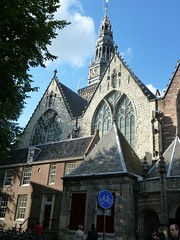
Oud Kirk (old church)
Oud Kirk (Photo credit: bolinhanyc)
I am in Amsterdam this week. I am here mostly for the art but also to see the places where the art was created. One of the reasons why I am here is that I read a book a while back called "The Art of Describing" by Svetlana Alpers. She writes about Italian painting being from a "textual" culture and Dutch painting coming from a visual culture. Italian painting is emblematic and can be read - knowledge in Dutch painting is visually recorded. It makes sense that the rise of the science of optics in the Northern Renaissance also parallels this new way of expressing their experience of the world. She also writes about the influence of maps on painting. The optics allows artists to see the world with a new, "scientific" accuracy. It allows us to measure the world in new ways. Some of these new technologies include lenses, telescopes, microscopes, and the camera obscura.

In contrast to this culture, I keep reading on writer's blogs (ironically enough) that in order to be an artist or writer in our culture we have to avoid distractions and stay off the internet. I am glad that the Dutch artists didn't think that they had to "unplug" in order to create art. Vermeer and Rembrandt were just as much businessmen in the hubbub of everyday life as they were artists. They worked and played with the technology of the day and were not afraid to let it inform their work.

I am a little unplugged this trip, not by choice but because the international data charges for Verizon are insanely expensive, and I am a fourth-floor walk-up, shared bath kind of traveler. Also, Google thought that I was Dutch for the last four days and translated my accounts into Dutch. I had to use Google Translate to use my email. Sometimes our technology is just too smart for its own good. Things are back to "normal."
Enhanced by Zemanta

Tuesday, June 28, 2011

Cave of Forgotten Dreams

Director Werner Herzog at a press conference i...Image via WikipediaI know this is not a movie review blog, but this is not really a movie review. I am on "vacation" in Chicago this week and one of the things I like to do on vacation is catch up on movies. German movie director Werner Herzog has shown up in this blog previously for his "Rogue Film School" and here in Chicago, I finally got around to seeing "Cave of Forgotten Dreams." There are so many reasons why this is an important film. The first of which is that it is a record of the oldest known artistic production of our species. The cave paintings are 35,000 years old, twice as old as the cave paintings in Lescaux. The cave is being protected by the French government because of what tourism has done to the paintings in Lescaux. The movie is filmed in 3-d. For myself, I think this is the first real use of 3-d since we have been making 3-d films. There are a couple of entertaining 3-d films out there, but this is the first time the technology has been used to completely situate one's experience of the film's subject matter. The 3-d technology is not just used as an effect or a gimmick; it is the core experience of the film from beginning to end. By using 3-d even in interviews with people in their offices or outdoors, it allows the viewers the chance to orient themselves to the medium when he is filming in the cave. I found the experience profoundly moving. The film has its eccentricities: philosophical hyperbole and a bizarre post-script, but this is a film by an artist, not National Geographic. And that is my next point: I always thought that NASA should send artists, musicians, and/or poets into space. Monkeys, test pilots, and chemists all seem to be unable to really communicate the significance or the meaning of their work. They do not seem to be interested in that at all anyway. In the past, art and science were a lot closer (I am thinking of Leonardo for instance). The French government made a brilliant decision by letting Werner Herzog have access to the cave.

Cave hyena (Crocuta crocuta spelaea) painting ...Image via Wikipedia
Enhanced by Zemanta

Friday, March 04, 2011

Smarthistory: a Kickstarter success story

Beham, (Hans) Sebald (1500-1550): Dialectica (...Image via WikipediaI was really glad to see that people have stepped up and supported Smarthistory - this is a really amazing site that needs and deserves our support. Their Kickstarter page is here, but PLEASE contribute; this is an incredible project that can really promote art history and online education, and despite reaching their financial goals, we have to think about on-going support. These are just the kinds of courses that are on the chopping block right now in these hard economic times and we need to step up.

We don't know what is going to happen as we lose liberal arts education. This used to be one of the most important parts of learning: participating in a shared culture. When we lose the liberal arts, we lose our sense of history. Being able to access arts on the web means that students in schools across the world get to benefit from the curation of professional art historians. Yes, looking at pictures on the web is not the same as being there. But this is the next best thing. It is also something completely different. It is a guided view of art and art history scholarship that you could not get in a static textbook. Also, I have seen paintings here for the first time that I could not get to experience any other way. Please support this site!


Enhanced by Zemanta

Tuesday, February 01, 2011

The Google Art Project

The Google Art Project has created a "street view" visit to a dozen museums and put up a library of high definition images from the participating museums. This will be a great resource for art and history instructors and everyone interested in art. Resources like these would also make an interesting low cost alternative to a "textbook" - art history textbooks are fairly expensive and lack the magnification and resolution possible with HD computer screens.

For now the following museums are included in the project:

  • Alte Nationalgalerie, Berlin - Germany
  • Freer Gallery of Art, Smithsonian, Washington DC - USA
  • The Frick Collection, NYC - USA
  • Gemäldegalerie, Berlin - Germany
  • The Metropolitan Museum of Art, NYC - USA
  • MoMA, The Museum of Modern Art, NYC - USA
  • Museo Reina Sofia, Madrid - Spain
  • Museo Thyssen - Bornemisza, Madrid - Spain
  • Museum Kampa, Prague - Czech Republic
  • National Gallery, London - UK
  • Palace of Versailles - France
  • Rijksmuseum, Amsterdam - The Netherlands
  • The State Hermitage Museum, St Petersburg - Russia
  • State Tretyakov Gallery, Moscow - Russia
  • Tate Britain, London - UK
  • Uffizi Gallery, Florence - Italy
  • Van Gogh Museum, Amsterdam - The Netherlands


Enhanced by Zemanta

Thursday, October 21, 2010

Of Concept Maps and Crucifixions

I visited the National Gallery earlier this year and I spent a lot of time looking at a few paintings of crucifixion or passion paintings. I was particularly interested in a few early renaissance paintings. These paintings come from a time when art served a teaching and learning function; they had a didactic purpose and not just decorative or expressive one. Paintings that fit this bill will have the crucified Christ at the center and in the landscape behind him, arranged radially, will be scenes that illustrate the life of Christ or the events of the Passion. One example that is in Wikimedia is Hans Memling's "Tafel mit Szenen der Passion Christi"

 
This is a painting of Jerusalem and at the center of the painting is the scourging of Christ. All of the scenes around it, in various parts of the city represent different events in the arrest, trial, and execution of Jesus. There are even two scenes representing the crucifixion; one with him dying on the cross and another on the next hill, of him being taken off the cross. There is even a resurrected Christ in the lower right corner about to harrow hell. This is all typical of Flemish painting especially.In the extreme lower right and left corners, I believe we have the devout patrons of this painting.

The point of all this is that the painting represents a central idea, The Passion of the Christ. It has a series of connected stories that are all related to that central idea - spatially and temporally. This painting represents a concept map of that narrative. Concept maps allow us to see connections to different ideas in new ways, but they also help us describe knowledge in a way so that we see how all of the pieces are connected. There are many examples of this throughout history and the world. Art is used to share ideas and their connections in the tangka paintings of Tibet and the Navaho sand paintings. Concept maps and "mind mapping" are not something new, they are an integral method of sharing knowledge and ideas.
Enhanced by Zemanta

Wednesday, January 06, 2010

Every day the same dream


Everyday the same dream is a work of Flash art from Molleindustria. It was made in 6 days for the Experimental Gameplay Project. (They have an interesting article online "Videogame Rules as a Political Medium.") What fascinated me about "Everyday the same dream" is that using simple animation and interface, the artist guides us through some really complex ideas. There are minimal instructions. This is a fantastic lesson in education technology - it shows a greater understanding about how we learn than nearly any other piece of software I have seen in a long time. Each time the player guides the protagonist through the day (or the dream), he is provided with subtle clues to interact with the environment and make changes. It is our sense of play that causes us to do things in the environment, to try different things. To move the "story" forward, you have to disrupt the flow of the given narrative - don't get in the car, pet the cow, go to work with no clothes on - things that might happen in a dream. It is during these "disruptions" that more information is gained and things begin to change. It is as if the author was saying that learning is the sum total of the disruptions we throw against an accepted idea.
Reblog this post [with Zemanta]

Monday, February 16, 2009

A Treatise on the Astrolabe

I have attempted in a few postings here to talk about art and science. I have been asked more than once about the connection between instructional design and art (other kinds of design) or how I find the time to create when I am writing and working so much for others. There are a couple of answers to those kinds of questions and I think the real trick is to understand that there is no difference between the art we create and the work that we do (another answer is "I never have enough time!"). It is all fine and good to be a poet and an artist, but the real genius is to see the poetry and art in all that we do; to give ourselves to our work in such a way that our creativity or playfulness is found even in the most serious of things. I am only sometimes successful in doing this. This is why I love people like Da Vinci, Chaucer, Dante, and Cheng Man-Ch'ing - the polymathic autodidacts of the world. It is a stunning thing to find out that a favorite poet worked in a bank or was a family physician. Or to read the complete works of Chaucer and run across "A Treatise on the Astrolabe." This would not be too far off from reading a GPS handbook by Umberto Eco. The astrolabe is really an early astronomical computer. It has programmed data (the star positions on the rete) and an input (the alidade or rule). With that, you can find our information about where you are, what time it is, how fast you are going; vital information for both navigating or practicing Islam. Writing something like this was all in a day's work for Chaucer because he was interested and enthusiastic about so many things and was interested in bringing those ideas to others. His "Treatise on the Astrolabe" is a fine example of early technical writing. It is written in very clear, direct prose. The economy of style would fit right in with standard guidelines at NASA. This treatise was written by Chaucer for his son, Louis: "Lyte Lowys my sone, I aperceyve wel by certeyne evydences thyn abilite to lerne sciences touching nombres and proporciouns; and as wel considre I thy besy praier in special to lerne the tretys of the Astrelabie." What is interesting here is that he is writing the treatise for someone he knows to already have a gift for science and math. In other words, he is shaping the document for his audience. He also had the astrolabe calibrated for Oxford because unlike a sextant, an astrolabe is only accurate for one line of latitude. The treatise is unfinished (at least according the latest textual evidence) but it looks finished enough to actually get a working knowledge of the astrolabe. My point here is that this text was used for teaching. It was the second most published of Chaucer's text apart from the "Canterbury Tales" and it is not just a manual for a scientific insturment but a record of an early form of technical writing, teaching, and translation (from Latin sources) from a major poet.
Note: Yes, my father was an English teacher and named me for Chaucer.

Monday, December 01, 2008

Concept Mapping the Unconscious

I have been reading about Matt Mullican since Dorothy Spear's New York Times article "Mapping an Imagined Order, Page by Page" from Nov. 16th. He traffics in symbols, signs, and links them together in ways quite familiar to those who use concept or mind maps. He "performs" his art by taking to the stage under hypnosis and drawing on large canvases. Of the many questions that Spears says his art posits include "how can thoughts and emotions be communicated visually?" This is a question we ask as instructional designers and artists. Mullican works in everything from notebooks to large, commissioned public works. If the work is familiar it is because there is something of his in every modern museum, and his work reveals something about how we use visual patterns to communicate. The Times piece discussed the influence of Oceanic and tribal art on Mullican but what is curious to me is that Oceanic and tribal art were also engaged in an attempt to communicate complex ideas and systems (cosmography, religious ideas, rituals, etc.). We engaged in the same activity in the work place that people have been engaged in for millennia now.

Friday, November 14, 2008

Better Living Through Chemistry

Mind and machine merge in the 1822 invention of the espresso machine. The machine age motorcycle of the mind. Is it a coincidence that from the belles lettres age of tea and lace that "Realism" bursts onto the scene at the same time with novelists like Balzac? Coffee is the lubricating oil of music, art, and other revolutions. The world was asleep and Balzac drank the blackest of coffee he could find and woke up. He saw the world for the first time with all of its many surfaces shining and reflecting into one another. Its darknesses darker, its light, a scintillating patina dancing over all. The City now breathes with life, every stone once a palace and now a future barricade; each man pushing a cart intertwined by history and economy into the lives of the least and the greatest.
Balzac would rise in the late afternoon like a tide, eat a light dinner, sleep until midnight, and then write and work for fourteen hours. His life, work, passions, and person were all colossal. I don't understand why critics call a man who believed in ghosts, the monarchy, and failed at every business venture a Realist. He reminds me at times of a child who won't go to bed when there is company over for fear that they will miss something. What did it mean when we could not put that book down when we were children? We knew that the book was not going to change over night, it would still be there, we could still continue it but we would rather spend the next day tired than put the book down. Balzac saw the world as a book he couldn't put down and set out to write about the whole thing. For this, he would need to stay awake. He wrote, published, and edited in all the media of his day: newspapers, magazines, books, plays, and an opera.
The history of coffee in the West follows the rise of industrialism. The early machines are still used and made today - things of steam, pistons, and springs that are works of art in themselves, The semi-automatic espresso machine was developed after World War II and the fully automatic espresso machine invented in the 1960s - coincidentally another time of social, political, and artistic revolutions.
I was asked a few weeks ago about how I reconcile work and art. How can we work in a college, write and research in education, teach and also write fiction or produce any art? I began to think about all the ways that my work informs my art and vice-versa. Balzac was in on the multimedia boom of his time, the modern printing press. He was a newpaper, magazine, and book publisher. He was not successful at any of these because he still had a huge foot in the previous century. We see ventures like this all the time today - internet ventures that act like paid subscription libraries in an age of open content. And I love the derision that is directed towards blogging in the "traditional" academic media (Chronicle of Higher Ed and New York Review of Books); they can't stand uncontrolled, non-tenured, non-vetted, non-peer-reviewed amateur scholars daring to publish. They should celebrate the return of the penny pamphlet - it is even cheaper now! The pamphleteers fed the imaginations of Shakespeare and Thomas Paine. Many of the world's greatest ideas came from the chemically-altered imaginations of the self-published. I like blogging because I can start a piece in the third person and end in the first and there is no one here to stop me.

I am no Balzac but his huge embrace of all media and forms of writing, his enormously polymathic output, is an inspiration. So my answer to the question about work and art in the Age of the 60 Hour Work Week is to love the world, live passionately, and be prepared to drink lots of coffee!

Friday, May 16, 2008

SketchCast


This is my test of SketchCast. I got an e-mail from Cable Green, the eLearning Director Washington State Board for Community & Technical Colleges. He often sends out emails with new tools. I love that web 2.0 is figuring out how to get voice on the web so quickly. I see good things in SketchCast's future. Aspirat primo Fortuna labori is never truer than with Web 2.0 start-ups: they get a lot of initial atttention and then they either flourish or fade depending on how they respond to user feedback and more importantly how people use their product. I am all for anything that puts voice and images together on the web quickly (and for free). I would like to see more drawing tools: shapes and lines -- I would love to be able to do voice annotations on a concept map and to share it easily.