Showing posts with label wikipedia. Show all posts

Friday, January 28, 2011

Rethinking Education from Mike Wesch

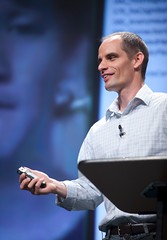
Michael Wesch - Pop!Tech 2009 - Camden, MEImage by poptech via FlickrMike Wesch posted this video to YouTube via his channel. I like his work. I have been in classrooms that size before, and he seems to make his work just as much about that class as the rest of the world. I love that he starts this out with a quote from McLuhan who becomes more relevant as information and networks expand and deepen. I am really interested in assessing user-created content like Wikipedia, collaborative projects, and personal blogs. This kind of content is no longer the information of the future but what is happening today. Creating content via social media and networks is a different project than a 20-page research paper with a single author. The kind of culture that sustained that kind of academic research is shrinking and yet, that is what we are training students to do: to publish in journals that will no longer exist in the form they are currently in IF they will even exist at all. What Wesch's videos do is get people thinking about what we need to do as teachers and students to participate in this "new" culture. One of his first videos "A vision of students today," was seen by some faculty I showed it to as depressing and confrontational. It depends on your perspective, I guess. Another faculty member I was working with saw it as a wake-up call - a joyful, liberating call and we rewrote her syllabus to include the tools the students were actually using. In other words, it is painfully obvious that the media we are using to teach is woefully out-dated and becoming irrelevant. The only people who are going to go on and make a living writing 20-page papers are people who are going to go on to make other students write 20-page papers or publish in journals that publish 20-page papers. And why would you assess every subject the same way? We are missing an opportunity to help students become life-long, creative participants in knowledge creation.

I am interested in your response to Wesch's work. Feel free to comment: where do you think assessment is going to go in the world of collaborative authorship and social media?


Enhanced by Zemanta

Wednesday, March 11, 2009

Education and the Scientific Method

It is interesting to me that education is one of those fields where everyone has a tenaciously held opinion about what it is, how it works, or why it doesn't despite not having any training or background in the field beyond having been educated. For myself, that is like saying "Of course I can sew my own jacket, I have been wearing one for years" or "I can fix your car; I have been driving since I was a kid." Pronouncements on the credibility or the veracity of learning theories or tools come fast and furious from people who do not engage in education as a discipline in itself or its research. This is why we still get teachers that tell us "they don't let" their students use Wikipedia, quote from blogs, or will ever consider using Second Life, etc. I mean, insert whatever-it-is-they-do-not-quite-understand here. These are the same students, when sent to the library to research geology or anthropology do not come back with citations from "Chariots of the Gods," hollow earth literature, or other non-academically viable sources. The students have the critical thinking skills required to go into a library, and despite the library containing books on astrology or conspiracy theories, that sort of thing tends not to be cited by students. Why can't instructors have the same faith in students on the internet? Who said it was our job to "let" or not let the students do anything? I won't harp on Wikipedia further because there is already enough actual research from journals like Nature that say that Wikipedia articles were shown to be just as accurate as anything in peer reviewed articles. The problem with things like Wikipedia or learning online in any form is that it is new. Books and traditional journals safely fit into the framework of traditional teaching. The increasing amount of available information, the users ability to participate in the creation of that information, and the myriad ways of accessing and aggregating that information are all shaking that traditional framework to its 1200 year-old foundation. All of a sudden it is very difficult for traditional teachers to evaluate online sources, information and tools because their sources of peer-reviewed information are always printed one to two years late with sources that are three to four years old - an eternity on the internet. And here we introduce fear. The last thing you do when you are afraid is ask questions: you certainly aren't going to bother with research, create an hypothesis, test it, and analyze data. You are going to run straight to drawing your conclusions and broadcasting your "results" because you feel threatened. This has never been about whether something is a good teaching tool or not but about our ability to adapt to change. Good teachers are often good communicators and when good communicators connect with tools that facilitate communication and interaction, good teaching happens whether that tool is a clay tablet and a stylus or a virtual world.