Showing posts with label design. Show all posts

Wednesday, December 04, 2013

DET/CHE: Cognition, Learning Theory, Backward Design: The importance of instructional design.

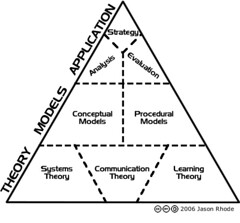
Hierarchy of Instructional Design
Hierarchy of Instructional Design (Photo credit: jrhode)
Jim Monaghan, AVP Academic Technologies/Associate Professor, Educational Technology, CSUSB

Instructional designers take on many roles at campuses. The perspectives of the designers combined with the organizational structure of the campus can greatly impact the results of the instructional design process. This presentation examines the importance of instructional design to the construction of high quality learning environments. Topics to be covered include fundamental principles in cognitive science, learning theories and backward design. Implications for the design of courses which range from technology-enhanced to technology-centric (e.g. fully online courses and MOOC’s) will be presented. Applications of instructional design in strategic planning for learning environments as well as practical considerations for implementation of strategies will be discussed. Advantages and disadvantages of a variety of organizational reporting structures will be explored. Specific ideas participants will take away from the session

• Importance of instructional designers to the development of high quality courses that use educational
technology
• Importance of organizational structure in facilitating instructional design for learning
• Overview of cognitive science that applies to the instructional design process

MOOCs, the model from Thrun,

Its about design, not technology

Design Considerations
Why would online video work?
What do we lose when we record a lecture?
How do we allow for substantive interactions?

He refers to the WASC handbook for interactions online.

What can tech allow us to do that we couldn't do otherwise?

Backward Design
Start with the end in mind - quote from Stephen Covey
Could also be from McTighe

Key elements of ID

What do you want your students to know'
How will you know that students have met the objectives
Interaction
Other considerations

A review of learning theories.
Behaviorism, Constructivism, Constructionism

He claims that drill and practice has its place. [I disagree with
this, I think you can learn the same with contextual learning.]

Social constructivism, situated cognition

Refers to a 1999 paper that applies cognitive science to designing
learning spaces. "Designing Learning: Cognitive science principles for
the innovative organization" Penuel & Roschelle.

What is the role of instructional designers?

CSUSB Online Learning Modules Template

1. Reading
2. Short lecture
3. Discussion
4. Student research
5. Assessment

Where are instructional designers housed in your organization?
Why does it matter?

Access to infrastructure
Access to decision makers
Responsiveness
Agility
Strategic or operational focus
Enhanced by Zemanta

Friday, July 12, 2013

Mobytes Instructional Design App

English: This is Juniper Hall at Humboldt Stat...
Juniper Hall at Humboldt State University.
(Photo credit: Wikipedia)
One of our technologically ever-vigilant instructional designers here at Humboldt State (Kim Vincent-Layton) shared an interesting Android app with us the other day - Mobytes Instructional Design App. The app is a handy collection of articles and templates on instructional design. What is a "mobyte"? A mobyte is a "just-in-time chunk of learning designed for just-enough knowledge to learn or apply while performing a task. It can be used for learning from scratch, refreshing and updating knowledge while on the move." I like this app because it covers, at a basic level, the current understanding and definition of instructional design that any student of education would find in a instructional design class. I would like to share this app with administrators and teachers to help promote a deeper understanding of instructional design and its possibilities. The author, Madhuri Dubey, has distilled five topics into the app:
  • Instructional Design (ID) basics 
  • Evolution and application 
  • Learning theory and styles 
  • Instructional theory 
  • Getting started with ID 
This reference would be useful for instructional design teams to all get on the same page as well as for instructors who would find it useful for a better understanding how teaching and learning work. It covers Gagne, ADDIE, Clark, Merrill, Bloom's and the usual suspects.

If you are not an Android phone person, much of the information here is available on Madhuri Dubey's blog.
Enhanced by Zemanta

Tuesday, February 22, 2011

The Instructional Designer's Toolkit

University of the Pacific Arthur A. Dugoni Sch...Image via WikipediaI have watched instructional designers from top-notch universities loaded down with the latest theories completely flounder when faced with the realities of the work. With instructional designers, I look for two things: a portfolio and any teaching/tutoring experience. I am not looking for a 3-d, animated Flash portfolio of Whizbang 2.0 - I am looking for a collection of problems that were solved through design, technical skill, or direct application of pedagogy. You will need some models for teaching and learning. Be prepared to talk about the strengths and weaknesses of any of them. I am not looking for ideologues, but folks that understand that models can be useful (a model is just a model though). Since instruction is about learning, we need a common language for how we describe how teaching and learning happens. A lot of this can be had in a traditional university but much of it comes through practice. If you are studying instructional design and want that kind of practice, there are numerous opportunities:
  • facilitate courses through your local community colleges, 
  • volunteer (or get paid) as a tutor, 
  • join a literacy project and teach people how to read, 
  • work as a teaching assistant in your dept., 
  • substitute teach,
  • facilitate online trainings in a professional organization.
Hierarchy of Instructional DesignImage by jrhode via FlickrThere are many more such opportunities. The  way to make the most of those opportunities is to ask questions, observe, keep a journal on what happens, read the professional literature in tutoring, education, and teaching for your discipline.

It is a lot to ask, especially for new graduates. Have of what is worth knowing about teaching and learning comes from program specific classes and the other half through a broad self-education. We need more people from the humanities in instructional design. There are problems that come up in ID that are seemingly insoluble to some yet are obvious to someone reads history or art. There are ideas floating around instructional design that would have little credence with an even casual acquaintance with philosophy or psychology would clear up. One has to ask why ID degrees have so little psychology in them when how we learn seems to be the central issue of the discipline!

An instructional design model representing Mer...Image via WikipediaBut all of this will only take you so far. It is unreasonable in every sense of the word to expect new graduates to have a broad education, fearless in the face of technology, and facility with theory. What is most important is the networks in which you are participating in. If you don't know the answer, how do you find out? Are you on Facebook, Twitter, or Plurk? Who are the most helpful people in your networks? Where are your most important connections? Are you taking online classes? What blogs do you read? What blogs do you comment on? How vital are your networks? How have your connections shaped your growth as a learner? I don't believe that one person can have all the answers, but one well connected person can come close enough.

What tools do you consider essential for instructional designers? Feel free to add a comment below. I also have a collection of tools that we are playing with here at College of the Redwoods.

Enhanced by Zemanta

Friday, October 24, 2008

Instructional Design in a Connected World

In reading discussions and listening to George Siemens and Stephen Downes speak in our class, Connectivism and Connected Knowledge, I have heard and read a lot of narrow and overly simplistic definitions of instructional design. Much of what has been said characterizes instructional design as mechanistic, linear, and formulaic. To an extent, there is some truth to this because instructional design has many problems to solve - one of them, for instance, might be that factory workers may need to know how to operate a specific piece of equipment or billing coders in hospitals may need to know some legal procedures. In cases like these, the important thing is that the information is being given clearly, in sequence, and in a way that will ensure that everyone is on the same page. An added bonus would be if you had a good instructional designer who could also include in that training:
  • problem-solving skills,
  • practice sessions that helped users remember the sequence of procudures,
  • interactivity with other learners,
  • attention to multi-modal learning (e.g. visual or aural learners)
  • and a community of professionals where learning would continue
But I am ahead of myself and the above list is not typical of a lot of instructional design.

The other problem that instructional designers have to solve is the unifority of curriculum. I know that the "throw the kids in a bucket of clay and watch them sculpt the Pieta" crowd flinches when they hear this. But the problem goes something like this: if English 101 is a requirement to succeed in Philosophy 110, how do ensure that students are getting the same level of education in all English 101 classes? Now lets say you have a teacher who follows her instincts, doesn't believe in standards and thinks that the students will learn more about writing if they keep a journal, read "Zen and the Art of Motorcycle Maintenence" and just "be here now." In an ideal world, a teacher like that would get on fine, even without tenure, but we do not live in that world yet. Creating that world is not the work of instructional designers. For me to say, "I do not agree with the current standards so everything I design is fundamentally flawed" means that I should be doing something else. It would be as if someone were to hire an engineer to build a bridge and that engineer said "we really should be flying over this river, not driving." I do not particularly like multiple choice tests, for instance, but my job as an instructional designer is to help instructors design the most effective multiple choice tests. I have found that by scaffolding the questions using Bloom's Taxonomy to be a demonstrably effective way to create those tests. Not every theorist likes Bloom, but not every theorist out there is tasked with making a multiple choice test work! And I can't wait around for the Rousseauist utopia to come before I work on the test.

Good instructional designers keep up on the latest learning theories, teaching methods, and instructional technology. We do this not to tell a teacher how to teach, but to help instructors solve problems. Most teachers do some things really well. There are other things that teachers may not like to do, like deliver the same lecture in their history course semester after semester. This teacher would benefit by having someone who could show him how to record lectures and put them online, reserving the classroom for the discussions that he enjoys moderating and participating in. Or an institution wants their employees to be more productive at their work and have the fore-sight to see that it might be a training issue. People often do not do the work you want them to do if you have not told them (or don't know) what that work really is! An instructional designer can look at a job, interview the management and workers, and by bringing everyone together, discover what they need to know and how to build training for that.

Teachers and administrator often do not have the time to keep up on the latest developments in instructional design and technology. Why should they? They have enough cut out for themselves in teaching and staying current in their field, they cannot be expected to wade through all of the commercial hype and rapid changes in technology from day-to-day. An instructional designer is a contact person into the meta-disciplines around instruction. This is not telling anyone how to teach but being a resource of information, tools, and techniques that can increase the interactivity, communication (both in breadth and depth), and community of a course.

In my own day to day work, I wear many hats: counselor, teacher, researcher, education historian, data analyst, administrator, artist, etc. I use a wide variety of methods and tools that are carefully matched to the problems being solved. There are times when I have to think like a Cognitivist ("What would be the most efficient way for students to memorize this information?"), or a Constructivist ("Where in this course can we increase opportunities for students to communicate and share with one another?") or a Connectivist ("How can we create a network that will allow the students to learn now and continue their professional growth?"). Teachers do a lot of things really well, but they don't always know why some of the things they do in the classroom work. An instructional designer can map out the successes to help instructors reproduce it in other areas of their teaching. That mapping out process can then be turned around to help create an institutional course development process: one that does not tell someone how to teach, but how to manage all of the processes that can (or even should) go into a face-to-face or online course.

Instructional designers also create networks: they can connect with other instructional designers, bring new teachers together with experienced teachers, they link instructors to learning opportunities, and help connect students with more experienced students or graduates who are working their professions. Each one of the problems above require communication skills and network building. The work of the instructional designer will always be relevant because ultimately their job is making connections and managing change.