Showing posts with label Facebook. Show all posts

Wednesday, April 23, 2014

Connectivism - The First 2000 Years

English: picture of 18th century english Tatle...
I would like to highly recommend a book I am currently reading to educators interested in Connectivism. It is called Writing on the Wall: Social Media - The First 2000 Thousand Years by Tom Standage, the digital editor at the Economist. The point of the book is that social media is not a new phenomena but it is something that we have been engaging in for millennia and that it is part of being human. The book is interesting, well-researched and brings pieces of history that have been floating freely in your head together in some unusual and useful ways. He ties how we used to communicate with everything from cuneiform tablets, pottery shards and graffiti together with Twitter, email and Facebook. Some of those themes are discussed were discussed here in postings about the Silk Road as a network, The Republic of Letters, and other postings. I have also written here about Connectivism being "nothing new" and, for me, that is a great compliment to a theory - it means that we can use the theory not only to account for where we are now and where we are going, but also use it to analyze where we have been.

How this vision informs instructional design is that we recognize the social dimension of learning and how learning experiences happen in networks. Instructional design and teaching is the facilitation of these networks. The one-way delivery of information is a one sided "conversation" that has some use. I can gather information through reading a book or hearing a lecture, but I learn when I discuss it, through writing, talking, meeting others (in whatever medium) and make connections.
Enhanced by Zemanta

Saturday, February 09, 2013

A Bus of One's Own

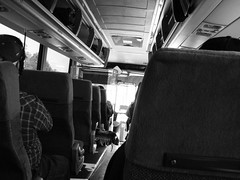
Greyhound, Black and White
Greyhound, (Photo credit: djupp)
My personal learning network (PLE) includes blogs, twitter, Facebook, journals, co-workers, classes and other communities. My PLE now includes Redwood Transit. I sometimes complain that I do not have enough time to read (physical books) and write (in a physical notebook). It is important for me because that is where I am inspired and it is a source of my own creativity. I obviously do a lot of writing on computers but it is too easy to just focus on "work related" reading and research. The printed word has not been at the fore-front of this learning network in a long time. I still read books and a couple of paper journals, but not on the scale that I used to in my pre-network literacy years. The primary reason is time. This is now changing. My new job at Humboldt State has me commuting. I was at first hesitant at the thought of taking the bus - I have spent a good deal of my early life on busses - school busses, Greyhound busses, the Green Tortoise, county and city busses. I have spent days on busses traveling to jobs, going to school, or visiting family. I never considered them luxurious by any means: they usually had no air conditioning or heat, you are stuck with others who are traveling for days. Their cleanliness was highly variable. I once rode a bus from Portland to Los Angeles with another passenger who was pregnant and had the flu. There has to be special circle in hell like that. I have also spent a day traveling with newly released prisoners they were traveling from San Luis to Los Angeles and some didn't make it as far as Nipomo.

It seems busses have changed some. People can no longer smoke on the bus. The Redwoods Transit busses are clean, well-lit, heated and have wifi. I realized that I have a great opportunity here. I can start reading novels again on a regular basis. I am forced to spend time on the bus and now I have that luxury that is missing from so many of our lives right now - time. Time to read, write, and process. This is only my first week and I am half-way through Machado de Asis' "Epitaph of a Small Winner." I have had a stack of books on my night stand that I have not been able to get to and now I finally have the time and space.

I have a novel that I have been chipping away at for the last few years - my 3rd or 4th one depending on how you want to define the novel. It is a glacially slow process because of work. This is not the artistic medium for the bus! Short stories and poetry lend themselves well to the short bursts of reverie and 15 to 20 minutes periods of focus that the bus may allow. Despite all of my work in online learning last year, I managed to get a short story published and the editors of the journal, Border Crossing, nominated it for a Pushcart Prize. I was thrilled about all of this - I understand that being nominated is a modest acknowledgement, but I am still thrilled. It also has me thinking about writing more short stories, "flash fiction" even because, with apologies to Woolf, I actually have the time and space to do that; a bus of my own.

A chart of Geoff Cain's PLE (personal learning network).
Enhanced by Zemanta

Saturday, September 15, 2012

Seoul Man: Viral Videos and the Shrinking World

I have been thinking recently about Psy and the K-pop phenomena of his video "Gangnam Style" that broke out of the internet and onto mainstream television and media. This video was destined to become the Numa Numa of the year (Gary Brolsma's lip-synching of the Romanian pop song Dragostea din Tei by O-Zone) except for one thing: the world is smaller now. Or rather, the internet and other media are quickly collapsing into a single macro-market. The video "Gangnam Style" was released in July and in two months, after being kicked around Facebook and Twitter, the YouTube video has gotten nearly 181,000,000 views. I believe it took Numa Numa a year or so to hit 2,000,000 views. Which is remarkable in itself seeing that Brolsma was just a kid with a web cam. (Mike Wesch has an excellent presentation on viral videos and YouTube that discusses Brolsma's video and many others called "An Anthropological Introduction to YouTube" that is really worth watching.)  Psy from Korea is part of the pop industry there, but there has been little breaking out of the K-pop world and into the mainstream until now. By mainstream, I mean Psy's appearance on the Ellen Degenere's show and his appearance at a Dodger's game. That would not have been possible without Facebook, Twitter, and YouTube. You can't set out to create this kind of content on purpose. Most people who are watching the video are not familiar with the Korean TV personalities and comedians in the video, they do not understand the context. They don't really need to. The dancing is funny, and the music has a catchy beat. To many Western viewers, the randomness and cultural alienation is part of its appeal.


Of course, there is a darker side to the shrinking world too. Another viral video with a definite air of cultural alienation is circulating and being used to basically dismantle the Arab Spring and as a pretext by extremists to attack all things Western. The same connections that can create a pop sensation can create chaos.

We have to recognize this change in how unpredictable information can be. Psy and his producers could not have predicted anything like the reception he has gotten. We no longer live in a world of "media outlets" and consumers. The consumers of the past are creating responses to media using the same tools that were once only available only to "The Media." We are the media. And when something goes viral, we have no idea how it will be perceived. I am not saying that we have to be careful what we put out there, but learning how these new connections are changing the world has never been more important. A theory of how meaning or dissonance is created through connections, like George Siemen's Connectivism, would be very useful about now.
Enhanced by Zemanta

Saturday, May 19, 2012

Facebook and My 1000 Closest Friends

This is an article I wrote for the Times Standard "Tech Beat' column for May 11, 2012:

I have read a few claims recently about the detrimental effects of the Internet. The most recent one came from the New York Times in the article “The Flight from Conversation” by Sherry Turkle, a professor from MIT, who says that the Internet is making our relationships with one another superficial. Her idea is that we are mistaking our “likes” on Facebook as real conversation and our “friends” online as real friends. I think this argument comes from a fundamental misunderstanding of the nature of online communication.

Turkle says that for the past 15 years she has studied connective technologies and talked to “hundreds of people of all ages and circumstances about their plugged in lives.” She relies primarily on anecdotes, and one of my favorite quotes from economist Roger Brinner says that “the plural of anecdote is not data.” A collection of subjective experiences does not make them objective. Anecdotal evidence is of limited usefulness; it can provide case studies and be the starting point for research, but it is generally considered as weak evidence.

Turkle says that the little devices we carry around with us are so powerful “they change not only what we do but who we are.” I basically agree with this. I don't particularly think this is negative. People write less. Last year the post office closed 3,700 locations. Some of this was due to expanded retail marketing, but much of it is because email and texting make most letter writing superfluous. Does this mean that somehow our correspondence is less meaningful?

I have hundreds of anecdotes of my own. Let's take my community college cafeteria in 1984. There were no cell phones. There was no email. The college library had a non-networked computer lab with TRS 80s. Our only hope was to actually talk to somebody face to face. I would go into the cafeteria, buy a cup of coffee, sit down at the table, and ask the nearest girl “What classes are you taking?” or “What's your major?” with what I hoped would pass for something not quite entirely unlike sincerity. One might suspect that, even though I was trying to start up a conversation, I may not have been really all that interested in what classes they were taking or what their major might have been. Needless to say, my intent was to have a conversation. More often than not, the “conversation” stopped there. But once in a great while it led to more coffee elsewhere.

Today, I have 879 friends on Facebook, but let's take a closer look. I do not expect birthday cards from 875 of them. I originally started using Facebook because many educators and instructional designers I met at education conferences (both face-to-face and online) were using it to share materials, links, and contact information. This accounts for at least 300 of my “friends.” About 200 of my “friends” are literary journals, editors, and literary agents. They never call or come over for dinner, yet I follow them on Facebook because I write and want to keep up with what is going on in the literary world.

A little over a hundred friends on Facebook are family. Some I see often, and many of them I have never met. Some of these distant cousins live in Ireland. We will be using Facebook to plan a birthday/family reunion this December when my father turns 80 and my little brother turns 50. There is nothing superficial about that.

You might have friends at your local service organization, temple, or church. But what happens when you go to that weekly meeting? Do you have a deep conversation? Maybe not, but you probably know that if you need help, you have a community to fall back on when things are tough. Or you might be willing to lend a hand to someone who is in need. It might be something simple like a lift to the hospital on a Monday morning or a chore that an older person might find difficult to do. When you meet those people, you might just smile and nod. The “like” in Facebook is that smile and nod.

Social networks can be superficial, and yet over and over again, we see that when there is trouble, those friends in social networks can have a major impact. I am thinking here of the Arab Spring and the communications networks that sprang up out of Twitter to change the face of the Arab world forever. Maybe the technology has allowed us to see the superficial surface of human communication frozen in time in the social network, but that is not how we should be judging technology because most people seem to be using to enhance their connections with one another rather than trivialize them.

Geoff Cain is a member of the Redwood Technology Consortium and director of distance education at College of the Redwoods. Contact him at geoff-cain@redwoods.edu<
Enhanced by Zemanta

Friday, March 23, 2012

Wired Love: From Telegraph to Twitter

An illustration of Phelps' Electro-motor Print...An illustration of Phelps' Electro-motor Printing Telegraph, the last and most advanced telegraphy mechanism designed by George May Phelps. (Photo credit: Wikipedia)This is an article I wrote for the "Tech Beat" column for the Times-Standard:

As one who works in online learning, I often get forwarded emails from colleagues alerting me to the dangers that might arise from using Facebook, Twitter, or other social networks. For instance, a few years back, after sending out a notice for a workshop on social networks and education, I received several emails warning me with a link to David Gardener's article called “The Marriage Killer: One in five American divorces now involve Facebook” from the Daily Mail. This lurid article begins with, “It used to be the tell-tale lipstick on the collar. Then there were the give-away texts that spelled the death knell for many marriages. But now, one in five divorces involve the social networking site Facebook....” The implication being that I may want to be careful in promoting the use of social networks like Facebook in education because there are perils that lurk beneath the surface of the Internet that may lead to unintended and tragic consequences.

This is not surprising. I have given workshops on how to use virtual worlds in education, often using educational sites designed in the virtual world “Second Life.” Invariably, after sending out the announcement for the workshop, I will get a cautionary email such as the one informing me of the 40-year-old British couple who had famously married in Second Life in a huge wedding, but then divorced later after one of them had an alleged “affair” in the online world. The wife said that she caught her husband's avatar having sex with another animated woman: the couple are now divorced (in the real world).

What are these stories really telling us? Is there anything really inherently dangerous in online communication? This is not a question of 'should we' or 'should we not' have relationships online. The fact is that the online world is just another medium of communication, and that is what humans do: communicate in a wide variety of ways. We are every bit as complicated in our courtship rituals and communications as the rarest of birds-of-paradise in New Guinea.

The only difference between the modern online courtship rituals and those of the past is the new medium of the Internet. There are a lot of things we are doing online that we never could have imagined doing just 10 years ago. Who would have thought that making purchases online would become so commonplace? Or online banking? Or wedding invitations?

But yet, there was something about the more recent warnings I received that seemed very familiar. And the reason is that every time we, as a culture, develop a new technology, there are always those who see it as the first step down a slippery slope that will ultimately mean the end of the world as we know it.

For example, people had been batting around the idea of the telegraph in various forms since the 1740s. Eventually, Samuel Morse developed a system that could transmit signals over long distances and by the 1860s there was a trans-Atlantic cable, a well-established telegraph network in the Northeastern United States and a network in California and other parts of the West linked by a trans-continental cable. In less than a generation, this new technology transformed how people handled money, got the news, ran elections and even fell in love!

Doesn't this sound familiar? Sense trouble?

The stage was set for wire fraud, romances and the usual chicanery that happens when people figure out new ways to communicate with one another. There was even a novel written in 1880 by telegraph operator Ella Cheever Thayer who published the world's first “cyber-romance.” “Wired Love: a romance of dots and dashes,” was a novel about two telegraphers who fall in love over the telegraph wires without ever meeting face-to-face. It was the mother to the film “Shop Around the Corner” (about a relationship via letters), and the grandmother to the modern email version of the love story “You've Got Mail.” “Wired Love” was a bestseller for 10 years, and according to Tom Standage in his book “The Victorian Internet,” relationships like this were not at all that uncommon.

For every failed relationship in cyberspace, there is an example of success. The most famous modern example is the couple in the “twitterverse,” Greg Rewis and Stephanie Sullivan (now Mr. and Mrs. Rewis). Greg Rewis proposed to his girlfriend on Twitter and sent an instant message on his phone asking her to check her Twitter account just for good measure. Later, their children sat in the church and tweeted the ceremony to those attending virtually.

Despite the “dangers,” the real lesson is that people communicate and connect with one another. This is what we do. We are very good at it. We will use all forms of communication for education, banking or socializing. Despite the warnings and cautionary tales, people will not resist using any means possible to connect with one another.

Geoff Cain is a member of the Redwood Technology Consortium and director of distance education at College of the Redwoods. Contact him at geoff-cain@redwoods.edu.
Enhanced by Zemanta

Wednesday, January 18, 2012

SOPA Resistance Day

On Jan 24th, Congress will vote to pass internet censorship in the Senate, even though the vast majority of Americans are opposed. We need to kill the bill - PIPA in the Senate and SOPA in the House - to protect our rights to free speech, privacy, and prosperity. See this timeline of SOPA and PIPA events and the activist backlash.

What can you do?
    SOPA Resistance Day!Image by ~C4Chaos via Flickr
  1. If you have a Twitter account, tweet about the #SOPASTRIKE and ask your followers to get ready. You can follow SopaStrike on twitter for news as the strike gets closer. Go to Blackout SOPA to add ‘STOP SOPA’ to your Twitter image.
  2. Post the SOPA Strike page to your Facebook account by clicking here.
  3. Get ready for January 18th! Email and tweet at your friends, tell them to tell everyone about the strike. When the day comes, call Congress, tweet like crazy (#SOPASTRIKE), and help the strike appear everywhere!
Enhanced by Zemanta

Sunday, December 11, 2011

Redwood Technology Consortium's Annual Holiday Tweet-Up

The Redwood Technology Consortium welcomes the public to join them at the 3rd annual Holiday Tweet-up, Wednesday, Dec. 14, at Greenway Partners in Arcata from 6:00-10:00 P.M.

The Tweet-up started three years ago with the intention of providing a face-to-face meeting place for community members whose main interaction was through social networking websites, like Twitter and Facebook. The event has become a fun place to gather with laptop computers, smart phones and even without technology devices to visit, play trivia games and win prizes.

English: Bronze statue of President William Mc...Image via WikipediaRTC will also provide a bar with the vodka-based Humboldt Hashtag (a clever nod to the Twitter habit of following the pound sign with a common word or phrase, which makes a topic easy to search), local wines and microbrews and non-alcoholic drinks.

Throughout the year, the RTC focuses primarily on advocacy for broadband duplication and education. This year, the Humboldt Internet Marketing Group was created, under the RTC umbrella, and community members meet at lunchtime on the second Tuesday of each month to discuss topics that focus on marketing businesses of all sizes in the internet age

This year, the RTC has seen the retirement of board members Steve Stratton and Robert Beckerdite, and welcomed new members Geoff Cain, Terry Olgin and Monica Topping. Veteran members Seth Johannesen and board president Mary Cruse, and board treasurer Sean Connors remain.

Greenway Partners is located at 1385 Eighth Street in Arcata, across the street from the Arcata Kinetic Lab.

The RTC Holiday Tweet-up is a no-cost, all-ages event.

Contact: Monica Topping (707) 498-3534
Redwood Technology Consortium
Enhanced by Zemanta

Tuesday, October 25, 2011

Open Ed Conference: Cognitive and Cultural Barriers to Openness

Speaker: Steve Hargadon

Steve HargadonImage by jdlasica via FlickrWhat are the cognitive and cultural barriers to openness, and how does understanding them help to promote broader openness?

A conversation with the desire to identify the core ways in which people are naturally or culturally conditioned to be suspicious of or opposed to openness; then to use that information to think about ways to build bridges to individuals or institutions locked into closed mindsets.

Notes: 
He open talking about all the open projects that he has participated have folded up due to lack of interest, funding, and institutional support. His favorite quote is Jefferson's "My sharing my light does not diminish my own." Why do we close off when we feel that there is no trust? He feels that on some level that he failed with open source software.

He used the example of an online Facebook study group in Chemistry who was busted by the instructor for starting an online study group.

What are the cognitive biases around how people feel about open eductation?

  • Competition compensation
  • Cowboy culture
  • Cultural influences (vs. Rationhality)
  • Narrative driven

Possible Examples of Solutions

  • What has OCW done

Conclusions/Ideas to Encourage Understanding and Adoption

  • Acknowledge and address proprietary concerns (OCW)

More at http://opencognitive.wikispaces.com

There are also selfless acts, cooperation, and sharing as motivations. There are also those who use seemingly altruistic acts as self-promotion.
Enhanced by Zemanta

Saturday, August 27, 2011

Open Learning and the Next Generation LMS

Onderwijsdagen 2007 - Keynote - Stephen DownesImage by moqub via FlickrWe have been talking at work about what the next generation of LMSs (learning management systems) should look like. In the education blog world, LMSs are considered pretty old fashioned because they tend to be proprietary silos, built on old code (by committee), and do not empower students to facilitate their own learning. Once the class is over, the LMS shuts the door behind the student. We agree with all of that. We find it particularly hard to get really meaningful information in and out of most LMSs. We are all in favor of "personal learning networks" - the way LMSs generally attempt to integrate Web 2.0 or social networks is pretty laughable. It is usually misunderstood and bolted on as an after-thought. But LMSs can be important to institutions because they provide a consistent interface for students who may not have any experience with technology. I got the idea to email Stephen Downes about this because I have been reading his blog and newsletter since I have been involved in teaching and education. I asked him what he thought the next generation of LMSs would look like and he was gracious enough to send us this response:


"I guess my short answer to the query is that I think the future LMS will look like what gRSShopper will look like when it's done. Because I've been developing gRSShopper for the distributed and open model of learning for some time now, in other words, exactly where I think institutions should be going. Of course I'm not a great programmer so gRSShopper is far from complete. But it gives a bit of a model of what the future LMS should look like.

In particular, gRSShopper supports a distributed environment, This allows the institution to aggregate student content from wherever it's posted. gRSShopper also supports syndication. So content can be distributed by email or RSS into pretty much any environment. The idea is that the LMS isn't a destination that people have to visit, but rather a clearing house that manages content aggregation, indexing and redistribution.

This is what I've been building out on gRSShopper - but because web 2.0 has migrated away from standards and toward proprietary APIs I need to do a lot more to extend it. But any LMS should be working with remote content minimally with RSS/Atom, DC, LOM, iCal, FOAF, and various other standards, as well as the Google, Yahoo, Facebook, Twitter and related APIs. gRSShopper is a tool for managing things like MOOCs, and should support open online course content.

In addition, student access is ideally managed witgh a personal learning environment (PLE). This is a bit like a gRSShopper for idividuals, but with better management for personal accounts on remote systems. It would also have a more robust player - it would be a PLE that plays cartridges, not LMSs (though PLEs should report to LMSs any results). PLEs contain permanent records for student - all bookmarks, references and readings, created work, etc., is stored (or indexed, if stored in the cloud) locally, so the student can always retrieve it.

That's a short answer. A long answer would be consideraly more in-depth, but along these lines.
"


We would love to gather more ideas from others. If you have some thoughts on what you think the next generation LMS should look like or not look like, send us an email or leave a comment below.
Enhanced by Zemanta

Tuesday, August 16, 2011

Flash Robs and the Darker Side of Human Nature

Free twitter badgeImage via WikipediaAfter weeks of Twitter fuled violence, rioting and crime, the British government is considering shutting off social networks. With similar problems, the mayor of Philadelphia is appealing to youths shape up combined with increased "stop and frisk" policies. Just as networks like Twitter and Facebook can be used to create art and topple governments, it turns out that they are good at quickly, nearly spontaneously  organizing gangs of criminals. The same technology that is used to form learning networks is the same technology that youths are using to organize robberies. I have links to the relevant stories at the bottom of this page. I originally wanted to join in on the rhetorical fun and talk about the "darker side of social networks" but this is really, once again, a case of the media missing the point. It is not the technology: the same press that publishes the works of Ghandi also can publish "Mein Kampf." The same phone technology that can announce a Nobel prize can direct a terrorist attack. Guess what? The problem is not the technology and stopping the technology will only spur further innovation and technological change that the authorities will understand even less. Attempting to close down communication is a lot easier than addressing poverty, unemployment, and the escalating crime rates. The technology is already here to monitor twitter and track who is tweeting and what they are tweeting. I am not condoning this, but it shows you how far behind the curve the British and Philadelphia are that their own police are not using Tweeps Around type software as a crime radar. Twitter is basically an open channel. Why aren't there flash mobs to prevent crime? Why do the police still look like they are barely above the phone-box-on-the-corner level of technology? But before they attempt to boot-block communications, I hope they do something about the roots of these crimes and address the needs of these desperate communities.


Enhanced by Zemanta

Tuesday, February 22, 2011

The Instructional Designer's Toolkit

University of the Pacific Arthur A. Dugoni Sch...Image via WikipediaI have watched instructional designers from top-notch universities loaded down with the latest theories completely flounder when faced with the realities of the work. With instructional designers, I look for two things: a portfolio and any teaching/tutoring experience. I am not looking for a 3-d, animated Flash portfolio of Whizbang 2.0 - I am looking for a collection of problems that were solved through design, technical skill, or direct application of pedagogy. You will need some models for teaching and learning. Be prepared to talk about the strengths and weaknesses of any of them. I am not looking for ideologues, but folks that understand that models can be useful (a model is just a model though). Since instruction is about learning, we need a common language for how we describe how teaching and learning happens. A lot of this can be had in a traditional university but much of it comes through practice. If you are studying instructional design and want that kind of practice, there are numerous opportunities:
  • facilitate courses through your local community colleges, 
  • volunteer (or get paid) as a tutor, 
  • join a literacy project and teach people how to read, 
  • work as a teaching assistant in your dept., 
  • substitute teach,
  • facilitate online trainings in a professional organization.
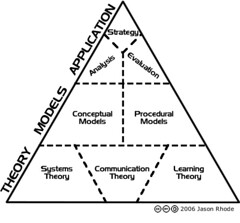
Hierarchy of Instructional DesignImage by jrhode via FlickrThere are many more such opportunities. The  way to make the most of those opportunities is to ask questions, observe, keep a journal on what happens, read the professional literature in tutoring, education, and teaching for your discipline.

It is a lot to ask, especially for new graduates. Have of what is worth knowing about teaching and learning comes from program specific classes and the other half through a broad self-education. We need more people from the humanities in instructional design. There are problems that come up in ID that are seemingly insoluble to some yet are obvious to someone reads history or art. There are ideas floating around instructional design that would have little credence with an even casual acquaintance with philosophy or psychology would clear up. One has to ask why ID degrees have so little psychology in them when how we learn seems to be the central issue of the discipline!

An instructional design model representing Mer...Image via WikipediaBut all of this will only take you so far. It is unreasonable in every sense of the word to expect new graduates to have a broad education, fearless in the face of technology, and facility with theory. What is most important is the networks in which you are participating in. If you don't know the answer, how do you find out? Are you on Facebook, Twitter, or Plurk? Who are the most helpful people in your networks? Where are your most important connections? Are you taking online classes? What blogs do you read? What blogs do you comment on? How vital are your networks? How have your connections shaped your growth as a learner? I don't believe that one person can have all the answers, but one well connected person can come close enough.

What tools do you consider essential for instructional designers? Feel free to add a comment below. I also have a collection of tools that we are playing with here at College of the Redwoods.

Enhanced by Zemanta

Friday, February 11, 2011

Egypt: The Revolution Will Be Twitterized

Egypt: ThebesImage by Brooklyn Museum via FlickrOnce again, the power of social media and networks has toppled a government. There is nothing superficial about tweeting 140 characters. There is nothing "weak" about the weak ties and connections in Facebook or other social networks. Events in Egypt, Iran and elsewhere have shown that these networks are worth learning and knowing about. It is interesting that in America the questions about social networks have to do with the so-called superficial nature of the connections (I am thinking here of Sherry Turkle) and in the rest of the world Twitter is the vehicle of change - the electronic samizdat.

Technology as an agent of revolutionary change is nothing new - letters and newspapers linked networks of revolutionaries in Europe and America. Velvet revolutionaries in the late 80s were smuggling 2400 baud modems into Eastern Europe. The networks were used to send meeting information, demonstration notices, and information to illegal computer bulletin boards:

"Back in '89, Czech students were trying to coordinate the uprising across the nation, and the technical students...were running the telecom angle. They used a 300-baud device with the size, shape, and heat of a kitchen toaster. The Czech secret police were far too stupid and primitive to keep up with digital telecommunications, so the student-radical modem network was relatively secure from bugging and taps. Fidonet BBSes were springing up surreptitiously on campuses whenever an activist could sneak a modem past the border guards. Modems were, of course, illegal. Most of the Czech cops, however, had no idea what modems were." - Bruce Sterling, "Triumph of the Plastic People," Wired 3.01. Jan. 1995.

Computer networks are the new coffee house (the traditional hot bed of revolution in the 18th century). Twitter and cell phone texting has changed Iran (shaken, not toppled). The government of Myanmar knows all about the "dangers" of technology too which is why it is against the law there to own an unregistered modem. 

Just as we would teach traditional journalism in schools with newspapers (I mean literal paper), we owe it to the students to utilize social networks and media in the curriculum. Social media literacy is not just for ordering pizza! The media is a superficial or as powerful as we make it.

Enhanced by Zemanta

Monday, February 07, 2011

Student Privacy and Facebook

This image is an example of a blocking cluster...Image via WikipediaThe Student PIRGs has come out with a guide for controlling your information on Facebook. This has come at a really good time because College of the Redwoods is expanding its presence on Facebook and other social networks. Understanding the benefits and the risks is equally important. We will have to review this frequently to keep up with how quickly Facebook can change.Social networks can be powerful communication tools but they are used by more than just students! I don't want to impede how folks communicate but understanding privacy issues is especially important in an educational setting (thinking possibly of FERPA).

I am interested in how other colleges are managing the issues around Facebook and social networks. Feel free to leave a comment here if your college has guidelines or policies related to Facebook or other social networks.
Enhanced by Zemanta

Thursday, February 03, 2011

The Internet and the Collapsing Past

I used to have memories. They were selected, chosen, and like old photographs, shifts of color and tone have changed them over time. Some memories are more highly selected and crafted than others. Some may even approach a certain degree of accuracy. There were things I thought I would never remember: names or friends from grammar school, that favorite Saturday morning cartoon character's side-kick, or what the old downtown of Santa Maria, CA looked like. Now all of this is coming back. All of the images, people, and places. In Facebook, I am talking to people that I met in middle school and have not talked to since. There was three and a half weeks once in the 7th grade when I was nearly not quite entirely unlike cool and that is how a couple of them still remember me. There are websites dedicated to the music and popular culture of the pretty much any year or decade. There was a time when the past would always remain the past. You didn't have to remember much of went by you so you didn't. Now, someone, somewhere, is uploading the play list from their junior college dance from 1982 up to Facebook, MySpace, their blog, ect. and you get to relive the Motels and the Bangles all over again. Between the 3.5 million articles in Wikipedia and the 24 hours of video uploaded per minute, your memories are up there somewhere. Friends and family send links to music, images, and people that I know that I would not remember, or more importantly, would remember differently. Sometimes, the way I remember a film, for instance, has more to do with my interests and values at the time rather than any merit the film may have had. I remember warning my wife that "Five Million Years to Earth" was a scary film. It is a good film, but like many Pinewood Studios films from the 60's, it ends with an apocalypse of "aliens" (plastic grasshoppers on the end of Popsicle sticks). Needless to say, she found the end very funny. I swore it was the most frightening movie I had seen as a 13 year-old.

We look at the internet as authoritative. It is becoming like the collective unconscious of the species (or at least the overly-connected subspecies, Homo Iunctus). It is a form of memory but again, as selective and faded as brain memory but "authoritative" because it is an external record, a scrapbook. People can upload images, but they can't upload my context for those images, but I look at an old photo on the web and think, "My god, that is how it was." In other words, how I remember things is changing because of technology, but because of the limitations of technology, the "memories" on the web are no more authoritative than the memories that come from my brain.

No other generation had this. We used to be able to move forward through time with just the shadows of recollections, content with vague images. Now we are using technology to mediate those memories. What does the game "Trivial Pusuit" prove now? That you don't have access to Wikipedia? I am not one of those who thinks that the internet is making us stupid - I think if the brain is freed up by not having to remember details of the career of Larry Storch or what was the name of the hotel on the corner of Broadway and Main in 1966, then the mind goes on to other things. Maybe this will facilitate extra intelligence or creativity?

Enhanced by Zemanta

Sunday, November 14, 2010

Farewell, Drop.Io: Too fast to live, too young to die...

The Open Source Initiative keyhole.Image via WikipediaI have often heard that one of the weaknesses of open source is that is that it is an unstable model. Somehow, open source software is supposedly more buggy, not as robust, not enough people supporting it, or too many people involved, etc. And yet, commercial programs drop like flies as the forces of an unbridled lassez-faire tech economy steam-roll through cyberspace like a nuclear tractor load of mixed metaphors and rampant hyperbole. Last week, I had to say goodbye to a favorite tool: Drop.Io. Free file storage, gave an embed code for what ever you stored up there, and a phone number where you could call in and it would record your message and host it as an embeddable MP3 file. Completely brilliant. As an online instructor, this was an extremely useful tool. They were not open source, but I didn't think they had a plan for making money - until Facebook bought them out. And good for them for getting bought out - the service was so good at the ground level right out of the gate that it was not clear how they would have turned it into "premium ware." So the service goes away and the programmers get absorbed by Facebook's production team.
This happened to Angel Learning and is now happening to Elluminate (quel dommage!) and Wimba Voice Tools (good riddance!). Ironically, the most stable model is going to turn out to be foundation-supported open source tools like Sakai. Sakai will continue to grow and change in some really interesting directions: it is one of the few players in online learning that can't get sued or bought out of existence by Blackboard. Goodbye, Drop.Io, you were the James Dean of free file sharing services.
Enhanced by Zemanta

Thursday, February 04, 2010

Frontline: Digital Nation

I watched Frontline's Digital Nation on television last night. I didn't watch it on the computer because I wanted to give it my full attention while I checked my email, sent notes to Twitter, updated my blog, Facebook, MySpace page and played Phosphor.Wait, what was I watching again?

In all I thought the program was fairly well balanced. Our culture is shifting. It has not evolved. If the digital world has caused us to evolve, why do I still have faculty who need to print out pages from an online learning management system? Why are we still using an LMS? Evolution is where humans begin to develop stouter, stronger, faster thumbs because those who master rapid texting will be the ones who reproduce, but I digress.

I love the scenes where kids who are "internet addicts" are sitting right there on the computer playing games while the mother complains (she is standing right next to him) that the kids grades are down, he is on the computer 12 hours a day, he doesn't eat right, and is becoming more and more antisocial and it us supposedly his problem. The real problem is that people do not know how to raise their children. My dad never negotiated or bargained with me. I can't tell you how many times I have seen mothers and fathers say "wouldn't you like to eat dinner now?" when what they should say is "Its time for dinner." That is the real cultural shift; parents as "pals." Teaching responsibility begins in the home. They can learn about democracy in civics class.

I feel the same way about Sherri Turkle and others when they say that "the kids do themselves a great disservice" by letting them be distracted from lectures. We are teaching children learning skills that are no longer relevant. There are so many ways to harness technology in the classroom that I find it incredible that teachers at MIT are still harnessed to the lecture method. What about using their cell phones as part of a student response system? Have the "google jockeys" in the class put notes and links up on a wiki (yes, MIT, I am available as a consultant for curriculum design). There were some good examples in the documentary of people using technology to turn poorly performing schools around. Not that the technology was the answer; it was the attention to the students that really made the difference. Technology was the medium.

The tests that show that multitaskers are poor performers only prove that tasks that merely require linear analysis are no longer the most effective use of a exo-networked brain.
Reblog this post [with Zemanta]