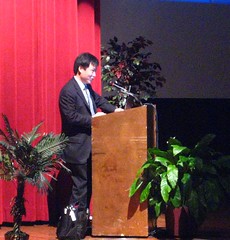
 Image by David Warlick via FlickrYong Zhao
presented on education today in CCC Confer (Elluminate! Live) on
Catching Up or Leading the Way: American Education in the Age of Globalization. Yong Zhao is currently Presidential Chair and Associate Dean for Global Education,
College of Education at the
University of Oregon, where he also serves as the director of the
Center for Advanced Technology in Education (CATE). He is a fellow of the
International Academy for Education. Zhao has published over 20 books and 100 articles. His most recent book is
Catching Up or Leading the Way: American Education in the Age of Globalization and the
Handbook of Asian Education. He has also developed computer software, including the award-winning
New Chengo/ZON (http://enterzon.com), the world’s first massively multi-player online role-playing game for studying Chinese.
These are my notes from his talk:
Zhao compares Asian and U.S. education. He looks at the phenomena of each culture feeling like they have to catch up with the other. The challenges he says lie in globalization and technology. He said that in the village he grew up in in China, they did not value his ability to ready and write - the village only needed a few people to do that. They really needed someone who was good at "driving water buffaloes." Globalization in his mind is merely the shortening of distance. He compared Columbus' voyage with current travel; a telegram across the seas used to take 17 hours - "The Death of Distance." What are the implications of the death of distance? The fist challenge is the development of global supply chains. The cost of production becomes cheaper. He used the global supply chain of Dell Computers as an example. Everything now is made in multiple locations. Why are we preparing our students for work that is already being out-sourced? We are producing qualified workers but they cost too much.
All "local" problems are now global - unrest, poverty, climate change, etc. What kinds of skills do we teach that will allow the workers not be obsolete in a few years? Or to address the real problems?
Technology isssues: over 10 million jobs lost due to automation in the last 10 years.
 Image via Wikipedia
We should not try to be like others. We can't rely on "common standards" - creativity, passion, diversity of talents have always been America's strengths. Since the 60s the U.S. has always been at the bottom of standardized testings. Yet, we have the most innovative economy in the world. We rely on new talent and new industries. We need more people to come up with new ideas. Have of the jobs in the U.S. will be coming in the creative industries. Move away from standardized testing and curriculum - we need to encourage creativity. We value individual talents in America. We should not be creating workers but entrepreneurs. New jobs in the U.S. came from new industries, not the old ones. We need to teach students to take initiative. Zhao talked about the "
bohemian index." We have multiple criteria to judge talent and we celebrate the differences.
1. We need to create an education system that plays to our strengths.
2. We need education to cultivate the entrepreneur spirit which is to:
- Take risks
- Emotional intelligence
- Creativity
3. View others as partners not competition
Student learning outcomes may not be very helpful because they are chasing after certain kinds of knowledge; knowledge should be acquired when someone needs to use the knowledge. We need to promote individual curiosity. He says that he has been reading reports about the death of American education since the 80s and has an interesting and funny
blogpost on that topic. He uses words like "inspiration." He talked about the "
creativity crisis" as well: we should reward creative thinking, give students opportunities to create, and provide opportunities for creative people to gather.
This talk was a refreshing antidote the standardized testing and STEM-at-all-costs thinking.


 Image via WikipediaWe should not try to be like others. We can't rely on "common standards" - creativity, passion, diversity of talents have always been America's strengths. Since the 60s the U.S. has always been at the bottom of standardized testings. Yet, we have the most innovative economy in the world. We rely on new talent and new industries. We need more people to come up with new ideas. Have of the jobs in the U.S. will be coming in the creative industries. Move away from standardized testing and curriculum - we need to encourage creativity. We value individual talents in America. We should not be creating workers but entrepreneurs. New jobs in the U.S. came from new industries, not the old ones. We need to teach students to take initiative. Zhao talked about the "bohemian index." We have multiple criteria to judge talent and we celebrate the differences.


