|
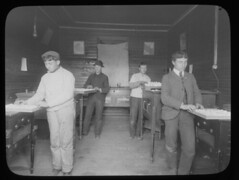
| English: Students completing a lab experiment in Fisher Hall. (Photo credit: Wikipedia) |
What makes a great science lab experience? Edmund Hall wrote a book on science on teaching science - gave an ideal vision. A good experience:
- Proper background and context
- Inquiry style learning
- Data measurement and analysis "hands on"
- After the lab, cement the learning
- Accessible and effective
- It will not do everything you want it to do but it will do what it does well.
- Students choose an experiment
- Allows students to create a hypothesis
- Analyze results and write a report
- Offering virtual labs for a number of possibilities - use them for what you need them for
- An online lab keeps the sensibilities of real science
- Customizes lab experience per professor
- Some analytics
How It Works
SmartScience is is in Java and is now in an HTML 5 version that is mobile and tablet friendly.
Each module has a reading, warm-up questions (to prepare the student for the lab), the students watch a video, they then make a hypothesis (they can add hypothesis), they then watch a video that gives them the results of the experiment, students can click on the screen to make selections and gather data, the data is automatically plotted. The method asks the students to analyze the data to see if their hypotheses were supported. There is a final assessment - multiple choice questions about the data. The assessments are automatically corrected and will include feedback. The students write a lab report. The students writing and assessments are bundled up into a .pdf for the instructor.
Students can also decide to perform the experiments at home, upload their data, and a picture.
Students can also decide to perform the experiments at home, upload their data, and a picture.
Instructors can pre-write hypotheses.
Built in vocabulary (glossary) tool.
Each lab includes a profile of a scientist.
One instructor asks the students to keep working on their lab reports until they get an A.
Let us know if you want to be in the pilot - there is one in the CSU
Supply them with name, campus, courses - they will then create a campus site for us.
The instructors create their own course pages. Faculty can look at the data from the experiment, the reports and assessments. Teachers then can add scores and comments.
Discussion - an instructor points out that the images need to not be orphaned. They need a legend and figure description.
Discussion - an instructor points out that the images need to not be orphaned. They need a legend and figure description.